


North Brazil is where distances stretch, river timetables shift with the rain, and a missed flight can mean losing a once-in-a-lifetime jungle cruise. On my own trips through Manaus, Belém, Alter do Chão, Palmas and Boa Vista, I learned that where you sleep before and after each adventure is just as important as the lodge or trek itself. This article focuses on choosing smart bases in those gateway cities so you spend more time on rivers and tepuis, and less time sweating in taxi queues with a 20-kilo backpack.
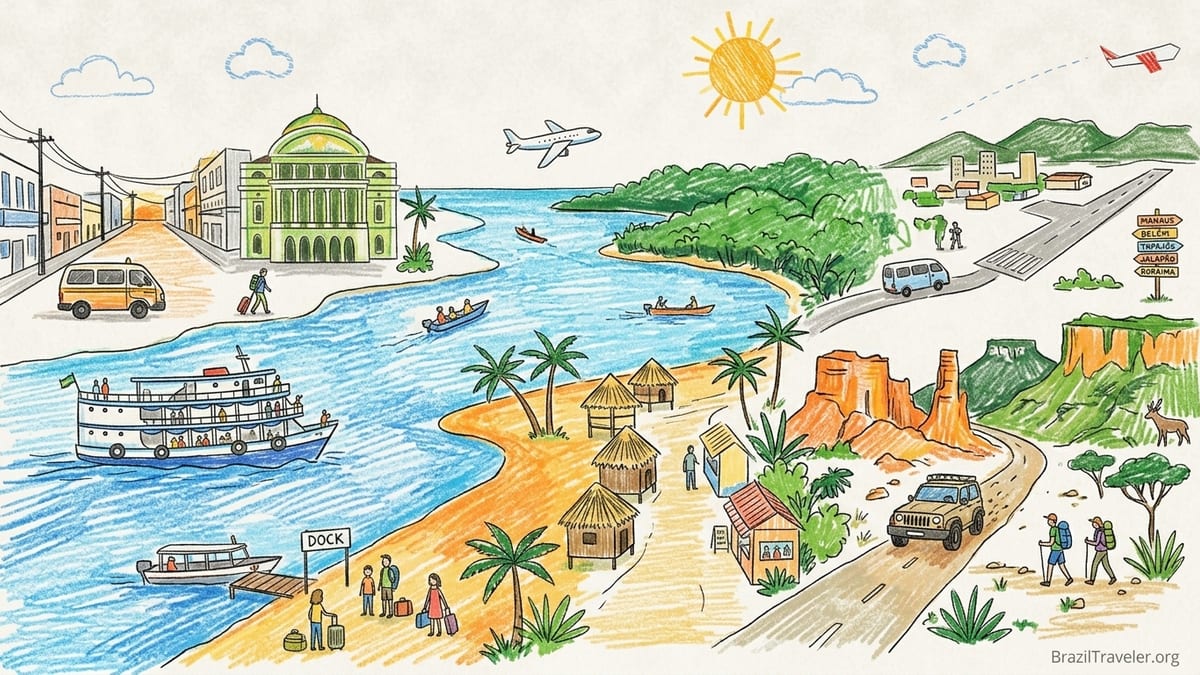
Why Base Choice Matters in North Brazil
In North Brazil, the distance between an airport and a dock, or a village and a national park gate, can easily be 30 to 40 kilometers. Santarém Airport, for example, sits roughly 38 kilometers from Alter do Chão on the Tapajós River, so even a simple flight-to-village transfer is a significant road journey. Factor in tropical storms, heavy traffic into markets, and tour departures that leave at five or six in the morning, and it becomes clear why base selection is not just a matter of a nice view.
A good base in this region needs to solve very practical problems. You want reliable early-morning taxi or transfers for jungle lodge pickups, convenient access to restaurants so you are not wandering hot streets at night, air conditioning that can cope with 30-plus degree humidity, and somewhere safe to store luggage while you trade your suitcase for a small duffel on a multi-day jungle or trekking trip. In several of these hubs, rideshare apps operate, but coverage and driver availability can change by neighborhood and time of day.
Unlike Brazil’s coastal cities where you can often improvise, the Amazon basin and interior states like Tocantins and Roraima require thinking in segments. I found it helpful to treat each place as a base for a specific experience. Manaus for river lodges. Belém for Marajó and river islands. Alter do Chão or deeper Tapajós stays for freshwater beaches and forest. Palmas for Jalapão’s canyons and dunes. Boa Vista for the overland transfer chain that leads to Mount Roraima in Venezuela. For each segment, I will explain how staying in different parts of the same city changed how easy the trip felt.
Throughout, I will only describe personal experience where I have actually stayed, and when I refer to options I have not yet used myself, I will flag that clearly and rely on what is verifiable today about distances, usual transfer times and hotel clusters.
Manaus: Before and After the Jungle Lodge
Manaus is the main gateway for classic Amazon lodge stays, river cruises and meeting-of-the-waters tours. The international airport sits about 13 to 15 kilometers from the historic center and major riverside ports, with taxi or app rides typically taking 25 to 40 minutes depending on traffic. On my first lodge trip, I made the common mistake of booking a pretty but impractical hotel right in the old center for the night before departure. It was close to the Amazon Theatre and the municipal market, but streets were quiet after dark, restaurant choices were limited within a short walk, and early-morning pickup meant coordinating a driver through empty streets at five in the morning.
Most Manaus lodges along the Rio Negro or Amazon arrange a combined road-and-boat transfer. Vans collect guests at centrally located hotels, then drive to marinas or river ports such as Marina do Davi for Rio Negro lodges. My lodge’s van list had a cluster of familiar addresses in the Adrianópolis and Vieiralves areas, which are newer, safer-feeling neighborhoods about 4 to 7 kilometers from the center. When I stayed there on a later trip, the pickup was smoother because the driver had several stops in a compact zone, breakfasts started earlier, and there were supermarkets and pharmacies within a few blocks to stock up on sunscreen, insect repellent and snacks the night before.
Air conditioning in Manaus is not a luxury; it is survival gear. I learned to check that rooms had modern split units rather than older wall AC. In one older property downtown, the unit struggled to pull humidity out of the air and I woke up sticky after a night of noise from thin windows and nearby bars. In Adrianópolis, by contrast, medium-range chain hotels tended to have better insulation, quieter elevators and dependable AC. That mattered on return from the lodge, when I arrived exhausted after a bumpy boat ride and three-hour transfer back to the city.
Next time, I will always book Manaus in two phases: one night in Adrianópolis or Vieiralves before the lodge for easy pickup, last-minute shopping and dependable taxis or rideshares, and one optional night in the historic center after the lodge when I no longer have a pre-dawn wakeup. That way I can enjoy walking to the Amazon Theatre and riverside at a relaxed pace without worrying about missing the only morning boat to my jungle base.
Belém: Central Streets or Riverside Nights
Belém is the Atlantic-side gateway to the Amazon’s mouth, and a base for trips to Marajó Island and forested river islands close to town. The airport lies about 10 to 12 kilometers from central districts like Nazaré, Batista Campos, Campina and Cidade Velha, with road transfers usually taking 20 to 35 minutes. Most visitors end up in a fairly small area of central neighborhoods where hotels, apartment rentals and restaurants concentrate along tree-lined avenues and near the riverfront.
On my stays in Belém, I tried both a more central residential area and a walkable spot close to the riverside restaurant complex built in converted port warehouses. The central stay, in a Nazaré-adjacent area, put me near shaded squares and local bakeries, with supermarket access for basics and easy daytime Uber rides to the Ver-o-Peso market or Mangal das Garças park. The residential streets felt calmer, and at night I could still catch a ride back without a long wait. The trade-off was that it took an extra ten minutes to reach the river when booking boat trips or ferries.
Sleeping near the waterfront dining complex and port area felt livelier in the evening. I could walk to restaurants and bars that stayed open late, which was convenient after a day trip to nearby islands. However, the closer you are to active docks and nightlife, the more you have to accept noise from traffic, live music and loading operations. Double-glazed windows are not standard; in one budget riverside stay I ended up wearing earplugs because trucks passed below my window until after midnight. Air conditioning worked well and covered some of the noise, but I would not choose that base if I needed a 4 a.m. wakeup for an early boat.
Belém’s river tours and ferries rarely leave directly from the prettiest waterfront promenade. Departures to places like Marajó Island or Combu Island use specific docks and terminals scattered along the Guajará Bay shoreline. This is where base choice becomes practical. If you are planning a multi-day excursion that departs at dawn, you want to sleep within a straightforward 10 to 15 minute taxi ride of the correct dock, in a neighborhood where rideshare drivers are actually circulating that early. In my experience, central districts such as Batista Campos, Nazaré or Campina balance this well, with enough hotel stock to keep prices moderate outside big events.
If I were planning another Belém stay around river trips, I would first pin the exact dock or tour office on a map, then choose a hotel zone in Nazaré, Batista Campos or Campina that keeps travel time under 20 minutes while still giving access to restaurants and a supermarket. I would save the most atmospheric riverside option for a night when I could sleep in, using it as a reward after returning from Marajó or other long excursions rather than as a departure base.
Alter do Chão Village vs Isolated Tapajós Stays
Alter do Chão, on the banks of the Tapajós River, is one of the region’s most charming freshwater beach destinations. It sits about 37 to 38 kilometers from Santarém’s center and roughly that distance from Santarém Airport along the PA-457 highway. Transfers by car usually take 45 minutes to an hour, depending on traffic and road conditions. This distance makes Alter do Chão both a stand-alone base and a slight logistical puzzle when you combine it with flights and more remote forest lodges along the Tapajós.
When I stayed in Alter do Chão itself, I appreciated being in the village grid, with sandy lanes radiating from the main square. From a simple pousada two blocks up from the river, I could walk to restaurants, bakeries and basic markets in under five minutes. Tour operators offering day trips to beaches, forest trails and river communities clustered around the square. Early pickups for boat trips were uncomplicated: I just walked down to the pier at the agreed time, without needing a taxi. For laundry, my guesthouse arranged a local service that turned around a bag within 24 hours, which was essential after several days of heat and river swims.
More isolated Tapajós stays, including riverside lodges accessed by boat from Alter do Chão or Santarém, offer deeper immersion. However, they increase your dependence on scheduled transfers and limit access to supplies. When I scouted options outside the village, I noticed that some lodges arranged boat transfers only on specific days, with limited luggage allowances and fixed departure windows linked to tides and daylight. Staying out there meant that if my flight into Santarém was delayed, I could miss the week’s only convenient boat, forcing a night in town anyway.
Another practical difference is cash and connectivity. In Alter do Chão village, I could find at least one bank branch or ATM, buy a local SIM or top-up credit at small shops, and use card payments in many restaurants. In more isolated stretches of the Tapajós, you often need to settle bills in cash, and internet can be limited to a single shared hotspot. That may be ideal if your priority is disconnection, but it makes things like confirming onward flights or reorganizing a delayed transfer more complicated.
For a first visit, my preference is to base myself in Alter do Chão village, with two to four nights in a centrally located pousada within a 5 to 10 minute walk of the main square and pier. That makes airport transfers simple and lets me pick day tours according to the weather. On a return trip, I would consider splitting the stay, using Alter do Chão as a hub for arrival and departure nights and adding two or three nights at a quieter lodge up or down the Tapajós, fully aware that this means committing to the lodge’s transfer schedule and being more self-sufficient with supplies and cash.
Palmas: Gateway to the Jalapão Wilds
Palmas, the modern capital of Tocantins state, functions primarily as a gateway to the Jalapão region and its orange sand dunes, rock formations and crystal-clear springs. The airport sits around 20 kilometers from the central hotel areas, with transfers by taxi or app usually taking 25 to 30 minutes. Most Jalapão tours use 4x4 vehicles and depart very early, often between 5 and 7 in the morning, to make long drives over rough roads more manageable in the cooler hours.
Many tour operators recommend or require that guests arrive in Palmas the day before departure. The reason is simple: if a domestic flight arrives after midnight or is delayed, it is unrealistic to start a 6 to 8 hour off-road itinerary at dawn. On my own planning, I allowed at least one night in Palmas both before and after Jalapão. Even without having yet completed the expedition, researching routes and daily distances convinced me that ending a multi-day trek and then trying to connect to an evening flight the same day would be stressful at best, impossible at worst.
Hotel clusters in Palmas tend to center around broad avenues and commercial zones with supermarkets, pharmacies and mid-range business hotels. That works well for pre-trip errands. In areas within a 3 to 5 kilometer radius of the main bus station and central avenues, I found it easy to identify properties that offered early breakfasts, handled luggage storage for guests heading into Jalapão, and had staff familiar with local tour companies. Rideshare apps and taxis seemed more available here than in outlying residential neighborhoods.
For Jalapão, air conditioning and hot water both matter. You return from days of dust and heat, and cool, dry air helps you recover. It is worth choosing places with recent reviews specifically mentioning AC performance and shower water pressure. I paid attention to comments about noise as well, since Palmas has through-traffic and busier avenues. A room a little further from the main road, but still within walking distance of a supermarket and a simple restaurant, seemed like the best compromise between convenience and rest.
If I had to position myself again, I would choose a central Palmas hotel within a short taxi ride of my tour operator’s pickup point, and I would avoid booking outbound flights earlier than late afternoon on my return day. Leaving at least one buffer night after Jalapão protects you from unexpected delays on unpaved roads, and it also gives you a chance to do laundry, repack clean clothes and enjoy a proper meal before moving on to another state.
Boa Vista: Staging Point for Mount Roraima
Boa Vista in Roraima state is the usual Brazilian starting point for Mount Roraima expeditions, even though the actual trek takes place mainly on the Venezuelan side. The city’s airport lies a relatively short distance from central accommodations, on the order of 5 to 8 kilometers, making transfers into town fairly quick, often 15 to 20 minutes by taxi or rideshare. That proximity can give a false sense of simplicity, but the real complexity is the onward leg across the border and up to the village of Paraitepuy, where the trail begins.
Most commercial tours that serve Brazilian travelers group people in Boa Vista, then shuttle them several hours by road to the border town of Pacaraima and across to Santa Elena de Uairén in Venezuela. In turn, local 4x4 transport continues to Paraitepuy for the start of the trek. From the itineraries I reviewed when planning my own trip, departures from Boa Vista for Roraima usually happen very early in the morning, sometimes as early as 5 or 6, to allow enough time for border formalities, road checks and the drive to the trailhead.
Because of that schedule, staying close to Boa Vista’s central hotel area makes a real difference. In the blocks around main avenues where tour operators keep their offices and vans depart, I found mid-range hotels that understood trekker needs: luggage storage for items not needed on the mountain, early or pre-packed breakfasts, and assistance with taxi bookings for late-night airport arrivals. Air conditioning quality was again essential; Boa Vista’s lowland heat can be intense, and you want to start a multi-day hike well rested, not dehydrated after a poor night in a stuffy room.
Noise is a subtler issue. Some of the most conveniently located properties sit right on major avenues with constant motorbike traffic. On one night stop, even with AC running, I heard engines and music until late. Given that many Mount Roraima itineraries have a pre-trek briefing in the evening and a very early departure, I would prioritize rooms on upper floors facing away from the street, or quieter cross streets that are still within a short walk of the pickup point. It helps to email the hotel in advance and explain that you are joining a dawn expedition, so they can recommend the quietest available room.
If I were booking again, I would schedule at least one full night in Boa Vista before the trek and one after. The night before allows for any connection delays and last-minute purchases of snacks, gas canisters if allowed, and rain gear. The night after gives your body a chance to recover, wash trekking clothes and reorganize gear before flying out. Trying to catch a same-day flight after driving back from the border and descending from the mountain strikes me as unnecessarily risky, especially if there are roadblocks or weather-related delays.
Practical Tips for Airport, Dock and City Logistics
Across all these bases, several practical themes kept repeating. The first is distance and time to critical departure points: airports, river docks and tour offices. Santarém Airport to Alter do Chão is about 38 kilometers, while Manaus Airport to its historic port areas is roughly a third of that. Yet in all cases, tropical traffic and weather can stretch transfers. I now treat any leg longer than 30 kilometers as grounds for an overnight stay, especially if the next morning involves a nonrefundable tour or lodge transfer.
Taxis and rideshare availability can vary sharply by neighborhood and hour. In central parts of Manaus, Belém, Palmas and Boa Vista, I had little trouble getting cars during daylight and early evening. Pre-dawn pickups were more delicate. When tours or lodges offered their own van pickups from recognized hotel lists, I always chose one of those hotels, even if it meant paying slightly more or sacrificing some atmosphere. There is a lot of peace of mind in knowing a driver already has your room number and hotel reception knows the company by name.
Access to food and supplies is another base-defining factor. In villages like Alter do Chão, the “supermarkets” are small but sufficient for snacks, water and basics. In larger cities, staying within a 10 minute walk of a full supermarket and pharmacy lets you replace forgotten gear or buy specific snacks without relying on a taxi for every errand. This became particularly important before Jalapão and Roraima, where I wanted lightweight high-calorie food to supplement the tour meals.
Finally, there is the question of laundry and luggage storage. Many city hotels in Manaus, Belém, Palmas and Boa Vista are used to guests who leave big suitcases while they go to the jungle with just a small bag. I made it a habit to confirm, before booking, that luggage storage was free or inexpensive and that reception was open 24 hours. For laundry, I alternated between hotel services and local laundries that charged by the kilo, especially after muddy days in Jalapão or rainy hikes near Roraima. Returning from wilderness areas to a room where a bag of clean clothes was waiting felt like a small luxury that improved the entire trip.
The Takeaway
Choosing where to stay in North Brazil is less about ticking off famous hotel names and more about aligning each base with the next day’s transport challenge. Manaus works best when you separate your pre-lodge night in a practical neighborhood with easy van pickups from a more atmospheric post-lodge night downtown. Belém invites a similar split, with central, leafy districts ideal for early dock transfers and energetic riverside stays better saved for relaxed evenings.
On the Tapajós, Alter do Chão village gives you walkable access to food, tours and laundry, while more isolated river lodges trade that convenience for immersion and tranquility. Palmas and Boa Vista, although not destinations that most travelers dream about on their own, become crucial staging posts for adventures in Jalapão and on Mount Roraima. Giving each of them at least one buffer night before and after your expedition reduces stress, protects you from delays and gives you a chance to reset.
Next time I return to the region, I will plan my bases with even more intention: selecting properties from tour pickup lists, keeping transfer distances manageable on arrival days, and always securing at least one good night’s sleep before entering the wild. In a part of the world where rivers rise and fall and roads can turn to mud overnight, that kind of base planning is not just logistical. It is what allows the real magic of North Brazil to unfold once you leave the city lights behind.
FAQ
Q1. Is it necessary to spend a night in Manaus before going to a jungle lodge?
In practice it is highly advisable. Flights into Manaus are often delayed, and lodge transfers to river ports and boats usually depart in the morning, so an overnight stay reduces the risk of missing your transfer.
Q2. Which Manaus neighborhoods are most convenient for lodge pickups?
Areas such as Adrianópolis and Vieiralves work well because many lodges already use hotels there as pickup points, there are supermarkets and pharmacies nearby, and taxi or rideshare drivers are plentiful.
Q3. Should I stay in central Belém or by the riverfront?
For early boat tours and safety, central districts like Nazaré, Batista Campos or Campina offer a good balance of access and calm. The riverfront is fun at night, so it can be ideal for a post-excursion stay when you do not need a dawn departure.
Q4. How far is Alter do Chão from Santarém Airport?
Alter do Chão is roughly 38 kilometers from Santarém Airport by road. Transfers usually take 45 minutes to an hour, so most travelers plan at least one night in the village before or after flights.
Q5. Is it better to stay in Alter do Chão village or in a remote Tapajós lodge?
Alter do Chão village offers walkable access to restaurants, small markets and tour operators, which simplifies logistics. Remote Tapajós lodges provide deeper immersion but depend on fixed transfer schedules and offer fewer options for supplies.
Q6. Do I need buffer nights in Palmas for a Jalapão trip?
Yes, at least one night before and ideally one after the expedition. Jalapão itineraries involve long, rough drives and early departures, and connecting directly to flights on the same day can be risky.
Q7. Where should I stay in Palmas before Jalapão tours?
Look for central hotels within a short taxi ride of your tour operator’s pickup point, close to supermarkets and pharmacies. These areas have better early-morning taxi and rideshare coverage and are used to storing luggage for guests.
Q8. How many nights should I plan in Boa Vista for a Mount Roraima trek?
Plan at least one night before and one night after the trek. Tour vans to the border and Santa Elena often leave Boa Vista early, and the return journey is long enough that same-day flights are not recommended.
Q9. Can I safely leave luggage in city hotels while I go to the jungle or mountains?
Many hotels in Manaus, Belém, Palmas and Boa Vista offer secure luggage storage for guests on multi-day tours. Always confirm the policy in advance and leave valuables in a safe or with you on the expedition.
Q10. How important is air conditioning in these North Brazil bases?
Air conditioning is very important. Heat and humidity are intense in Manaus, Belém, Palmas and Boa Vista, and good AC helps you rest properly before demanding early starts, boat transfers and long driving days.