

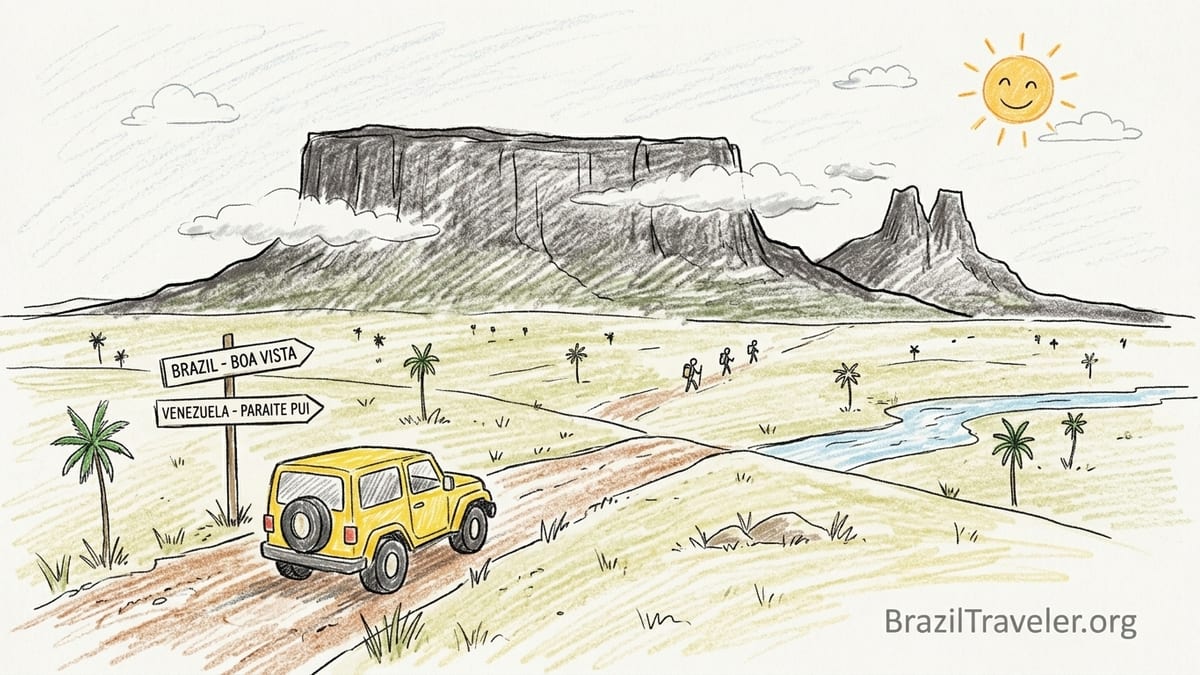
Mount Roraima had lived in my imagination for years before I finally stepped onto its wind carved summit. I joined a nine day trek that began in Boa Vista, crossed the Brazil–Venezuela border, and followed the classic route from Paraitepui to the top of the tepui. What follows is not a romantic brochure but a detailed account of what the expedition actually demanded of me in 2025, from paperwork and transfers to rain, mud, fatigue, and the small gear choices that made a big difference.
Starting in Boa Vista: Operators, Costs and First Impressions
I flew into Boa Vista the day before the expedition and used the city as most people do today: a staging point between the rest of Brazil and the Venezuelan Gran Sabana. I had booked a package with a Boa Vista based agency several months earlier, after comparing prices and itineraries from operators like Roraima Adventures, Fui Trilharr and smaller local outfits recommended in Brazilian trekking forums. For a nine day itinerary with four nights on the summit, my package cost just over 6,000 reais in 2025, not including flights to Boa Vista. That price covered ground transport from Boa Vista to Paraitepui and back, Venezuelan park fees, local Pemón guides, porters for group gear and food, tents, and most meals.
The agency placed me in a simple hotel near Avenida Ville Roy, with air conditioning and hot showers that I appreciated much more after the trek than before. Boa Vista itself feels surprisingly orderly, with wide avenues and a relaxed frontier energy, but what mattered for the trek was logistics. That afternoon, our coordinator held a briefing in the hotel lobby. We weighed backpacks, checked if everyone had cash in reals and a small amount of dollars, and reviewed which items the agency would supply: dome tents, foam sleeping mats, communal kitchen tarp, gas stoves, basic dishes, and dry food staples like rice, pasta and oats.
My personal load at that point was 11.5 kilograms without water. It included my sleeping bag, clothes, rain gear, trekking poles, snacks, toiletries, small first aid kit, camera and two liters of bottle capacity. I chose not to hire a personal porter, which several people in the group did. That decision shaped my experience on the steep ramp days more than I had anticipated. The agencies encourage backpack weights under 12 kilograms for people not used to multi day treks in deep mud, and in hindsight that was a good benchmark.
In the evening, I walked to a nearby supermarket with a couple of teammates to buy last minute snacks: goiabada, nuts, instant coffee, and electrolyte powders. These ended up being some of the most psychologically important items on cold, wet summit mornings when the group breakfast of plain oats felt a little too basic.
Border Crossing and the Long Road to Paraitepui
We left Boa Vista around 5:30 in the morning in two 4x4 vehicles, following the BR 174 north to the border town of Pacaraima. The drive took about three hours on good asphalt, broken only by a brief police checkpoint and a sunrise stop at a roadside pastel stand. The road here runs through indigenous territories and remote stretches, which is why I was glad to be with a local operator instead of trying to improvise my way up alone.
At Pacaraima, we disembarked with our daypacks for the border procedures. Because the trekking route approaches Mount Roraima from the Venezuelan side, we had to clear both Brazilian exit formalities and Venezuelan entry controls. In 2025, this meant presenting a passport with at least six months of validity, proof of yellow fever vaccination, basic travel insurance that covered trekking in remote areas, and a return or onward plan. The agency had pre sent our group list and itinerary to its partner in Santa Elena de Uairén, which kept things moving, but the process still took nearly two hours as officers checked pages and asked routine questions about our stay in the Gran Sabana.
On the Venezuelan side, we switched vehicles, now with a local driver and a Pemón guide. The road from Santa Elena to Paraitepui is partly paved, then turns to a red dirt track that grows rougher with each kilometer. In dry weather, standard pickups and vans manage it, but in the rainy months our 4x4 low gear was essential. The final stretch took us past isolated farmsteads and open savanna dotted with moriche palms, with the hulking silhouette of Mount Roraima slowly materializing ahead. Paraitepui itself is a small indigenous village with a basic park registration office, a few houses and some rudimentary toilets.
Here we had our last chance to adjust pack weight and hire local porters for personal loads. Rates in 2025 hovered around the equivalent of 150 to 200 reais per day for a porter to carry up to 15 kilograms, paid partly in Brazilian currency and partly in Venezuelan bolívars in agreement with the agency. I chose to keep carrying my own gear but used the opportunity to remove an extra fleece and a book that I knew I would not read. By the time we started walking shortly after lunch, the tropical sun was already high and the first impression of the trail was a dusty, gentle descent across open grassland.
Trail Days on the Savanna: Heat, Rivers and Early Fatigue
The first trekking day from Paraitepui to the Rio Tek camp took us just under five hours with breaks, covering around 14 kilometers. The trail undulated over low hills, fully exposed to the sun. My thermometer read 32 degrees Celsius at mid afternoon, and the heat combined with humidity meant I drank almost four liters of water that day. Most agencies, including mine, arrange water refills at small streams along the way, treating it briefly with chlorine tablets or filters. By the time we saw the white tents near the Tek river, my shoulders had begun to protest the pack weight.
Rio Tek camp is basic but sits beside a clear, fast moving river that serves as our bath, laundry and water source. Tents were pitched on slightly sloping ground dotted with rocks. There were no built structures beyond a few makeshift wooden frames for tarps. Toilets were simple pit latrines screened by tarps, with a wooden plank to balance on. The smell was strong by evening and taught me to bring my own small roll of biodegradable toilet bags for emergencies away from camp.
Nighttime temperatures on the savanna dropped much more rapidly than I expected. While the day had felt like an oven, by 2:00 in the morning it was cool enough for me to zip my 5 degree Celsius rated down sleeping bag completely, wearing a base layer and thin beanie. Some people with lighter summer bags slept in down jackets and still complained of cold. I slept poorly that first night, partly from nerves and partly from the hardness of the thin foam mat. If I repeated this trek, I would absolutely bring a small inflatable mat to supplement the one supplied by the agency.
The second day, we walked from Rio Tek to the Base Camp at the foot of Mount Roraima. Right after leaving camp, we crossed the Tek river and then the Kukenán river. In dry periods these crossings are usually knee deep, and in our case the water reached just below my thighs. There were no bridges. We crossed barefoot or in sandals, carrying boots around our necks, with the guides positioning themselves slightly downstream for safety. After heavy rain, which can happen quickly, these rivers can swell and temporarily halt progress, something our guide stressed when advising us not to linger too long in the morning.
Climbing the Ramp: Mud, Waterfalls and Mental Effort
The push from Base Camp to the summit along the natural ramp of Mount Roraima was the most demanding single day of the expedition. We left camp around 7:00 after a very early breakfast. The trail immediately entered cloud forest, with tangled roots, constant mud and dripping foliage. For much of the ascent, the path climbed steadily at a gradient that felt like an unending staircase, broken by short traverses exposed to spray from waterfalls.
Underfoot, the mud varied from ankle deep to sometimes mid calf in churned sections. My boots were waterproof to the ankle but this did not matter much once water and mud poured in from above. Trekking poles were essential for balance on the slick rock slabs and root steps. In some sections, our guide asked us to move one by one, hugging the rock wall and using both hands, not because the route was technical but because a slip would have sent someone skidding down a very rough slope.
We gained roughly 900 vertical meters that day and were on the move with breaks for about seven hours. By the third hour, my hip belt had carved a tender groove into my skin and my quadriceps began to shake on steeper steps. This was where my training in the months before the trip really mattered. In the lead up, I had focused on stair climbing sessions with a weighted backpack twice a week, adding bodyweight squats and lunges. Even so, the combination of weight, altitude rise and humidity left me more drained than I had anticipated from simply looking at the numbers on an itinerary.
Arriving at the rim of the tepui felt like stepping into another world. The temperature dropped abruptly as mist thickened around us. The rock turned black and angular, ridged and pitted like some alien city. Small endemic plants clung to crevices, and pools of dark water filled natural basins. I felt both elation and a surprising quiet. The climb that had occupied my mind for three days was behind us, but our guide reminded us that the descent in wet conditions could be just as punishing.
Life on the Tepui: Camps, Toilets and Reality of Comfort
Our summit camps were set in natural rock shelters known as “hotels,” where overhanging walls protect tents from the worst of the rain and wind. These are not lodgings in any comfortable sense but they make the difference between surviving the near constant moisture and truly soaking everything. Our group occupied a space large enough for seven tents, squeezed close together on relatively flat sandy patches beneath a massive boulder.
The cold surprised many of us. Daytime summit temperatures hovered around 15 degrees Celsius when the sun appeared, but wind and wet clothes quickly stole warmth. At night, it dropped close to 8 degrees. Inside the tent, condensation gathered on every surface. My down sleeping bag performed well, but once I accidentally touched the side of the tent and sent a curtain of cold droplets onto the bag, it took a full day under weak sun to dry. My fleece gloves and wool hat became constant companions even for short trips to the toilet area.
Toilet conditions on the summit were among the least pleasant aspects of the trip. Because the tepui is a fragile ecosystem with thin soils and slow decomposition, agencies now require groups to use designated toilet zones and, increasingly, to pack out solid waste in double bags that porters carry back down to Paraitepui. Our group followed that system. It was functional but not dignified. Squatting behind low rock walls in wind swept drizzle, while trying to manage toilet bags and layers of clothing, quickly eroded any remaining illusions of glamorous adventure. I was grateful for having packed plenty of wet wipes and a small bottle of hand sanitizer in a waterproof pouch.
Despite the discomforts, summit days offered some of the most astonishing landscapes I have ever walked through. We spent two full days exploring features such as natural rock “jacuzzis,” panoramic viewpoints over the Gran Sabana and bizarre sandstone towers. Distances were not huge in kilometers, often eight to ten kilometers round trip, but moving over broken rock, constant puddles and occasional scrambles made each outing a slow and careful process that left everyone tired by late afternoon.
Gear Choices, Failures and What I Would Change
Looking back, some of my gear choices worked extremely well, while others became lessons. On the positive side, my mid weight synthetic trekking pants were ideal. They dried reasonably quickly after river crossings and handled repeated abrasion with rock and mud. My decision to bring two pairs of socks for walking and one dedicated pair for sleeping paid off in comfort and blister prevention. Lightweight trail running shoes that I packed as camp footwear were a luxury I would keep; having dry shoes for evenings on the summit had a huge impact on morale.
On the failure list, my main trekking boots, although sturdy and well broken in, were not as suitable as I had hoped. Their waterproof membrane kept water in as much as out, turning them into soggy buckets once flooded. A more breathable leather or fabric boot without a heavy membrane, combined with reliable gaiters, might have performed better in this wet environment. My rain jacket was another weak point. It had lost much of its durable water repellent coating, and under prolonged summit drizzle it began to “wet out,” clinging coldly to my mid layers. If I were to return, I would invest in a higher quality shell with solid ventilation zips.
My backpack, a 60 liter model, was slightly larger than necessary and tempted me to carry more than I strictly needed. A 50 liter pack with a robust hip belt and simple design would have been sufficient and likely more comfortable in the tight rock passages near the summit. On the other hand, I was grateful for having packed a compact trekking umbrella. On savanna days and some summit traverses, it created a pocket of shade or dry space that spared my skin and kept me surprisingly comfortable during slower uphill sections.
Finally, I underestimated how much I would value a small insulated flask. Hot tea or coffee during lunch breaks on wind exposed ridges became a coveted comfort, and the single communal thermos the guides brought never stretched far. Carrying my own 500 milliliter flask would have added minimal weight for significant psychological benefit.
Training, Fitness and Managing Fatigue
I approached Mount Roraima as someone who hikes regularly but does not live at altitude or train professionally. For three months before the trek, I adopted a simple program: two weekly stair climbing sessions in a 15 story building wearing a 10 kilogram backpack, one longer hike of 15 to 20 kilometers on weekends, and two strength workouts focused on legs and core. That baseline allowed me to complete the trek without injury, but it did not make the days easy.
The combination of heat, mud and repeated elevation gain wore me down. By the fifth trekking day, my knees felt tender on descents and my lower back ached by evening. Stretching in camp, massaging muscles with a small ball I had brought, and using ibuprofen sparingly helped keep the discomfort manageable. Several people in our group who had arrived with less preparation struggled significantly, especially on the long descent from the summit back to Base Camp, which took us almost eight hours in slick conditions.
Cardiovascular fitness mattered, but so did mental pacing. I learned quickly not to chase the guide’s pace on the early hills. Instead, I settled into a rhythm that allowed me to keep breathing through my nose for much of the time. Hydration and salt intake were another lesson. On the hottest days, I added oral rehydration salts to one liter of my water, which prevented the headaches and cramps that others experienced. This is not a trek that rewards bravado. Listening to the body, eating even when not particularly hungry and speaking up early about any emerging issues with knees or blisters were key for getting through the nine days in decent shape.
Reaching the tepui itself did not feel like an easy sightseeing excursion so much as the culmination of sustained effort. The views were magnificent when clouds parted, but some of my strongest memories are not of panoramas. They are of slogging step by step up the ramp in humid air, of slipping in mud and laughing with strangers as we helped each other, and of the bone deep relief of sitting down under the summit rock shelters at the end of those days.
Current Rules, Safety, Guides and Insurance
All access to the classic trekking route to Mount Roraima currently passes through Venezuelan territory, even when arranged from Boa Vista. That means Brazilian, European and North American travelers all need to consider the political and security context. While tour operators in Boa Vista report that the Boa Vista to Santa Elena corridor has been functioning with relative stability in recent seasons, foreign ministries still maintain cautious travel advisories for parts of Venezuela. For this reason, booking with a reputable agency that has recent experience on the route, updated information about checkpoints, and established relationships with Pemón communities is not just a convenience but a safety measure.
On the Venezuelan side, the route falls within Canaima National Park. In practice, individual trekkers do not usually obtain permits directly from Inparques, the national parks authority. Instead, licensed local agencies and guides manage the registration and fee payments for groups. In Santa Elena and Paraitepui, Pemón community leaders also oversee guide and porter assignments. Walking without a recognized local guide is not allowed. Age restrictions vary by operator, but most agencies I spoke with in 2025 set a minimum age of 14 to 16 for accompanied minors, and several require medical certificates for participants over 60.
Travel insurance deserves particular attention. Many standard policies exclude trekking above certain altitudes or in remote areas without road access. Before my trip, I specifically searched for a policy that covered multi day hiking in South America, emergency evacuation from remote areas and medical treatment in both Brazil and Venezuela. I carried printed proof of this policy, which the agency had asked for during final confirmation. Although we never needed to use it, one person in a parallel group at Base Camp did have to be accompanied back to Paraitepui early due to a knee injury, and their insurance later reimbursed some of the additional local costs.
Border rules and documentation requirements can change more quickly than printed guidebooks. In the month before departure, I checked both Brazilian and Venezuelan official sources for any new vaccination, visa or entry rules. I also confirmed with the agency, which had just finished a prior expedition, that no new checkpoints or paperwork had appeared on the Boa Vista to Santa Elena road. For anyone planning a Roraima trek now, I would strongly recommend replicating that double check in the weeks just before travel, since this itinerary depends on a functioning international land border.
The Takeaway
Mount Roraima from Boa Vista is not a remote fantasy. It is an achievable, guided expedition for physically prepared hikers who respect the demands of border logistics, weather and terrain. Yet it is also not a casual sightseeing walk. The nine days I spent between Boa Vista and the tepui tested my knees, my patience with mud and cold, and my ability to adapt to very basic sanitation and sleeping conditions.
If there is one thing I would convey to anyone considering this trek, it is to approach it with both humility and seriousness. Train your legs and lungs. Be honest about how much weight you can carry and whether a personal porter might turn a punishing experience into a challenging but enjoyable one. Invest in rain protection, footwear that copes with mud and constant moisture, and small comforts like dry sleeping socks and a reliable headlamp.
Beyond the gear lists and border stamps, what has stayed with me is the sense of walking through a landscape that feels at once ancient and fragile. Watching dawn break over the Gran Sabana from the edge of the tepui, with the clouds swirling below and the knowledge of the days of effort it took to stand there, made every muddy step worth it. For those willing to accept the expedition on its own terms, starting in the unassuming streets of Boa Vista and ending on the wind swept rock of Mount Roraima, it remains one of South America’s most demanding and rewarding treks.
FAQ
Q1. How many days does the Mount Roraima trek from Boa Vista usually take?
The most common packages from Boa Vista run between nine and twelve days in total, including transfers, border procedures, and four to five nights on the mountain.
Q2. How much does a full Mount Roraima expedition from Boa Vista cost?
In recent seasons, reputable Boa Vista based operators have charged from around 5,500 to 7,000 reais per person for nine to eleven day itineraries, not including flights.
Q3. Do I need a guide to trek Mount Roraima?
Yes. Independent trekking is not allowed. Access is controlled by local Pemón communities and park authorities, and groups must be accompanied by authorized local guides.
Q4. How fit do I need to be for this trek?
You should be comfortable walking five to eight hours a day with a backpack over uneven, muddy terrain and with significant elevation gain, several days in a row.
Q5. What are the temperatures like on the trail and on the summit?
On the savanna the daytime heat can exceed 30 degrees Celsius, while summit nights can drop below 10 degrees with wind and constant humidity.
Q6. Are there toilets and showers during the trek?
Camps have basic pit latrines or designated toilet zones, and you wash in rivers or small streams. There are no showers or conventional bathrooms on the trail or summit.
Q7. What should I wear on my feet for Mount Roraima?
Sturdy trekking boots with good grip are important, paired with gaiters. Many hikers also bring light shoes or sandals for camp and river crossings.
Q8. Can I hire a porter to carry my backpack?
Yes. Local porters can usually be hired in Paraitepui to carry personal loads for an additional daily fee, which can significantly reduce physical strain on the ramp days.
Q9. Is travel insurance mandatory for this expedition?
Most serious operators require proof of travel insurance that covers multi day trekking in remote areas and medical care in both Brazil and Venezuela.
Q10. When is the best time of year to trek Mount Roraima?
Operators tend to favor the drier months, often between December and March, when river levels are lower, although conditions are still variable and rain is possible year round.