


I arrived in Manaus with a head full of postcard images about the Amazon and almost no real idea of how those dreamy jungle lodges were actually reached. Within a few hours of landing, the rainforest stopped being an abstract green mass on the map and became a very physical place of diesel fumes at the river port, slippery wooden docks, wet air that felt almost drinkable and a long chain of boats, buses and canoes stretching from the city into the forest.
From Downtown Manaus to the Edge of the Forest
My Amazon tour began at 7:30 in the morning at Hotel Villa Amazonia, a restored mansion a block from Manaus’s Teatro Amazonas. The operator had confirmed pickup the day before by WhatsApp, along with a reminder to pack only a soft bag for the jungle and leave the rest in hotel storage. At exactly 7:30 a plain white minivan pulled up in front of the hotel, the driver stepping out with a laminated sign bearing the lodge name and a clipboard with all our names. There was no big logo or safari styling, just the practical transport that moves visitors between concrete city and flooded forest every day.
We drove out of the centro in light traffic, past the port cranes and low houses, toward the Ceasa Port on the southern edge of Manaus. This is the standard starting point for many jungle lodges south of the city on the Juma and Mamori river systems, and by 8:10 we were turning into the busy market area. Our guide joined us here: a local from Amazonas, fluent in English, Portuguese and good Spanish, carrying a binder of insurance documents and his Brazilian guide registration. That simple detail reassured me that this was not a casual, unregulated operation.
From the minivan we stepped directly down a narrow gangplank onto a covered speedboat with four rows of plastic seats and a 200-horsepower outboard. Life jackets were stacked in orange piles, and as we pulled away from the dock the air changed from exhaust and fish to a warm, moving wall of humidity. Within fifteen minutes the brown Solimões River opened around us and the skyline of Manaus shrank behind, the city falling away faster than I expected.
Crossing the Meeting of the Waters
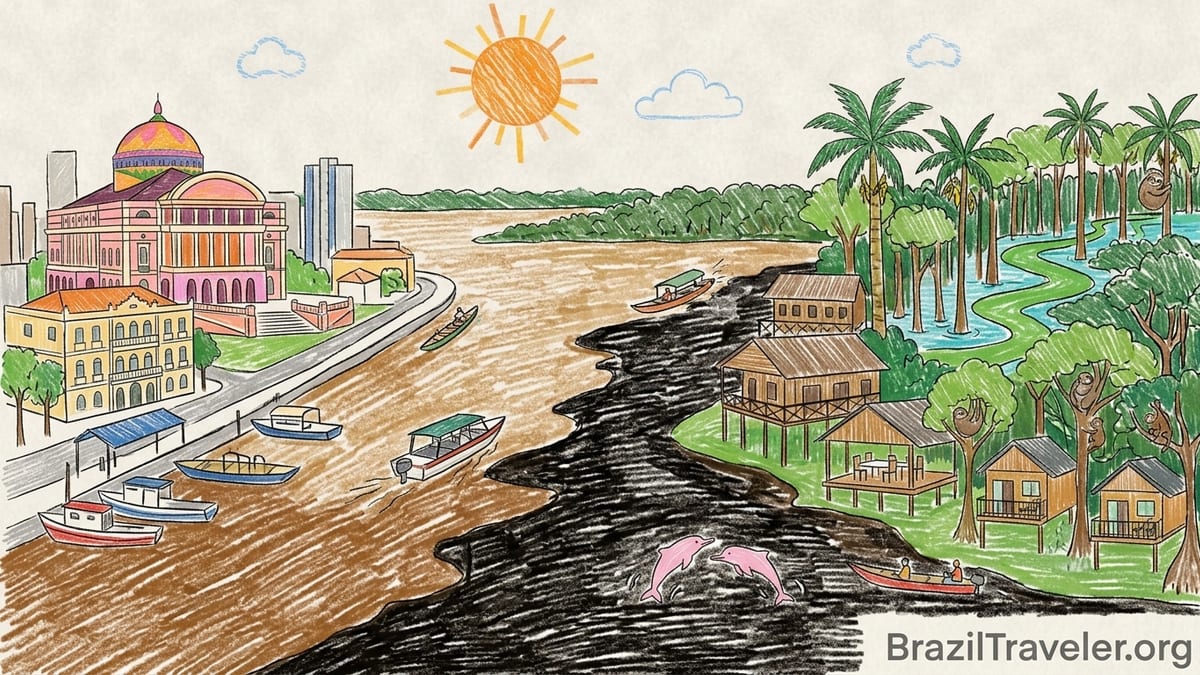
About forty minutes after leaving Ceasa, the boat slowed and the guide motioned for us to look over the side. The water under the hull divided into two distinct colors: the almost black, tea-colored Rio Negro on one side and the muddy brown Solimões on the other, running side by side in a clear line that stretched toward the horizon. This was the famous Meeting of the Waters, a phenomenon I had seen dozens of times in photos but never really believed until I could see the contrast with my own eyes.
We idled at the confluence for about twenty minutes. The guide explained that the Negro’s water is cooler, more acidic and flows faster than the warmer, heavier Solimões, so they refuse to mix for several kilometers. He invited us to lean over and dip one hand on each side; the temperature difference was noticeable even from the boat. A small floating snack bar drifted nearby selling cold soft drinks and coffee to local boatmen, a reminder that this spectacular natural border is also part of ordinary commuter traffic for people living along the river.
Several Manaus operators sell separate half-day Meeting of the Waters trips with hotel pickup, lunch and a stop to see giant water lilies or pink river dolphins, often advertised in the range of 200 to 300 US dollars for two people in a small group boat. My own experience folded the phenomenon into the necessary transfer south toward the lodge, which felt efficient but also brief. If I had another day in Manaus I would book a dedicated Meeting of the Waters excursion to have longer on the water and more time among the floating houses and smaller channels near Janauari Lake.
Into Narrower Rivers and the First Glimpse of the Lodge
Once we left the confluence, the speedboat continued along the Solimões for another half hour before pulling into a simple riverside pier. Here the transfer chain shifted from water back to land. We climbed into an open-backed truck with bench seats, similar to the vehicles used by several jungle operations that must cross a strip of highway and rural road between major rivers. The road was a mix of tarmac and packed red dirt, lined with banana trees, wooden houses on stilts and the occasional roadside stall selling fried pastries and bottled water.
After roughly an hour of driving we reached a smaller community landing where long, narrow motorized canoes waited under a tin roof. Our luggage was piled into the bow, and we stepped carefully into the boat one by one while the driver steadied the hull. The final leg into the forest took just over an hour along a tributary that wound past flooded trees and tangles of açaí palms. The sun was high now and the humidity inside the life jacket was almost suffocating. The air smelled of wet earth and leaf litter, and insects droned constantly above the water, though few actually landed on us while the boat was moving.
The lodge itself appeared gradually, a collection of wooden structures on stilts emerging from behind a curve in the river. Similar to well-known properties such as Juma Amazon Lodge and Kabanas Amazon Lodge on the Juma River, the complex stretched along a quiet bank, elevated above flood level and linked by raised walkways. We arrived around 11:15, were greeted with a plastic cup of cold cupuaçu juice in the open-sided restaurant and given a short orientation in both English and Portuguese before being shown to our rooms.
Rooms, Food and the Reality of Jungle Comfort
My room was a simple but comfortable wooden bungalow with a small balcony overlooking the water. Inside there was a double bed and a single, both with mosquito netting, a ceiling fan and a bathroom with cold-water shower and basic amenities. The electricity came from a generator that ran from late afternoon until early morning, enough to power the fan and charge phones but not the kind of constant, silent air conditioning available at higher-end lodges such as Anavilhanas Jungle Lodge. The air felt heavy even with the fan spinning, and by midafternoon every cotton shirt I owned was damp.
Meals were included in the package and served buffet style. Lunch on the first day offered grilled tambaqui fish, chicken, rice, beans, a vegetable stew and bowls of fresh papaya and pineapple. Breakfasts throughout the stay followed the now-familiar Brazilian pattern: strong coffee, fruit, bread rolls, cheese, ham and occasionally tapioca pancakes made to order. Vegetarian options were present but basic, mostly rice, beans, salad and one hot dish. Drinking water was filtered and available at all times from a dispenser; plastic bottles were discouraged, which aligned with the environmental messaging of the lodge.
Insects were a constant but not unbearable presence inside the common areas. Fine-mesh screens on windows kept most mosquitoes out of the dining room and bar, but they slipped into the bungalows whenever doors were left open. At sunset I learned to close the bathroom window, switch off the main light, turn on a small bedside lamp and only then open the mosquito net to climb into bed. Outside, especially along the walkways after dark, a headlamp revealed clouds of tiny moths and midges and the occasional larger beetle that seemed improbably loud when it hit the wooden railing.
Canoe Outings, Forest Walks and Wildlife We Actually Saw
Our first canoe outing took place that same afternoon. At 3:30 we met on the main deck, collected orange life jackets and climbed into wooden canoes with padded seats, each holding six guests plus guide and driver. Paddling slowly along the narrow channels behind the lodge, we saw three species of kingfisher, several great egrets, a line of cormorants drying their wings and, after about an hour, our first black-capped squirrel monkeys moving through the canopy. The guide pointed out sloths high in the branches twice, but at that distance they appeared only as motionless gray-brown bundles pressed against tree forks.
The next morning began at 5:30 with a sunrise canoe trip, the water still as glass and the forest wrapped in low mist. We listened to howler monkeys calling from somewhere beyond the far bank, a deep, distant roar rather than anything visible, and watched macaws fly overhead in pairs. Back at the lodge by 7:30, breakfast was followed by a midmorning forest walk that lasted about three hours, starting from a trailhead behind the buildings. Our local guide stopped frequently to explain medicinal plants, trees used in boatbuilding and vines that could be cut to yield drinkable water. Along the way we encountered leafcutter ant columns, a tarantula in its burrow and a blue morpho butterfly that flashed metallic wings each time it took off from the path.
On the second afternoon we tried piranha fishing from the canoe using simple bamboo rods, small hooks and bits of meat. Despite their ferocious reputation, the piranhas here were cautious. In two hours our group landed three small fish, all of which the driver unhooked with practiced ease and kept for the lodge kitchen. At dusk we continued along the same channel for night wildlife spotting. The guide used a powerful flashlight to search the riverbanks for eye shine, eventually locating a small caiman that he lifted briefly from the water for us to see before returning it unharmed. We also spotted several nightjars flitting over the water and heard, though did not see, frogs and insects in a layered, almost mechanical chorus.
Community Visits and Cultural Encounters
One morning was dedicated to visiting a small riverside community about thirty minutes by motor canoe from the lodge. The visit was arranged with advance notice, and we arrived to find children already playing near the dock and a few adults waiting outside a wooden meeting house. The guide explained that some families work seasonally with nearby lodges, selling cassava flour, fruits and handmade crafts directly to visitors, which provides additional income beyond fishing and subsistence agriculture.
We watched a brief demonstration of manioc processing in one household, from grating the poisonous raw root to pressing and roasting the resulting flour. Nothing about it felt staged, but there was a clear understanding that our cameras and curiosity were part of a tourism exchange. Later, in the community school, a teacher spoke about the challenges of keeping older children engaged when secondary education requires travel to larger towns. The experience was valuable in grounding our time in the forest in real lives, though I was also aware that some travelers may prefer itineraries that focus more heavily on wildlife and less on cultural stops.
In contrast to highly marketed dolphin feeding interactions that operate closer to Manaus, our lodge’s program did not include pink river dolphin encounters. We saw two dolphins briefly in open water on our way back from the community visit, gray backs arching near the boat before disappearing, but there was no guarantee and no structured swim. Anyone whose heart is set on extended dolphin observation or controlled interaction would need to seek a package that clearly lists this activity as an inclusion rather than assuming it is standard everywhere.
How the Itinerary Felt: Pace, Downtime and What I Would Change
Over three nights, the rhythm of my tour settled into a predictable pattern: early morning activity, breakfast, midmorning outing, lunch and siesta, late afternoon activity, dinner and an optional night excursion. The first full day felt busy but manageable, and I appreciated returning to the lodge by late morning on the second day’s forest walk, with a few hours free to read in a hammock or simply watch the river. The heat in the early afternoon made any serious exploration unappealing, so the enforced rest was welcome.
By the third day, however, I noticed that activities began to feel similar. Another canoe outing, another forest walk on a slightly different loop and another chance at piranha fishing all blurred together. This is not a criticism of the guides, who worked hard to vary explanations and point out new plants and animals, but rather a reflection of how quickly novelty can become routine if you compress too much into a short stay. For travelers doing only two nights, the program is intense: arrival day with an afternoon canoe trip, one full day with two or three outings and then departure after a final morning activity.
If I were choosing again, I would opt for a four-night program instead of three. An extra full day would allow either a longer journey deeper into narrower channels or simply an unscheduled day with optional activities, giving more space for the experience to sink in. I would also arrive in Manaus at least one day before heading into the forest, both to recover from long flights and to have time for a dedicated Meeting of the Waters and Janauari Lake boat trip from the city, which most jungle-lodge packages do not include automatically in 2026 unless booked as a specific add-on.
Current Manaus Amazon Packages, Prices and Practical Details for 2026
Based on 2025 and 2026 price lists and program descriptions from several operators working out of Manaus, multi-day Amazon stays break down into a few broad price tiers. At the more accessible end, small lodges and floating camps near Manaus and on rivers south of the city advertise three-day, two-night packages starting around 550 to 600 US dollars per person in shared rooms. These usually include round-trip transfers from Manaus hotels or airport, all meals at the lodge and a core set of activities such as canoe trips, forest walks, piranha fishing and night caiman spotting. Drinks, Meeting of the Waters side trips and specialized birdwatching excursions are often extra.
Midrange eco-lodges with more comfort and stronger sustainability credentials, like those located on protected sections of the Negro or Juma rivers, typically price three-night packages in the range of 900 to 1,300 US dollars per person in 2025 and into 2026, with slightly higher rates in high season and for premium rooms. A three-night package at a property of this level often includes all meals, daily small-group outings, English-speaking guides and scheduled transfers by road and boat from Manaus. Some also include a brief stop at the Meeting of the Waters during the transfer to or from the lodge rather than as a full separate tour.
At the higher end, boutique jungle lodges on the Rio Negro that focus on small groups, high-quality guiding and a la carte meals publish rates that can reach or exceed 1,700 US dollars per person for three nights in 2025, with four or five-night experiences rising accordingly. These usually include ground transfers between Manaus and the lodge, full board, a broad range of boat and forest activities and professional, often university-trained naturalist guides. Alcoholic drinks, private guiding and specialized photographic or fishing trips tend to be charged separately.
Packages of four and five nights generally scale prices in a roughly linear way, sometimes with a small discount per additional night. One operator advertising “Adventure” packages for five days and four nights from Manaus lists starting prices close to 1,000 US dollars per person at the simpler end, including one night sleeping in hammocks in the forest plus basic lodge nights, meals, transfers and regular activities. Another company selling floating-lodge stays of three to five days near Manaus prices its trips from about 1,100 US dollars for three days, with all meals and transport included. In every case, the safest approach is to confirm exact 2026 rates directly with the operator or a trusted agent before booking and to check what currency is used in quotations, since some quote in Brazilian reals and others in US dollars.
Transfers, Water Levels, Guides and Cancellation Terms
Nearly all serious Manaus-based jungle packages include round-trip transfers from either a central hotel or the airport. For southbound itineraries, the standard sequence remains the same in 2026: pickup from Manaus around 7:30 or 8:30, road transfer to Ceasa Port, speedboat across the River to a rural landing, overland by minibus or truck to another river and then motorized canoe to the lodge. Return journeys usually leave the lodge late morning, aiming to deliver guests back to Manaus by midafternoon. Operators advise against booking flights that depart before about 3:30 or 4:00 in the afternoon on departure day, due to the multiple stages involved.
Water levels on the Amazon and its tributaries vary dramatically over the year and have direct implications for where boats can reach and what kind of activities are possible. During high-water months, generally between about March and July, canoe trips can glide among partially submerged trees and flooded forest, with easy access to narrow igarapés. In low-water season, more sandbanks appear, some channels become too shallow and travel times on remaining navigable routes can lengthen slightly. Some floating lodges and camps adjust their programs seasonally, replacing certain flooded-forest canoe outings with longer forest hikes or visits to lakes that remain navigable. In recent years, periods of very low water have occasionally disrupted itineraries, so asking operators about current water levels and contingency plans before travel is sensible.
Guide credentials vary by lodge and price point. At basic camps, guides may be local residents with deep practical knowledge of the forest, river and wildlife but limited formal training or foreign-language skills beyond basic English phrases. Midrange and higher-end lodges increasingly advertise bilingual or trilingual guides with official Brazilian guiding certifications and, in some cases, backgrounds in biology, ecology or related fields. In my own group, the lead guide had grown up in a nearby community and later studied tourism and environmental management in Manaus, a combination that provided both lived experience and broader context for questions about conservation and development.
Cancellation and payment terms have become more explicit since the disruptions of global travel over the last few years. For 2025 and 2026, many Manaus operators require a deposit at booking, often around 30 to 50 percent of the total, with full payment due a set number of days before arrival. Refund policies vary widely. Some flexible plans allow free date changes or partial refunds up to about 30 days before departure, while stricter promotional rates may be nonrefundable once confirmed. Travel insurance that covers medical issues, evacuation from remote areas and unexpected trip interruption remains strongly advisable for any multi-day Amazon stay, given the cost and logistics of reaching care from the forest.
The Takeaway
Looking back on my own journey from the cobblestones of Manaus’s historic center to the dark waters around the lodge, what stands out most is not a single dramatic wildlife sighting or a perfect photograph. It is the feeling of transition, of watching the city dissolve through a series of boats and buses until life slowed to the pace of the river and the loudest sounds at night were tree frogs and distant thunder. The Amazon from Manaus is not an untouched wilderness free of people; it is a lived-in landscape of communities, fishermen, children going to school by canoe and local guides who move comfortably between floating houses and jungle trails.
For travelers considering 2, 3, 4 or 5-night Amazon packages from Manaus in 2026, the main decisions revolve around how much comfort you want, how far you are willing to travel from the city and how much time you can allocate. Two-night stays deliver a vivid but compressed snapshot, best for those on tight schedules. Three nights, like my own trip, allow the forest to become familiar, though an extra day would have given the experience more breathing room. Four and five-night programs offer the greatest chance to slow down, adjust to the heat and truly feel the rhythm of river and forest.
If I were planning again, I would build an extra day in Manaus before and after the jungle, choose a four or five-night lodge package with strong guide credentials and clear information about water-level impacts and cancellation terms, and budget separately for a dedicated Meeting of the Waters excursion. The Amazon rewards patience and attention more than frantic box-ticking. Give yourself enough nights to sit quietly on a balcony as the light fades, listening to the first calls of howler monkeys and the rising metallic buzz of insects, and the river will start to feel less like a destination and more like a temporary home.
FAQ
Q1. How many nights should I spend on an Amazon tour from Manaus?
For a first visit, three to four nights is a good balance. Two nights feels very rushed, while five nights gives more time for slow exploration and rest between activities.
Q2. What do typical 2 and 3-night packages from Manaus include?
Most 2 and 3-night packages include round-trip transfers from Manaus, accommodation at a lodge or camp, all meals, canoe trips, forest walks, piranha fishing and night caiman spotting, with drinks and optional excursions like full Meeting of the Waters tours usually extra.
Q3. How much do multi-day Amazon tours from Manaus cost in 2026?
As of 2025 and into 2026, simpler three-day, two-night packages start around 550 to 600 US dollars per person, midrange eco-lodges often run between 900 and 1,300 US dollars and higher-end Rio Negro lodges can exceed 1,700 US dollars for three nights.
Q4. When is the best time of year to visit the Amazon from Manaus?
High-water months, roughly March to July, allow canoeing among flooded trees and easy access to narrow channels. Lower water from about August to November exposes more beaches and can make some areas harder to reach but offers different scenery. Wildlife viewing is possible year-round.
Q5. Will I definitely see wildlife like dolphins, sloths or monkeys?
You are very likely to see birds, monkeys and caimans on a multi-day tour, but there are no guarantees for specific animals. On my trip we saw squirrel monkeys, several bird species, tarantulas and caimans, with only brief, distant views of sloths and river dolphins.
Q6. Do Amazon lodges near Manaus provide safe drinking water and good food?
Reputable lodges offer filtered drinking water and buffet-style meals with rice, beans, fish, chicken and fresh fruit. Food is usually simple but plentiful. Those with strict dietary needs should confirm options in advance.
Q7. How bad are the insects and humidity on an Amazon tour?
The air is very humid and you should expect to be sweaty most of the time. Insects are common, especially at dusk and after dark, but using repellent, wearing long sleeves and keeping bungalow doors closed helps a lot. Mosquito nets are usually provided over beds.
Q8. Are guides on Manaus Amazon tours qualified and English-speaking?
Guide quality varies by lodge. Many midrange and higher-end operations use bilingual guides with local backgrounds and official Brazilian certifications. Budget tours may rely more on local expertise with limited foreign-language skills, so check this when booking.
Q9. How do water levels affect my Amazon itinerary?
Seasonal water levels determine where boats can go and which activities are possible. High water means more flooded-forest canoeing, while low water can limit some channels but open up beaches and longer forest walks. It is wise to ask operators about current conditions before travel.
Q10. What should I look for in cancellation and payment terms for 2026 tours?
Check deposit requirements, final payment deadlines and how far in advance you can cancel or change dates without heavy penalties. Many operators now allow some flexibility up to around 30 days before arrival, but promotional rates may be nonrefundable, so read conditions carefully.