


I arrived in Alter do Chão expecting lazy days on river beaches and an Amazon experience dominated by hammocks and slow boats, much like in Manaus. What I found upriver in the Tapajós National Forest was very different. By arranging a community-led trek to the Jamaraquá riverside village, I was able to walk for hours under primary rainforest, stand at the roots of a giant samaúma tree and learn how residents themselves manage tourism inside one of western Pará’s most accessible protected forests.
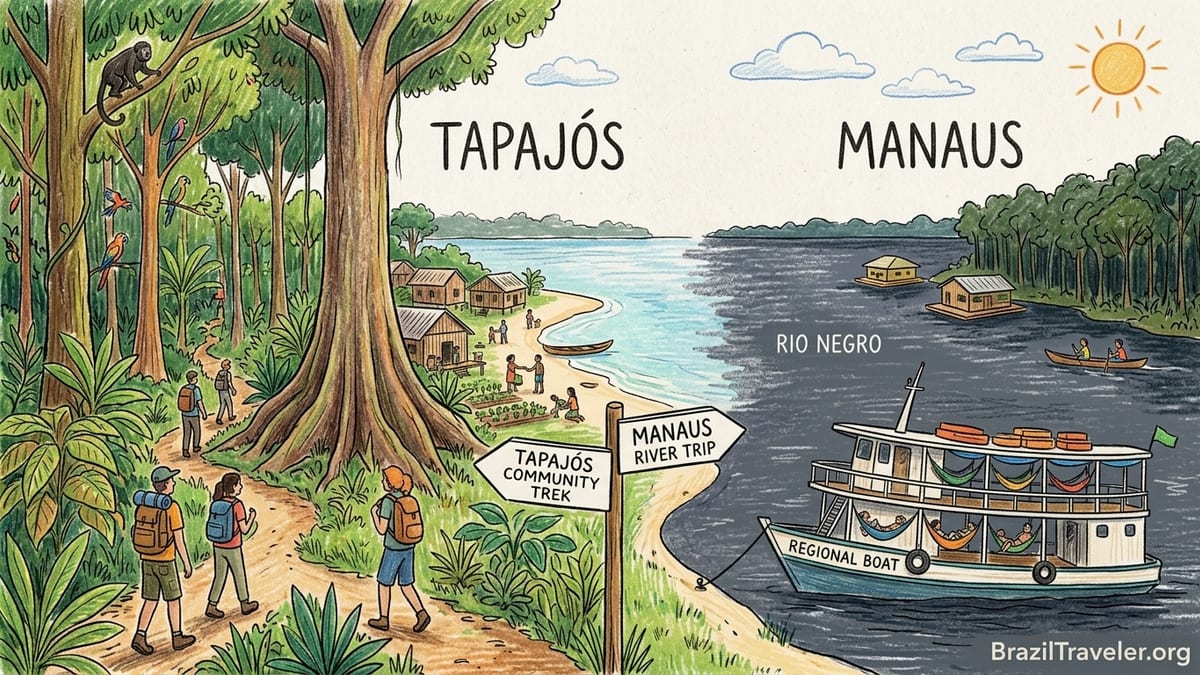
Why Choose Tapajós Over Manaus for a Forest Trek
Most travelers first hear about the Amazon through Manaus, where the classic experience is a multi-day boat trip sleeping in hammocks and making short, guided forays into nearby forest. Those trips certainly reach wild areas, but the rhythm is dictated by the boat. Walks are usually one or two hours, often on secondary forest close to floating lodges. In contrast, the Tapajós region around Santarém and Alter do Chão has a different focus. Here, the most rewarding experiences are community-based hikes that begin and end in riverside villages inside or beside protected areas.
Jamaraquá, within the Tapajós National Forest in the municipality of Belterra, is one of those villages. Local guides take small groups on interpretive trails that can last three to six hours, deep enough into the forest to experience real changes in vegetation, soil and light. Instead of returning to a large lodge owned by an outside company, hikers come back to the community’s beach, small restaurants and family houses that host visitors. For anyone who has only seen the Amazon from a boat deck, it feels like a shift in who is leading the experience and how close you stay to local daily life.
Another difference is accessibility. The section of Tapajós National Forest near Jamaraquá lies roughly 75 kilometers south of Santarém and can be reached both by river and by the BR-163 highway. That means you can base yourself in Alter do Chão or Santarém and organize a focused day or overnight trip that prioritizes time on foot in primary rainforest, rather than days lost to river transit.
Finally, Tapajós is ideal if you want an Amazon trip that combines beaches and forest in a compact itinerary. You can spend one day on the white sand of Ilha do Amor or Ponta de Pedras, and the next walking under towering samaúma trees and learning about latex, cassava and community crafts in Jamaraquá. The two experiences are only a few hours apart but feel like different worlds.
Organizing a Community-Led Excursion from Alter do Chão
To arrange my trek, I started in Alter do Chão, the popular village on the Tapajós River about 35 kilometers from Santarém. The easiest first step was visiting the small tourist information and community-tour desks near the main square, where several operators sell day trips upriver to Jamaraquá, Maguari and other villages inside Tapajós National Forest. Prices and conditions change regularly, and what follows reflects what I was quoted during this visit, not a guaranteed rate list.
For a shared day trip from Alter do Chão to Jamaraquá by speedboat, operators I spoke with were charging in the range of 350 to 450 Brazilian reais per person, including boat transport, local guiding on one of the forest trails and a simple community lunch, but not drinks or extra activities such as night canoeing. Private boat charters, which are more common in low season or for families, were quoted from about 2,000 to 2,500 reais for a small group of up to six people on a full-day itinerary. Those figures underline how much of the cost is in the fuel and boat, not the guiding itself.
Because I wanted to emphasize the community side of the experience and avoid paying more than necessary for intermediaries, I also asked specifically about road-based options. From Santarém or Alter do Chão, it is possible to travel by land along the BR-163 toward Belterra and the Tapajós National Forest entrance, then continue by local boat or community vehicle to Jamaraquá. A local operator in Alter do Chão quoted me approximately 600 to 700 reais total for a private car with driver from Alter do Chão to the forest entrance and back, plus an additional small boat transfer to Jamaraquá shared with community members. This route makes sense if you want to visit more than one community or stay overnight.
In practice, my own excursion ended up being a shared speedboat trip directly from Alter do Chão’s riverside, booked the day before departure through a local agency that works in partnership with guides from Jamaraquá. I paid 400 reais as part of a small group of eight travelers, which covered the boat, park entrance formalities, a Jamaraquá guide, and a home-style buffet lunch in the village. I brought additional cash for drinks, crafts and a small tip for the guide. Payment was in cash and by local instant transfer; no one in the community mentioned accepting foreign cards, so visitors should not rely on them.
Reaching Jamaraquá: Boat Times, Routes and First Impressions
On the morning of the trip, we left Alter do Chão at around 8:30 a.m. in a covered speedboat with plastic seats and lifejackets stored up front. Traveling upriver on the Tapajós felt surprisingly like being on a clear-water lake, with the opposite shore sometimes barely visible. Our captain hugged the right bank, passing small beaches, forested points and the occasional riverside house. Depending on river level and current, the run between Alter do Chão and Jamaraquá takes around two and a half hours by speedboat. On our trip the upstream leg lasted just under two hours and forty minutes.
As we approached the Tapajós National Forest corridor, the forest line grew denser and taller. The captain slowed near a sandy point where a small sign indicated the Jamaraquá community. Even before stepping ashore, the distinction from a resort property was clear. Instead of a private pier and manicured lawn, there was a simple wooden landing, a broad strip of pale sand, children swimming in the shallows and wooden houses set back under fruit trees. This is not a purpose-built tourist village, but a working riverside community that has added tourism to its economy.
Total travel time from leaving my guesthouse in Alter do Chão to arrival in Jamaraquá’s central area was a little under three and a half hours. That included a short walk from the river beach up to the community meeting area, where our Jamaraquá guide introduced himself and explained how the day would work. The plan was a forest trek in the late morning, lunch back in the village, and optional swimming or craft shopping in the afternoon before returning to Alter do Chão in the late day light.
Visitors arriving by road follow a very different first stage, with asphalt, laterite and finally forest dirt roads replacing the long, open river. However, several researchers and official documents note that Jamaraquá can be accessed both via the Tapajós River and via the BR-163, with the road used frequently by domestic visitors and organized vans from Santarém and Belterra. Once in the village, though, everyone meets the same guides and uses the same trails, which are community-managed and not exclusive to any agency.
Hiking the Trilha do Piquiá under the Primary Forest Canopy
Jamaraquá offers more than one trail, but for this visit our guide suggested a variant of the Trilha do Piquiá, a loop through primary forest that reaches a cluster of large trees and returns by a slightly different route. Several independent hikers have logged this trail with handheld GPS in recent months, usually indicating a distance between 7 and 9 kilometers depending on the exact start and end points and any side spurs. Our guide described it as an approximately 8-kilometer circuit, and based on walking time and energy expenditure, that seemed consistent on the day.
We left the village around 10:00 a.m. under a high, humid sky. The first fifteen minutes crossed secondary forest and old fallow plots, with cassava plants and fruit trees still visible between taller trunks. Underfoot, the soil was sandy and relatively firm, with a clear path. After half an hour, the canopy closed more densely overhead and the air felt instantly heavier. Even in the dry season, humidity in this section of Tapajós can reach levels that surprise anyone used to drier forests. Within minutes my clothes were saturated with sweat and my notebook pages began to curl.
The trail itself shifted from straightforward to moderately technical. Exposed roots crisscrossed the path, creating natural steps on small rises and slippery traps in shaded depressions. Fallen leaves hid occasional holes or cut roots. On slight slopes, the soil had compacted into a hard surface that provided good traction when dry but would clearly become slick in rain. Our guide’s recommended pace was steady but unhurried, and including water breaks and interpretive stops, we spent around three and a half hours on the trail from village to village, with roughly two and a half hours of actual walking.
What makes this walk different from a resort’s short “jungle trail” is not only its length but the variety of forest it crosses. We passed low-lying areas with palmettos and a stronger smell of damp earth, drier plateaus where Brazil nut and hardwood trees dominated, and pockets where sunlight speared down through small canopy gaps and allowed young pioneer species to flourish. Birdsong was almost constant, though the dense foliage kept most birds hidden. We heard the rattling calls of woodpeckers, high whistles of tinamous and the distant, explosive barks of howler monkeys. Insects were omnipresent but rarely overwhelming, with small columns of ants crossing the trail and occasional mosquitoes appearing in more humid sections.
Meeting the Giant Samaúma and Learning from the Forest
About halfway through the hike, the guide stopped us beside what at first looked like an ordinary large trunk. As we stepped closer, the scale became clear. The samaúma tree before us had buttress roots taller than most people in the group and a trunk that several adults could not encircle with joined arms. The guide estimated that it had been standing long before the oldest living resident of Jamaraquá was born.
Instead of launching into a rehearsed legend, he focused on ecological functions. The samaúma’s buttress roots, he explained, help stabilize the tree in periods of strong wind and shallow soil, while also channeling rainwater and nutrients along their surfaces. High in the canopy, the giant supports epiphytes, bromeliads and orchids that would never survive at ground level. In the wet season, when nearby low areas can flood, this raised structure offers refuge for small animals and insects. In terms of carbon storage, large trees like this are among the forest’s most important reservoirs.
He also spoke about more practical relationships. For riverside residents, the samaúma serves as a reference point in the forest and a living reminder of the area’s long history of low-impact use. It is too valuable alive to cut, both because of its ecological role and because of its importance for guiding visitors and teaching school groups about primary forest. Children from Jamaraquá and neighboring communities regularly visit the tree during environmental education outings, building a sense of pride in their home forest.
Standing there, listening to his explanations, I noticed how different this moment felt from some “giant tree” visits I had experienced near Manaus, where guides rushed through a quick photo stop between boat activities. Here there was no other group waiting behind us, no pressure to perform a story. The emphasis was on patiently reading the forest and answering questions from whoever happened to be in the group that day.
Community Knowledge: Latex, Cassava and Everyday Forest Skills
After leaving the samaúma, the guide continued pointing out plants and forest uses without treating them as staged demonstrations. At one point, he showed us a rubber tree with old tapping scars and described, in simple steps, how his parents and grandparents once extracted latex, smoked it over a fire and sold it to buyers who came by boat. He did not stage a live tapping, nor did any community member perform this as a show, so I cannot describe a full, current latex demonstration as part of this visit.
Closer to the village, a small cassava processing area sat under a roof beside a family house. A woman invited us to look at the wooden press and roasting pan used to transform bitter cassava roots into the toasted farinha that appears on almost every Amazonian plate. On the day of my visit they were not in full production, and she made clear that photos should be taken only with consent. She answered basic questions about how long the process takes and how often her family produces flour, but this did not turn into a scheduled performance. Travelers should be prepared for this rhythm, where everyday life continues around tourism rather than being rearranged solely for it.
One area where the community clearly chooses to engage tourists is crafts. In Jamaraquá, I saw a small shop focusing on pieces made with natural latex and forest seeds, as described by several organizations that support community-based tourism along the Tapajós. Bracelets, earrings and simple decorative items were on display. Prices were set on hand-written tags, and payment was again in cash or local transfers. No one pressured visitors to buy, but it was clear that these sales help keep tourism income within the community rather than flowing only to outside agencies or city-based hotels.
This balance between sharing knowledge and maintaining privacy is one of the clearest differences between community-managed excursions in Tapajós and external tours that only briefly pass through the reserve. When the community itself coordinates schedules, group sizes and activities, there is more space to say no to intrusive requests and to keep the focus on genuine exchanges. Visitors must accept that some days they will see latex being collected or farinha being roasted, and other days they will simply hear about those processes in conversation.
Practicalities on the Trail: Conditions, Seasons and What to Bring
Walking the Trilha do Piquiá felt moderately demanding. There are no steep climbs, but the combination of heat, humidity and constant attention to roots and obstacles makes the roughly 8 kilometers feel longer. In our mixed group of adults with average fitness, one or two people were visibly tired by the final hour, and everyone drank more water than they expected. For most reasonably fit travelers, I would describe the difficulty as moderate, but it could feel challenging in peak rainy season or for those unused to humid heat.
Footwear is crucial. Closed shoes with good grip, such as light hiking boots or trail running shoes, make the terrain more comfortable and protect against hidden roots and insects. Several people in our group wore simple sneakers and managed without incident, but they had to place their feet more carefully on uneven sections. Sandals and flip-flops are appropriate for the village beach and boat, not for the forest trail. The guide himself wore well-used rubber boots, which shed mud easily and protect in puddles.
Tapajós has a marked contrast between high and low river seasons. In the first half of the year, higher water levels can submerge beaches and flood low-lying forest areas, making short canoe excursions into igarapés and flooded forest possible. In the second half, especially from August to November, broad sandbanks emerge, and beaches become the main attraction. My visit fell in the lower river season, when Jamaraquá’s wide sand fringe was exposed and canoeing into flooded forest was not part of the itinerary. Travelers visiting in the high-water months may be offered short paddles into partially flooded forest beside the village, but those options depend closely on river levels in a given year.
In terms of supplies, our operator provided a large container of drinking water on the boat, and the community restaurant offered filtered water at lunch. Even so, I was glad to have brought my own one-and-a-half liter bottle, which I refilled at the restaurant before the hike. A hat, lightweight long-sleeved shirt, breathable trousers and insect repellent made the walk far more comfortable. While I saw mosquitoes, they were not overwhelming on this dry-season visit, but it would be unwise to count on that at other times of year.
Lunch, Communication, Payments and Staying in the Community
Back in the village, lunch was served at a simple community restaurant under a large roof with open sides. Plastic tables and chairs were arranged on a packed earth floor. The buffet included grilled fish from the Tapajós, rice, beans, salad and a generous bowl of toasted cassava flour. Our day-trip price included this meal without drinks. Soft drinks and juices were available for an additional charge that was roughly in line with prices in Santarém, although I avoid listing exact numbers because they change frequently and the community has a right to adjust them as costs fluctuate.
Communication with guides and hosts was primarily in Brazilian Portuguese. In my group, the external guide from Alter do Chão spoke conversational English and Spanish and helped translate key safety information and natural history explanations from the Jamaraquá guide. Visitors who do not speak Portuguese should not expect fluent English from community members, although occasionally younger residents who have worked with visitors for years may understand and reply to basic questions.
Cash remains essential throughout the experience. There are ATMs and bank branches in Santarém, but not in Alter do Chão or Jamaraquá. Payment for the day tour from Alter do Chão was possible by card at the agency office, but everything in the community itself, from cold coconut water to bracelets, was paid in cash or local bank transfers. For a day trip that includes crafts or optional drinks, a budget of a few hundred reais in cash per person offers a comfortable margin. Those planning to stay overnight will need more for accommodation and additional meals.
Jamaraquá offers rustic lodging options in community-run guesthouses and hammock houses. While I did not stay overnight on this visit, regional tourism materials and community information mention simple rooms and hammocks available on request at modest nightly rates, usually including breakfast. Anyone planning to sleep in the village should coordinate in advance, both out of respect and to ensure that beds and food are available on the desired dates.
The Takeaway
Spending a day walking from Jamaraquá into the Tapajós National Forest changed my idea of what an accessible Amazon experience could look like. Instead of counting how many wildlife species I could tick off or how many boat excursions I could stack into a short itinerary, I found myself focusing on the quality of time with local guides, the texture of the forest soil underfoot and the feeling of standing beside a tree whose lifespan far exceeds my own.
The most rewarding part of the trek was the extended stretch of primary forest around the giant samaúma. There, with no village noises and only the layered sounds of insects and distant birds, it became easier to understand why residents fight to keep this landscape intact. The guide’s explanations about soil, tree roots, rubber history and cassava cultivation connected pieces that on a shorter, resort-style walk might appear only as scattered curiosities.
Was the long journey from Alter do Chão worthwhile? For me, yes. Between leaving my accommodation and returning after sunset, the outing filled more than eleven hours, but only a small portion of that time felt passive. The combination of river travel, an approximately 8-kilometer hike and unhurried conversations in the village gave the day a clear structure. Compared with some boat-dominated itineraries I had experienced around Manaus, where forest walks felt like brief interludes between long transfers, this community-centered day in Tapajós felt like the inverse.
If I returned, I would try to book more directly with community operators. During my stay in Santarém and Alter do Chão, I came across references to local associations and community contact numbers that help organize visits to Jamaraquá, Maguari and nearby villages without layers of intermediaries. Next time I would contact those associations in advance from Santarém, confirm current prices and availability, and then use Alter do Chão agencies only when necessary for shared transport. That approach would not only bring more income directly to communities, but also give greater flexibility to design itineraries that prioritize time on foot in the forest, guided by the people who know it best.
FAQ
Q1. Can I visit Jamaraquá and hike in Tapajós National Forest on a day trip from Alter do Chão?
Yes, it is feasible as a long day trip. Expect roughly two and a half to three hours by speedboat each way between Alter do Chão and Jamaraquá, plus several hours of hiking and time for lunch in the community.
Q2. How difficult is the Trilha do Piquiá hike from Jamaraquá?
The Trilha do Piquiá is roughly 7 to 9 kilometers depending on the route. For most reasonably fit travelers it feels moderate, with no steep climbs but high humidity, exposed roots and uneven terrain.
Q3. Do I need a local guide to hike in Tapajós National Forest near Jamaraquá?
Yes. Trails are community-managed, and Jamaraquá’s visitor experience is organized around local guides who know the routes, forest conditions and community agreements. Arriving with an external guide alone is not appropriate.
Q4. Is it better to reach Jamaraquá by boat or by road from Santarém?
Both options exist. Boats from Alter do Chão or Santarém travel upriver on the Tapajós, while road-based trips use the BR-163 toward Belterra and then continue by local transport. Boat trips are more common for visitors staying in Alter do Chão.
Q5. What should I wear and bring for the hike in Jamaraquá?
Wear light, long-sleeved clothing, closed shoes with good grip, a hat and insect repellent. Bring at least one to two liters of water per person, sunscreen and any personal medications.
Q6. Are there opportunities to see flooded forest or do canoe trips from Jamaraquá?
Yes, but they depend on the river season. In high-water months some low-lying forest near the community floods, allowing short canoe excursions. In low-water months, broad beaches emerge and walks and swimming become the focus.
Q7. Can I pay for community services in Jamaraquá with a credit card?
Do not count on it. Agencies in Santarém or Alter do Chão may accept cards, but in Jamaraquá itself payments for meals, crafts and drinks are typically made in cash or local bank transfers.
Q8. Is it possible to stay overnight in Jamaraquá instead of doing a day trip?
Yes. The community offers simple lodging options such as hammock houses and basic guest rooms, generally including breakfast. Arrangements should be made in advance through community contacts or partner operators.
Q9. How does the Jamaraquá experience differ from Amazon tours around Manaus?
A key difference is the focus on community-managed hiking in primary forest rather than boat-heavy itineraries with short, standardized forest walks. In Jamaraquá, residents host and guide visitors inside a protected area that is also their home.
Q10. How can I book more directly with community operators in Tapajós National Forest?
The most direct path is to obtain current contact details for community associations in Santarém or through reputable local organizations that support community-based tourism, then confirm dates, prices and activities before arranging transport.