


Booking an Amazon jungle lodge near Manaus is less like choosing a hotel and more like committing to a small expedition. Stays are usually sold as all-inclusive multi-day packages that combine accommodation, meals, guided excursions and boat or road transfers into the rainforest. Prices can be substantial, conditions are humid and remote, and the experience you get varies widely depending on whether you are in a blackwater Rio Negro environment, a flooded tributary forest or a lodge close to Manaus. This guide explains the main lodge styles, compares key properties and package costs, and helps you decide how much comfort and exclusivity you really need for your Amazon adventure.
Understanding Manaus Jungle Lodges and River Environments
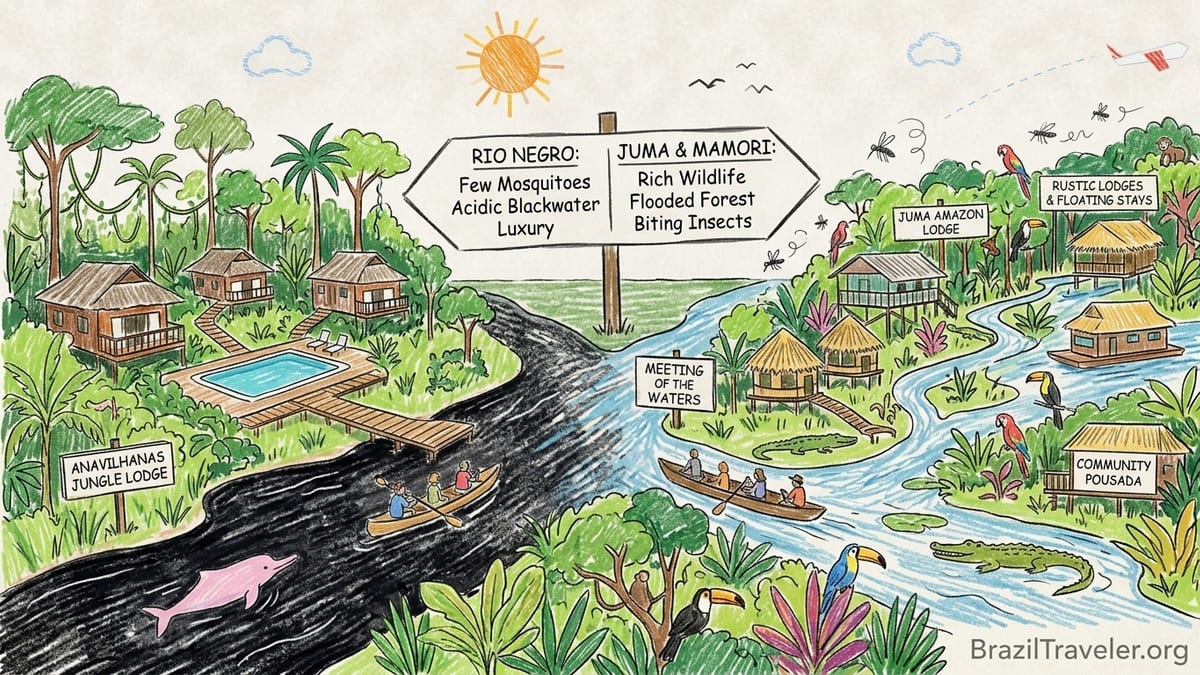
Manaus is the jumping-off point for most Brazilian Amazon lodge stays, but the lodges themselves are scattered across very different river systems. Some, such as Anavilhanas Jungle Lodge, sit on the Rio Negro, a vast blackwater river northwest of Manaus reached by road and then boat. Others, such as Juma Amazon Lodge and Juma Kabanas, are deep in the flooded forests south and southeast of the city along the Juma River and Mamori region. There are also properties closer to Manaus like Amazon Ecopark Jungle Lodge, which occupy secondary forest along tributaries near the confluence of the Rio Negro and Solimões.
These locations matter for both comfort and wildlife. The Rio Negro’s acidic blackwater environment tends to have fewer mosquitoes compared with whitewater or mixed rivers, which many travelers find more comfortable at dusk and after dark. In contrast, the Juma and Mamori areas have richer aquatic life and a classic flooded forest feel, but biting insects are more present and humidity can feel more intense. Lodges closer to Manaus sacrifice some sense of remoteness yet make travel times shorter and logistics easier for families or nervous first-timers.
Another key difference is how isolated each lodge is from public transport and independent services. Almost all jungle lodges near Manaus can only be reached on pre-arranged transfers bundled into packages. Once you arrive, there are no restaurants, shops or alternative tour operators nearby. This makes it crucial to study what is included or excluded from a package, how many guided activities you get, and whether things like airport pick-up, drinking water and special excursions such as the Meeting of the Waters are part of the base price.
Because you cannot simply “walk away” or book an alternative day tour once you are in the rainforest, understanding the style of each lodge, its typical guest profile and its package structure is essential. The sections that follow group the main lodge options near Manaus into luxury, midrange, rustic adventure, family-friendly, floating accommodation and community-focused stays, and provide concrete examples of current prices and inclusions where verifiable.
Luxury Rainforest Lodges: Comfort Deep in the Forest
Anavilhanas Jungle Lodge, near the town of Novo Airão on the Rio Negro, is one of the benchmark luxury lodges for the Brazilian Amazon. It lies within sight of the Anavilhanas Archipelago, a protected area of hundreds of forested islands about 180 kilometers from Manaus. Reaching the lodge involves a road transfer of roughly two and a half hours from Manaus, followed by a short boat ride. The lodge sells packages from two to five nights that include accommodation in upscale cottages, bungalows or panoramic rooms, a la carte meals, guided excursions and regular shared transfers between Manaus and the lodge. Alcoholic and soft drinks are extra, and the property has a strict daytime transfer schedule with no departures after mid-afternoon, which means a late arriving flight will usually require an overnight in Manaus.
Rooms at Anavilhanas are designed for comfort in the tropics, with air conditioning available at least during the night, 24-hour electricity, private bathrooms with hot showers, and details such as quality linens and screened windows. Facilities include a river-view swimming pool, a bar and lounge, and well-maintained walkways that make it easier to move around in wet conditions. Activities, which are generally shared with a small group, range from canoe trips among the igapó and igarapé flooded forests to pink river dolphin observation, piranha fishing, night safaris by boat, and visits to local communities. Packages typically include two guided activities per full day, and the rate is per room rather than per person.
Juma Amazon Lodge represents another high-comfort option, though in a different river environment. Located about 100 kilometers southeast of Manaus, on a branch of the Juma River, the lodge is reached by a combination of road and boat transfers arranged from the airport or city hotels in Manaus. The lodge sells named packages such as Arara (three days and two nights), Mutum (four days and three nights), Tucano (five days and four nights) and Uirapuru (six days and five nights, often with one night in Manaus before or after). These packages are priced per person, include round-trip transfers, full board and a set menu of guided activities such as sunrise canoeing, forest walks, piranha fishing, night outings and visits to a traditional riverside community.
For 2026, published prices for Juma Amazon Lodge’s forest-view category show, for example, that the four-day, three-night Mutum package in a double room in mid season is listed at around 11,650 Brazilian reais per person, while the shorter three-day, two-night Arara package in a double is around 8,738 reais per person in the same season. These package prices cover accommodation, meals, regular transfers and scheduled tours, but not drinks or optional extras. The lodge’s cancellation conditions become tighter during high season and New Year periods, with some holiday dates non-refundable, which is important to factor in when committing significant sums months in advance.
Midrange Jungle Accommodation Close to Manaus
Travelers who want a full jungle experience without the top-tier luxury prices often look to properties closer to Manaus. Amazon Ecopark Jungle Lodge is one of the most established midrange options, situated on a tributary of the Rio Negro within easy reach of the city. Packages here are sold in nights, typically two or three, and are priced per person. A representative 2026 rate for a three-night package, which includes transfers, full board and excursions such as a nature hike, visit to a rehabilitation “Monkey Forest,” piranha fishing, evening canoe outing and a Meeting of the Waters trip, is listed at around 1,105 US dollars per person in a traditional room, rising to roughly 1,299 dollars in a superior room.
In practical terms, this positions Amazon Ecopark well below the highest-end Rio Negro lodges and broadly below or comparable to long-stay packages at Juma Amazon Lodge, particularly once you account for dollar to real exchange rates that can shift. Rooms at Ecopark have air conditioning and private bathrooms, and electricity is available around the clock. Because the lodge is much closer to Manaus than some competitors, transfers operate on a broader schedule during daylight hours. Package descriptions highlight that transfers from the airport to the lodge are included within certain time windows, with shared boat departures coordinated with daytime flight arrivals, and that check-out on the last day is usually mid-morning.
One subtle but important issue when comparing midrange packages is how lodges count days and nights. At Amazon Ecopark, for example, a two-night package gives you lunch and dinner on the first day, three meals on the second, and breakfast on the third, plus a programmed set of excursions. The arrival and departure days each include at least one meal and one activity window. Juma Amazon Lodge, in contrast, structures its named packages so that activities begin on the afternoon of arrival and continue on the morning of departure. This means that even a three-day, two-night package effectively delivers two full days of touring, but in price tables those days are counted in a slightly different way. When evaluating nightly value, it is worth reviewing the sample day-by-day itineraries rather than comparing only the nominal number of nights.
For couples and families, midrange properties close to Manaus reduce transfer times and make airport logistics easier, which can be valuable if you are combining the Amazon with a tight domestic itinerary. However, the trade-off is generally more human presence in the surrounding area, less dramatic night skies and a feeling that you are somewhat closer to the city. Wildlife observation can still be rewarding, especially for first-time visitors seeing macaws, toucans, frogs, caimans and river dolphins for the first time, but those seeking the most pristine conditions might find greater satisfaction at more remote Rio Negro or Juma region lodges.
Rustic Adventure Lodges, Floating Stays and Community Ecotourism
Beyond the well-known luxury and midrange lodges, there is a growing set of rustic adventure, floating and community-based options within reach of Manaus. Juma Kabanas is an example of a lodge positioned as rustic but comfortable, located on the Juma River south of Manaus. The property offers several packages under names such as “Kabanas trip two nights,” “Nature experience three nights,” “Amazon jungle tour four nights” and longer five-night stays. Recent advertised starting prices for the two-night package are in the region of 2,580 Brazilian reais per person, with three- and four-night packages priced higher. These prices typically include transfers from Manaus, accommodation in simple bungalows or “kabanas,” meals and a schedule of guided activities like forest walks, canoeing, dolphin watching and night outings.
Rustic lodges like Juma Kabanas often have fans and mosquito nets instead of full hotel-style air conditioning. Electricity may operate on a generator schedule rather than 24 hours, especially overnight. Bathrooms can be private or semi-private depending on the cabana type, so it is important to verify the exact room category. In exchange, guests frequently enjoy a more intimate experience, with smaller groups on excursions and more informal contact with guides and local staff. This appeals to travelers who prioritize immersion in forest life and who do not mind slightly simpler infrastructure as long as hygiene and safety are sound.
Floating lodges are another distinct category, such as Tapiri Floating Lodge in the Juma Lake and Paraná do Mamori region. Package examples advertised by operators include three-day, two-night and four-day, three-night adventures where all nights are spent on a floating structure totally surrounded by water. These packages generally cover boat transfers from Manaus, full board, and multiple excursions each day, including wildlife-focused canoe outings, fishing and optional overnights in the forest. Facilities are basic compared with fixed luxury properties, but you gain the sensation of living directly on the water, with wildlife sightings such as river dolphins and caimans often possible right from the deck.
Community-based ecotourism projects, including small pousadas near Juma Lake or along the Mamori region, tend to offer three- or four-day packages that emphasize direct interaction with local families, subsistence fishing practices, and low-impact forest walks. Prices can be considerably lower than high-profile luxury lodges, and a greater share of income usually remains in the community. However, cancellation conditions may be informal, and facilities like air conditioning, hot showers and Wi-Fi are often limited or absent. Travelers choosing these stays need to be genuinely comfortable with basic conditions and understand that activities are shaped by everyday community rhythms rather than a polished resort program.
What Packages Really Include: Activities, Transfers and Hidden Costs
Because almost all Manaus-area lodges sell bundled packages, comparing nightly hotel-style rates can be misleading. A more useful approach is to look at the total three- or four-day package cost for your group size, including compulsory transfers and any necessary nights in Manaus before or after. For instance, using mid-2026 published prices, a couple booking Juma Amazon Lodge’s four-day Mutum package in a double forest-view category in mid season might pay around 23,300 reais for the package itself. This includes shared transfers from Manaus, accommodation, all meals and programmed tours. To that you would add any nights in a city hotel before an early departure or after a late return, plus drinks and tips.
By contrast, the same couple choosing a three-night package at Amazon Ecopark Jungle Lodge, priced at approximately 1,105 US dollars per person in a traditional room, would be looking at a total around 2,210 dollars for the package. This would cover airport or hotel pick-up within standard hours, full board, and a set list of excursions, including the Meeting of the Waters. Conversion into Brazilian reais will depend on the exchange rate at the time of payment. Although the raw per-person number may seem similar to some Brazilian real values for longer Juma packages, the shorter transfer distances and inclusion of the classic confluence tour make Ecopark attractive for those with limited time.
Within the rustic bracket, a three-night package at Juma Kabanas costing just over 3,100 reais per person at recent advertised starting levels would total around 6,200 reais for a couple, again including meals and core activities. Floating lodges and community pousadas in the Juma and Mamori areas often quote per-person packages for three or four days that can come in under or around this figure, though specific prices vary by operator and season. Many also offer camping or survival-style overnights in the forest as optional add-ons rather than inclusions, usually at a modest supplemental charge per person.
For families of four, package pricing can change significantly. Some lodges, including Juma Amazon Lodge, publish quadruple occupancy rates that reduce the per-person cost when four guests share a large bungalow or family unit. For example, the three-day Arara package in mid season is listed at around 7,100 reais per person in a quadruple room configuration, which would bring the package total to roughly 28,400 reais for a family of four. Midrange lodges closer to Manaus may allow children under a certain age to share with parents at reduced rates or even free of charge, though the exact age thresholds and discounts vary and need to be checked directly with the operator or booking agent.
Counting Days, Mosquitoes, Humidity and Other Practicalities
A recurrent point of confusion is how lodges count “days” in their packages. Many three-day, two-night offers in the Manaus region, including those at Amazon Ecopark and Juma Amazon Lodge, include arrival and departure days that each contain at least one excursion. This is one reason operators defend charging for a full “three days” even though you sleep only two nights. In practice, an arrival before midday often allows for lunch and an afternoon activity on day one, a full schedule on day two, and a sunrise outing and breakfast on day three before returning to Manaus around late morning or early afternoon. Late arrivals, especially after lunch, usually miss the first canoe or walk and may also lose a meal, so when flight times are tight, paying for an extra night in Manaus to ensure a morning departure can deliver better overall value.
Mosquitoes are a genuine consideration when comparing blackwater and whitewater or floodplain environments. On the Rio Negro, the acidic blackwater discourages mosquito breeding, and many visitors report far fewer bites around Anavilhanas and similar lodges compared with the Juma or Mamori areas. This does not mean you can skip repellent, long sleeves and bed nets, but it can make evenings more pleasant, particularly for children and mosquito-sensitive travelers. In contrast, lodges in the Juma region surrounded by varzea and igapó floodplains typically see more insects, especially at sunset and after rain. Floating lodges sitting directly on still or slow-moving water can attract additional bugs, though breezes on open decks may help.
Humidity is intense across the region year-round, with temperatures often above 30 degrees Celsius during the day. Air conditioning, or at least a powerful fan and good cross-ventilation, becomes more significant on multi-night stays. Luxury and many midrange lodges provide air-conditioning in rooms, usually available through the night. Rustic and community lodges may rely on fans and screened windows, and some operate generators only during certain hours, meaning power may go off late at night. Travelers with respiratory conditions or who sleep poorly in heat should factor this into their choice and may prefer properties advertised with 24-hour electricity and air conditioning.
Accessibility and children’s policies vary across lodges. Juma Amazon Lodge, for example, has some bungalows located closer to reception and the restaurant, which tour operators highlight as better suited for guests with mobility limitations or families with small children. Most programs, however, still involve boat embarkations, uneven forest trails and stairs to access elevated walkways or viewing platforms. Restrictions on children’s ages may apply to certain activities such as night boat trips, jungle camping or long hikes. Parents should confirm minimum ages for participation and whether life jackets sized for younger children are available before booking.
When Is Luxury Worth It, and When Does Simpler Win?
Paying extra for a top-tier lodge can materially change the level of comfort and, in some cases, wildlife opportunities, but it does not automatically guarantee a more intense or authentic Amazon experience. At properties like Anavilhanas Jungle Lodge, part of what guests are buying is a carefully curated environment: air-conditioned rooms with designer touches, an infinity pool facing the Rio Negro, a well-trained guiding team and a capped number of guests on each excursion. Guides typically speak good English, and the lodge can allocate smaller groups or even arrange private outings at an additional cost. For honeymooners or travelers celebrating a special occasion, the combination of comfort, scenery and service can justify the premium.
Juma Amazon Lodge offers a slightly different mix. While its rooms are comfortable and the common areas atmospheric, the real premium comes from its remote location in classic flooded forest, which supports dramatic sunrise scenes with mist over the river, easy access to forest trails, and a sense of deep isolation from urban life. Photographers and serious birders may appreciate being surrounded by more complex forest mosaics, though sightings always depend on seasonal conditions and guide skill. The higher per-person cost of multi-night packages reflects not only room standards but also the longer and more complex transfer logistics and the relatively low capacity compared with city hotels.
On the other hand, simpler lodges and floating structures can deliver equally memorable wildlife encounters at lower cost, especially for travelers who do not require hotel-style amenities. At Juma Kabanas or a community-run pousada near Juma Lake, you are more likely to share a boat with a smaller group and spend informal time with guides who grew up on the river. Night canoe paddles under the southern stars, learning traditional fishing techniques, and sleeping with the sounds of the forest just meters away are experiences that do not depend on thread counts or cocktail menus. Travelers comfortable with cold showers, intermittent power and a lack of air-conditioned lounges may find that every extra real they save on lodging can be invested in extra days in the forest.
Value also depends on how much time you plan to spend in your room. Photographers and serious birdwatchers may be out before dawn each day and return after dusk, using the lodge principally as a place to sleep, eat and charge equipment. For them, a midrange or rustic base with excellent guiding might trump pure luxury. Conversely, travelers who know they will spend hot afternoons by the pool or who are combining the Amazon with a demanding wider itinerary might appreciate the chance to rest in cool, spacious accommodations. Understanding your own priorities before comparing prices will help you decide whether the extra cost of a luxury lodge is a wise investment or unnecessary overhead.
Recommendations for Different Types of Travelers
For honeymooners and couples seeking a once-in-a-lifetime romantic setting, Anavilhanas Jungle Lodge is a standout option. Its Rio Negro location offers beautiful sunsets over blackwater channels, a refined atmosphere, strong service standards and relatively fewer mosquitoes than many whitewater areas. The higher nightly cost delivers real gains in comfort, privacy and cuisine, and staff can often arrange private dinners or tailored excursions. Couples with more time and a taste for adventure, however, might consider splitting their stay between one of the Manaus boutique hotels and a Juma region lodge, combining urban culture with deep rainforest immersion.
Families with school-age children often benefit from being closer to Manaus and choosing lodges with air-conditioned rooms, flexible transfer schedules and shorter boat rides. Amazon Ecopark Jungle Lodge fits this profile, with relatively quick access from the airport, structured yet not overly intense activity programs, and the Meeting of the Waters tour included in longer packages. Families ready for more adventure, and whose children are comfortable with longer travel days, might opt for Juma Amazon Lodge or Juma Kabanas, selecting family bungalows or neighboring cabanas and focusing on three- or four-day stays that balance excitement with rest.
Serious nature enthusiasts and photographers should weigh location and guiding strength above decor. The Rio Negro around Anavilhanas offers blackwater island systems, river dolphins and excellent canoeing among flooded forests, while the Juma and Mamori regions provide iconic varzea landscapes, higher general biomass and opportunities to document both dawn mists and dramatic storm fronts. Seeking out lodges that explicitly advertise experienced naturalist guides, flexible photo-friendly schedules and small group sizes will matter more than whether the bathroom fittings are stylish. In some cases, arranging a private or semi-private guide at a midrange lodge can be more valuable than staying at the most exclusive property on a shared schedule.
For travelers on a tighter budget or planning an affordable first Amazon experience, rustic lodges and community-based ecotourism projects can be excellent choices. Choosing a three-day, two-night or four-day, three-night package at a floating lodge or simple pousada near Juma Lake, for instance, can reduce accommodation costs significantly below those at premium resorts while still including full board and regular guided activities. The trade-offs are more basic rooms, possible generator hours instead of continuous electricity, and sometimes less formal safety infrastructure. Checking recent independent reviews, confirming lifejackets and first-aid provisions, and ensuring that guides are properly licensed will help you reap the benefits of lower prices without compromising too much on safety.
The Takeaway
Planning a jungle-lodge stay near Manaus requires more research than booking a standard hotel, but the rewards can be profound. The key decisions involve choosing your river environment, clarifying your comfort needs, and understanding how multi-day packages bundle transfers, meals and activities. Luxury properties on the Rio Negro deliver beautiful design, strong service and a relatively mosquito-light blackwater setting, at prices that match their positioning. Remote lodges in the Juma region immerse you deeper in flooded forest landscapes, with rich wildlife encounters and more intense conditions. Midrange and rustic options, especially floating lodges and community-based pousadas, offer more affordable yet often equally memorable stays for those willing to accept simpler infrastructure.
Once you narrow down the style that fits your priorities and budget, compare concrete package details: how many full excursion days you get, what transfers are included, whether airport pick-up is covered, and how cancellation policies work for your travel dates. Consider the total cost for your specific group size, including city overnights and any optional tours, rather than focusing only on headline nightly rates. Finally, be realistic about your tolerance for heat, humidity, insects and remoteness. The right lodge will make these elements feel like part of the adventure rather than discomforts to be endured, leaving you with vivid memories of dawn mists, forest sounds and the reflections of the Amazon’s rivers all around you.
FAQ
Q1. How many days do I really need at an Amazon jungle lodge near Manaus?
Most travelers find that three to four days and two to three nights strike a good balance between cost and experience. This usually gives you at least two full days of activities plus excursions on your arrival and departure days. Shorter stays risk feeling rushed, especially if your arrival flight is delayed, while longer packages work best for wildlife enthusiasts and photographers who are happy to repeat activities under different light and weather conditions.
Q2. Are mosquitoes really less of a problem on the Rio Negro than in the Juma region?
In practice, many visitors report fewer mosquito bites at Rio Negro lodges such as those near Anavilhanas than at lodges in whitewater or floodplain environments like the Juma and Mamori regions. The Rio Negro’s dark, acidic water is less favorable for mosquito breeding. That said, you should still bring strong repellent, long-sleeved clothing and, if you are sensitive, consider treating clothes with insecticide, because conditions vary with season and rainfall.
Q3. Do the lodge package prices include airport transfers from Manaus?
Most established lodges include at least one regular shared transfer from Manaus airport or city hotels in their package prices, but the details differ. Some, such as Juma Amazon Lodge and Amazon Ecopark, schedule transfers during daytime flight windows and may charge extra or require an overnight in Manaus if you arrive late. High-end properties like Anavilhanas also set afternoon cut-off times for safety on the roads and rivers. Always confirm the exact pick-up times, meeting points and any supplements before booking flights.
Q4. What room facilities should I expect at luxury versus rustic lodges?
Luxury and many midrange lodges offer air-conditioned rooms, 24-hour electricity, private bathrooms with hot showers, comfortable beds with mosquito screens, and often extras like minibars and in-room safes. Rustic and community-based lodges typically provide simpler fan-cooled rooms, sometimes with limited generator hours and more basic bathrooms. Floating lodges may have compact cabins with shared or semi-private facilities. Checking room photos and confirming whether air conditioning is available at night is sensible if you are heat sensitive.
Q5. Are meals and drinking water included, and can lodges handle dietary requirements?
Multi-day lodge packages almost always include three daily meals, served buffet-style or as set menus. Safe drinking water, often filtered or bottled, is normally provided at no extra charge, though branded bottled water or soft drinks may be billed separately at upscale properties. Most lodges can cater for vegetarians and simple dietary needs if informed in advance. Travelers with strict requirements, such as gluten-free or severe allergies, should contact the lodge before booking to confirm what is realistically possible in a remote setting.
Q6. How do cancellation policies work for Amazon jungle lodges?
Cancellation terms are generally stricter than for city hotels because lodges operate with small room counts and complex logistics. High-demand dates, such as national holidays and New Year, often have non-refundable conditions at properties like Juma Amazon Lodge. Mid-season and low-season stays may allow partial refunds if you cancel several weeks before arrival, with increasing penalties as the date approaches. Always request the specific cancellation policy for your chosen dates in writing before paying a deposit.
Q7. Is it safe and practical to visit with young children?
Many lodges close to Manaus, and some deeper in the forest, welcome children and offer family-friendly rooms. However, programs often involve boats, uneven jungle trails and hot, humid conditions. Safety equipment such as lifejackets in child sizes, shaded boats and flexible schedules become important. Families with toddlers may prefer shorter transfers and two- or three-night stays, while those with older children can enjoy more adventurous itineraries in the Juma or Rio Negro regions. Confirm minimum ages for key activities before you commit.
Q8. Can I explore independently once I am at the lodge?
In almost all cases you cannot realistically explore beyond the immediate lodge grounds on your own, both for safety reasons and because there are no independent services or marked trails nearby. Rivers are the main transport routes, and all boat travel is organized by the lodge or its partner operator. This is why checking the quality and variety of included guided activities is crucial; your experience will depend heavily on the lodge’s program and guides.
Q9. How should I compare total costs for a couple versus a family of four?
For couples, focus on the per-person package price or per-room rate and then add the cost of any hotel nights in Manaus, drinks, tips and optional tours. For families of four, investigate whether the lodge offers family rooms or quadruple occupancy discounts, which can significantly reduce the per-person cost. Also ask about child rates, which may be reduced or waived under certain ages. Multiplying a standard per-person rate by four without checking these details can overestimate the real cost of a family stay.
Q10. What is the best lodge style for a first-time Amazon visitor on a moderate budget?
For a first visit with a moderate budget, many travelers do well with a three- or four-day package at a reliable midrange or rustic lodge that includes transfers, full board and a solid set of activities. Properties near Manaus, such as Amazon Ecopark, work well if you value shorter transfers and air-conditioned rooms, while rustic lodges like Juma Kabanas or floating options in the Juma or Mamori regions provide deeper immersion with simpler comforts. The key is to prioritize strong guiding, clear inclusions and recent positive reviews over purely decorative luxury.