


The Festival Folclórico de Parintins is one of Brazil’s most intense cultural experiences, a three night showdown between the blue Boi Caprichoso and the red Boi Garantido on an island in the middle of the Amazon River. For 2027, demand for Bumbódromo tickets, riverboats, hotels and festival packages is expected to be higher than ever, so smart planning and early bookings are essential. This guide brings together the latest available information as of late 2026 and explains how to choose tickets, boats and accommodation for a safe, memorable visit in 2027.
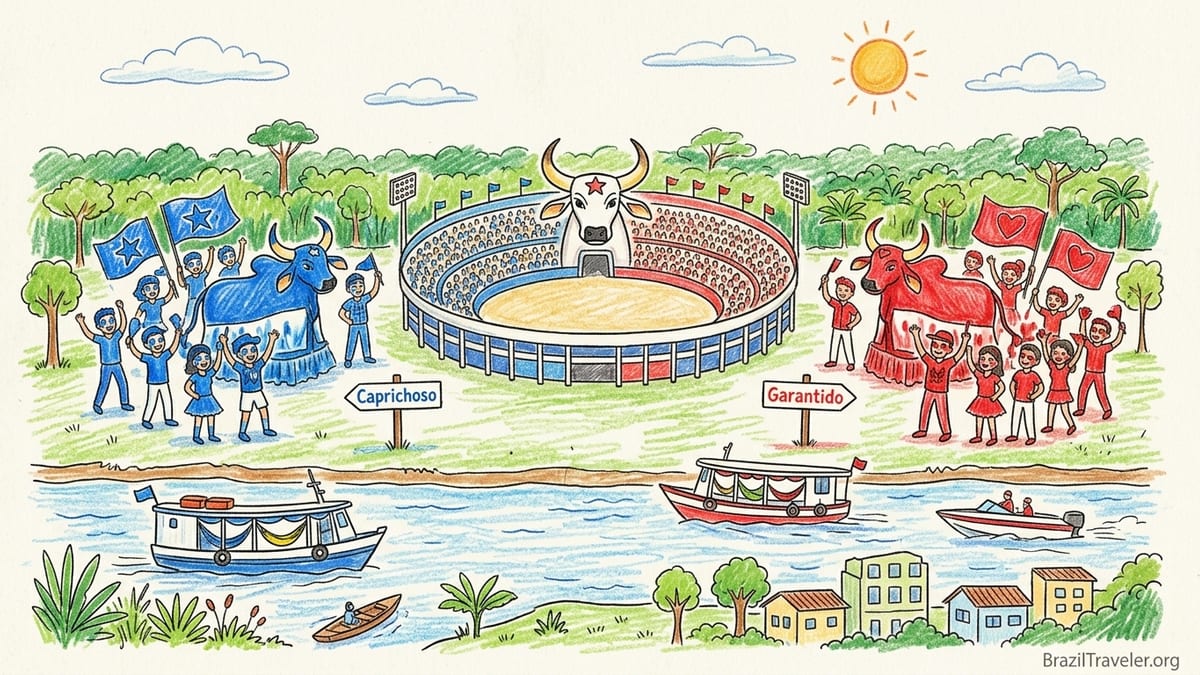
What the Parintins Festival Celebrates
The Festival Folclórico de Parintins takes place every year around the last weekend of June in the small Amazonian city of Parintins, in the state of Amazonas. The official 2027 dates have not yet been confirmed by the authorities, but recent editions have run from Friday to Sunday on the final June weekend, with 2026 shows taking place on 26, 27 and 28 June at the Bumbódromo arena. Travellers planning 2027 trips can reasonably expect a similar pattern and should monitor official festival and state culture channels for the exact 2027 calendar before buying nonrefundable flights.
At its core, the festival is a retelling of the Boi Bumbá legend, a story with Afro Brazilian, Indigenous and Catholic elements. The narrative revolves around a beloved bull that dies and is brought back to life, opening space for themes of rebirth, forgiveness and community. Over time, this story has merged with strong Amazon identities, so today the performances also celebrate rainforest biodiversity, river life, Indigenous cosmologies and regional workers, from canoe builders to açaí harvesters.
Unlike many festivals that present multiple groups every night, Parintins focuses entirely on the duel between two associations, Boi Caprichoso and Boi Garantido. Each night, only one boi performs at a time inside the Bumbódromo, and everything the audience sees is part of the competition. Costumes, floats, songs, choreography, narrative coherence, respect for traditional characters and use of the arena space are all scored by official judges, who remain anonymous until the last night.
The festival has grown into a national cultural symbol and a major tourism driver for Amazonas. In recent editions, state and municipal authorities have framed Parintins as a showcase for environmental awareness and sustainable tourism, with large sponsors investing in themed campaigns and limited edition products, such as blue and red branded drinks that match the colors of Caprichoso and Garantido. This mix of deep tradition and contemporary spectacle is what attracts visitors from across Brazil and an increasing number of international travellers.
Caprichoso vs Garantido: Understanding the Two Bois
To enjoy Parintins, visitors need to understand that the rivalry between Caprichoso and Garantido is central to local identity. Families in Parintins usually support one boi for life, and political debates, neighborhood pride and even bar decorations often reflect blue or red allegiances. The rivalry is passionate, but inside the arena it follows strict rules that emphasize artistic excellence rather than aggression.
Boi Caprichoso is traditionally associated with the color blue. Its iconography often highlights Amazonian mysticism, forest spirits and more experimental artistic choices. Caprichoso’s supporters, known as the “Nação Azul”, fill one side of the Bumbódromo’s terraces, known locally as the galera. The galera is judged as part of the show, so Caprichoso’s fans rehearse songs, chants and flag movements for months, creating a huge living choreography in blue and white during the presentations.
Boi Garantido is associated with red and is often described as more traditional or popular, calling itself “o Boi do Povão” or “Boi do Povo”. Its narratives emphasize the Amazon river communities, ancestral devotions and neighborhood pride from the lower parts of Parintins Island. Garantido’s fans, the “Nação Vermelha”, occupy the other side of the galera and respond with their own songs, coordinated flag waves and choreographed celebrations. For many locals, supporting Garantido is tied to a sense of working class identity and historical roots in the city’s older districts.
Both bois present similar core characters, such as the amo do boi, the sinhazinha da fazenda and the cunhã poranga, but their interpretations vary according to each year’s theme. The musical style, known as toada, combines percussion, regional rhythms and pop arrangements. Over the 1990s, toadas from Parintins reached national fame, with hits like “Tic Tic Tac” and “Vermelho” influencing Brazilian pop culture. When visitors hear thousands of voices in the Bumbódromo singing new toadas for 2027, they are hearing the latest chapter of this ongoing musical tradition.
Inside the Bumbódromo: Sections, Tickets and Three Night Schedule
The Bumbódromo in Parintins is an open air arena built specifically for the festival, with architecture inspired by the head of an ox. Inside, space is divided between the performance floor, giant floats, official boxes and the terraces that host the competing galeras. The capacity quoted in recent years is roughly 35,000 to 40,000 people per night, although the exact number can vary depending on safety regulations and temporary structures.
The main spectator categories are the free galera sections behind each boi and paid areas such as numbered seats, VIP boxes and sponsored lounges. The galera is reserved for registered supporters of each boi and is not usually sold as individual tickets. Visitors can sometimes join through local associations or organized packages that include a galera credential, but they must commit to cheering for one side and following the choreography. For most international visitors, the more practical option is to buy paid seats or a package with reserved seating that does not require active participation.
Paid categories can change slightly every year, but recent editions have included numbered concrete stands, private boxes for groups and corporate spaces with food and drink included. For the 2026 festival, Brazilian tour companies advertised three night packages with numbered seats in intermediate sectors of the Bumbódromo starting around the low four figures in Brazilian reais, often combined with shared hotel rooms. Premium lounges with open bar, catering and better sightlines have appeared in recent years and can cost several times more than a simple seat for the three nights, particularly in packages sold in São Paulo and Rio de Janeiro.
The competition always takes place over three consecutive nights, usually Friday, Saturday and Sunday. Each night, only one boi is allowed on the arena floor at a time, and the running order alternates each year. On the first night, one association opens the festival with a slightly shorter show that introduces its theme and key characters. The second and third nights are generally longer and more intense, culminating in the final scores announcement on Monday. Visitors planning 2027 trips should factor in at least one extra day after the final night to absorb the atmosphere in town and avoid traveling while exhausted.
How and Where to Buy Bumbódromo Tickets
There is no single permanent ticketing operator for Parintins. The government of Amazonas and the festival organizers usually announce official sales points and authorized online platforms a few months before each edition. In recent years, numbered seats and boxes have been sold through major Brazilian ticketing websites and, in some cases, at physical outlets in Manaus and Parintins. Because details change annually, anyone planning for 2027 should rely only on information from official government culture departments, the two bois and the festival’s official communication channels.
By the first half of 2026, many 2026 numbered seats and private boxes were already sold out or only available as part of packages resold by agencies in Manaus, São Paulo and other cities. Prices quoted for mid tier numbered seats for all three nights typically started in the low hundreds of reais when first released and increased significantly on resale, with prime boxes and lounges reaching several thousand reais per person. For 2027, it is realistic to expect similar or slightly higher price ranges, particularly if inflation and sponsorship levels follow recent patterns.
Travellers should be cautious with unofficial resellers that offer last minute tickets on social media or messaging apps without clear authorization. Unfortunately, local media has reported occasional scams, where visitors transfer money for tickets that never materialize. Safer approaches include using only ticketing platforms named by the state culture secretariat, buying directly from the bois’ official partner agencies or choosing reputable tour operators that supply written contracts specifying the seating sector and inclusions.
For visitors on tighter budgets or those who cannot secure seats early, it is still worth traveling to Parintins during the festival. Some people manage to buy single night tickets locally, often on the day of the show, at face value from authorized booths or from residents who decide not to attend. This involves uncertainty and patience, and there is no guarantee that 2027 will follow the same pattern, but it remains a real world strategy used by independent Brazilian travellers in earlier editions.
Getting to Parintins: Flights, Fast Boats and Slow River Vessels
Parintins sits on an island in the Amazon River, roughly halfway between Manaus and Santarém. There is no road access, so visitors arrive either by air or river. For most international travellers, the trip begins with a flight into Manaus, the capital of Amazonas. From there, options include a domestic flight to Parintins, a fast boat or a traditional slow passenger vessel with hammocks.
In recent years, during the festival period, Brazilian airlines have operated special flights between Manaus and Parintins, using small to medium sized aircraft. Seats on these flights usually sell out quickly once festival dates are announced, and prices tend to surge compared with regular off season fares. A one way ticket on a festival period flight between Manaus and Parintins has often cost several times the price of a normal Manaus domestic flight of similar distance, placing it solidly in the mid to high triple digits in reais in many examples reported by passengers.
River travel remains the most iconic route. Traditional slow boats, known locally as barcos recreio, take roughly 14 to 18 hours between Manaus and Parintins, depending on current and stops. Passengers bring their own hammocks and sleep on open decks, while the crew provides basic bathrooms and, in some boats, simple showers. According to official price lists published in Manaus port authorities, standard hammock passage for intermediate destinations like Parintins has been advertised in recent years around the low hundreds of reais, although festival demand can push real market prices higher.
Fast boats and ferries shorten the journey to approximately six to eight hours. Services marketed for the festival have used vessels described as lanchas rápidas and ferries with air conditioned cabins. Packages for 2026 published by Amazonian boat brokers showcased combined deals from Manaus to Parintins with reserved hammock space or reclining seats, air conditioning and sometimes live music on board, with prices several times higher than a basic hammock on a regular slow boat but still often below the cost of peak time flights. For 2027, travellers should expect festival period riverboat tickets to be significantly more expensive than standard off season Amazon routes and should book early when reputable operators publish their schedules.
Where to Sleep: Hotels, Guesthouses, Boats and Floating Stays
Parintins is a small city that transforms during the festival. Outside June, it has a modest inventory of standard hotels, guesthouses and small inns. During the festival, hundreds of additional options appear in the form of chartered riverboats serving as floating hotels, private house rentals, school buildings converted into dormitories and short term room lets in family homes. This temporary expansion is essential, because tens of thousands of extra visitors arrive during the three nights of the festival.
Traditional hotels and pousadas in Parintins offer private rooms with beds, air conditioning and private or semi private bathrooms. Many include breakfast and sometimes simple transfers between the port, airport and Bumbódromo. During the 2025 and 2026 festivals, Brazilian travel agencies quoted nightly rates for basic hotel rooms in Parintins in the mid to high triple digits in reais, with better rated properties charging more, especially for rooms that allowed three or four people to share. Availability for these hotels tends to disappear months in advance, and some repeat guests reserve for the next year as soon as they check out.
Boat hotels have become a signature feature of the festival. Operators from Manaus and other Amazonian towns charter large regional boats, sail them to Parintins and moor them near the city’s waterfront. On these boats, travellers sleep in cabins or in rows of hammocks. Published 2026 packages for some vessels show configurations where cabins have private bathrooms, air conditioning and bunk beds, while hammock decks remain open but may have fans and shared showers. Safety equipment requirements include lifejackets and emergency instructions, and reputable operators are transparent about their licensing and inspection status.
Guesthouses and homestays offer a more intimate experience. Many families in Parintins temporarily rent spare rooms with fans or air conditioning, often sharing their kitchen and living room with visitors. These arrangements can be found through Brazilian booking platforms, local contacts or tour agencies. Prices can vary widely, but for 2026 festival nights, simple private rooms in family homes were advertised in some cases for amounts that undercut standard hotel rates while still including breakfast. Guests should ask clearly about bathroom sharing, air conditioning hours, quiet hours and distance to the Bumbódromo before confirming.
Comparing Sleeping in Hammocks, Hotels and Packages with Reserved Seating
Sleeping in a hammock on a festival boat is one of the most distinctive experiences available to Parintins visitors. On slow passenger boats, hammocks are tied closely together on open decks, which can feel crowded but social. Toilets and showers are usually basic, with cold water and simple privacy partitions. Luggage typically stays under or next to the hammock, and small valuables are kept in daypacks or money belts. The biggest advantages are cost and atmosphere, since hammock tickets remain among the cheapest ways to stay near the action and offer constant views of the river and riverside life.
Boat hotel packages, often marketed specifically for the festival, improve on this by limiting the number of passengers, offering assigned hammock hooks or cabins, providing meals and sometimes including transfers and guided walks. Some 2026 offers from Manaus based operators combined three nights of boat accommodation, breakfast and dinner, and daily transfers to the Bumbódromo with optional ticket add ons. Prices for these multi night packages tended to fall between the cost of a simple hammock journey and that of a high end hotel plus transfers, making them attractive for backpackers and mid range travellers who want comfort without luxury.
Standard hotels and pousadas are best for visitors who prioritize private bathrooms, reliable air conditioning and quieter nights. Families with children, older travellers and people sensitive to heat often choose these options, even at higher prices. When comparing hotels, it is worth asking specifically about air conditioning hours, water pressure in showers and whether the property has a generator in case of power cuts, which can occur in Amazonian cities during periods of heavy demand.
Fully organized festival packages represent the top tier in terms of convenience. Brazilian agencies have offered bundles that include return flights from major cities, airport transfers in Manaus, flights or boats to Parintins, hotel accommodation and reserved seating in good Bumbódromo sectors. Some packages also add city tours, pre festival rehearsals and exclusive parties with boi performers. For 2026, such packages could easily reach multiple thousands of reais per person from São Paulo or Rio de Janeiro, but they simplified logistics for those who prefer not to navigate Portuguese language bookings and regional transport on their own.
Costs for Two Night vs Three Night Festival Experiences
Because 2027 specific prices are not yet published, visitors need to base budgets on recent editions and allow a margin for increases. A practical way to think about costs is to compare a compressed two night experience, where visitors attend only two shows, with a complete three night stay covering the entire competition. The main variables are transportation from Manaus, type of accommodation and category of spectator admission.
For a two night visit using riverboats, an independent traveller might pay for a fast boat from Manaus to Parintins, arriving on the first festival afternoon, two nights in a basic guesthouse and two nights of mid tier numbered seats, followed by a slow boat back to Manaus on Monday. Based on 2026 patterns, the combined river transport for that route could realistically fall into the mid triple digits in reais, accommodation might add a similar amount or more for two nights in a private room, and two nights of mid level tickets purchased early could add another mid to high triple digit figure. Local meals, taxis or moto taxis and small expenses would increase the total, but a determined budget traveller could still keep the entire two night Parintins section of their trip under a low four figure total in reais.
A complete three night experience, covering every show, generally costs more than just 50 percent extra. This is because hotel and boat prices during the festival are usually sold as three night packages, and three night ticket bundles may be priced more attractively than buying individual nights. For example, a mid range traveller in 2026 booking through a reputable agency might find a three night boat hotel package from Manaus including round trip slow boat transport, shared cabin with air conditioning and breakfast, and three nights of Bumbódromo seats for a few thousand reais depending on cabin type and boi preference. Adding domestic or international flights to Manaus plus pre and post festival nights in the capital can double or triple the total trip budget.
For high comfort visitors flying both segments and staying in one of the better hotels in Parintins with reserved seating in prime Bumbódromo sectors, a realistic three night total starting from Manaus in 2027 is likely to sit well into the multi thousand reais range, particularly if flights are purchased close to festival time. On the other hand, an experienced backpacker willing to sleep in a hammock and look for last minute tickets in town might manage to attend at least one or two nights for a few hundred reais above the base cost of being in the region, demonstrating the wide spread of possible budgets.
Life Outside the Arena: City Atmosphere, Weather and Safety
Even without a premium ticket, Parintins during the festival is an immersive cultural experience. Streets in the city center are decorated in blue and red, with entire blocks devoted to one boi or the other. During the day, visitors can attend boi rehearsals, small stage performances organized by the municipality and informal street parties with toadas blasting from sound systems. Official secondary stages in recent editions have been set up at locations such as the Mercado Municipal and other public squares, showcasing local bands and community groups.
Weather in late June is hot and humid, with temperatures commonly in the high twenties or low thirties Celsius during the day and little relief at night. The arena is open air, so spectators should prepare for intense heat, occasional rain showers and the possibility of muddy paths around the Bumbódromo. Light clothing, comfortable shoes, a waterproof layer and a refillable water bottle are important. During recent festivals, local utilities and government projects have provided treated drinking water points around the arena area, but visitors should still plan to buy water and soft drinks inside.
Crowds are dense, especially around show time and in the streets immediately after presentations. Petty theft can occur in any busy festival environment, so visitors are advised to carry only essential cash and cards, keep phones in front pockets or in secure neck pouches and avoid leaving bags unattended on seats. Serious crime rates during the festival have generally been described as manageable thanks to visible police and security patrols, but basic urban caution is important, especially late at night in less crowded streets or near riverfront areas.
Transport within Parintins relies on taxis, moto taxis and, in some areas, bicycle taxis. During the festival, standard fares can increase, particularly after the shows, when many people try to leave the Bumbódromo simultaneously. Some hotels and boat operators coordinate shuttle transfers at set times to reduce stress. Visitors should clarify whether their accommodation includes transfers to and from the arena, which can save both money and hassle, especially for families and older travellers.
The Takeaway
Planning a trip to the Parintins Festival in 2027 means balancing cultural curiosity, logistical realities and personal comfort. The event occupies a remote Amazonian island, operates at near capacity for three consecutive nights and relies on river and air links that can sell out months in advance. Those who prepare early and purchase official tickets, flights and accommodation through trustworthy channels stand the best chance of enjoying the spectacle without last minute anxiety.
A two night visit can work for travellers on limited time or budget, delivering at least one full night inside the Bumbódromo and enough street life to understand the rivalry between Caprichoso and Garantido. However, the three night experience allows visitors to see the full narrative arcs of both bois, follow how judges respond to each performance and join the citywide conversation about who deserved to win. For culture focused travellers, this additional night often justifies the extra cost.
Independent bookings suit flexible travellers who speak some Portuguese, are comfortable with informal river transport and do not mind searching for tickets or accommodation in a dynamic market. Fully organized packages are preferable for first time visitors to the Amazon, families with children or older relatives, and anyone who wants guaranteed seating and transfers. Both approaches can lead to unforgettable memories if grounded in realistic expectations about heat, crowds and infrastructure.
Above all, Parintins is more than a show. It is a living, breathing expression of Amazonian identity, staged by two community rooted associations that channel local pride, creativity and environmental awareness into three nights of song, dance and color. Whether you watch from a numbered seat, a VIP lounge or a hammock moored on the river, the 2027 festival will reward travellers who arrive respectful, prepared and ready to choose a side, at least for one weekend, in the eternal duel between blue and red.
FAQ
Q1. When will the Parintins Festival take place in 2027?
The exact 2027 dates have not yet been officially announced, but based on recent editions it is very likely to occur over the last weekend of June, from Friday to Sunday. Travellers should wait for confirmation from official festival and government channels before booking nonrefundable transport.
Q2. Is it better to stay all three nights or just two?
Three nights offer the full competitive narrative, since both Caprichoso and Garantido build their stories across the entire weekend. A two night visit can still be rewarding and cheaper, but it usually means missing one of the shows or arriving or leaving in a rush. Culture enthusiasts generally prefer the three night experience.
Q3. How far in advance should I buy Bumbódromo tickets for 2027?
In recent years, good seats and packages have started to sell out several months before the festival. Once official sales channels for 2027 are announced, it is sensible to secure tickets as early as possible, especially if you want specific sectors or are travelling in a group.
Q4. Are there tickets for the galera sections of Caprichoso and Garantido?
The galera areas are not sold like regular tickets, because they are part of the judged performance. Entry is usually controlled by each boi’s associations and fan groups. Some agencies and local contacts can include galera access in packages, but visitors must commit to cheering for that boi and following the choreography.
Q5. What is the safest and most comfortable way to travel from Manaus to Parintins?
For most visitors, especially families and older travellers, a combination of flights or fast boats booked through reputable operators is the safest and most comfortable solution. Slow hammock boats are more adventurous and cheaper, but offer basic comfort and variable schedules.
Q6. Do festival packages usually include Bumbódromo tickets?
Many mid range and high end packages marketed in recent years have included tickets, often in numbered stands or boxes. However, inclusions vary by operator, so it is essential to confirm in writing whether your package covers admission for all three nights and which sector you will sit in.
Q7. Can I visit Parintins during the festival without spending a lot of money?
Yes, but it requires flexibility. Travellers who choose hammock boats, simple guesthouses, local eateries and are open to buying single night tickets in town have reported manageable budgets. Costs rise quickly if you add flights, central hotels and premium seating.
Q8. Is the festival suitable for children and families?
Families do attend, and the atmosphere inside the arena is focused on performance rather than rowdiness. That said, crowds, late night hours and tropical heat can be challenging for young children. Families often choose comfortable hotels, arranged transfers and mid level seating to keep the experience manageable.
Q9. What should I pack for the Parintins Festival?
Essential items include light, breathable clothing, comfortable walking shoes, a waterproof layer, sun protection, insect repellent, a refillable water bottle and any necessary medications. If you plan to sleep in a hammock, bring a good quality hammock, rope, a light sheet and possibly a small travel pillow and earplugs.
Q10. Can I enjoy the festival atmosphere without going inside the Bumbódromo?
Yes. During the days, the city is full of rehearsals, street performances, decorated neighborhoods and small stages. At night, bars and squares broadcast the shows, and both bois organize events outside the arena. While nothing replaces seeing the presentations live, visitors without tickets can still experience a strong sense of the rivalry and celebration in the streets.