


I arrived in Belém with a head full of Amazon clichés. I expected dense rainforest, wide brown rivers and maybe a quick jungle tour. What I found crossing to Ilha de Marajó, and spending three nights in the small town of Soure, was something very different: an Amazon written in salt and mudflats, buffalo pastures, Atlantic tides and a working island that lives by cattle, fish and cheese as much as it does by tourism.
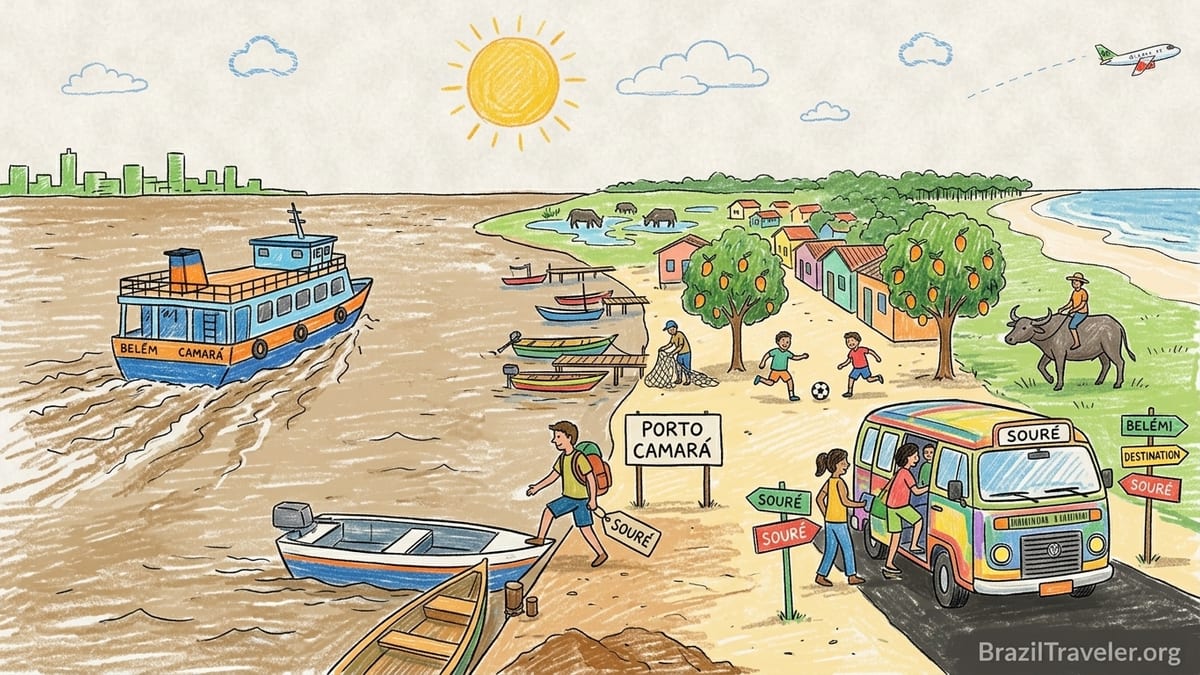
Crossing from Belém to Porto Camará: The Real Start of the Journey
The trip to Soure begins long before you see any beach. My day started at the Belém riverside, at the hydrographic terminal where ferries depart toward Ilha de Marajó. The most widely used operator on this route is a company that runs modern passenger boats and ferries between Belém and Camará, the main landing point on the island’s eastern side. On recent schedules, the crossing from Belém to Porto Camará usually lasts around three hours, with morning and early afternoon departures that locals still double-check a day in advance at the terminal or by phone because times can shift slightly with demand and maintenance.
Ticket prices on this route fluctuate with fuel and season, but in mid 2026 passengers were regularly reporting one-way fares in the range of 70 to 110 reais for standard seats, with a bit more for air-conditioned cabins. I bought my ticket at the dock the day before travel to avoid queues and to secure a seat in the air-conditioned upper deck, which turned out to be worth the small extra cost once the midday heat built over the Guajará Bay. The terminal in Belém has basic services and some small snack stalls, but it is not a place you want to rely on for full meals. I boarded with bottled water, a light lunch and mosquito repellent already in my bag.
Delays on this route are not rare. On my crossing, we left Belém about 25 minutes behind schedule while crew loaded freight and checked documentation for vehicles boarding the ferry. Other travelers I spoke to mentioned waiting an hour or more on busier holiday weekends when tides or cargo held things up. The crew did not make elaborate explanations, but the atmosphere on board stayed relaxed. Passengers from Marajó are used to the idea that the river and tides, not a printed schedule, have the final word on departure time.
Once the ferry pulled away, Belém’s skyline dropped behind the brown water. The view on this leg is not dramatic in the usual postcard sense. You see long stretches of water, occasional islands of mangrove and the low green line of Marajó appearing on the horizon. The crossing is a first reminder that the Amazon is an enormous maritime environment as much as a river basin, and that many of its communities, like those on Marajó, are more easily reached by boat than by road.
Porto Camará to Soure: Buses, Vans and the Cost of Missing a Connection
Porto Camará itself is not a destination so much as a logistics hub. The small port area fills quickly when a ferry arrives. Buses, vans and shared taxis crowd the parking lot, all shouting destinations like Soure, Salvaterra and Joanes. There is no large, covered bus terminal and very limited shade, so stepping off the boat at midday you feel the full weight of the island heat.
From Porto Camará to Soure, the road trip is short in distance but critical in planning. Shared vans and small buses run this route regularly throughout the day. In mid 2026, travelers commonly reported paying around 20 to 30 reais for the van from Camará to Soure, including a quick stop in Salvaterra. I traveled on a shared van that left about 20 minutes after our ferry docked, a rhythm that seems intentional: drivers time their presence at the port to arriving boats and often wait just long enough to fill seats before leaving. The ride to Soure took roughly an hour on paved but patched roads, crossing a landscape that mixes red-earth pasture, low forest and glimpses of waterlogged fields.
The consequences of missing a ferry connection here are concrete. A couple from São Paulo on my van had arrived on a later ferry the previous day, only to find that most vans to Soure were already gone and taxi drivers were quoting prices near 200 reais for a private transfer. With spotty mobile data in the port area and few official counters, they chose to stay overnight in Salvaterra instead. When ferries run significantly late, or if you travel in the late afternoon outside high season, you may have to negotiate directly with drivers, accept a detour to Salvaterra, or face the possibility of waiting hours before another vehicle fills enough seats to leave.
On arrival in Soure, vans usually drop visitors near the central area or directly at their pousadas if previously arranged. I stepped out onto a quiet street shaded by mango trees, a stark contrast to Belém’s traffic. Soure feels immediately smaller and more horizontal, with sandy streets, low houses and air heavy with river humidity. It is from this modest town that most visitors set out to discover the beaches, buffalo farms and rivers that make Marajó so distinct.
Staying in Soure: Working Island, Not Resort Town
I spent three nights in Soure, enough time to understand that Marajó is not a conventional tropical resort strip. Accommodation ranges from simple family-run guesthouses in the central grid of streets to more comfortable pousadas closer to the road that leads out toward the beaches. In 2026, mid-range double rooms with air conditioning and breakfast were widely advertised between roughly 220 and 380 reais per night, while more basic fan-only rooms could be found under 200 reais, especially outside school holidays and the July high season.
My pousada sat a few blocks from Soure’s riverside. The room was simple but clean, with a strong ceiling fan, air conditioning that struggled in the hottest afternoon hours and patchy Wi-Fi that slowed to a crawl once everyone returned from the beach. Staff were quick to point out the closest cash machines, since Soure has only a small selection of ATMs and card terminals can fail during network outages. I withdrew most of the cash I expected to need as soon as I arrived, a decision that proved wise when one of the main bank branches suffered a technical outage the next day and locals joined a slow-moving queue waiting for it to come back online.
Soure’s climate is a full-body experience. Daytime temperatures hover around the low 30s Celsius for much of the year, with humidity often above 80 percent. Afternoons can feel punishing in the open, and even short walks along sandy streets leave you seeking shade. Mosquitoes and tiny biting midges appear especially near mangrove areas and at dusk. Repellent is essential, particularly if you plan to stay along the riverfront or head into mangrove forests on excursions. During my stay, electricity flickered twice during evening storms, briefly affecting fans and air conditioning, a reminder that this is a remote island, not a sealed resort bubble.
These inconveniences are balanced by Soure’s quiet charm. Kids play soccer in sandy side streets. Riders on buffalo and horses cross town at unhurried pace. Along the riverfront, modest houses with verandas face the Paracauari River, where wooden boats are tied to rickety piers and fishermen mend their nets in the late afternoon shade. Soure works first as a community that raises cattle and fish and only second as a tourist hub, and that reality permeates every experience.
Riverside Streets, Ceramics and Everyday Life in Soure
My favorite hours in town took place along Soure’s river-facing streets. In the late afternoon, the heat softens and families come out to sit on doorsteps overlooking the Paracauari. The river at this point feels wide and calm, but the tidal influence of the Atlantic is already obvious. At low tide, the banks turn to exposed mud and the boats lean on their sides. At high tide, water rises almost to the foot of the small concrete promenades, lapping at mangrove roots and wooden poles.
Walking these streets you quickly encounter craft workshops and small galleries that keep the island’s ceramic tradition alive. One of the most emblematic producers is a local atelier that works with designs inspired by ancient Marajoara pottery. The pieces feature bold geometric patterns, stylized faces and animal motifs derived from archaeological finds that made Ilha de Marajó famous among researchers and museum curators. In one riverside workshop, an artisan explained how her family learned both from archaeological references and from older craftspeople who had revived these techniques in the 20th century. She shaped a simple clay bowl while we talked, tracing spiral motifs with a wooden stick as a radio played low-volume carimbó, a local rhythm.
Buffalo leather also appears in Soure’s handicrafts. Near the small market, I visited a modest curtidura, or tannery, that produces belts, sandals and saddles from buffalo hide. The smell of cured leather and tanning chemicals is strong, but the workers were happy to explain how buffalo skin behaves differently from common cattle, requiring specific processes to avoid cracking in the humid climate. Here the island’s rural economy is tangible: the same animals you see in distant pastures supply milk for cheese, strength for hauling and hides for leatherwork.
Conversations with residents highlight how tourism fits into this matrix. A ceramics vendor told me that July, with Brazilian school holidays, brings a rush of visitors that doubles her sales, but that for much of the year, she relies on local customers and occasional tour groups. A fisherman in his fifties, cleaning small river fish in front of his house, spoke of shifting seasons and stronger tides in recent years that have altered his catch. For him, tourists are welcome when they buy fish or hire his boat, but they are not the island’s primary concern. Life still revolves around the daily tides, cattle cycles and market prices for milk and cheese.
Praia do Pesqueiro and Barra Velha: Between River and Atlantic
From Soure’s center, the road to Praia do Pesqueiro heads through rural neighborhoods and then into pastureland where buffalo graze in shallow pools. The beach sits roughly 10 to 13 kilometers from town and is the most famous stretch of sand in the municipality. In practice, visitors reach it by mototaxi, taxi, bicycle or organized transfer. On my visit in 2026, mototaxis quoted between 20 and 30 reais one way from central Soure to the beach, while a private taxi could cost from 60 to 80 reais depending on negotiation and whether the driver agreed to wait during your beach time.
Praia do Pesqueiro itself is wide and pale, backed by small restaurants and simple wooden barracas that offer shade, cold beer and regional dishes like fried peixe filhote, caranguejo cooked toc-toc style and filé marajoara prepared with buffalo meat and the island’s distinctive queijo do Marajó. The water here is warm and carries a mix of fresh and slightly salty taste because Marajó sits where the Amazon’s outflow meets the Atlantic Ocean. The most striking feature, however, is the tide. On a falling tide, the sea retreats far from the line of barracas, exposing long sandbanks and tidal pools. At rising tide, the water returns with speed, closing the distance to the umbrellas and at times forcing restaurant staff to move chairs higher up the beach.
The coastal landscape around Pesqueiro has more in common with a river delta than with a classic open-ocean resort. You see mangroves at either end of the beach, and the horizon is often haze-softened, with brownish water carrying suspended sediments. At high tide, children play in small shore-breaking waves, but there are no long lines of surf. A few operators offer short buffalo-back rides along the firm sand near the village, which is a point where ethical concerns often emerge. Those who do not wish to ride animals can simply decline; no one insisted during my visit, and I preferred to watch the herds grazing in distant fields rather than mount them on the shoreline.
Barra Velha, closer to town at about 3 kilometers from the urban core, offers a more rustic and quiet experience. The beach is framed by taller mangroves and has less built infrastructure. When I visited near low tide, large areas of wet sand extended into shallow creeks that wound through the mangrove stands. Access is by a patchy road that can become muddy in the rainy season, and there are fewer food stalls, so bringing water and snacks is wise. The tidal range feels even more pronounced here, with wooden posts, roots and crab holes exposed at low water, and narrow strips of firm sand available at high tide. Together, Pesqueiro and Barra Velha showcase the dual nature of Marajó’s coastline: at once fluvial and oceanic, shaped by tides rather than crashing surf.
Inside a Buffalo Farm: Ecotourism, Ethics and Queijo do Marajó
No experience shaped my understanding of Soure more than a visit to an operating buffalo farm. I joined a structured ecotourism circuit at Fazenda São Jerônimo, one of the best-known rural properties near Soure. The farm lies off the road that leads toward Pesqueiro, and reaching it requires a short drive or mototaxi ride of about 15 minutes from town. The owners have run guided visits for decades, combining trails, canoe rides, mangrove walks and controlled encounters with their buffalo herds.
Booking the excursion was straightforward but time-sensitive. Tours usually start at 8 a.m., a schedule tied closely to local tides and heat. I arranged my visit by messaging the farm’s dedicated WhatsApp number a few days in advance, confirming my name, date and the hotel where I was staying. They required a firm reservation because group sizes are limited. In 2025 and 2026, published rates for the main circuit at São Jerônimo clustered around 250 to 290 reais per person, including guided walks, a canoe trip along an igarapé, a stretch of deserted beach at Goiabal, a suspended walkway through mangroves and direct contact with buffalo that can include riding or swimming alongside them if you choose.
The quality of guiding on my visit was high. Our small group of eight was led by a member of the family that owns the farm, assisted by a younger local guide. They alternated between Portuguese and slower, simplified English for two foreign visitors. Along the forest trail, they identified native trees used for timber and medicine, pointed out bird calls and explained how seasonal flooding turns parts of the property into water meadows that buffalo can navigate more easily than traditional cattle. On the canoe segment, we glided silently under low branches while the guide spoke about crab harvesting, fishing restrictions in the nearby marine extractive reserve and the community’s efforts to maintain mangrove health.
Interaction with buffalo is the most iconic yet most ethically sensitive part of the experience. São Jerônimo offers the option to ride buffalo on land and in shallow water, and in one segment visitors may choose to cross a creek while mounted on an animal or walking beside it, with a handler. Before this portion, our guide made clear that participation was optional. Two people in our group, myself included, opted not to ride. Instead, we walked alongside the animals, observing how they responded to voice commands and whistles from the handlers. The buffalo here appeared calm and in good body condition, with no visible wounds or signs of distress. The farm limits working hours during the day and rotates animals, which several independent visitors and responsible travel writers have noted as a positive practice. Even so, the ethical debate remains personal.
Beyond the tourist circuit, the farm functions as a real production unit. In a covered area near the main house, we watched women separating buffalo milk for queijo do Marajó, the creamy local cheese that has become one of the island’s gastronomic symbols. They explained that production methods mix traditional know-how with basic hygiene controls and that cheese from the farm supplies restaurants in Soure and beyond. Nearby, salt-lick posts and shaded shelters showed how the animals are managed in the equatorial heat. Talking with the owners, it became clear that tourism income helps support investments in better pasture management and mangrove conservation, but that markets for milk, cheese and meat still define the farm’s economic viability.
Food, Fishing and the Everyday Taste of Marajó
Food in Soure is an extension of its landscapes. In simple restaurants near the central plaza, I tried caldeirada made from river fish, rice stained yellow with tucupi, and thick slices of buffalo meat served with queijo do Marajó that melted slightly from residual heat. Along the riverside, small eateries grilled fish caught earlier that day. When I asked one cook about origins, she pointed directly to the opposite bank of the Paracauari and laughed that if the fishermen did not show up, her menu simply shrank.
Fishing is more than scenery here; it is a core livelihood. Locals describe how different tides and seasons bring different species closer to shore, and how regulations within the Soure Marine Extractive Reserve shape when and where they can cast nets. One afternoon I watched a group of fishers haul a seine net from a small wooden boat onto a muddy bank. The catch included small tainha and a few larger specimens destined for restaurants. They spoke openly about fuel costs and competition, but also about the modest injection of income that tourists bring when they book boat trips or pay for guided outings to remote creeks.
Queijo do Marajó appears at nearly every table. Some versions are fresh and spreadable, others more matured and sliceable, but all share a dense, slightly acidic profile that pairs well with regional dishes. In one small dairy shop, a worker described how cheese production faces both opportunity and challenge. Demand from Belém and other cities is growing, yet transport logistics from the island remain complicated when ferries are delayed or weather disrupts schedules. Cold chain maintenance is not trivial in a humid, warm environment where electricity can flicker. Still, pride in this product runs deep, as it embodies the region’s combination of buffalo husbandry, riverine conditions and artisanal expertise.
Street snacks reveal another layer of culture. On weekend evenings, Soure’s small central area hosts vendors selling tapioca with queijo do Marajó, grilled skewers of buffalo meat and cups of açaí that taste different from city versions because they use fruit pulled closer to harvest time and often served less sweet. These foods, along with fruit juices made from cupuaçu and bacuri, emphasize that Marajó is linked to the broader Amazon but retains a specific local flavor, literally and figuratively.
Heat, Mosquitoes, Money and Missing Ferries: The Practical Side
Beyond bucolic images of buffalo in water meadows, visiting Soure demands practical realism. Heat and humidity shape every decision. I quickly learned to schedule most outdoor activity for early morning and late afternoon, reserving midday for lunch, rest or a dip near the shore. On the day of my farm excursion, the 8 a.m. departure felt ideal; by 11 a.m., the sun over open pastures and mangroves was already intense enough that walking without a hat and long sleeves would have been uncomfortable.
Mosquitoes fluctuate with rain patterns and proximity to mangroves. At Praia do Pesqueiro, tiny biting insects known locally as maruins appeared as the tide rose toward late afternoon, especially near the vegetated back of the beach. Long, lightweight clothing and strong repellent were the difference between a pleasant sunset and a session of frantic scratching. In town, mosquitoes were more moderate but still present, particularly around standing water.
Cash and connectivity require planning. Soure does have ATMs, including at least one branch of a regional bank, but outages are not unusual. Some beach restaurants and tour operators accept cards, yet network fluctuations can render card machines useless for hours. I carried sufficient cash to pay for meals, mototaxis and tours, assuming that electronic payment might fail at any point. Mobile data from national providers dropped to near zero at times outside the central area and along the road to Pesqueiro, which meant confirming return rides with drivers before leaving service zones. Missing a scheduled ferry back to Belém would imply at least an extra night on the island and another set of expenses, so I planned my return crossing for early in the day and arrived at the Camará port well in advance, preferring idle waiting in the shade to the anxiety of cutting departure times too close.
These constraints highlight Marajó’s status as a working island on the edge of the Amazon delta rather than a polished resort strip. Public trash collection exists but is not comprehensive along all rural roads. Electric lines run visibly through buffalo pastures, testament to recent improvements yet also to the fragility of service. While some pousadas are comfortable and aesthetically pleasing, there is no large concentration of luxury hotels close to the beach. Travelers expecting the packaged ease of a Caribbean all-inclusive may find the combination of logistics, heat and basic infrastructure challenging if they do not prepare mentally and practically.
The Takeaway: What Marajó Gave Me, and What I Would Do Differently
After three nights in Soure, I left Ilha de Marajó with a sense that I had glimpsed a different Amazon from the one that dominates international imagination. Here, the forest gives way to open pastures cut by tidal creeks, and river water blends with the Atlantic in a choreography of advancing and retreating sandbanks. Buffalo graze where other cattle would sink, fishermen read the tides like clocks, and the town’s rhythm follows ferries and market days as much as it does sunrise and sunset.
What I enjoyed most was the combination of coastal landscapes and rural culture. Walking along Soure’s riverside streets in the late afternoon, watching children fish from makeshift piers while the tide rose at their feet, felt more revealing than any postcard viewpoint. The day at Fazenda São Jerônimo, despite my personal choice not to ride or swim with the buffalo, offered a coherent narrative of how ecology, animal husbandry and tourism intersect on the island. Standing waist-deep in a mangrove creek while a herd waded past, ears flicking at horseflies, anchored my understanding of Marajó more firmly than any guidebook passage.
Inconveniences were real but manageable. The heat and humidity required conscious pacing. Mosquitoes and maruins demanded layers of repellent and clothing I might not usually wear at the beach. Ferry delays and the need to carry significant amounts of cash added friction to the journey. Yet none of these outweighed the sense of discovery that came from realizing the Brazilian Amazon includes vast island and mangrove landscapes, cheese-making farms and hard-working small towns, not just canopy walkways and jungle lodges along inland rivers.
Were three nights in Soure justified? For me, yes. The first day oriented me to the town and allowed time for ceramics, riverfront walks and conversations. The second focused on Praia do Pesqueiro and Barra Velha, mapping the nuances of tides and coastal access. The third belonged primarily to the buffalo farm and its surrounding ecosystems. With only two nights, I would have felt rushed, forced to choose between beaches and the rural interior. On a return visit, I would repeat the early-morning farm excursion and unhurried walks along the riverside streets. I might skip midday hours at Pesqueiro in the hottest months and invest instead in dawn or twilight visits, when colors soften and the tide’s transformations are most dramatic. Above all, I would come back ready once again to accept that in Marajó, the island, the tide and the animals set the rules, and visitors are guests in a living, working landscape.
FAQ
Q1. How do I get from Belém to Soure on Ilha de Marajó?
The most common route is by ferry or fast boat from Belém to Porto Camará, followed by a van or bus to Soure. The boat crossing takes around three hours and road transfer roughly one hour, depending on road and traffic conditions.
Q2. How much should I budget for the Belém to Marajó crossing and onward transport?
Recent traveler reports in 2026 indicate one-way passenger fares between about 70 and 110 reais for the Belém to Camará boat, and around 20 to 30 reais for a shared van from Porto Camará to Soure. Private taxis cost more and should be negotiated in advance.
Q3. How many nights are recommended in Soure?
Two nights allow a quick glimpse of the town and one main excursion, but three nights give enough time for both beach visits and a buffalo-farm experience without rushing, especially given possible ferry or weather delays.
Q4. Is Soure a typical beach resort destination?
No. Soure is a small working town focused on buffalo farming, fishing and local trade. It has pleasant pousadas and good food, but not large seafront resorts or nightlife strips. Expect simple infrastructure and a rural atmosphere rather than a polished resort.
Q5. What is special about Praia do Pesqueiro and Barra Velha?
Praia do Pesqueiro is the best-known and most structured beach, with restaurants and wide sand that changes shape with strong tides. Barra Velha is closer to town, quieter and more rustic, with large mangroves and more visible tidal flats.
Q6. How do I visit a buffalo farm such as Fazenda São Jerônimo?
You contact the farm in advance, typically by phone or messaging, to reserve a spot on the morning ecotourism circuit. In recent years, prices for the main tour have been around 250 to 290 reais per person, including guided walks, canoeing, mangrove sections and optional buffalo interaction.
Q7. Do I have to ride or swim with buffalo during farm tours?
No. Guides at leading farms explain that riding and swimming segments are optional. Visitors can walk alongside the animals, observe from a distance or skip those portions entirely if they prefer not to participate in direct interaction.
Q8. Are there ATMs and card payments available in Soure?
Yes, Soure has some bank branches and ATMs, and many pousadas and restaurants accept cards. However, service and connectivity can fail, so it is wise to bring enough cash for transport, tours and meals if electronic payment is unavailable.
Q9. When is the best time of year to visit Ilha de Marajó?
The drier months from about June to December usually bring more stable weather, better beach conditions and clearer access roads. July is busier with Brazilian school holidays, while the rainier months can make rural tracks muddier and some outings less comfortable.
Q10. What should I pack for a trip to Soure and the beaches?
Essential items include strong insect repellent, sunscreen, a wide-brimmed hat, light long-sleeved clothing for sun and insects, comfortable sandals that can handle mud and tide pools, some cash in reais, and a waterproof bag for electronics during boat or mangrove excursions.