


Mistaking Manaus and Santarém for interchangeable “Amazon gateways” is one of the quickest ways to waste time and money on an Amazon trip. After spending several nights in each city, taking river excursions and staying in surrounding forest areas, I came away convinced that choosing the wrong hub can mean extra flights, long boat journeys and experiences that do not match what you imagined. The two places lead to very different styles of Amazon holiday, and they sit far enough apart that combining them needs real planning rather than a casual day trip.
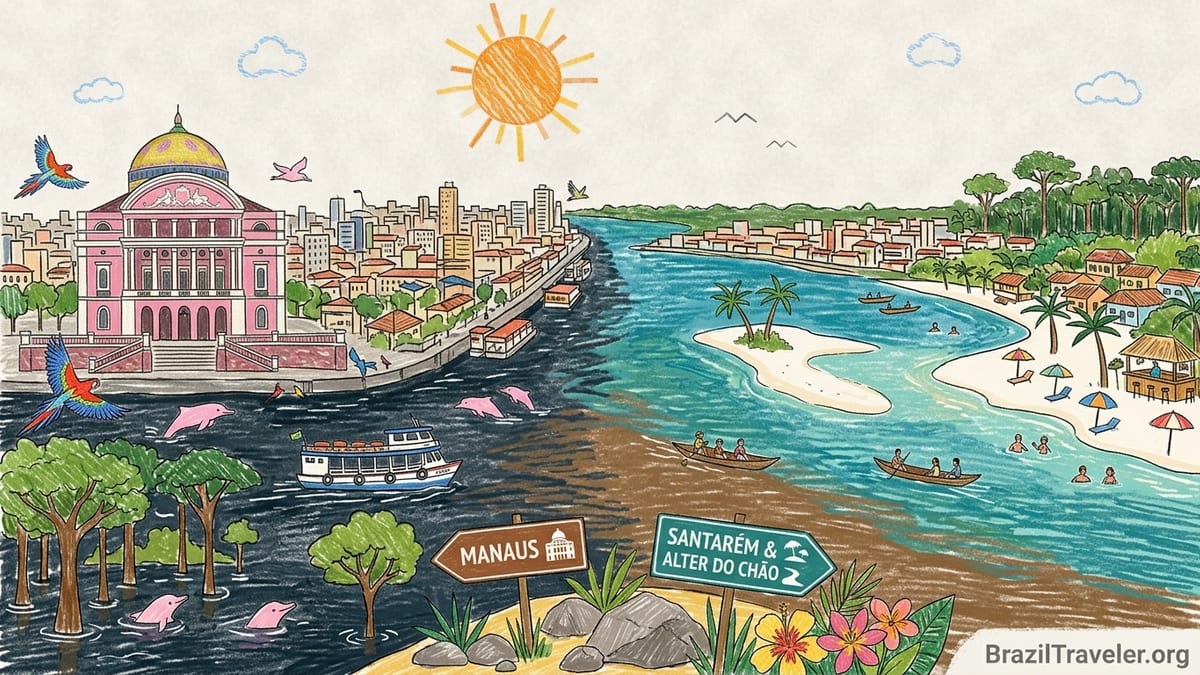
Two Gateways, Two Very Different Amazons
Manaus, capital of Amazonas state, is a sprawling river metropolis of around 2 million people perched on the dark waters of the Rio Negro, close to where it meets the Solimões to form the Amazon River. Santarém, in Pará state, is a mid-sized city of a few hundred thousand people at the confluence of the blue-green Tapajós with the main Amazon channel. On a map they both look like classic Amazon “base camps,” but the feel on the ground is strikingly different, and so are the landscapes you will explore from each.
In Manaus, I arrived at Eduardo Gomes International Airport and immediately felt the scale. The taxi ride into the Centro area took about 25 to 35 minutes in moderate traffic. Official taxi rates from the airport desk at the time of my visit were typically in the range of 70 to 100 reais to most central hotels, depending on time of day and traffic, with ride-hailing apps sometimes a little cheaper. The drive takes you along multilane avenues, past malls and concrete neighborhoods that remind you this is a major Brazilian city that just happens to be surrounded by rainforest.
Santarém’s Maestro Wilson Fonseca Airport felt far more compact. My taxi to a central hotel along the waterfront took about 15 minutes and cost around 40 to 60 reais, with app-based rides again on the lower end. The city comes across as more provincial and horizontal, with low-rise buildings, a calmer waterfront promenade and the wide Tapajós shimmering in front. Within an hour of landing, I already felt much closer to the river and the quieter side of the Amazon that most people picture.
Crucially, the distance between these gateways is huge on the ground. Regular passenger boats from Manaus to Santarém commonly take in the region of 36 to 40 hours or more sailing down the Amazon, and even direct flights usually take around 1 hour 30 minutes. Treating them as if you could day-trip between the two is a geographical mistake that still appears in some poorly researched travel pieces. You must commit to one or allocate enough days to justify linking them.
Staying in Manaus: Urban Heat, Iconic Opera and Big-River Excursions
I based myself in Manaus for several nights, near the historic center around Largo de São Sebastião, to explore both the city and the Rio Negro region. The humidity hits as soon as you step outside. Daytime temperatures often sit above 30 degrees Celsius with very high humidity, and downtown streets can feel hot, congested and noisy, especially at rush hour. Crossing wide avenues required the usual big-city awareness of traffic, and I kept valuables discreet in busier areas around the port and central market.
My first stop was the Teatro Amazonas, the opulent opera house from the rubber-boom era. Guided visits were available in Portuguese and, depending on the day, in English, with ticket prices in the vicinity of 20 to 30 reais for foreigners. Inside, the European-inspired frescoes, Italian marble and intricate wooden details make it one of the most atmospheric cultural sites in the entire Amazon basin. I planned my visit for late afternoon, which allowed me to step straight out into the square as temperatures dipped slightly and street musicians began to play.
From there I walked down to the Mercado Adolpho Lisboa, the city’s historic market, and the nearby port area. The market’s cast-iron structure and riverfront location are classic postcards of Manaus, but it is also a practical place to see fresh açaí, fish species from the Rio Negro and Amazon, and regional products that end up in local cuisine. I noticed an increased police presence compared with some older traveler reports, yet I still followed basic precautions: no visible jewelry, small amounts of cash, and extra care around the bus station and port after dark.
The next day was reserved for the famous Meeting of the Waters excursion, where the dark Rio Negro and the milky-brown Solimões run side by side without mixing for several kilometers. Shared boat tours sold in central agencies and at hotels commonly fell in the range of roughly 200 to 350 reais per person for a full-day outing, often including lunch and side trips to floating houses or tributary creeks. I opted for a mid-range group tour. The boat departed from the busy riverfront after a transfer by van, and within an hour we were cruising along the striking two-tone division in the water, with guides explaining the differences in temperature, speed and sediment that keep the colors distinct.
Manaus Rainforest Experiences: From Rio Negro to Novo Airão
While Manaus is a city first, its real value as a gateway is the variety of rainforest experiences within reach. Classic “jungle package” operators maintain lodges along the Rio Negro, offering 2 to 4 night stays with full board, canoe trips, nocturnal walks and piranha fishing. When I priced comparable mid-range options, lodge packages including transfers from Manaus, meals and daily activities often ran between 1,800 and 3,000 reais per person for three nights, depending on room type and season. Higher-end luxury lodges, some reached by seaplane or fast boat, could easily cost several times that.
I joined a two-night excursion on the Rio Negro combined with a day trip farther upstream toward the Novo Airão region. The transfer itself took several hours by speedboat and van, underlining that Manaus is not “in the jungle” but at its edge. Once on the river, though, the environment changed rapidly. In the high-water season, typically around April to June in the Rio Negro basin, we navigated through igapó flooded forest, paddling canoes silently between tree trunks whose lower branches were submerged. It created a dreamlike landscape that is specific to this time of year and very different from the dry-season beaches of the Tapajós near Santarém.
Wildlife sightings were present but not spectacular. Over three days I saw pink river dolphins surfacing near the boat, several species of herons and kingfishers, macaws flying overhead and the occasional howler monkey calling from high canopy. I did not see jaguars, giant otters or anacondas, reminders that even in rich ecosystems, large-fauna encounters are never guaranteed. Guides stressed ethical distances from wildlife and discouraged any feeding of dolphins or monkeys, noting that some operations closer to town still promoted questionable practices.
In terms of comfort, Manaus-area lodges tended to cater to a broad international market, with air-conditioned rooms, buffet meals and a fairly standardized schedule of activities. This makes the region appealing if you want a “classic” Amazon package: you fly into a major airport, transfer to a lodge, and everything else is bundled. It can, however, feel commercialized, especially on group departures during peak European and North American vacation periods when boats and dining rooms fill up quickly.
Discovering Santarém: Confluence City and Riverfront Life
After returning to Manaus and taking a separate flight to Santarém, I checked into a mid-range hotel near the waterfront. Compared with Manaus, the city center felt more compact and navigable on foot, though the midday sun still made short walks intense. The main riverside promenade opened onto views of the Tapajós merging with the Amazon in distinct blue-green and brown bands, an impressive sight available right from the city without needing a full-day tour.
I spent a morning exploring the central market and waterfront area. Stalls sold regional produce, Brazil-nut products and river fish, along with simple snack counters where a plate of fish with rice and salad might cost around 25 to 40 reais. Café-style lunches and dinner mains in modest restaurants clustered in the range of 35 to 70 reais, notably similar or slightly cheaper than what I had paid for equivalent meals in Manaus. A few more atmospheric spots along the water charged more for the view, but even then a substantial meal with a drink stayed well below typical big-city Brazilian prices.
From the city, it is possible to arrange short boat trips to viewpoints near the confluence or along the Tapajós. I joined a local operator for a few hours on the river, paying the equivalent of roughly 150 to 250 reais per person in a small group for a half-day that combined a visit to a riverside community with swimming stops on sandbars. The water clarity and color in the Tapajós were immediately striking compared with the darker Rio Negro. Even close to the city, the river had that clear, teal tone that has led people to describe the area as a freshwater Caribbean.
Like Manaus, Santarém is a functioning regional hub, so you must still take standard big-town safety precautions. I avoided walking alone late at night in quieter streets, kept electronics out of sight when not in use and used licensed taxis or ride-hailing apps to return to my hotel after dark. During the day, however, the atmosphere along the waterfront felt relaxed, with families strolling and vendors selling açaí and snacks.
Alter do Chão and the Tapajós: Freshwater Beaches and Community Tourism
The real highlight of my Santarém stay was not the city itself but the village of Alter do Chão, about 35 kilometers away. By road, it took around 40 minutes in a taxi from Santarém, with fares often quoted in the range of 100 to 150 reais each way, though shared rides or pre-booked transfers can lower the per-person cost for couples or groups. There are also local buses that take longer but cost only a fraction of that. I chose to overnight in Alter do Chão for several nights to experience the rhythms of the place instead of visiting as a simple day trip.
Alter’s reputation as an “Amazonian Caribbean” comes from its white-sand river beaches that appear when water levels drop. According to local tourism information, the falling-water season around August to November typically exposes the broadest beaches, including the postcard-famous Ilha do Amor sandbar in front of the village. In these months, wooden canoe operators, known locally as catraieiros, ferry visitors across the green lagoon to the main beach area, creating a scene of umbrellas, simple bars and warm, clear water that feels more like a tropical island than a muddy riverbank.
My visit coincided with a transition period when the water was receding but still high enough to flood varzea areas behind the beaches. Even then, several sandy stretches were usable, and I joined a small canoe excursion into the Lago Verde and surrounding inlets. Prices for these short canoe crossings and mini-tours can be quite modest, often tens rather than hundreds of reais, especially when negotiated in Portuguese and shared with other visitors. I budgeted extra to support community-led initiatives that have emerged in the Tapajós National Forest and Tapajós-Arapiuns Extractive Reserve, reachable by longer day trips or overnights from Alter.
One full-day excursion took me up the Tapajós to visit a riverside community that runs its own small-scale tourism projects, including guided forest walks and meals cooked in family homes. The cost, including transport from Alter, guiding, lunch and contributions to the community association, was roughly in the 350 to 500 reais range. Facilities were simpler than in lodge-based packages around Manaus, with wooden houses, hammocks and limited air conditioning, but the sense of direct contact with local residents and their forest-based livelihoods was much stronger.
Tours, Lodges and Costs: Manaus vs Santarém in Practice
To compare the two gateways fairly, I looked at equivalent mid-range options: private room accommodation with air conditioning, two significant excursions, local transfers and meals over a five-night period. In Manaus, I stayed in a mid-level hotel near the historic center, where nightly rates hovered around 250 to 400 reais for a double room including breakfast. My airport transfer by taxi cost close to 90 reais, and two full-day excursions, each with hotel pickup and lunch, added another 450 to 700 reais. Daily meals in sit-down restaurants rarely cost less than 50 reais for a main plus drink, and often more when I chose better-rated places.
In Santarém, and especially in Alter do Chão, I found comfortable pousadas with double rooms in the approximate 200 to 350 reais nightly range, breakfast included. Airport transfer into Santarém was typically around 50 reais, and my taxi out to Alter do Chão added perhaps 120 reais more. Two substantial excursions from Alter, one by motorboat exploring beaches and one visiting a community deeper along the Tapajós, came to an estimated 600 to 900 reais in total, depending on group size and whether lunch was included. Meals in Alter’s restaurants, including places specializing in Pará cuisine, tended to run 40 to 80 reais for a main course with a drink.
Putting these pieces together, my five-night Manaus budget, covering hotel, airport transfers, city taxis, two major tours and moderate restaurant spending, easily reached in the region of 4,000 to 5,500 reais for two people. The Santarém and Alter do Chão version, with similar length of stay and two big outings, landed more around 3,500 to 5,000 reais for two, partly because the town is smaller and some activities are shorter or more flexible. Both numbers can rise significantly if you opt for high-end rainforest lodges; Manaus has more of these, and top-tier properties can push a five-night budget for two far beyond 10,000 reais once you factor in flights.
Private boat hire was a notable cost in both destinations. In Manaus, arranging a private speedboat for a personalized Meeting of the Waters itinerary or extra stops around the Rio Negro often meant paying several hundred reais per day at a minimum, with capacity for multiple passengers. In Santarém and Alter, hiring a small motorboat for a custom itinerary along the Tapajós or Arapiuns also ran into the hundreds of reais per day, but splitting with others made it more manageable. The key lesson was to clarify routes, fuel costs and total time in advance to avoid surprises.
Seasonality, Wildlife and Comfort: Matching Expectations
Understanding water levels is essential for choosing between these gateways. Around Manaus and the Rio Negro, the high-water period, often April to June, allows canoes to penetrate flooded forest and creates mirror-like reflections among the trees. Trails on dry land may be shorter, but navigation options multiply. During the lower-water months around September to November, more riverbanks and islands emerge, and some operators adjust itineraries toward beach stops and fishing. I found the high-water Amazon landscape visually unique, but it did reduce the number of classic “jungle hike” routes that were fully dry.
In Santarém’s region, the calendar matters in a different way. The city’s official tourist materials describe “Amazonian winter,” roughly January to July, as the flood season when igapó forests and lakes swell. For Alter do Chão, though, the most photogenic beaches usually appear from about August through November when river levels drop, exposing the white sandbars and linking small islands. My experience backed this up: even a few weeks of water-level difference changed whether some beaches were broad and walkable or only thin strips at the forest edge.
Wildlife is a common question for travelers choosing between Manaus and Santarém. On my Manaus-based lodge trip, I saw a broader mix of larger mammals and birdlife, especially during quiet early-morning canoe outings. In the Tapajós region, my sightings leaned toward birdwatching, river dolphins and smaller forest fauna, although friends who stayed longer in community lodgings along the Tapajós-Arapiuns reported good chances of monkeys, sloths and nocturnal creatures. What neither place could promise, however, were cinematic scenes of predators or dense troops of animals at every turn. Any itinerary sold as a guaranteed wildlife spectacle deserves skepticism.
Urban comfort also differs. Manaus felt more chaotic, with heavier traffic, more intense heat absorbed by concrete and a bigger gap between central tourist squares and rougher peripheral areas. Santarém and Alter felt calmer, but they are still working Amazonian towns and villages, with basic infrastructure, patchy sidewalks and occasional power cuts. In both, I drank only filtered or bottled water and carried light, breathable clothing, strong insect repellent and high-SPF sunscreen. Security-wise, recording video openly in crowded markets or on the port piers never felt wise, and I stored passports and most cash in hotel safes, keeping only what I needed for the day.
Combining Manaus and Santarém on One Trip
Because so many maps flatten the Amazon, it is tempting to assume that Manaus and Santarém can be slotted into the same week as if they were neighboring towns. In reality, doing both properly demands extra travel and at least 10 to 14 days if you hope to enjoy more than a sequence of transfers. The overwater route by scheduled riverboat from Manaus to Santarém, sleeping in hammocks or simple cabins on deck, is a memorable journey, but it typically eats up nearly two full days each way, depending on the vessel and river conditions.
A more realistic combination for most travelers is to fly between the two cities. At the time of research, there were direct flights linking Manaus and Santarém in roughly 1 hour 30 minutes, though schedules and days of operation can shift. A longer Amazon itinerary could begin with three or four nights in Manaus, including time in the city and a Rio Negro lodge, followed by a flight to Santarém, a night in town, and three to five nights in Alter do Chão and perhaps a Tapajós community. This approach spreads the risk: if one region is facing unusual drought, smoke or flooding, the other may still be comfortable.
Cost-wise, adding the second city primarily impacts your domestic flight budget and extra transfers. Internal airfares in Brazil fluctuate widely based on season and promotions, but even conservative estimates suggest that a multi-city ticket linking, for example, São Paulo, Manaus, Santarém and back to a major hub can easily add several hundred US dollars or equivalent in reais to the total. When deciding whether to combine, ask yourself if you value variety in landscapes and experiences enough to trade off two or three days that could otherwise be spent deepening your time in just one region.
For travelers with three weeks or more to explore northern Brazil, I found a Manaus to Santarém combination deeply rewarding. The contrast between dark Rio Negro flooded forest and turquoise Tapajós beaches is dramatic, and spending nights in both a structured lodge and a community-run guesthouse gave me a broader understanding of how different regions are handling tourism and conservation. With only one week or less, though, I would firmly recommend choosing one base and doing it justice rather than skimming across both.
Which Gateway for Your Style of Amazon Trip
After staying several nights in both Manaus and Santarém and experiencing their surrounding regions, I came away with a clear sense of which traveler each gateway suits. For a first rainforest experience where you want the classic “Amazon package” with a lodge, scheduled activities and relatively smooth logistics, Manaus has the edge. Its airport has more frequent connections from Brazilian hubs, and its tour industry offers a dense menu of 2 to 5 day jungle programs, from budget hammock trips to high-end bungalows in remote reserves.
For a luxury nature holiday, especially if you prefer strong infrastructure at your lodge, comfortable transport and staff used to international service standards, Manaus again stands out. The Rio Negro corridor near and beyond Novo Airão hosts several lodges marketed to upscale visitors, with air-conditioned suites, elaborate tasting menus that reinterpret Amazon ingredients and curated photography or birding excursions. These packages come at a price, but they deliver a turn-key experience that is harder to find, so far, in the Santarém and Tapajós region.
By contrast, if your Amazon dream centers on swimming in clear water, walking long arcs of freshwater beach and spending time in riverine communities, I would steer you toward Santarém and especially Alter do Chão. Community-led experiences in and around the Tapajós National Forest and Tapajós-Arapiuns Extractive Reserve give visitors structured ways to stay in local villages, join forest walks, help with traditional food preparation or explore mangroves and igarapés alongside resident guides. These itineraries feel less packaged than many tours sold in Manaus, though they can require more flexibility and Portuguese language or a bilingual intermediary.
For photographers, both destinations deliver, but in different ways. Manaus and the Rio Negro excel in moody, reflective high-water scenes: trees mirrored in blackwater, early-morning mist, dramatic dark skies over the river. Santarém and Alter, in the lower-water months, shine with bright sandbars, transparent shallows and color contrasts between blue-green Tapajós and brown Amazon. If you are focused on human stories of community adaptation, the Tapajós region currently offers particularly compelling case studies of sustainable tourism, agroforestry and river-based livelihoods that welcome visitors into the narrative.
Families weighing an Amazon trip should think carefully about travel time and heat. Manaus has the benefit of more direct flights and very structured lodge programs, which can reduce the stress of logistics with children. On the other hand, Alter do Chão’s shallow, calm beaches, informal eateries and short boat rides are very attractive for families who want free play time in the water rather than long hours on fast boats. In both cases, early starts and long midday breaks were the key strategies I observed for keeping kids comfortable in the equatorial climate.
The Takeaway
If I had to return to just one gateway for a first rainforest experience, I would choose Manaus. The combination of the Teatro Amazonas, bustling markets, Meeting of the Waters excursion and accessible Rio Negro lodges creates a comprehensive introduction to the scale and complexity of the Amazon basin, even if some elements feel busy or commercial. The city can be overwhelming, but the pay-off in terms of varied tours and relative ease of booking from abroad is substantial.
For a pure luxury nature holiday, Manaus also wins. Its portfolio of high-end lodges, some with private guides, sophisticated cuisine and seaplane or fast-boat transfers, remains broader and more established than anything I found around Santarém. If your priority is comfort packaged with Amazon scenery, and your budget is flexible, Manaus delivers more options in one place.
For freshwater beaches and relaxed days of swimming, I would, without hesitation, return to Santarém and Alter do Chão. The Tapajós in falling-water season offers some of the most beautiful river beaches I have seen anywhere, and the overall vibe is laid-back rather than staged. For community tourism, especially if you are interested in staying in riverside villages, supporting small-scale enterprises and seeing first-hand how local organizations are using tourism to strengthen conservation, the Tapajós and Arapiuns corridors near Santarém impressed me more than the larger, more centralized operations typical of Manaus.
Finally, for photography and a family vacation, the answer depends on the season and your tolerance for transit. I would pick Manaus and the Rio Negro in high-water months for dramatic flooded-forest images, and Santarém with Alter do Chão in low-water months for bright beach landscapes and child-friendly swimming. What my comparative trip made clear is that neither city is a simple add-on to the other. Each shapes your Amazon story in a distinct way, and choosing the one that best aligns with your expectations will matter far more than most glossy brochures suggest.
FAQ
Q1. Are Manaus and Santarém close enough for a day trip between them?
Manaus and Santarém are separated by many hundreds of kilometers along the Amazon River. Riverboats often take around 36 to 40 hours between the two, and even flights run about 1 hour 30 minutes. They are not suitable for a day trip in either direction.
Q2. Which gateway is better for a first-time Amazon visitor?
For a first-time visitor who wants a classic, structured Amazon experience with a wide choice of lodge packages and organized tours, Manaus is usually the better starting point. Its tour infrastructure is more developed and easier to navigate in English.
Q3. When is the best time to visit Alter do Chão for beaches?
The most reliable months for broad white-sand beaches at Alter do Chão tend to be during the falling-water period, often from August to November, when the Tapajós River level is lower and sandbars emerge.
Q4. Is Manaus or Santarém cheaper for mid-range travelers?
In my comparison, night-by-night costs for mid-range hotels and meals were similar, with Santarém and Alter do Chão sometimes slightly cheaper. Overall budgets depend more on the type of tours you choose, since lodge packages and private boats can dominate spending in both regions.
Q5. Where will I see more wildlife, Manaus or Santarém?
Both regions offer good chances for birds, river dolphins and some mammals, but neither guarantees dramatic wildlife sightings. Manaus-area lodges may offer a somewhat broader range of habitats on typical packages, while Tapajós trips near Santarém emphasize a mix of river, forest and community life rather than pure wildlife watching.
Q6. Which destination is better for community-based tourism?
Santarém and the surrounding Tapajós and Tapajós-Arapiuns areas currently have a particularly strong network of community-based tourism projects, where local residents manage lodging, guiding and food. Manaus also has community initiatives, but the overall offer feels more dominated by conventional tour operators and larger lodges.
Q7. How long should I stay in each place?
For Manaus, I recommend at least three to four nights, including time for the city, a Meeting of the Waters tour and at least one overnight in the forest if possible. For Santarém and Alter do Chão combined, plan on four to six nights to enjoy the beaches, river excursions and, if you wish, a night or two in a community or forest setting.
Q8. Is it safe to travel independently in Manaus and Santarém?
Both cities require standard urban precautions. During my visit, walking in central and waterfront areas by day felt generally fine, but I used taxis or ride-hailing apps at night, avoided displaying valuables and relied on hotels and local guides for current safety advice.
Q9. Do I need to book tours in advance?
In high season and around national holidays, it is wise to book key tours and lodges in advance for both Manaus and Santarém, especially if you have fixed dates or want specific community experiences. In shoulder seasons, some travelers successfully arrange many activities on arrival, particularly around Alter do Chão.
Q10. If I can visit only one gateway, which should I choose?
If your priority is a classic rainforest lodge experience with maximum tour choice and easier logistics, choose Manaus. If you dream of freshwater beaches, community-led trips and a more relaxed village atmosphere, choose Santarém with Alter do Chão. Both can offer memorable introductions to the Amazon, but they deliver very different styles of holiday.