


The Brazilian Amazon forces a big, usually expensive decision on travelers: commit to a multi-day river cruise, or base yourself at a jungle lodge deep in the forest. To find out which experience actually justified the cost, I booked both in the same season, sailing a classic midrange expedition cruise out of Manaus and then spending several nights at a respected rainforest lodge in the Anavilhanas region. What follows is a side-by-side, operator-specific comparison of what I paid, what was included, how much wildlife I really saw and, crucially, which one I would book again with my own money.
The Exact Trips I Booked, What They Cost, and What Was Included
For my cruise, I chose the Amazon Clipper Premium, a well-known midrange expedition boat that departs from Manaus and operates 3-day and 4-day itineraries on the Rio Negro and Amazon. For the lodge stay, I booked Anavilhanas Jungle Lodge, a high-comfort property on the Rio Negro near the Anavilhanas Archipelago, one of the easiest regions to access from Manaus for a classic Brazilian Amazon lodge experience. I traveled in late May, in the high-water season, and spaced the two experiences only a few days apart so that weather, river levels and wildlife conditions were directly comparable.
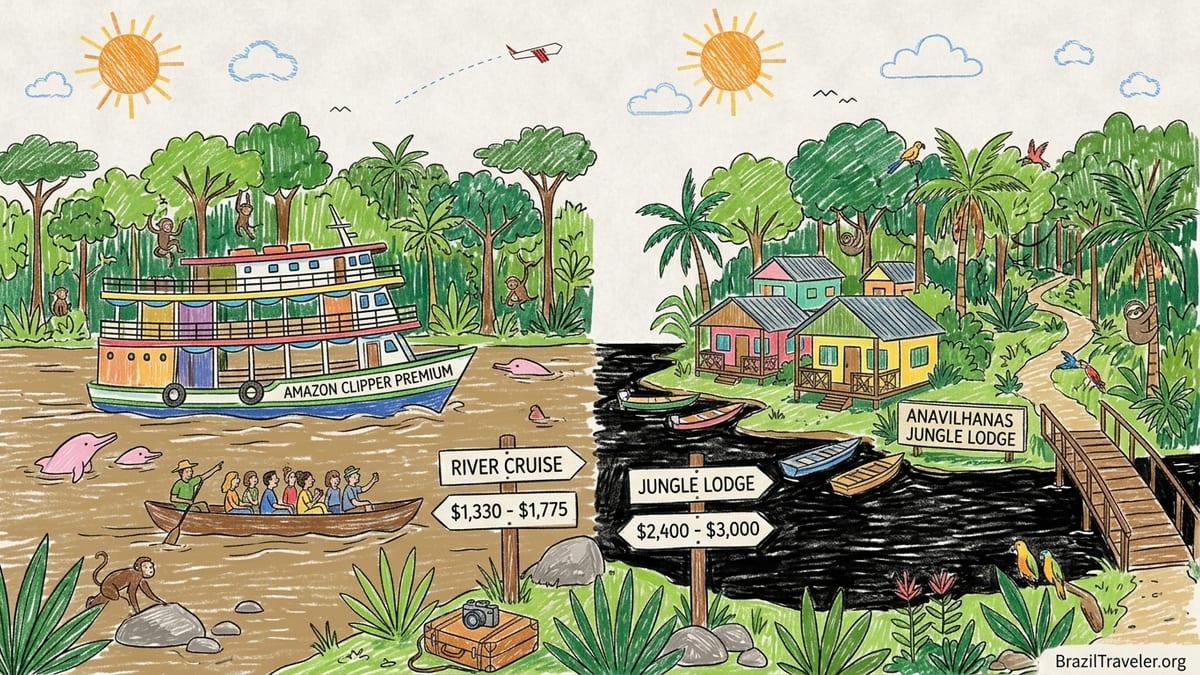
On the cruise side, 2024–2025 published rates for the Amazon Clipper Premium show the 4 days / 3 nights "Amazon & Negro" route priced at about 1,775 US dollars per person in a double cabin, and the 3 days / 2 nights "Amazon River" route at about 1,330 US dollars per person. These are cruise-only prices, based on double occupancy, and include all meals, filtered drinking water, guided canoe excursions, forest walks and visits to riverside communities. They do not include flights, hotel nights in Manaus, bar drinks, or tips. When I booked a 3-night itinerary for two adults, my bill before extras was just under 3,600 US dollars.
At Anavilhanas Jungle Lodge, 2025 rate sheets list packages by length of stay. A common sweet spot is the 4 days / 3 nights program, which includes accommodation, all meals, small-group excursions and round-trip ground and boat transfers from Manaus. Exact numbers fluctuate with room category and season, but in recent price tables a 3-night package for two adults in a standard bungalow typically comes out in the range of roughly 2,400 to 3,000 US dollars in total, with higher categories such as panoramic bungalows or villas costing more. I paid in the middle of that band for two adults in a mid-tier room on a 3-night package.
Crucially, both products were almost fully inclusive once I arrived. On the cruise, the only real extras were drinks from the bar and tips for the crew and guides. At the lodge, the package covered transfers, full board and activities, and I only paid on top for bar drinks and one optional private canoe outing. That made the comparison fairly clean: similar durations, fully guided activities in small groups, similar seasons, but two very different ways of inhabiting the Amazon.
Cabins vs Bungalows: Where I Actually Slept Better
The Amazon Clipper Premium is a classic riverboat refitted for expedition cruising. Cabins are small by land-hotel standards, but functional. Mine measured roughly 11 to 12 square meters, with a narrow corridor of floor space around two single beds that could be joined as a double. Each had a private bathroom with shower, a window, strong air conditioning and 24-hour electricity. Storage was just enough for two soft duffel bags. Noise at night was a mix of air-conditioning hum, river sounds and some mechanical vibration whenever the engines ran.
At Anavilhanas Jungle Lodge, even the entry-level bungalow felt like a proper hotel room rather than a cabin. The unit was significantly larger than my cruise cabin, with space for a full double bed, a small desk, a separate sitting area, plus a bathroom that did not require any sideways shuffling to move around. There was air conditioning, hot water, a minibar and decent Wi‑Fi near the main building. Power ran 24 hours a day, and sound insulation was enough that most forest noise came in muted, apart from louder rains and the occasional frog chorus.
In practical sleep terms, I rested better at the lodge. On the boat, once engines started to reposition in the early hours, there was a low vibration and throbbing that light sleepers will notice. Earplugs helped, but I never fully forgot that I was in a floating machine. At Anavilhanas, the room was still, the mattress thicker, and the climate control more efficient. Even during sudden tropical downpours, the sense was of being cocooned in a rainforest hotel, not fighting with thin cabin walls.
This does not mean the cruise cabins were uncomfortable. For a river vessel in the Brazilian Amazon, the Amazon Clipper Premium falls squarely into the midrange expedition category, with private bathrooms and air conditioning in every cabin. Basic regional riverboats that ply the river between Manaus and Belém often offer only hammock decks, shared bathrooms and no real climate control, at prices far below dedicated expedition cruises. At the other extreme, premium small-ship products such as the Grand Amazon Expedition by Iberostar operate more like five-star floating hotels, with cabins around 23 square meters, private balconies, strong air conditioning, and all-inclusive dining.
On the River: Constantly Changing Views Versus Deep Forest Immersion
Living aboard the Amazon Clipper Premium meant the landscape was always moving. Mornings began with mist over black water on the Rio Negro, riverbank palms emerging as the light brightened, and small fishing canoes gliding past. Afternoon navigation took us through segments of the main Amazon River, where the classic coffee-colored current and wider horizon replaced the dark stillness of the Negro. The sensation was of being stitched into the river system, watching villages, flooded forest and sandbars slide past without lifting a bag.
Daily life on board was simple but satisfying. Breakfast, lunch and dinner were buffet-style in the dining room, with regional Amazonian dishes such as grilled tambaqui and pirarucu, along with salads, fruits and a few international standards like pasta. Between excursions, most people retreated to the shaded upper deck with a book, binoculars or a cold beer from the bar. When we were not sleeping or eating, we were usually in the motorized canoe, gliding silently along igarapés and flooded forest cuts while the guide pointed out pink river dolphins, three-toed sloths, squirrel monkeys and a surprising number of birds.
The lodge offered a different rhythm. At Anavilhanas, my view from the room was effectively the same every day: river and forest across the narrow channel, sometimes veiled in mist, sometimes bright with sun. The sense of immersion came from walking the same paths repeatedly, learning where a particular troop of capuchin monkeys usually fed and recognizing the curve of roots on a trail we had walked the day before. Excursions left morning and afternoon in small boats or on foot, then returned to the main property, where I could swim in the pool, have a caipirinha at the bar or simply sit on my veranda and listen to macaws overhead.
In terms of scenery, the cruise clearly delivered more variety. In one three-night itinerary, I saw the "meeting of the waters" outside Manaus where the dark Rio Negro meets the brown Solimões, navigated open river reaches, entered narrow flooded channels and visited both tiny communities and empty stretches of forest. The lodge, by definition, stayed in one area, with repeated forays into similar environments. However, that focus allowed the guides to know their immediate environment in minute detail: which trails were active with howler monkeys during that week, which oxbow lakes had more caiman, and which fruiting trees were likely to bring toucans into easy viewing range.
Guides, Wildlife Encounters and True Time in Nature
Wildlife was the main reason I came, so I tracked how many hours per day I actually spent out in the field rather than on a boat or in a room. On the Amazon Clipper Premium, the schedule included two to three excursions per day: an early morning birding or dolphin-spotting run by canoe, a late-morning forest walk or village visit, and a late-afternoon or night outing focused on nocturnal species like caimans and nightjars. Each excursion lasted roughly two to three hours, which meant I was actively out in nature for about six or seven hours on a typical day, with the rest spent navigating, eating or resting.
At the lodge, the pattern was similar in terms of hours, though slightly more flexible. Anavilhanas organized a morning and an afternoon excursion for each full day, plus an occasional evening outing. Over three full days, I spent roughly six to eight hours per day on canoe trips, forest walks or piranha fishing sessions. Because there was no need to reposition a vessel, start times were less constrained by navigation schedules, and we could return quickly to the lodge for a break if rain turned heavy or if the group tired.
Guide quality was strong in both settings, but with different strengths. On the cruise, there was a small team of naturalist guides, each fluent in Portuguese and English, usually rotating between groups. Guide-to-guest ratio hovered around one guide to eight or ten passengers during canoe excursions. They were well trained in the broad natural history of the Amazon basin and adept at spotting wildlife quickly from a moving boat. The onboard lecture one evening on river hydrology and floodplain ecology was one of the better interpretive talks I have heard in the region.
At the lodge, groups were generally smaller. My excursions were usually led by one bilingual naturalist with six or seven guests. Because the guides live and work in the same patch of forest for long stretches, their stories often felt more rooted in that specific landscape and in the lives of nearby riverine communities. One afternoon, for example, our guide pointed out a line of cut palm nuts on the forest floor, then walked us 10 minutes deeper along a barely visible track to a harpy eagle nest he had been monitoring for months. The encounter was closer and more intimate than any raptor sighting I had on the cruise.
Comfort, Motion and the Hidden Costs of Each Style
Comfort is where the two experiences diverged most clearly. On the Amazon Clipper Premium, cabins came with private bathrooms and air conditioning, but space was tight, sound insulation thin, and public areas shared at all times. Privacy is limited on any small expedition vessel. If you are traveling as a couple, you will hear at least some corridor traffic, and sun deck lounging is inherently social. The boat moved slowly and the Rio Negro is generally calm, but there is always some motion. If you are prone to seasickness, even mild river movement combined with engine vibration may leave you queasy until the first dose of motion-sickness medication kicks in.
Premium small ships such as the Grand Amazon Expedition are tailored to travelers who want more hotel-like comfort on the river. The ship carries about 70 cabins, all with private balconies of roughly 23 square meters of cabin space, individual climate control and full bathrooms. It operates all-inclusive itineraries of 4 days / 3 nights or 5 days / 4 nights on the Rio Negro and Solimões, with all meals, drinks and excursions bundled into the fare. That pushes the per-person rate significantly above midrange products like the Amazon Clipper, but you gain more spacious cabins, multiple lounge areas and a larger suite of onboard facilities.
The lodge, in contrast, felt more like a boutique resort in the jungle. At Anavilhanas, the pool overlooking the river, landscaped paths between bungalows, well-designed main lodge building and air-conditioned rooms all contributed to a sense of traditional hospitality. There was no vibration or movement underfoot, no engine hum, and fewer constraints on when I could shower or unpack. Upgrades to larger rooms or panoramic bungalows add to costs, and the leap from a standard bungalow to a more luxurious category can be several hundred US dollars per stay, but the environmental comfort is not subtle.
Hidden costs appear with both products. For cruises, you will often need at least one pre-cruise hotel night in Manaus and sometimes one post-cruise night, which can add 150 to 300 US dollars per night for a comfortable central hotel for two adults. Onboard bar bills and gratuities can add another 10 to 20 percent to the base fare, especially on more premium ships where drink prices are higher. For lodges, long arrival transfers are usually included in package prices, but the travel time can absorb most of a day, and private transfers cost extra if you want to control your schedule. Room upgrades at lodge properties also add significantly to the total bill, especially at design-focused properties with very limited top-end inventory.
Repetition, Schedules and How Much Flexibility You Really Have
One criticism often leveled at jungle lodges is that excursions can feel repetitive after a couple of days: another canoe trip, another forest walk, another sunset on the river. I did feel some of this at Anavilhanas by day three. We visited slightly different channels and trails, but the template of "morning boat ride, afternoon forest activity" repeated, and I started to recognize individual trees and bends in the river. For some travelers, especially those who love slow travel and deep familiarity, this is a feature. For others, particularly families with limited patience for similar outings, this can feel like diminishing returns.
The cruise, however, had its own constraints. The daily schedule was more rigid, because sailing segments had to be completed by certain times to make tidal windows or daylight-dependent navigation. Meal times were fixed. Excursions left when the program dictated, not when wildlife conditions looked best from your cabin window. There was also less scope to opt out of an outing and do something else independently. On most segments of the Rio Negro and Amazon visited by expedition cruises, there simply is nowhere to walk to on your own. You are on a boat surrounded by water and forest, and the only way to move is with the group.
At the lodge, I had more ways to design my downtime. I skipped one afternoon excursion to sit by the pool and watch storm cells roll across the Rio Negro, and another guest opted for a paid private canoe excursion with a guide to focus on bird photography at his own pace. Walking independently is still limited because of safety and trail design, but within the property boundaries there was more room to roam than on a small ship. If you like space and unstructured hours between guided activities, a lodge will usually serve you better than a boat.
Transfers and arrival logistics also felt different. Boarding the Amazon Clipper in Manaus was simple: a taxi to the port, a brief check-in and safety briefing, and we were underway within an hour. For Anavilhanas, the lodge arranged a combination of road and boat transfers that took around three hours each way. It was comfortable, in an air-conditioned vehicle and covered speedboat, but it ate up a morning on arrival and most of an afternoon on departure. Over a three-night stay, that meant almost a full day was effectively spent in transit to and from the lodge.
Total Cost for Two Adults Over Three and Five Days
Because the question for many travelers is not simply "which is better" but "which is better value," it is helpful to look at approximate, operator-specific totals for two adults over three and five days, based on current published or widely quoted rates. For simplicity, I will focus on midrange options comparable to what I experienced: the Amazon Clipper Premium on the cruise side and Anavilhanas Jungle Lodge on the lodge side, and I will exclude flights to Manaus.
For a three-night Amazon Clipper Premium cruise on the 4 days / 3 nights itinerary, current rates of around 1,775 US dollars per person in a double would yield about 3,550 US dollars for two adults, cruise-only. Add one pre-cruise night and one post-cruise night in a good Manaus hotel at, say, 180 US dollars per night, plus a modest bar bill and crew gratuities, and a realistic three-night cruise total for two adults sits near 4,000 to 4,300 US dollars.
For a three-night Anavilhanas Jungle Lodge package, recent rate tables suggest a range in the neighborhood of 2,400 to 3,000 US dollars total for two adults in a standard or midrange room, including transfers, meals and excursions. Add one pre-lodge night in Manaus and modest bar spending, and you are likely to land between 2,800 and 3,500 US dollars for a similar duration. In other words, for a three-night stay, the lodge often costs somewhat less overall than a comparable midrange expedition cruise, particularly once you factor in the extra hotel nights and bar bills associated with the cruise model.
Over five days, differences can widen. A five-day / four-night premium cruise such as the longer itineraries operated by larger ships like the Grand Amazon Expedition, which are all-inclusive of food and drinks, often fall well above 3,000 US dollars per person in a double cabin, so totals of 6,000 to 7,000 US dollars for two adults for four nights are not unusual, although specific current fares should always be confirmed at booking time. A five-day / four-night lodge package in the Brazilian Amazon at an upper midrange property often comes in noticeably lower than that, especially if you choose a standard room category and are not paying separately for bar drinks at premium ship prices. For budget-conscious travelers who still want a multi-day Amazon immersion, the numbers usually favor the lodge, unless you specifically want the all-inclusive, floating-hotel aspect of an expedition ship.
The operator-specific differences matter. The Amazon Clipper Premium uses smaller cabins, offers expedition-style buffets rather than gourmet tasting menus, and charges separately for drinks. The Grand Amazon Expedition offers larger cabins with balconies, more formal dining and an all-inclusive bar, at a higher buy-in. Lodges like Anavilhanas position themselves as high-comfort bases in the forest, with air-conditioned rooms, good food and small-group tours, but fewer moving parts than a functioning ship, and that often translates into slightly lower per-night package prices at similar comfort levels.
The Takeaway: Expectations, Sleep, Learning, Wildlife and Value
Going in, I expected the cruise to feel more adventurous and the lodge to feel more comfortable. That expectation largely held, but with nuances. The Amazon Clipper Premium cruise gave me a sense of journey that no static base can replicate, with changing river environments, long horizons and the thrill of waking up each day in a new segment of the Rio Negro or Amazon. The lodge, however, exceeded my expectations as a comfortable, deeply relaxing place to absorb the rainforest without giving up air conditioning, space or resort-style touches like a pool and well-designed common areas.
In pure sleep quality, the lodge won decisively. The stillness of a well-built bungalow in the forest, the larger bed and the absence of engine vibration made a real difference over multiple nights. The cruise cabins were perfectly fine, but space was tight, and even small noises carry through a thin bulkhead in the middle of the night. Light sleepers, older travelers and anyone sensitive to motion are likely to rest better at a jungle lodge.
In terms of learning and guiding, the contest felt closer. The cruise guides excelled at explaining the broader Amazon system, river dynamics and basin-wide ecology. Their evening talks, varied daily landscapes and chance to observe major confluences like the meeting of the waters made the cruise a powerful introduction to the region as a whole. The lodge guides, by contrast, shone in their intimacy with a specific patch of forest. I learned more about the behavior of a few key species, local plants and the seasonal rhythms of that slice of the Rio Negro at Anavilhanas than I did at any single point on the cruise.
For wildlife encounters, both trips delivered, but differently. The cruise provided more variety in a short time: dolphins in the main river, different bird communities on blackwater and whitewater segments, and several species of monkeys and reptiles. The lodge gave me more prolonged and sometimes closer encounters with specific animals, because guides knew exactly where to look within a relatively compact radius. If your goal is to tick a long list of Amazon species in a few days, a well-designed cruise itinerary may edge ahead. If you prefer to sit quietly near a harpy eagle nest or return to a favorite oxbow lake for a second look at giant river otters, a lodge can feel more rewarding.
What felt overpriced? Among the two, the cruise demanded more justification. Once I aggregated cruise fare, hotel nights in Manaus, bar bills and tips, the cost per day on the river for two adults clearly exceeded that of my lodge stay, even at a high-comfort property like Anavilhanas. I do not regret a cent, because the sense of movement and variety is something a lodge cannot mimic, but there were moments when I was acutely aware that part of what I was paying for was not extra wildlife or guiding, but the sheer expense of running a ship that sleeps and feeds a small group of travelers while navigating a remote river.
Would I book each again? Yes, but for different purposes. I would book another midrange Amazon expedition cruise when I wanted to share the experience with someone who values the romance of river travel and is comfortable with compact cabins, less privacy and a fixed group schedule. I would book the lodge again for a trip where rest and comfort mattered at least as much as variety, or when traveling with people who might struggle with steps, vibration or tight sleeping quarters. If I had to choose only one for a first experience in the Brazilian Amazon and pay out of my own pocket, I would lean slightly toward the jungle lodge. It delivered more comfort per dollar, nearly as much wildlife viewing, and a calmer daily rhythm that allowed the sounds and smells of the forest to really sink in.
For couples seeking a romantic but adventurous trip, a high-comfort lodge such as Anavilhanas or Juma Amazon Lodge usually strikes the best balance of privacy, comfort and immersion, with enough structured activities to keep days full but ample time on the veranda with a drink in hand. Families may appreciate the predictability and safety of a lodge, but older children and teenagers who love the idea of "living on a boat" can find an expedition cruise unforgettable, provided motion sickness is not an issue. Serious photographers and wildlife enthusiasts might choose a lodge as a base, then add a shorter, intensive cruise, or vice versa, but in either case should budget for private or small-group outings to control pace and light conditions. Older travelers and anyone with mobility limitations will often be happier at a lodge, where stairs are fewer and movement less constant. Travelers who care more about comfortable accommodation than expedition-style adventure should gravitate to the best jungle lodge they can afford, ideally one that combines air-conditioned rooms with ethical, small-group excursions and a strong track record of local employment.
FAQ
Q1. Is an Amazon river cruise in Brazil more expensive than a jungle lodge stay?
For midrange options around Manaus, a multi-day Amazon river cruise for two adults usually costs more overall than a comparable-length stay at a high-comfort jungle lodge, especially once you include pre and post-cruise hotel nights, bar bills and tips.
Q2. Which offers better wildlife viewing, a cruise or a lodge?
Both can be excellent. Cruises often deliver more varied habitats in a short time, while lodges can provide closer, more repeated encounters in a smaller area that guides know very well.
Q3. How many days do I need in the Brazilian Amazon?
Three nights is the practical minimum for either a cruise or a lodge, giving you two full days of excursions. Four to five nights allows you to settle into the rhythm of the forest and reduces the impact of any bad-weather days.
Q4. Will I get seasick on an Amazon river cruise?
The Rio Negro and upper Amazon near Manaus are relatively calm, but there is always some motion and engine vibration. If you are prone to motion sickness, bring medication and consider a lodge instead of, or in addition to, a cruise.
Q5. Are cabins on Amazon expedition cruises comfortable?
Midrange expedition boats usually offer compact cabins with private bathrooms and air conditioning, but limited storage and thin walls. Premium ships provide larger, hotel-style cabins with balconies, at significantly higher prices.
Q6. Do jungle lodges include all meals and excursions?
Most reputable lodges around Manaus sell packages that include full board, shared excursions and round-trip transfers from the city. Drinks, room upgrades and private outings usually cost extra.
Q7. Is it safe to bring children on an Amazon cruise or to a lodge?
Many lodges and some cruise operators welcome families and design activities suitable for older children, although certain ships have minimum age limits. Always check age policies, safety standards and typical group profiles before booking.
Q8. When is the best time of year to visit the Brazilian Amazon?
High-water season from roughly January to June allows boats and canoes to penetrate flooded forests, while low-water season from July to December can make certain wildlife easier to spot along exposed riverbanks. Both periods offer strong experiences.
Q9. How do I choose between a basic riverboat and an expedition cruise?
Basic public riverboats are primarily transport, often with hammocks and shared facilities. Expedition cruises charge more but include guided excursions, private cabins, structured wildlife viewing and a focus on interpretation rather than simply getting from A to B.
Q10. If I can afford only one, should I pick an Amazon cruise or a jungle lodge?
If you prioritize comfort, flexible downtime and quiet nights, a lodge is usually the better first choice. If the idea of waking up each day in a new stretch of river excites you and you are comfortable with motion and smaller cabins, an expedition cruise can be a memorable way to experience the Brazilian Amazon.