

I landed in Cuiabá at the tail end of the dry season with one clear goal in mind: to spend several days on the rivers of the Northern Pantanal searching for wild jaguars. On paper, it looked simple. Fly into the regional capital, take the Transpantaneira road to Porto Jofre, board a small boat and drift along the riverbanks where big cats patrol the edges. The reality was far more textured: heat that pressed down like a hand, long hours of scanning empty banks, the rattle of wooden bridges, and a mix of unforgettable wildlife moments alongside the quiet possibility of never seeing the animal I had come so far to find.
Reaching the Jaguar Highway: From Cuiabá to the Transpantaneira
My Pantanal journey began at Marechal Rondon International Airport in Cuiabá, the usual gateway for Northern Pantanal safaris. I had arranged a package with a specialist operator that bundled transfers, lodging, meals and daily boat safaris. This “all in one” approach is now common in the region, with several companies offering 4 to 8 day jaguar-focused itineraries that start and end in Cuiabá and move along the Transpantaneira toward Porto Jofre.
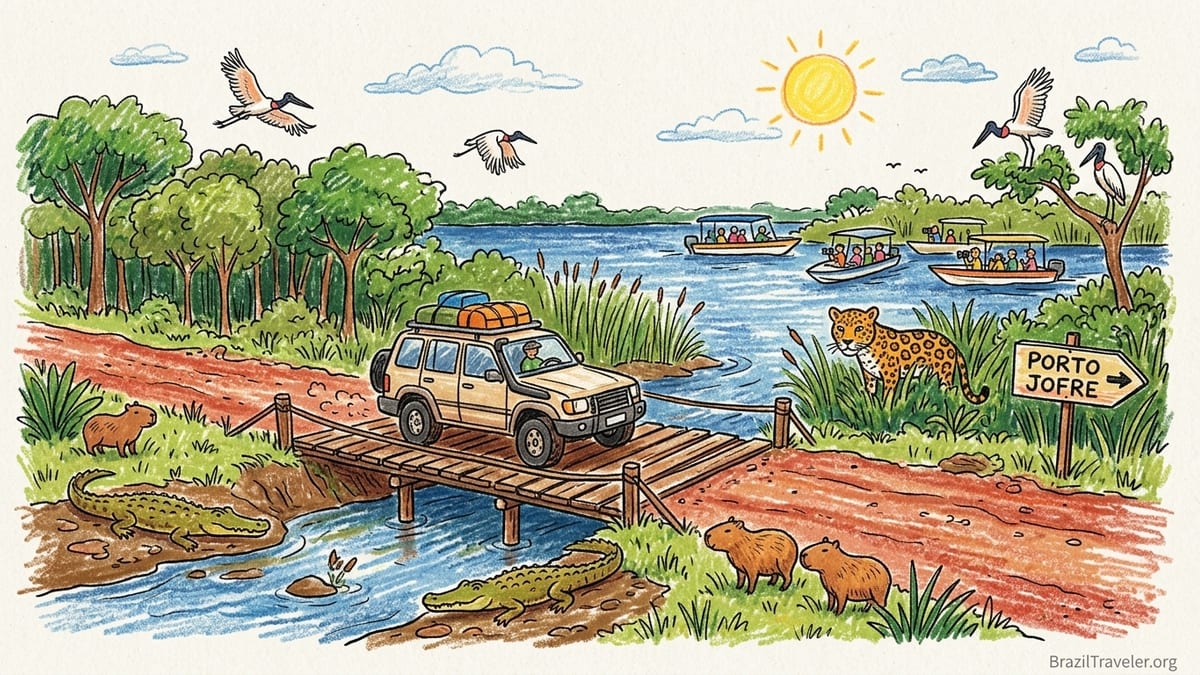
We left the city mid-morning in a high-clearance 4x4, the vehicle type increasingly recommended for the rougher sections of the Transpantaneira. It took about two hours on paved road to reach the small town of Poconé, considered the start of the Pantanal proper. From there, the asphalt ended and the fabled dirt road began. The Transpantaneira runs roughly 147 kilometers from Poconé to Porto Jofre and is punctuated by more than a hundred wooden bridges, some newly refurbished, others rattling and warped. Travel time is usually quoted at around four hours in the dry season, but with photo stops and slower sections it easily stretches to five.
Dust defined that first afternoon. With the windows cracked for ventilation and the air conditioning fighting a losing battle, a fine red powder drifted through every gap. My guide suggested a buff or light scarf to cover mouth and nose, and I was glad I had one. Even in late August, the roadside ponds still held water and were busy with caimans and capybaras, but many stretches were already dry, concentrating wildlife near the remaining pools. We paused often to watch jabiru storks, hawks and herons, but the focus was on reaching the river, where jaguar sightings are most frequent later in the season.
Some travelers now skip the long road transfer entirely and fly by small plane from Cuiabá to Porto Jofre or nearby river lodges, a premium option marketed in dedicated fly-in jaguar safaris. Prices for such trips in 2025 and 2026 often start around several thousand US dollars per person for a week, reflecting the cost of charter flights and private boats. I chose the road transfer partly for budget reasons, but also because I wanted to feel the gradual transition from ranch land to wetlands, to see the bridges and cattle and roadside caimans that define so many first impressions of the Pantanal.
Settling on the River: Lodge Life and Boat Logistics
By late afternoon we rolled into the Porto Jofre area, a cluster of lodges, houseboats and small docks spread along the banks of the Cuiabá River. I stayed at a riverside lodge that works with dedicated jaguar boats. Other visitors were based on floating hotels anchored upriver, closer to key confluences like the meeting of the Cuiabá and Três Irmãos rivers, where many operators focus their searches.
The rhythm here was built around the river. A typical jaguar package in the Northern Pantanal now includes full-board accommodation and two boat outings per day during the core season, usually from July through November, when receding waters draw wildlife to the exposed banks. Daily schedule details vary between operators, but the structure is similar: early breakfast, long morning boat, lunch and rest at the lodge, then an afternoon boat that returns around sunset. Most boats used for these safaris are aluminum or fiberglass speedboats powered by 90 to 115 horsepower outboard engines, with a roof for shade and swivel or padded bench seats arranged in two or three rows.
My boat had space for six guests, but on most days we were only four plus guide and pilot. This made a real difference in comfort and photography. In high season, some boats from larger operations do head out more fully loaded, which can mean more elbows on the gunwale and harder angles for cameras. Seating was simple but functional: padded benches with backrests, no armrests, and a central aisle for the guide to move through. A cooler at the front held drinking water and soft drinks, and there was space under the seats for daypacks and camera bags.
Noise is an unavoidable part of this kind of safari. The engines are powerful enough to run against the current and quickly reach distant side channels, but they are loud, especially for guests seated at the rear. Many experienced visitors now travel with earplugs or noise-reducing earbuds, something I wished I had packed. When we drifted with the engine off, the silence was immense, broken only by bird calls and the soft clatter of caiman sliding off sandbanks.
Dawn Departures and the Reality of Long River Searches
Each day began before sunrise. Breakfast was available from about 5:00 a.m., mirroring schedules I had seen advertised for photography-focused flotels and houseboats that cater to early risers. We left the dock between 5:30 and 6:00 a.m., the river still wrapped in mist. Morning light is prized not only for photos but also for comfort; once the sun climbs, temperatures on the open water become punishing.
The first hour on the water felt magical. Capybaras huddled on the banks, steam rising from their dark coats. Toco toucans crossed overhead in sharp silhouettes. We cruised steadily downriver, then veered into narrower side channels where the forest pressed in and the water slowed. Here the search intensified. On a typical jaguar boat in the Northern Pantanal, the guide and pilot scan constantly for subtle signs: a fresh paw print on a sandbar, a line of vultures circling in one patch of forest, a rustle in the reeds, or the distinctive rosetted flank of a cat lying low on the bank.
The reality is that these searches can be long and uneventful. Over my first full day on the river we spent close to nine hours on the boat: six in the morning, three in the afternoon. We moved steadily but not quickly, often cutting the engine to float in silence while the pilot glassed the banks with binoculars. When conditions allow, some operators now run “full-day” jaguar searches of up to ten or eleven hours, with lunch taken aboard under the shade of the awning. My lodge preferred the split schedule, which was welcome when the afternoon heat built.
Communication on the boat was a mix of English and Portuguese. My guide spoke good conversational English and offered running commentary on the landscape and wildlife. The pilot, a local from a nearby ranching family, spoke almost no English but had an extraordinary eye for movement on the bank. Between them they also monitored an informal radio network used by many operators. When one boat spots a jaguar, word spreads quickly along the river. This network helps visitors maximize their limited time, but it also concentrates boats around each sighting.
Heat, Insects and the Practicalities of Comfort
By late morning the sun had real weight. On parts of the Cuiabá and Três Irmãos rivers with little shade along the banks, the high aluminum sides of the boat reflected heat back onto our legs. Airflow is constant when cruising, but when we idled or drifted, the still air turned sharp and dense. I wore lightweight, long-sleeved shirts and quick-dry pants in light colors, plus a wide-brimmed hat with a chin strap to keep it from lifting in the wind. Even with the boat’s canopy, sunscreen and lip balm were essential. Several people on neighboring boats visibly burned on their first day, underestimating how much the reflected light off the water intensifies UV exposure.
Mosquitoes were less ferocious on the open water than I had feared, at least in the late dry season. At dawn and dusk near backwater areas, though, clouds of smaller biting insects rose from the reeds, and repellent became important. Around the lodge itself, especially near standing water at night, mosquitoes were more persistent. Most lodges in the region now offer air-conditioned rooms with screened windows and sometimes mosquito nets, but repellent, long sleeves and light socks still made evenings more comfortable. I also encountered occasional horseflies on the boat, their bites sharp and surprising.
Dust was the main inland irritation. On each transfer day along the Transpantaneira, a layer of fine powder coated everything in the back seats. I had packed my camera bodies and lenses inside padded bags with rain covers, which kept most of the dust at bay. Some fellow travelers who brought only basic daypacks found themselves constantly wiping grit off their gear. If I were returning, I would add inexpensive dry bags or zippered pillowcases to double-wrap electronics during road sections.
Hydration was another quiet challenge. Most lodges and operators now provide filtered drinking water and encourage guests to refill personal bottles rather than relying on disposable plastic. On long river days I drank three to four liters without feeling like I was overdoing it. A simple insulated bottle kept the water cool for several hours, and I quickly understood why many wildlife photographers in the region now travel with small electrolyte tablets as well.
Jaguar Encounters: What I Actually Saw on the River
Over three full days of river safaris, I had one clear jaguar encounter and several tantalizing almost-sightings. On my second morning, just after 9:00 a.m., we received a crackle over the radio that another boat had found a cat on a shaded bank along a side channel of the Três Irmãos. Our pilot opened the throttle and we covered the distance in roughly twenty minutes, zigzagging between caimans and floating logs.
As we rounded a bend, the first thing I saw was not the jaguar but a cluster of boats. There were already about seven vessels gathered: a mix of lodge boats, private photography charters and one larger craft from a group tour. Engines idled at low speed or were cut entirely as each pilot tried to hold a steady position in the slow current. The cat lay on a low sandbank under tangled roots less than thirty meters from the boats, its tawny coat dappled with rosettes and shadow. It was not the isolated wilderness moment many imagine, but it was undeniably wild.
The encounter lasted about forty-five minutes. For the first twenty, the jaguar slept with its head on its paws, occasionally flicking its ears at flies. Then it rose, stretched and walked parallel to the waterline for a few dozen meters before disappearing into thicker vegetation. Cameras fired every time it moved. Most of us were shooting with telephoto lenses in the 300 to 400 millimeter range, enough to frame tight portraits without needing to crowd the bank. Throughout the sighting, our guide reminded the pilot to keep a respectful distance and minimize engine use, a practice that more operators are emphasizing as boat numbers increase in core jaguar areas.
On the other days, jaguars remained ghosts. Once we arrived at a fresh set of tracks on a sandbar, but the cat itself had melted into the forest minutes before we reached the spot. Another afternoon, a distant shape slid off the bank ahead of a boat we could see in the mid-river distance, but whatever it was stayed out of sight. Our guide kept a running tally across the season; some guests during my week had three or four separate jaguar encounters, others none at all. Even in a place now promoted globally as one of the best jaguar viewing areas on Earth, there is no guarantee.
Other Wildlife and Whether the Cost Felt Worth It
If my only measure of success had been the number of jaguars, I might have left ambivalent. Instead, the Pantanal impressed itself on me through an accumulation of other encounters. On the second afternoon, we watched a family group of giant river otters for nearly an hour as they fished and bickered along a vegetated bank. They chewed noisily on fish, reared up in the water to look at us and occasionally barked in our direction. Another morning, a tapir swam across a broad channel ahead of the boat, its ears just visible like small periscopes above the ripples.
Birdlife was constant and extraordinary. Hyacinth macaws flapped between isolated gallery trees along the banks, sometimes landing low enough for us to see their yellow bare skin patches around the eyes. Jabiru storks paced methodically through shallows, their massive beaks probing for fish and amphibians. Kingfishers, from tiny green-and-rufous birds to larger ringed species, launched themselves repeatedly into the water. Each bend produced new shapes: a snail kite hovering over a marsh, a black-collared hawk dropping to snatch a fish from the surface, a tiger heron frozen mid-stride.
Costs in the Northern Pantanal have risen in recent years as the region has gained attention and as logistics remain complex. In 2026, multi-day jaguar packages from Cuiabá that include river-based accommodation, boat safaris, meals and transfers commonly start in the low to mid four figures in US dollars per person, especially during the peak July to October period. High-end photography charters and private houseboat stays can cost substantially more. For me, the combination of one strong jaguar sighting, world-class birding and the sheer feeling of being immersed in a vast wetland justified the expense. Others on my boat were more narrowly focused on big cats and debated whether fewer days might have been enough.
One advantage of basing in the Northern Pantanal is the possibility of combining river days with nights at inland lodges along the Transpantaneira. Some packages now split time between a ranch-style lodge near Poconé, where spotlight drives can reveal giant anteaters, crab-eating foxes and nightjars, and a riverside base at Porto Jofre for intensive jaguar searches. My own trip was river-focused, and if I returned I would deliberately add two or three nights at an inland lodge both to diversify the wildlife and to break up the long boat days.
Gear Choices, Photo Setups and What I Would Do Differently
On the photography side, the boat-based nature of jaguar safaris in the Northern Pantanal shapes gear decisions more than many people realize. I carried two camera bodies: one with a 100–400 millimeter zoom, the other with a 24–105 millimeter lens for landscapes and close passes from curious otters or birds. Many serious photographers now favor even longer lenses, but the distances on the river can be surprisingly short, and the flexibility of a zoom helped in tight channels.
Stabilization on the moving boat is its own art. Tripods are rarely practical on shared vessels with multiple guests, but a monopod or simple beanbag can help. I ended up resting my long lens on a rolled-up towel on the gunwale for much of the time, which absorbed vibrations without risking scratches. The boat’s roof provided shade, but it also limited how high I could angle the camera, something to remember if you hope to photograph birds in flight. A dry bag or rain cover draped over the camera when the engine was running cut down on dust and spray.
Binoculars proved just as important as camera gear. The guide used a higher-end pair to scan distant banks, while I carried a compact 8x32 model that was light enough to wear around my neck all day. On several occasions we picked out movement with binoculars that we might have missed with the naked eye, especially in tangled riverine vegetation. If I went again, I would bring a slightly larger 8x42 pair for brighter views in low light at dawn and dusk.
In retrospect, my biggest packing mistakes were comfort related. I underestimated how harsh the combination of sun and wind could be over multiple long days and wished for a lightweight buff to shield my neck and lower face. I would also add a small pair of foam earplugs for engine noise and a second wide-brimmed hat in case one blew into the river, something I saw happen to another guest on a neighboring boat. Finally, I would pack a simple folding cushion or inflatable seat pad to ease the long hours on hard benches.
Planning Around Season, Packages and Expectations
Official tourism material for 2026 emphasizes the Northern Pantanal, especially the Porto Jofre region, as a major jaguar-viewing destination, with the prime viewing period roughly from July through November as waters recede and prey animals concentrate along the rivers. Local operators and recent travelers tend to agree, though they sometimes refine the window, pointing to particularly high success rates in August and September when river levels are lower but the first big rains have not yet arrived. Outside this window, from December into the early dry season, swollen rivers and dispersed wildlife can make jaguars harder to find, though some guides argue that skilled tracking still yields sightings.
Package structures have adapted to this seasonality. Many Northern Pantanal jaguar trips are now sold as four to eight day programs that include a defined number of full-day or split-day river safaris. Some advertise a minimum of two or three full days on the river specifically devoted to jaguar searches, reflecting a broad consensus that one or two outings are not enough to meaningfully shift the odds in your favor. Operators based along the Transpantaneira and in Porto Jofre also increasingly offer add-on day trips, allowing guests at nearby inland lodges to pay extra for a single long jaguar-focused boat day, departing around 5:00 a.m. and returning after dark.
Logistics around transfers remain a significant part of the experience. Shared road transfers from Cuiabá to Porto Jofre, included in many mid-range packages, mean sitting in a van or 4x4 for most of a day over bumpy bridges and dusty surfaces. Some high-end trips now incorporate a short charter flight between Cuiabá and the river to minimize transit time and avoid the sometimes punishing road conditions, especially in shoulder or wet seasons when mud and standing water can slow progress dramatically. During my late dry-season visit, the road was fully passable, but I saw how quickly conditions could deteriorate with a few heavy storms.
Expectation management may be the most important part of planning. Despite strong marketing about “jaguar guarantees” and some itineraries touting very high past success rates, operators on the ground remain cautious. Guides I spoke with emphasized that even in peak season, sightings are never certain and can vary week by week depending on water levels, prey movements and human activity. Building in enough days on the river, valuing other wildlife and accepting that jaguars are wild animals rather than scheduled attractions helped me enjoy the trip more fully.
The Takeaway
My days along the rivers of the Northern Pantanal were defined as much by long, quiet stretches of searching as by the single, vivid hour I spent with a jaguar on a shaded bank. The journey from Cuiabá along the Transpantaneira, the early dawn departures from a simple riverside dock, the burn of afternoon heat on aluminum boat sides and the constant orchestra of birds all became part of the fabric of the experience.
From a practical standpoint, the trip underscored several lessons. First, time matters. Three or more full days on the water significantly improve your chances of seeing a jaguar compared with a single outing. Second, comfort and protection are not luxuries but essentials in this environment; thoughtful packing of sun protection, earplugs, insect repellent and dust protection does more for enjoyment than one more camera accessory. Third, choosing an operator that respects both wildlife and guest capacity on boats can shape your day-to-day experience as much as the lodge’s comfort level.
Financially, a Northern Pantanal jaguar safari in 2026 is a serious commitment, particularly for travelers combining it with other Brazilian highlights like Iguazu Falls or the Atlantic coast. Yet for those drawn to big cats and expansive wetlands, the combination of river-based searching, tangible conservation stories and dense supporting wildlife can be deeply rewarding even if the number of jaguar encounters is modest. On my departure, watching the Transpantaneira bridges recede in the rearview mirror, I knew that one clear view of a jaguar, framed by a swirl of boats, had been enough to anchor the memory, but not enough to cure the desire to return.
If I go back, I will likely split my time between an inland lodge and a river base, travel again in the heart of the dry season, and come better armed against heat and dust. I will return knowing that the search, with all its uncertainties and empty riverbends, is not a prelude to the experience but its core. The jaguar, when it appears, is the punctuation mark on a story already rich with caimans, macaws, otters and the silent sweep of a great Brazilian wetland.
FAQ
Q1. What is the best time of year to visit the Northern Pantanal for jaguar viewing?
For river-based jaguar safaris around Porto Jofre, most lodges and operators recommend visiting between July and November, when receding waters concentrate wildlife along the banks and boat access is reliable. August and September are often considered the peak months within this window.
Q2. How many days on the river should I plan for a realistic chance of seeing a jaguar?
While sightings are never guaranteed, three to four full days of dedicated river safaris significantly improve your chances compared with a single outing. Many jaguar-focused packages include at least two or three full-day or split-day boat excursions for this reason.
Q3. How long does the transfer from Cuiabá to Porto Jofre take?
The road journey from Cuiabá to Porto Jofre usually takes around six hours in the dry season, with about two hours on paved road to Poconé and four hours on the Transpantaneira dirt road. Photo stops, roadworks or early rains can extend this travel time.
Q4. Are there flight options instead of driving the Transpantaneira?
Yes. Some higher-end operators now offer small-plane flights between Cuiabá and the Porto Jofre area or specific river lodges. These fly-in options reduce travel time and avoid road dust and bumps, but they substantially increase total trip cost compared with shared road transfers.
Q5. What kind of boats are used for jaguar safaris in the Pantanal?
Most jaguar safaris use aluminum or fiberglass motorboats with 90 to 115 horsepower outboard engines, a shaded canopy and bench or swivel seating for four to eight guests. Boats are designed to be stable for photography while remaining maneuverable in narrow channels.
Q6. How close do boats usually get to jaguars on the riverbank?
Distances vary with each encounter and depend on water levels, vegetation and the cat’s behavior. In my case, the jaguar remained roughly thirty meters from the nearest boat, a range that allowed clear viewing and photography without crowding the animal.
Q7. What wildlife can I expect to see besides jaguars?
Even without multiple jaguar sightings, visitors commonly encounter caimans, capybaras, giant river otters, numerous herons and kingfishers, jabiru storks, toucans and macaws. With a bit of luck, tapirs, giant anteaters and various raptors also appear along the rivers and on inland drives.
Q8. How expensive is a jaguar-focused Pantanal trip?
In 2026, multi-day jaguar packages that include lodging, meals, boat safaris and shared road transfers from Cuiabá often start in the low to mid four figures in US dollars per person for peak season. Prices rise with private boats, fly-in transfers and higher-end accommodations.
Q9. What should I pack specifically for comfort on the river?
Lightweight long-sleeved clothing, a wide-brimmed hat, high-SPF sunscreen, insect repellent, a buff or scarf for dust and sun, earplugs for engine noise, polarized sunglasses and a refillable water bottle all make long boat days more comfortable. A small seat cushion and a dry bag for electronics are also useful.
Q10. Is it still worth visiting the Pantanal if I do not see a jaguar?
That depends on your expectations. If your sole goal is multiple big-cat encounters, the risk of disappointment is real. If you value broader wetland wildlife, river scenery and the overall experience of the Transpantaneira and Porto Jofre region, the trip can be deeply rewarding even with few or no jaguar sightings.