


Every trip I have taken to Chapada dos Veadeiros has started with the same question: should I base myself in Alto Paraíso de Goiás or in the village of São Jorge at the gate of the national park? After several stays and inspections across both areas, including pousadas on the main highway and small inns tucked down dirt lanes, I have learned that the right base is as important as the right waterfall. The pousada you pick will decide your breakfast time, how often you drive at night, how dusty your car gets, and how easy it is to be standing at a trailhead when the park opens at 8 am.
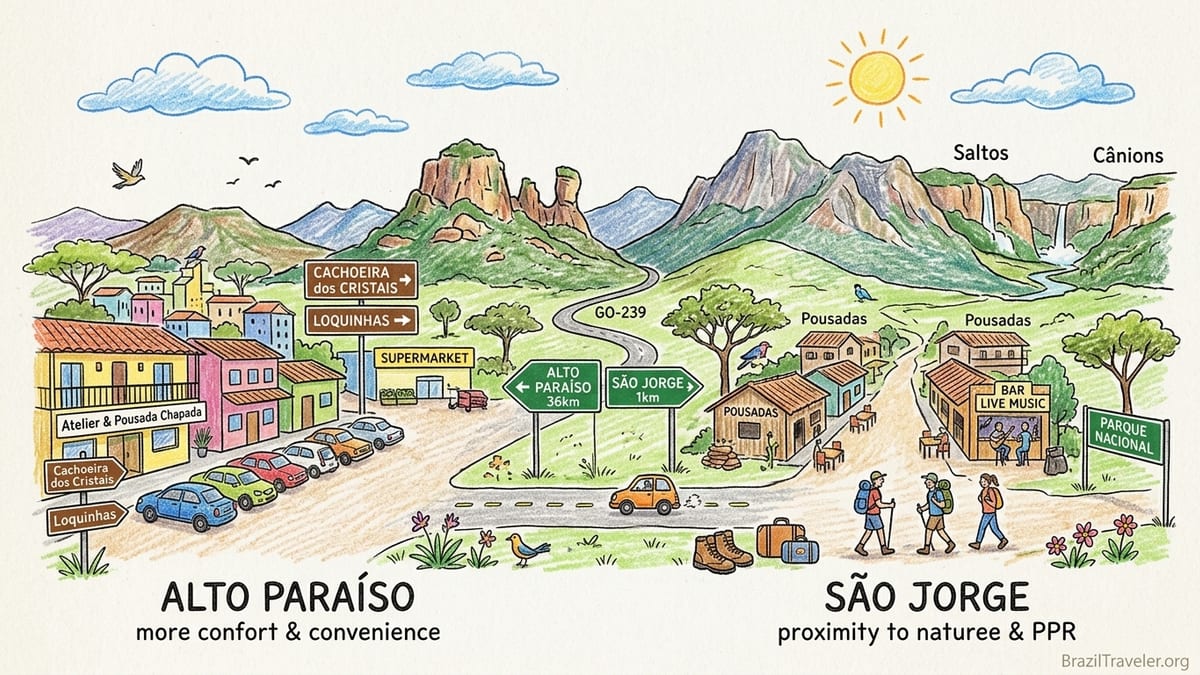
Alto Paraíso vs São Jorge: How Your Base Shapes the Trip
Alto Paraíso is the officially promoted gateway to Chapada dos Veadeiros, the place you are most likely to reach first from Brasília by bus or rental car. The town sits on the GO-118 highway and functions as a hub: from here a paved spur, the GO-239, runs around 36 kilometers west to São Jorge, while other roads spread toward attractions like Cachoeira dos Cristais, Loquinhas and, further away, Cavalcante. That central position means that if you want to sample a bit of everything across the region, Alto Paraíso keeps driving times more balanced.
São Jorge, in contrast, feels like a village that grew up around the park gate. The official entrance to Chapada dos Veadeiros National Park sits just outside the village, and there is a simple rhythm to days here: an early breakfast, a short drive or walk to the gate for the 8 am opening, a long hike, then dinner back in the same few rustic restaurants. If your priority is maximizing time on the park’s classic trails like the Saltos, Carrossel and Cânions, a São Jorge base removes a lot of daily highway shuttling between town and trailhead.
On my mixed-base trips, starting in Alto Paraíso and then moving to São Jorge worked best. Alto Paraíso made it easy to gather information, arrange guided tours, buy groceries and access a range of waterfalls close to town without always driving the full 36 kilometers to the park. Later, shifting to São Jorge cut my pre-hike commute to 5–10 minutes and made it realistic to be at the gate right at opening time without leaving in the dark. That Alto Paraíso versus São Jorge decision is not about which is better in the abstract but about the shape of your days and how much driving you accept.
For travelers without a car, Alto Paraíso offers clearer logistics. Buses from Brasília normally terminate here, and local tour operators pick up directly from town pousadas. São Jorge, by comparison, usually requires an extra transfer by van or private driver along the GO-239, which adds both cost and coordination. Once you are in the region with your own vehicle though, overnighting in São Jorge becomes extremely attractive for park-focused itineraries.
Staying in Alto Paraíso: Comfort, Convenience and Access
In Alto Paraíso, the pousadas I have stayed in or inspected generally offer more comfort per real spent than in São Jorge and span a wider range of styles. Near the entrance to town I inspected Pousada Sítio da Felicidade, set just five minutes from the roundabout with the iconic Chapada sign. The access is by a short dirt track from the highway, which in the dry season was dusty but navigable with a regular compact rental car. Guests did note that in high season the vegetation along the track can grow tall enough to narrow the passage and obscure the gate, something to keep in mind if you arrive after dark or during a wet spell when visibility is poor.
Within the town grid, mid-range pousadas like Atelier & Pousada Chapada and Statera Host offer a more polished experience, with tiled floors, modern bathrooms, better sound insulation and curated decor that appeals to couples and design-conscious travelers. During my inspection at Atelier & Pousada Chapada, rooms felt bright and well ventilated, with proper mattresses and good linens that made a difference after full days on the trail. Guests consistently praise the abundant breakfast, which the staff was willing to start serving earlier for hikers who wanted to leave by 7 am for longer day trips.
Parking and road access in Alto Paraíso are straightforward if you choose a place close to the paved streets. Most town pousadas have small internal courtyards or gated parking areas set back from the road, which felt secure when leaving luggage in the car. A recent trip report I reviewed described driving around town and along the GO-118 and GO-239 in a low-clearance rental without problems on the paved sections, and only short segments of dirt were needed to reach many popular waterfalls. That matches my own experience: the main worry is dust rather than clearance in the dry season, although in the rainy months from roughly October to April some secondary roads can develop mud and ruts.
Wi-Fi in Alto Paraíso, while not business-grade, is generally workable. In places like Statera Host and similar town pousadas, I was able to upload photos in the evenings and join basic voice calls, although speeds dropped when many guests were streaming. Some smaller family-run inns on the edge of town had weaker coverage in rooms, pushing me to check maps and weather in the breakfast area. If you need reliable connectivity for remote work, Alto Paraíso is significantly safer than São Jorge, but you should still plan to work asynchronously with files downloaded ahead of time.
Staying in São Jorge: At the Gate of the National Park
São Jorge trades polish for proximity. The village spreads out along the GO-239 and a couple of sandy, rutted lanes that turn to powder in the dry months and mud during summer storms. When I stayed here for a week focused on the national park, I chose a pousada within walking distance of the main street and a five-minute drive from the park entrance. Each morning we left just after 7:30 am, drove along the paved strip to the gate and were queued up as staff opened at 8 am. On days when we tackled the longer Saltos and Carrossel circuit, being that close meant we could finish hiking by late afternoon without feeling rushed to make a long return drive.
Pousadas in São Jorge set breakfast times around the park’s schedule. I consistently encountered breakfast starting between 7 am and 7:30 am, and several hosts proactively asked what time I planned to hike in order to set out coffee, bread, fruit and eggs a little earlier if needed. Rooms here tended to be simpler: ceiling fans instead of air conditioning, screens on the windows rather than full glass, and rustic bathrooms. Nighttime temperatures in the dry season can drop enough in the high plateau that fans are comfortable, but travelers used to hotel-level climate control should confirm that their chosen pousada actually has air conditioning if visiting in the hotter shoulder months.
The evening atmosphere in São Jorge is one of its highlights. After long hikes, the village comes to life around a few key corners, with live music at bars, simple restaurants serving rice, beans and grilled meats, and conversations stretching out under clear skies. On the downside, the food scene is smaller and prices are often slightly higher than in Alto Paraíso, partly due to the extra logistics of reaching the village. There have been nights when choice was limited, especially outside weekends and holidays, and I was glad to have some snacks from Alto Paraíso supermarkets to round out late dinners.
Wi-Fi in São Jorge has improved, but it still lags behind Alto Paraíso. In one of my stays, the connection was strong enough in common areas to message family and check the park’s official site for weather-related updates, but streaming or uploading large batches of photos was unreliable. Power flickers during storms are also more impactful in the village than in town. If staying here, I recommend downloading offline maps for trailheads and saving digital copies of your park ticket or risk acknowledgement form before you arrive.
National Park Logistics: Trailheads, Rules and Driving Times
The national park entrance sits just beyond São Jorge along the GO-239. According to the official park information currently available, the gate operates daily, including holidays, with access from 8 am to 6 pm, and visitors must exit before closing. Arriving close to 8 am is worthwhile on clear, dry-season weekends when queues can form and parking inside the gate becomes tight. When based in São Jorge, I set my alarm for around 7 am, had a quick breakfast and reached the gate by car in roughly 5 to 10 minutes depending on traffic and photo stops.
From Alto Paraíso, the routine is different. You need to factor in at least 40 to 50 minutes to drive the approximately 36 kilometers to São Jorge, plus a few extra minutes to get through the village to the park gate. On one inspection trip I left a pousada near the center of Alto Paraíso at 7 am sharp and, driving at a conservative speed along the GO-239, arrived at the gate at 7:50 am. That worked in the dry season when visibility was good. In wet months, or for travelers who dislike driving in the half-light before sunrise, this schedule can be stressful and is one of the strongest arguments for overnighting in São Jorge instead.
Inside the park, the classic circuits to the Saltos, Cânions and Carrossel start from well-marked trailheads reached on foot from the main parking area. Guides are not mandatory for the standard routes, but local tourism bodies continue to recommend hiring accredited guides, especially during the rainy season when flash flood risk is higher and some side trails can be confusing. The latest visitation protocols emphasize staying on marked paths, not entering the park outside official hours or through unofficial gates, and signing a risk acknowledgement document at the entrance when required.
For itineraries that mix park days with other attractions like Vale da Lua, Almécegas, Loquinhas and Cristais, Alto Paraíso regains its advantage. Several of these waterfalls lie within a few kilometers of town along paved or short well-trafficked dirt accesses, meaning you can leave after breakfast at 8 or 9 am and still arrive early enough to enjoy the pools in softer light. Using Alto Paraíso as a base for two or three nights at the start or end of your trip reduces the amount of backtracking on the GO-239 and allows rest days without long pre-hike drives.
Roads, Dirt Tracks and Night Driving
Driving conditions play an outsized role in how enjoyable days in Chapada dos Veadeiros feel. The main approach from Brasília to Alto Paraíso along the GO-118 is fully paved and, according to both official road descriptions and recent traveler reports, generally in good condition. From Alto Paraíso westward to São Jorge, the GO-239 is also paved, with a smooth surface that even low-clearance rental cars can handle without trouble in the dry season. This is the route you will drive repeatedly if you stay in Alto Paraíso but hike in the national park or visit attractions anchored near São Jorge.
The challenges begin on the unpaved side roads that peel off toward individual waterfalls and rural pousadas. During one stay at a property outside Alto Paraíso, access required following a narrow dirt track bordered by tall grasses. In the late dry season the surface was a mix of hardened ruts and loose dust which coated the car but did not threaten traction. However, guests who had visited during or just after the rains reported deeper puddles and occasional slippery patches where a small car needed to proceed slowly and choose lines carefully. A recurring theme from drivers returning in 2026 is that a regular compact car can reach most mainstream attractions, but you should be prepared to stop short and walk the final few hundred meters when conditions worsen.
Night driving is where many visitors, including me, draw the line. Between Alto Paraíso and São Jorge the road is paved but largely unlit, with stretches where wildlife can appear suddenly. After long hikes, the idea of a 40-minute highway return in the dark back to Alto Paraíso becomes less appealing than having dinner and a short stroll to your bed in São Jorge. That practical reality is another reason I now plan my itinerary so that park-intensive days are based in the village. When I do need to return to Alto Paraíso after sunset, I keep speeds conservative and avoid scheduling early pre-dawn departures on consecutive days.
Within the towns themselves, be prepared for speed humps, dogs and pedestrians on the roadway, especially in São Jorge where the compact main street doubles as a social space. Several pousadas in both bases have parking areas with tight turning radiuses and rough concrete walls; one driver returning from the region in 2026 described scraping a bumper on a textured wall while maneuvering into a tight spot. When checking in, it is worth asking staff to guide you into the parking courtyard the first time, particularly if you are not used to Brazilian urban parking layouts.
Room Comfort, Breakfasts and Evening Atmosphere
Across Alto Paraíso and São Jorge, room comfort varies more by individual pousada than by town, but some trends are clear. Alto Paraíso has a higher concentration of pousadas that feel like small boutique hotels, with upgraded bedding, more consistent hot water, and quiet at night despite being in town. In inspected properties like Atelier & Pousada Chapada and similar mid-range options, I found double rooms with queen or king beds, blackout curtains, and split-unit air conditioning, which helps on hotter afternoons even in the dry season. Bathroom fixtures tended to be modern, with proper glass shower enclosures instead of plastic curtains and better water pressure.
In São Jorge, rooms lean rustic. Many properties use ceiling or floor fans, with ventilation assisted by screened windows. On cool, breezy nights this feels pleasant and fits the village ambiance, but during heat waves it can be stuffy by mid-afternoon. Mosquito screens and simple tile or cement floors are common, which is practical when returning from trails with dusty shoes. Noise is more of a factor here; live music from bars and conversations on the main street can carry until around 10 or 11 pm on weekends. Choosing a pousada one or two blocks back from the busiest stretch helped me sleep better while still keeping everything walkable.
Breakfasts in both bases follow a familiar Brazilian pousada pattern: strong coffee, juices, fresh fruit, bread, eggs, cheese and cakes, set out buffet-style. The main difference lies in timing and flexibility. In Alto Paraíso, standard breakfast times hover between 7:30 am and 9:30 am, but several properties, especially those used by hiking groups, willingly set up earlier coffee and basics when guests request it a day in advance. In São Jorge, early starts are built into the routine. On my park days, I was often eating by 7:10 am without any special negotiation, alongside guides and other hikers comparing trail choices for the day.
Evenings in Alto Paraíso have a broader range of options. The town center offers vegetarian and vegan restaurants, burger joints, pizzerias and spots that combine meals with live music or holistic practices. The mood can be surprisingly cosmopolitan for a small town, especially in high season when travelers from São Paulo, Rio and Brasília fill the streets. This variety makes Alto Paraíso a better base for longer stays when you want to rotate through different dinner styles and perhaps find a quieter place after big hike days.
Specific Pousadas That Worked Well
Among the Alto Paraíso pousadas I have either used or inspected, a few stand out for balancing logistics with comfort. Atelier & Pousada Chapada sits within the town grid, which means fully paved access, easy walking distance to restaurants and shops, and simple parking. Rooms felt thoughtfully decorated, and guests repeatedly highlight the quality of the breakfast, which is important when you are relying on it as your main fuel before a 10 kilometer hike. Staff were proactive in providing route suggestions and adjusting breakfast slightly earlier on days when many guests were heading to trailheads.
Statera Host, another Alto Paraíso option that travelers continue to rate highly, blends pousada charm with a more contemporary guesthouse feel. Rooms are comfortable rather than luxurious, but the overall atmosphere of the property supports a restful stay: quiet corners to read, a pleasant garden area, and a breakfast that, while described as simple, covers everything needed before heading out. The location in town keeps you off dirt roads entirely but still lets you reach highway accesses for waterfalls like Cristais and Loquinhas in just a few minutes of driving.
On the edge of Alto Paraíso and along the highway corridor between town and São Jorge, properties like Pousada Aurora and Sítio da Felicidade offer a different experience, with more contact with nature and easier access in both directions. At Pousada Aurora, for instance, guests appreciate being close to the main road for day trips toward both São Jorge and Cavalcante, while still enjoying a quiet, rural setting at night. The trade off is that some segments of the access may involve short stretches of dirt that can be dusty or muddy depending on the season.
In São Jorge itself, many pousadas are small and family-run, so the specific choice often comes down to recent reviews, your budget and how close you want to be to the center. I have found that prioritizing good feedback on cleanliness, quiet at night and breakfast timing yields a better experience than fixating on decor photos alone. Asking directly whether rooms have fans or air conditioning, how parking works, and whether early breakfast is offered for park days helps set expectations, especially in a village where infrastructure remains more rustic than in Alto Paraíso.
Designing Your Itinerary Around Both Bases
After several circuits through Chapada dos Veadeiros, the pattern that keeps emerging is that using both Alto Paraíso and São Jorge as bases offers the best of each. On trips of five to seven nights, I now recommend starting with two or three nights in Alto Paraíso. This allows a more relaxed arrival from Brasília, a day at nearby waterfalls such as Loquinhas or Cristais, and time to stock up on groceries, snacks and cash. You can also use this period to gauge your comfort with local driving conditions on shorter outings before committing to early highway runs.
From there, shifting to São Jorge for two or three nights unlocks easier access to the national park and attractions like Vale da Lua and Almécegas, which lie closer to the village and along the GO-239. On these São Jorge nights, I plan strictly park-focused days, waking up early to be in line for the 8 am opening, tackling the longer circuits on the first clear day and keeping shorter routes like the Cânions for later in the stay when legs are feeling the miles. Evenings become simpler and quieter, revolving around a handful of bars and restaurants and lots of time under the stars.
If your schedule is shorter, such as a three-night weekend built around a holiday, you can still use the same logic on a compressed scale. One workable pattern is two nights in Alto Paraíso with one long day trip to the park, accepting the earlier start and highway drive, followed by a third night in São Jorge to end the trip right at the park gate. Alternatively, if your primary goal is the national park itself and you do not mind a more limited restaurant scene, basing entirely in São Jorge will reduce your daily driving and leave more hours on the trail.
Whatever pattern you choose, be mindful of seasonal variations. During the peak dry season roughly from May to September, both Alto Paraíso and São Jorge fill quickly on weekends and holidays, and pousadas with the best locations or breakfast setups may require advance booking. In the rainy season, some dirt road accesses can become challenging or temporarily impassable, and park management may modify trail access in response to weather or fire risk. Before you finalize lodging, it is worth checking recent traveler feedback for each pousada and confirming with the property how road and park conditions are affecting day-to-day operations.
The Takeaway
The decision between staying in Alto Paraíso or São Jorge in Chapada dos Veadeiros is not a competition so much as an exercise in matching your base to your priorities. Alto Paraíso, as the main gateway town, offers better infrastructure, more varied restaurants, stronger Wi-Fi and a greater range of pousada styles and price points. It reduces the need to drive on dirt roads for many nearby waterfalls, gives you easier access to services like supermarkets and ATMs, and supports travelers who need to keep one foot in the online world while exploring.
São Jorge, on the other hand, places you at the literal doorstep of Chapada dos Veadeiros National Park. It cuts your pre-hike commute to minutes instead of nearly an hour, aligns breakfast times organically with park opening hours, and provides an evening atmosphere that feels closely tied to the rhythms of the trails. The trade-offs are simpler rooms, weaker connectivity, more limited dining options and a heavier reliance on fans instead of full air conditioning in many pousadas.
Having stayed in both and visited across dry and rainy months, my strongest recommendation is to design an itinerary that leverages the strengths of each base. Use Alto Paraíso when you want comfort, variety and shorter drives to a broader network of attractions, and shift to São Jorge when your days are centered on the park’s main circuits and you want to minimize pre-dawn or nighttime driving. Pay close attention to pousada details like breakfast hours, parking layout, air conditioning, and proximity to paved roads, and do not hesitate to ask specific questions before booking.
Chapada dos Veadeiros rewards those who plan their base as carefully as their hikes. With the right pousada in the right village for the right stage of your trip, your days will start with a strong coffee and an easy drive to the trailhead, and end with tired legs, clear skies and the satisfying feeling that your lodging is working with, not against, the landscape you came to see.
FAQ
Q1. Is it better to stay in Alto Paraíso or São Jorge for a first visit?
For a first visit of four nights or more, a split stay works best: start in Alto Paraíso for easier logistics and nearby waterfalls, then move to São Jorge for park-focused days at the gate.
Q2. How early do I need to leave Alto Paraíso to reach the national park when it opens?
From central Alto Paraíso, plan to leave around 7 am to comfortably drive the roughly 36 kilometers to São Jorge, pass through the village and arrive at the park gate near its 8 am opening.
Q3. Do I need a 4x4 vehicle to reach most pousadas and trailheads?
A regular compact car is usually enough in the dry season for town pousadas and major attractions, but some dirt accesses can become muddy in the rainy months and may require slower, more cautious driving.
Q4. Are breakfasts early enough in São Jorge for long hikes in the park?
Yes. Most São Jorge pousadas start breakfast around 7 am and often arrange slightly earlier service on request so that hikers can be at the park gate by opening time.
Q5. How reliable is Wi-Fi in Alto Paraíso and São Jorge?
Wi-Fi in Alto Paraíso is generally adequate for messaging and light work, while São Jorge connections are weaker and better suited to basic tasks rather than heavy uploads or streaming.
Q6. Is nighttime driving between Alto Paraíso and São Jorge recommended?
The paved road between the two is in good condition, but it is unlit and can have wildlife on the verge, so many travelers prefer to avoid driving it in the dark after long hike days.
Q7. Do pousadas in Chapada dos Veadeiros usually have air conditioning?
Many Alto Paraíso pousadas offer air conditioning, especially in mid-range and higher categories, while São Jorge accommodations more often rely on ceiling or floor fans and natural ventilation.
Q8. Can I visit Chapada dos Veadeiros without renting a car?
It is possible by basing in Alto Paraíso, arriving by bus from Brasília and using local tours, but having your own vehicle greatly increases flexibility for trailheads and pousadas.
Q9. How many nights should I plan in Chapada dos Veadeiros?
Five to seven nights allow time for both Alto Paraíso and São Jorge bases, several park hikes, and visits to nearby waterfalls without rushing, though shorter long weekends are still rewarding.
Q10. Are national park rules and opening hours the same all year?
The park has a standard daytime opening schedule, but specific trail access can change with weather or safety conditions, so you should always confirm current rules and hours before your visit.