


On my first trip through Brazil’s central-west, I thought I had the seasons figured out. I planned Brasília as a mild city break, Chapada dos Veadeiros for waterfalls, Bonito for glass-clear rivers, and the Pantanal for wildlife. What I had not understood is how brutally the dry season can parch the Cerrado, how quickly a rainy-season storm can close a trail, or how much river clarity and jaguar sightings depend on water levels. After several return visits at different times of year, I now plan my months very differently, and I pack a very different bag.
Understanding Central-West Brazil’s Seasons Before You Book
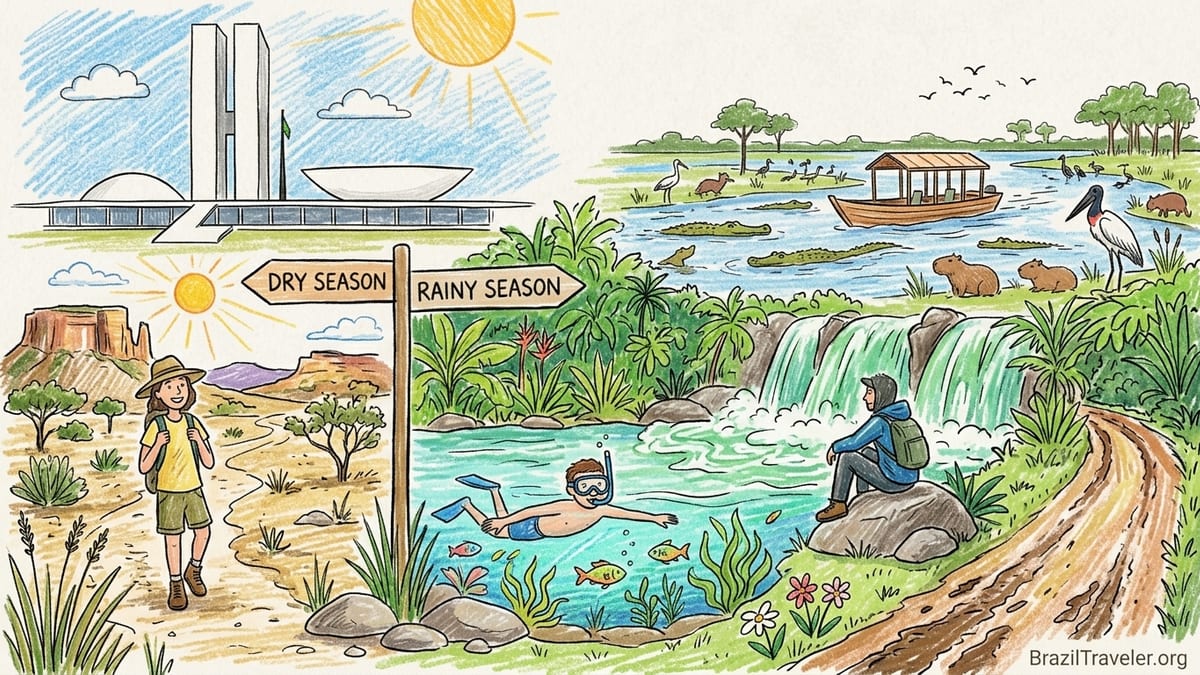
Central-west Brazil runs on a simple calendar at first glance: a pronounced dry season roughly from May to September and a rainy season from October to April, shaped by a tropical savanna climate across much of the region. In practice, that split feels very different depending on where you stand. In Brasília, winter afternoons in July can be comfortably warm while humidity drops to desert levels. In Chapada dos Veadeiros the same dry months mean endless sun, dusty trails and calm emerald pools. In Bonito they bring crystal visibility in the rivers, while in the Pantanal they concentrate wildlife along shrinking waterholes but can also bring wildfires and smoke.
Across my trips I learned that the same July date that was perfect for hiking near Alto Paraíso left my nose bleeding in Brasília and gave me hazy sunsets over the Transpantaneira in the Pantanal. Conversely, a stormy late-November loop through Bonito left some trails muddy but rewarded me with jungle-green scenery and thundering waterfalls. None of these destinations really has a “bad” month in absolute terms, but every month has strong trade-offs. The key is to decide what you want to prioritize: river clarity or lush jungle, easy logistics or dramatic flooded landscapes, cool dry days or steamy wildlife boat rides.
The national pattern is backed by official climate data that shows most of the Center-West’s rain falling in the warmer months and a marked dry season mid-year, with Brasília and the Federal District registering October to April as the rainy period and May to September as dry. On the ground, that means you cannot simply pick a single “best” month for a multi-stop trip across Brasília, Chapada dos Veadeiros, Bonito and the Pantanal. The same itinerary feels like a different journey in July versus in January.
After misjudging the seasons more than once, I now break the region down and choose months and packing lists for each destination individually. Below is how the seasons actually changed what I could do, what the weather disrupted, and which months I would pick today if I were planning the same routes again.
Brasília: Clear Skies, Harsh Dryness and Surprise Storms
Brasília’s climate is deceptively gentle on paper. The city sits on the Brazilian Highlands at around 1,000 meters of elevation, with a tropical savanna climate that keeps average temperatures around the low 20s Celsius. The real story, which I felt within 24 hours of arriving one July, is the humidity. The official data describes a dry season from about May to September and a rainy season from October to April, with around 90 percent of annual rainfall falling in the wet months. During my first dry-season visit I landed expecting “winter” to feel crisp and mild. By my second afternoon, the inside of my nose felt like sandpaper and my lips were cracking.
I had packed as if I were visiting a European city in September: jeans, light shirts, a thin sweater, but no nasal spray, no heavy moisturizer, and only a small bottle of water in my daypack. Within days I was buying saline spray at a pharmacy in Asa Sul and refilling a one-liter reusable bottle three or four times a day. Relative humidity often drops below 30 percent during Brasília’s winter, which local health authorities regularly warn is below what the World Health Organization considers ideal. That dryness affects not just comfort but also planning: I cut short an afternoon walk across the Monumental Axis because my eyes were stinging and I felt light-headed.
My later rainy-season visits, in December and March, felt like a different city. Gray clouds rolled in most afternoons and short but intense thunderstorms cooled down the urban plan. I learned to schedule indoor time in the early evening near the Conjunto Nacional or one of the café-filled commercial centers, because downpours could temporarily flood sidewalks and slow traffic along the Eixão. On one March afternoon, I watched sheets of rain sweep over the Congresso Nacional from the viewing platform, grateful for the light rain jacket I had thrown on at the last minute. Humidity shot up, but the air felt easier on my lungs than in August.
If I were planning another Brasília stopover, I would personally aim for the shoulder months of late April or early May, or late September, to split the difference between clear skies and extreme dryness. For travelers sensitive to low humidity, the peak of the dry season in July and August can still work, but I would treat Brasília almost like a high-altitude desert city: pack strong lip balm, saline nasal spray, a wide-brimmed hat, sunglasses and a large water bottle, and avoid long midday walks without shade. In the rainy months from December to February, build in extra time to move around the city and be prepared to duck into shopping centers or museums when the heavens open.
Chapada dos Veadeiros: Waterfall Country in Two Different Moods
Chapada dos Veadeiros was where I first understood how the same park could feel like two different destinations depending on the month. The high plateau of Goiás follows the regional pattern: a dry season usually from May to September and a rainy season from roughly October to April. Brazilian and local guides generally point to April through October as a strong period, with particular praise for May to September when trails are dry, skies are deep blue and visibility in natural pools is excellent.
My first visit, in late August, gave me textbook dry-season conditions. Leaving Alto Paraíso around 8 a.m., the air felt fresh, even cool enough for a light fleece at the trailhead of the Vale da Lua, but by late morning the sun turned fierce. I had underestimated the combination of altitude and a near-cloudless sky. I hiked to Cachoeira dos Saltos in the national park with only a baseball cap and 1.5 liters of water. By the time I reached the lookout over the 120-meter falls I could taste dust in my mouth, my skin was already reddening, and every step kicked up a dry film that coated my sandals. The payoff was stunning: crystal-clear pools at the base of smaller cascades like Carrossel, perfect for swimming, with almost no risk of flash floods.
I returned in January on a different trip, drawn by stories of the waterfalls in full flow. This time the Cerrado was intensely green and the red earth of the trails had turned to sticky mud in places. A storm the previous afternoon had closed access to some sections as a precaution because of flash-flood risk in narrow canyons. At Cachoeira do Segredo, the same pool that had been transparent turquoise in August was now a churning jade bowl, beautiful but far too turbulent for relaxed swimming near the fall. My mistake on that trip was footwear: I had worn the same low-traction trail runners from the dry season, which became treacherous on muddy, sloped rock. Local guides around São Jorge were in high-rubber boots or grippy sandals built for river crossings.
Rainy-season storms also dictated my daily schedule. On several days the forecast showed a 70 to 80 percent chance of afternoon thunderstorms, so I started hikes at first light, aiming to be back at a pousada or restaurant in Alto Paraíso by mid-afternoon. On one January afternoon, a storm rolled across the plateau so fast that the unpaved stretch of road to the Macaquinhos complex turned to ruts within half an hour, convincing my driver to turn back. I lost the chance to see that set of waterfalls on that trip purely because I had not planned enough flexible days for weather delays.
If I were advising someone today, I would split Chapada dos Veadeiros into two different goals. For photography, swimming and safer self-guided hiking, I would choose May or June. Water levels are still generous after the rains, the vegetation remains green, but trails are mostly dry, rivers are clear, and the risk of violent storms is lower than in December or January. I would avoid the peak of the dry season in September if you are sensitive to heat and dust, and only recommend the heart of the rainy season between December and February to travelers who understand that some trails and waterfalls may close at short notice due to safety concerns, and who pack proper rain gear, grippy footwear and dry bags for electronics.
Bonito: Clear Rivers in the Dry Months, Green Jungle in the Rains
Bonito in Mato Grosso do Sul is one of the clearest examples in Brazil of how rainfall transforms an experience. Official and local guides generally describe two broad periods. From roughly November to April, conditions are hotter and wetter, with more rain feeding waterfalls and turning the surrounding forest an intense green. From about April to October, the region enters a drier phase when the famous rivers around Bonito, such as Rio da Prata and Rio Sucuri, reach their maximum transparency.
On my first visit I arrived in late October, essentially in the transition between dry and wet. The floating tours operated by agencies in town, which bundle visits to attractions like Aquário Natural and Rio da Prata, supplied neoprene suits and snorkel gear, so I did not need to worry about water temperature. What I had not anticipated was how sensitive river clarity is to recent rain. A storm two days earlier had slightly reduced visibility at Aquário Natural. Underwater, I could still see shoals of golden dourado and piraputanga, but the water had a faint milky cast compared to the nearly 30 meters of visibility that local guides say you can often get in the dry months.
On a later trip in July, during the core of the dry season, I finally understood what they meant. Floating down Rio Sucuri felt like flying over an aquarium display. Every limestone detail on the riverbed was visible, every plant sharply outlined. I had packed a shorty wetsuit thinking the water would be cold, but the rental suit included in the tour price was perfectly adequate and the main challenge was the morning chill in the air before entering the water. My mistake that trip was not booking key tours far enough in advance: mid-year holidays in Brazil meant many popular slots at Rio da Prata and the Abismo Anhumas cave were already sold out or carried higher prices than weekday low-season rates.
Conversely, when I passed through in late November on another cross-country route, the town felt hotter and more humid. Afternoon rainstorms were more frequent and waterfalls such as Boca da Onça were at their most dramatic. Trails could be muddy, and I was grateful for lightweight quick-dry pants instead of jeans. Certain attractions respond directly to the rainy calendar: for example, the flooded limestone lake known as Lagoa Misteriosa often closes to snorkeling and diving from roughly mid-October to mid-April due to safety and visibility concerns, which caught a couple I met at breakfast by surprise when they had planned a December dive there based on an outdated blog.
If I were planning Bonito again, I would choose my month based on priorities. For maximum river clarity and ideal floating conditions, I would aim for late May through August, avoiding the heaviest Brazilian school holiday weeks in July if possible. I would pack sun-protective swimwear, a lightweight long-sleeve rash guard for floating, and sandals or water shoes with good grip for wet decks and river entries, plus a light fleece for cooler mornings in winter. If I wanted thundering waterfalls, fuller rivers for rafting on Rio Formoso and the deepest greens, I would look to late November or early December, but I would go in aware that heavy rain can lead to temporary closures or reduced visibility in some rivers, and that some specific cave and lake dives may not be available in the heart of the wet period.
The Pantanal: Planning Around the Flood Pulse
The Pantanal operates on a flood pulse that reshapes the landscape every year, far more dramatically than anything I experienced in Chapada or Bonito. Climatologically it follows a tropical wet and dry pattern, with an annual rainfall on the order of a meter or more and temperatures often high. What matters most for travelers is the sequence of flooding and drying. Local operators and conservation bodies usually divide the year into a wetter season around December to March, a receding flood period and then a dry spell that often peaks from about July to October.
My first attempt at a Pantanal trip was in late March. I flew into Cuiabá and drove down to Poconé to access the Transpantaneira, the dirt road that crosses the northern wetlands. From there, the landscape alternated between flooded fields and elevated patches of land. Many sections of the road were passable only with care, some of the wooden bridges felt precarious, and our driver pointed out side tracks that were still underwater. We did spot caimans, capybaras and an impressive array of waterbirds, but large mammals were diffused across a flooded landscape and difficult to see. Boat trips were the star of that visit: gliding through drowned forests at sunset was magical, but we knew we were not in peak wildlife-viewing season.
Later, I visited again in September, during what many outfitters describe as the height of the dry season. National and regional sources often highlight July to October as the best time for concentrated wildlife sightings, and within days I saw why. The same stretches of the Transpantaneira that had required a cautious crawl in March were now dry and dusty. Water had receded into fewer ponds and channels, and animals gathered around them. On a single morning drive from a lodge near Porto Jofre, we counted dozens of caimans sharing shoreline space with capybaras, jabiru storks and herons, and on a boat excursion later that day we had three separate jaguar sightings along a single riverbank.
The trade-off came in the form of heat, dust and environmental stress. Afternoons on the Transpantaneira were fiercely hot, with the sun reflecting off pale dirt, and my throat felt coated after only an hour in an open-backed safari truck. I had arrived with only a light buff for dust, assuming conditions would be similar to a national park in the dry season, and quickly wished I had packed a more substantial face covering and wraparound sunglasses. In drier years, the same season can also bring smoke from regional fires, reducing visibility and air quality. On one September evening, distant plumes rose beyond the wetlands, and local guides spoke of how changing rainfall patterns in recent years have affected the timing and intensity of both floods and fires.
It is also important to factor in costs and logistics. During my September visit, a three-night package from Cuiabá that included transport, full board at a mid-range lodge, guided boat trips and game drives was priced in the rough range of several hundred US dollars per person, noticeably more than quotes I had received for shoulder months. Lodges and specialist jaguar-spotting operators around Porto Jofre often book out months ahead for August and September. Conversely, contacts who visited in the peak wet months around January reported lower prices but also described difficulties reaching certain lodges by road, more reliance on boats or small planes, and greatly reduced chances of seeing jaguars.
If planning the Pantanal today, I would again let my priorities decide. For a first-time visitor focused on wildlife, particularly jaguars and giant otters, I would aim for late July through early October, accepting the heat and dust as part of the experience and packing accordingly: a wide-brimmed hat, high-SPF sunscreen, a sturdy dust mask or buff, light long sleeves, and plenty of rehydration salts. For photographers more interested in the unique flooded landscapes, mirrored water horizons and breeding waterbirds, a visit in the receding flood period around April or May can be spectacular, even if big-cat sightings are less predictable and logistics rely more on boats than on road travel.
Packing Lessons: What I Got Wrong in Each Season
Across these trips through Brasília, Chapada dos Veadeiros, Bonito and the Pantanal, my biggest mistakes came from underestimating extremes. In Brasília in the dry months, I assumed a mild winter climate would not require anything special beyond normal city clothes. Within days I was hunting for saline nasal spray, heavier moisturizer and a wider hat. Now, I treat any dry-season stopover there as I would a high, semi-arid city: I pack a large water bottle, lip balm with SPF, nasal spray and eyedrops, and I plan work or sightseeing breaks indoors during the hottest, driest part of the afternoon.
For Chapada dos Veadeiros, my dry-season packing was only half right. I had breathable shirts, a good daypack and a lightweight fleece for cool mornings, but my mistake was not respecting the intensity of the sun at altitude. I relied on a baseball cap that left my neck exposed and used too little sunscreen, so I burned on the first long hike. In the rainy season, I repeated an error many travelers make: wearing regular running shoes on muddy, rocky trails. After slipping my way down to a swollen waterfall, I invested in sandals with thick, grippy soles that could go in and out of water and on rock, which transformed the rest of that trip. I also learned to keep documents and electronics in small dry bags inside my daypack, since tropical showers can soak through otherwise solid backpacks in minutes.
In Bonito, my assumptions about water were reversed. I packed my own shorty wetsuit for July, worried the spring-fed rivers would be uncomfortably cold. The tour operators already included full neoprene suits in the package price, and the main challenge turned out to be chilly air on early-morning transfers, easily handled with a compact windbreaker. What I should have brought instead were more UV-protective layers for long hours in the water and on open decks, and a waterproof pouch for my phone when visiting deck-based attractions like the platforms at Buraco das Araras. On my wetter-season visit, I was thankful for quick-dry clothing and a lightweight rain jacket, but I had not realized that sandals with slick soles would struggle on mud. Renting or buying inexpensive rubber boots in town would have made some waterfall trails more comfortable.
The Pantanal demanded the most specific gear. In the wet season, I was glad to have long, thin socks and breathable long sleeves to protect against mosquitoes during evening boat rides, but I had skipped bringing binoculars, assuming lodge-provided gear would be adequate. It was either limited or well-used, and I regretted not packing my own compact pair for spotting far-off birds. In the dry season, I underestimated how dusty and reflective the environment would be. A simple cotton buff helped, but fine dust still coated my nose and throat after each drive. Now I would bring a more substantial face mask or scarf, closed shoes rather than sandals for game drives, and a light-colored, wide-brimmed hat instead of a dark baseball cap that absorbs heat.
Across all destinations, one universal lesson emerged: in central-west Brazil, “dry” rarely means mild and “rainy” rarely means cool. Dry means strong sun, dust and, in places like Brasília and the Pantanal, genuine physiological stress from low humidity or airborne particles. Rainy means vivid greens and dramatic water features, but also intense midday heat, slick trails and sudden storms. My packing list changed more between July and January in this region than it did between spring and autumn on many other continents.
How I Would Time Each Destination Today
Having seen how seasons shifted my experiences, I would now resist the temptation to design a single “perfect month” for all four of these destinations. Instead, I would either accept some compromises or split them into separate trips. If I had to combine them into one itinerary, I would likely target late May or early June. Brasília would be entering its dry phase but without the worst of the August-like humidity drop. Chapada dos Veadeiros would have mostly dry trails and still generous waterfall flow from recent rains. Bonito’s rivers would already be clearing nicely, and the Pantanal would be transitioning from its receding flood to a more consolidated dry season, offering a mix of lush scenery and improving wildlife concentrations.
If I could choose months individually, my preferences would be more specific. For Brasília, I would pick late April or early May to balance pleasant weather, reduced thunderstorm risk and manageable dryness, especially if combining with domestic flights through the city. For Chapada dos Veadeiros, May or June would be my sweet spot for hiking, photography and swimming, provided I watched local weather advisories and avoided venturing into narrow canyons after heavy rain. July could still be excellent there, but I would be more cautious about heat, dust and wildfire risk on surrounding Cerrado plains.
For Bonito, I would opt for mid-May through August if my priority was floating in the clearest possible rivers and enjoying calmer, cooler mornings, noting that July can be busier and somewhat more expensive due to Brazilian holidays. If I wanted lush, cinematic waterfall scenes and was prepared for hotter, wetter days, I would instead choose late November or early December, taking care to check which attractions might be closed or limited in that period, particularly certain cave and lake dives that are sensitive to water levels and visibility.
For the Pantanal, my current recommendation for wildlife-focused travelers remains late July through September, despite the heat and dust. That is when shrinking water sources cluster animals and when specialist jaguar tours along rivers near Porto Jofre reach their peak. I would, however, keep an eye on recent reports about rainfall patterns and fires, as climate variability can shift conditions from year to year. If my focus were more on landscapes than big cats, I would seriously consider an April or early May trip, when receding floodwaters still dominate the scenery, boat access is excellent, and prices at some lodges can be somewhat softer than in the peak jaguar season.
Ultimately, understanding how dust, sun, rainfall, humidity, river clarity and wildlife concentration interact in each of these places is the difference between frustration and a transformative trip. Accept that there is no single perfect month for all four, and choose the version of central-west Brazil that matches your own idea of an unforgettable journey.
The Takeaway
Traveling across central-west Brazil taught me that seasons here are not a backdrop but an active force that shapes every day. In Brasília, the dry season can turn a simple urban stroll into a lesson in hydration and humidity management, while the rains slow down traffic but soften the air. In Chapada dos Veadeiros, the same canyon can shift from a serene, swimmable pool framed by golden grass to a thundering, chocolate-colored chute that demands caution and respect. Bonito’s rivers can resemble underwater cathedrals in July and soft-focus aquariums after a strong November storm, and the Pantanal can feel like an archipelago of islands in March before turning into an open, dusty savanna filled with wildlife in September.
What finally made the region click for me was planning each stop with its own seasonal logic. I abandoned the idea of one universal recommendation like “go in July” and instead accepted that a great month for jaguars might mean slightly colder water in Bonito, or that peak waterfall flow near Alto Paraíso might coincide with temporary closures on riskier trails. The reward was a series of trips that felt tailored to each place’s character rather than dictated by my vacation dates.
If you are mapping your own route, think in terms of trade-offs instead of perfection. Decide whether your priority is floating through crystal-clear rivers or seeing the Pantanal at its greenest, whether you care more about storm-free days on Chapada’s trails or the sheer drama of rainy-season falls. Then pack like you are heading into both strong sun and serious rain, even if your forecast promises only one. The central-west will almost certainly surprise you. The question is whether you are surprised in a way that interrupts your plans, or in a way that becomes the story you tell long after you come home.
FAQ
Q1. What is the best single month to visit all four destinations together?
There is no perfect universal month, but late May or early June offers a workable compromise for Brasília, Chapada dos Veadeiros, Bonito and the Pantanal, with generally drier weather, improving river clarity and increasingly good wildlife viewing, though each location will still involve some trade-offs.
Q2. How bad is the dry-season humidity in Brasília for most travelers?
From about June to August, humidity in Brasília can fall well below what health bodies consider comfortable, which many visitors feel as dry eyes, cracked lips and nose irritation; most people cope fine with regular hydration, lip balm and nasal spray, but anyone with respiratory issues should take the dryness seriously when planning long outdoor days.
Q3. Is Chapada dos Veadeiros safe to hike in the rainy season?
Many trails remain open between roughly November and March, but heavy storms can trigger flash-flood risks in narrow canyons and lead to temporary closures of certain waterfalls, so it is essential to check conditions locally, start hikes early, avoid slot-like riverbeds after heavy rain and consider hiring local guides who follow safety alerts.
Q4. When are Bonito’s rivers at their clearest for floating and snorkeling?
River visibility in Bonito is usually at its best from around April to October, particularly in the cooler, drier middle months, when rainfall is lower and the limestone-filtered water in rivers like Rio da Prata and Rio Sucuri can reach exceptional clarity for snorkeling and floating tours.
Q5. Can I still enjoy Bonito during the hotter, wetter months from November to April?
Yes, the wetter period brings more dramatic waterfalls and very lush vegetation, and most organized tours still run, but you should expect higher temperatures, more afternoon storms, muddier trails and occasionally reduced visibility in some rivers or temporary closure of specific cave and lake dives when water levels rise.
Q6. When is the best time to see jaguars in the Pantanal?
Jaguar sightings along key rivers, especially near areas such as Porto Jofre in the northern Pantanal, are most reliable in the core dry season from roughly July through September, when falling water levels concentrate wildlife along fewer channels and shorelines, making big cats easier to spot from boats.
Q7. Is it worth visiting the Pantanal in the wet season?
The wet months around December to March can be rewarding for those who value flooded landscapes, abundant waterbirds and boat-based exploration, but road access is more limited, some lodges are harder to reach by land, costs may be lower but jaguar sightings are less predictable and you will need flexibility in case of weather-related disruptions.
Q8. How far in advance should I book tours in Bonito and the Pantanal?
For peak periods such as July and school holidays, it is wise to reserve Bonito’s popular floating tours and key Pantanal lodges or jaguar excursions several months ahead, while in quieter shoulder seasons a few weeks can be enough, though highly sought-after attractions and specialty wildlife operators can still fill up earlier.
Q9. What kind of clothing works best across dry and rainy seasons in Chapada dos Veadeiros and Bonito?
Lightweight, quick-dry long sleeves and pants, a wide-brimmed hat, strong sunscreen, and footwear with good grip that can handle both rock and mud will serve you well in both seasons, with a compact rain jacket and small dry bags especially useful in the rainy months and a fleece or windbreaker handy for cooler early mornings in the dry season.
Q10. How is climate variability affecting seasonal planning in central-west Brazil?
In recent years local guides and official reports have noted shifts in the timing and intensity of rains, floods and fires, particularly in the Pantanal and surrounding Cerrado, so while the broad patterns of dry and rainy seasons remain, travelers should check up-to-date local information on conditions, especially regarding road access, wildfire risk and safety closures, in the weeks before departure.