

Leaving Brasília for Chapada dos Veadeiros always sounded simple in my head: a quick drive, a couple of iconic waterfalls, and back in time to enjoy the city lights of the capital. Only when I actually did the trip did I understand what official tourism already suggests by placing the airport roughly 230 kilometers from Alto Paraíso. This is not a casual city excursion. It is a substantial journey across the Cerrado, where your decision about how to get there is as important as any waterfall you hope to swim under.
Leaving Brasília: Why the Transport Choice Matters More Than You Think
I started my Chapada dos Veadeiros trip in Brasília, looking at the map and naively thinking in city distances. The straight line between Brasília International Airport and Alto Paraíso de Goiás looks short, but the reality on the ground is about 220 to 250 kilometers by road, depending on your exact starting point in the city and whether you are heading to Alto Paraíso or straight to São Jorge. That translates to roughly three hours of driving in light traffic and up to four if you hit city congestion leaving Brasília.
Before leaving, I compared three concrete options. A standard compact rental car from a major company at Brasília Airport was pricing around 180 to 250 reais per day with basic insurance, not including fuel or tolls. An executive transfer service in a 4x4 or SUV from Brasília to Alto Paraíso, such as those offered by specialized local agencies, was quoting around 900 to 1,200 reais each way for a private vehicle that could carry three or four passengers. Shared tour packages leaving Brasília, usually for multi-day itineraries, spread the transport cost across the group, but they do so at the price of fixed schedules.
On paper, the rental car looked cheaper and more flexible for two people, but it came with the responsibility of driving both ways, managing fuel, and, crucially, keeping an eye on time so I would not end up tackling the return to Brasília in the dark. The transfer option, on the other hand, converted the journey itself into part of the experience, but only made sense if the cost could be shared. Guided tours promised peace of mind but much less freedom to adjust the pace for a particular waterfall or trail.
In the end, I decided that the way I left Brasília would shape the entire character of the trip. Treating Chapada dos Veadeiros as an easy hop was the first mistake I almost made. What finally pushed me to plan more carefully was reading that it takes about three hours just to reach Alto Paraíso from the northern exit of Brasília, and then more time again to continue to São Jorge at the gate of the national park. Once you factor in daylight, trail opening hours, and your own energy, the transport decision becomes the spine of your itinerary, not a detail you solve at the last minute.
Driving BR-020 and GO-118: The Real Experience on the Road
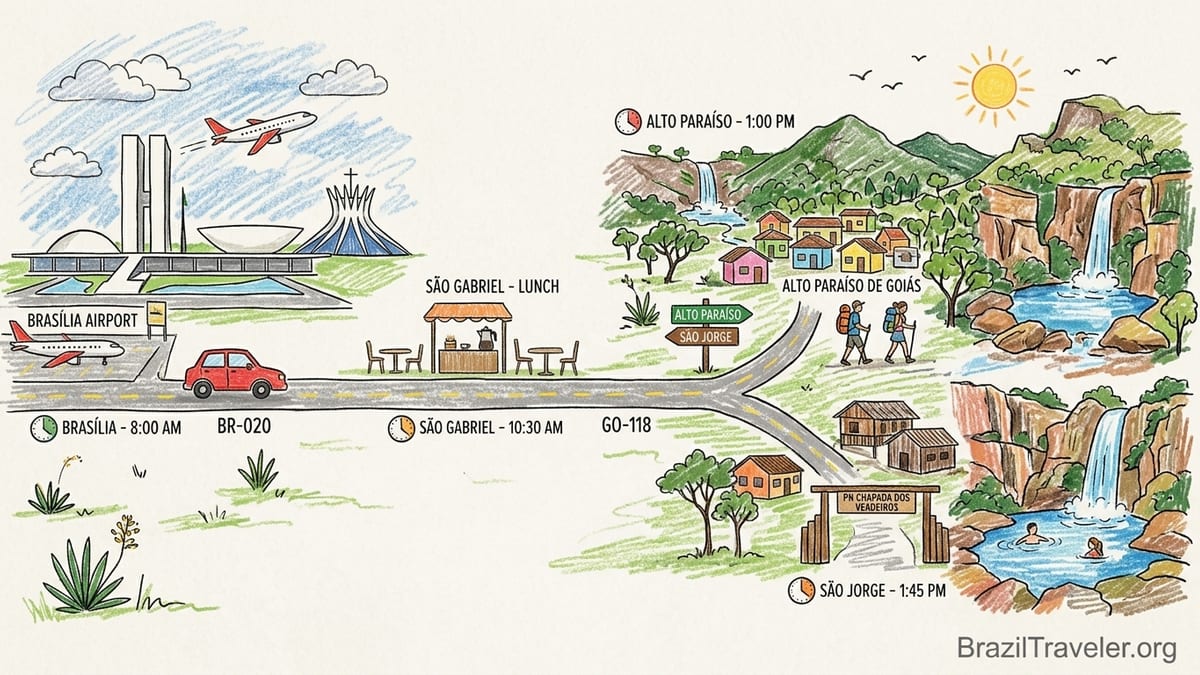
For my first trip, I chose to rent a car and drive. I picked it up at Brasília International Airport at 8:00 a.m., cleared the paperwork, and was rolling by around 8:45. The exit toward the north can be slow at rush hour, but once you leave the urban area you quickly reach the BR-020 and then connect to the GO-118 toward the Chapada. The total airport to Alto Paraíso distance worked out to a bit over 230 kilometers, which matched what official tourism information had warned: this is a proper overland journey through Goiás, not a city suburb drive.
The first hour felt like any Brazilian highway, with a mix of local and long-distance traffic, some trucks and a few buses. As Brasília fell behind, the Cerrado gradually opened around the road and the traffic thinned. I had checked recent reports and learned that the asphalt on the main route had been resurfaced within the last few years, and locals still described the road as good and mostly paved. That proved true. I did not find major potholes and only one short stretch of rougher surface near a town entrance. The bigger risk was not the pavement but the temptation to speed on long straight sections and the occasional animal crossing.
I stopped once in São Gabriel, about halfway to Alto Paraíso, at a roadside restaurant that drivers in Brasília often recommend for breakfast. That 25-minute pause for coffee, pão de queijo and a bathroom break made a big difference, because the last stretch of GO-118 climbs gradually and has fewer services. Including my stop, I reached the entrance sign of Alto Paraíso in just over three hours of easy driving. Without the break, it would have been closer to two hours and forty-five minutes, but I would have arrived more tired and cranky.
Continuing from Alto Paraíso to São Jorge, where the main entrance of Chapada dos Veadeiros National Park is located, meant another 35 kilometers on the GO-239. The road is paved, but it is narrower and has more curves, and it demands concentration after a long morning. That last leg took about 35 to 40 minutes at a calm pace. By the time I parked near my pousada in São Jorge, it was almost 1:00 p.m. I had left the airport before nine, driven roughly 270 kilometers in total, and, crucially, had already lost most of the prime hiking window for that first day.
Arrival in Alto Paraíso vs São Jorge: How Much Daylight Did I Really Have?
I experimented with two different base towns on this trip. The first night I stayed in Alto Paraíso and the following two nights in São Jorge. That gave me a clear picture of how arrival time affects actual sightseeing, not just the number of nights on paper. Reaching Alto Paraíso a bit before noon on the first day gave me just enough time to check in, drop my bags and grab a quick lunch, but not enough to plan a full trail inside the national park.
With the sun strong and energy still high, I opted for an easier private property waterfall complex near Alto Paraíso, one of those with well-maintained paths, a short approach walk under one hour and a cafe at the trailhead. I arrived at the parking area a little after 2:00 p.m. and had a comfortable three hours of light to explore two different falls, swim and sit on a rock watching the light change over the canyon. That first afternoon was more of a warm-up than a serious hiking day, but it felt like I had salvaged usable sightseeing time out of a morning dominated by logistics.
When I moved to São Jorge the next day, the difference in feel was immediate. Staying 2 or 3 kilometers from the main gate of the national park meant I could be at the entrance at opening time without a long transfer. On my main park day, I had breakfast before 7:00 a.m., walked to meet the guide at 7:30, and we were on the trail a little after 8:00. In practical terms, that gave me close to nine hours of usable daylight, with a long lunch break by the river and several swimming stops.
The day I tried to imagine doing all of this as a day trip from Brasília, the math simply did not work. Even with an aggressive 5:00 a.m. departure from the Plano Piloto, you would reach the trailhead near São Jorge around 8:30 or 9:00 at best. Park rules limit entry to specific hours and some longer circuits are no longer allowed without certified guides, so you would be forced to choose a shorter hike. Sunset in central Brazil tends to be around 6:00 p.m. for much of the year. To avoid driving back to Brasília in the dark on a single-lane road, you would need to be on the return leg by mid-afternoon. That leaves a narrow window for any meaningful waterfall experience.
Guided Days in the National Park: Trails, Heat and Real Effort
For my main day inside Chapada dos Veadeiros National Park, I joined a small guided group in São Jorge. Recent regulations encourage or require guides on some circuits, especially those that reach more remote canyons. Given that the park covers more than 240,000 hectares and that the Cerrado can be unforgiving in the dry season, I felt safer with a local professional who knew both the terrain and the current rules.
Our group had eight travelers plus one guide, which is a typical size for agencies that run daily departures. We chose a classic route that combined waterfalls and canyons on the Rio Preto, a hike advertised locally as around 10 kilometers round trip with a moderate level of difficulty. On the ground, that translated into roughly five to six hours of actual walking, with several breaks. The trail started on a wide path with some shade but quickly opened onto stony stretches exposed to the sun. In the dry season, from around June to September, the ultraviolet index is intense and the air feels thin, so hat, sunscreen and at least two liters of water per person were truly nonnegotiable.
The park administration has invested in clear signage and well-marked trails, and the main circuits begin on maintained paths with wooden footbridges and viewpoints. However, this is not a city park. Sections of the trail involve uneven stone steps, short but steep climbs and descents, and rocky riverbanks that require attention. I saw people in ordinary sneakers struggle on loose gravel where those with proper hiking shoes felt more secure. Carrying a daypack with water, snacks, and a light towel was also essential because there are no vendors inside once you leave the visitor area.
The reward for the effort was full access to spectacular waterfalls with deep natural pools. At the larger falls on the Rio Preto, our guide allocated about one hour for swimming, photos and rest before we had to start back. The water was fresh enough to sting at first but comfortable after a few minutes. Although there were other groups, the guide’s local knowledge helped us time our arrival so the pools were not overcrowded. Overall, the day felt intense but manageable, the kind of moderate hike most reasonably fit travelers can handle if they respect the heat and pace themselves.
Guides, Group Size and How Much Hiking You Actually Do
On my second guided day, I visited a private property near Alto Paraíso famous for a sequence of waterfalls in a single canyon. Here, the logistics were different. The agency picked us up from our pousada at 8:00 a.m. in a van, drove 30 to 40 minutes on a mix of paved and dirt roads, and then we walked a shorter but more intense trail along the river, with frequent stops at different pools. In total we covered maybe 6 kilometers, but the constant up and down on irregular rocks made it feel like more.
Group size this time was smaller, just five travelers, and that changed the experience. With fewer people, it was easier to ask questions, adjust the pace and take photos without feeling rushed. The guide explained details about Cerrado plants, pointed out quartz crystals embedded in the rock and quietly reminded us to stay on marked paths to protect fragile vegetation. When we reached a narrow section above a fall, he managed safety carefully, limiting how close people stood to the edge and reminding everyone that even confident swimmers can get into trouble with slippery rocks.
One aspect that surprised me was how the advertised difficulty levels did not fully capture the impact of sun and temperature. Trails that would be an easy stroll in a temperate climate felt medium to challenging after noon, when shade was scarce and the rocks radiated heat. The best hours were clearly before 10:00 a.m. and late afternoon, which reinforced my feeling that staying close to the trailheads in São Jorge or Alto Paraíso is more important than shaving a few reais off accommodation prices in a distant town.
Food and water planning also shaped the day. For park routes, agencies typically recommend carrying your own snacks and sometimes arrange a late lunch in the village on the way back. On private properties, there is often a simple restaurant at the entrance where you can pre-order a plate of rice, beans, salad and grilled meat or a vegetarian option for somewhere around 40 to 60 reais. Knowing this in advance helps avoid the common mistake of under eating during the day and facing the long drive back to Brasília exhausted.
Does a Rushed Day Trip from Brasília Make Any Sense?
At one point, I wanted to test whether I could compress a visit into a single day from Brasília. Online searches revealed agencies selling long day tours that leave Brasília around 4:30 or 5:00 a.m., drive straight to a specific waterfall complex near Alto Paraíso, and promise a sunset return to the capital. These tours usually cost several hundred reais per person, including transport and guiding, and they fit best for travelers with very tight schedules who value a snapshot experience over depth.
To simulate that rhythm, I planned a day where I left São Jorge at dawn, did a shorter morning trail near Alto Paraíso, and then drove directly toward Brasília in the early afternoon. Even with these favorable conditions, I arrived at the outskirts of Brasília around 5:00 p.m., just as city traffic intensified. By then, I had been awake since before 6:00 a.m., hiked several kilometers in the sun, driven for more than three hours and still needed to navigate an unfamiliar metropolis at rush hour. Trying to overlay a full Brasília round-trip driving time on top of a serious hike felt, frankly, unsafe.
The more I observed the distances and the rhythm of the days, the more a rushed day trip from Brasília looked like a compromise that cuts corners on both safety and enjoyment. You do not have the flexibility to wait for clouds to soften the midday sun, you cannot linger at a waterfall because the schedule demands that the van departs at a specific hour, and you risk missing the best early morning hiking window because you are still on the highway. Even if everything runs perfectly, you will spend at least six hours in a vehicle for just a few hours on the trail.
If, on the other hand, you base yourself for three or four nights in Alto Paraíso or São Jorge, the same transport hours turn into a one-time investment rather than a daily grind. A multi-day itinerary means you can dedicate your first afternoon to a gentler waterfall near the road, your second day to a full national park circuit, and a third to a different valley or property, perhaps with a shorter trail if your legs are already feeling the effort. That structure makes much more sense if your priority is not to tick a box but to actually experience Chapada dos Veadeiros.
Current Access Rules, Park Entrance Fees and Tour Availability
Before my trip, I checked the latest information from the park administration and local operators, because rules have evolved in recent years. Chapada dos Veadeiros National Park now manages visitation through a combination of online and on-site ticketing, with daily limits on some trails to reduce environmental impact. Entrance fees for non-resident visitors have been updated in the last couple of seasons and sit around the mid tens of reais per person for a day ticket, with discounted prices for Brazilian residents, seniors, students and local inhabitants. These fees help fund trail maintenance, signage and firefighting efforts during the dry season.
Access hours can vary slightly by season, but in general the park opens in the morning and closes in the late afternoon. Arriving early is not just a comfort decision. For some of the longer circuits, such as those reaching the more distant canyons or viewpoints, there is a latest recommended start time after which rangers will not allow hikers to begin the trail. A guide is now mandatory on several of these longer routes, and although you can still hike a few shorter circuits independently, even those are easier with updated advice on water levels, heat alerts and possible trail closures.
Tour availability from Brasília has grown since the destination gained prominence in domestic travel lists. Agencies based in Brasília offer multi-day packages that bundle airport pick-up, transfer to Alto Paraíso or São Jorge, accommodation in mid-range pousadas and two or three full days of guided hikes. Prices vary according to the time of year and comfort level, but sample packages of four days and three nights, including round-trip transport, can start in the low thousands of reais per person in a double room, with options to upgrade to higher-end lodges. These packages have the advantage of turning the Brasília to Chapada connection into a seamless arc instead of a separate headache.
Once in the Chapada region, you will find a network of local operators who sell daily tours to individual attractions such as Vale da Lua, Almécegas, Santa Bárbara and complexos of multiple falls on private lands. Some can be reached with regular cars; others require short stretches on rougher dirt roads where a 4x4 transfer is strongly recommended. While it is still possible to show up and book a tour the day before, popular circuits can fill quickly in Brazilian holidays and school vacations, so advance planning remains wise if your dates are not flexible.
What I Would Change Next Time
Looking back, there are several concrete decisions I would adjust if I were planning the Brasília to Chapada dos Veadeiros journey again. The first is departure time from Brasília. On my initial trip I left the airport after 8:30 a.m., which seemed early by city standards but late for a three-hour highway drive to a hiking destination. Next time, I would aim to leave the city around 6:00 a.m., whether in a rental car or a transfer, so that I reach Alto Paraíso close to 9:00, in time to check in, drop bags, eat a proper early lunch and still enjoy a full afternoon at one or two nearby waterfalls.
The second change would be to commit firmly to at least three nights in the region, ideally four. My trial of simulating a day trip persuaded me that anything less turns the journey into a blur of fuel stops and alarm clocks. With three or four nights, I would arrange two full guided hiking days and one lighter day that mixes a shorter walk, a visit to Vale da Lua or an easily accessed complex, and some unstructured time in the village. That buffer day is especially valuable if the weather does not cooperate, since heavy rains can temporarily close some trails or make access roads muddy.
I would also invest a bit more in the quality of transport from Brasília. The rental car gave me flexibility, but it also demanded energy on days when I might have preferred to nap after long hikes. For a group of three or four friends, I now see clear value in a private transfer that picks you up at the airport, drops you at your pousada in Alto Paraíso or São Jorge, and then returns at the end of the stay. Once in the region, you can rely on local tours with their own vehicles to reach the trailheads, many of which already assume that visitors will not be driving themselves.
Finally, I would pay even more attention to seasonality. The dry months from roughly May to September offer blue skies, clearer trails and stronger chances of uninterrupted hiking, though waterfalls run a bit lower. The rainy season brings fuller falls and greener vegetation, but also a real risk of flash floods and temporary closures, especially in narrow canyons. Checking current park advisories a few days before leaving Brasília is now on my nonnegotiable list along with packing a hat and sunscreen.
The Takeaway
The main lesson from my Brasília to Chapada dos Veadeiros journey is that the transport decision is as fundamental as any choice of trail or waterfall. The approximately 230 kilometers between Brasília International Airport and Alto Paraíso, and the additional stretch to São Jorge, are not trivial transfers you squeeze in around sightseeing. They are structural elements of the trip. Underestimating them leads to rushed mornings, tired driving at dusk and half-finished hikes under a punishing sun.
If you are flying into Brasília and feel tempted to treat Chapada dos Veadeiros as a casual side trip, I encourage you to reconsider. Plan for at least three nights in the region, leave Brasília early in the day, and decide honestly whether you want to bear the responsibility of driving or prefer to hand it to a professional transfer or tour operator. Once you arrive, respect the heat, follow the current park rules, and give yourself the luxury of time to sit by a waterfall without checking your watch every ten minutes.
In the end, what stays with me is not only the image of the Rio Preto plunging into a deep canyon or the strange rock formations of Vale da Lua. It is the memory of the long, changing horizon along the GO-118, the small cafes in roadside towns, and the sense of gradually leaving a modernist capital for an ancient plateau. When you treat the journey from Brasília to Chapada dos Veadeiros as part of the experience rather than a hurdle, the Cerrado itself becomes the first and last attraction of your trip.
FAQ
Q1. How long does it really take to drive from Brasília to Alto Paraíso?
In light traffic, the drive from Brasília to Alto Paraíso usually takes about three hours, but it can stretch to closer to four with city congestion or longer stops.
Q2. Is the road from Brasília to Chapada dos Veadeiros in good condition?
The main route via BR-020 and GO-118 is mostly paved and in generally good condition, with resurfaced sections in recent years and only occasional rough patches near towns.
Q3. Can I visit Chapada dos Veadeiros as a day trip from Brasília?
It is physically possible with very early departure and late return, but the long driving time severely limits hiking and waterfall time, so it is not recommended.
Q4. Do I need a guide to hike inside Chapada dos Veadeiros National Park?
Guides are mandatory for some longer circuits and strongly recommended in general, both for safety and to stay updated on current rules and trail conditions.
Q5. How much is the entrance fee to Chapada dos Veadeiros National Park?
Entrance fees are charged per person and are in the mid tens of reais for non-resident visitors, with discounts for residents, students, seniors and locals.
Q6. Is it better to stay in Alto Paraíso or São Jorge?
Alto Paraíso offers more services and varied lodging, while São Jorge puts you closer to the main park entrance and allows earlier starts on classic trails.
Q7. What is the typical difficulty of the main trails?
Most popular circuits are rated moderate, with distances from 6 to 12 kilometers, uneven rocky terrain and significant sun exposure that can make them feel strenuous.
Q8. When is the best time of year to visit Chapada dos Veadeiros?
The dry season from around May to September offers more stable weather and safer trails, while the rainy season brings fuller waterfalls but higher flood risk.
Q9. Are there regular buses from Brasília to Alto Paraíso?
Intercity buses do run between Brasília and Alto Paraíso on scheduled departures, but they can be slower than driving and still require local transport to reach many trails.
Q10. How many nights should I plan to stay in Chapada dos Veadeiros?
A stay of at least three nights is ideal, giving you two full hiking days and one lighter day to explore shorter trails or relax without rushing back to Brasília.