


I crossed Northeast Brazil in a long arc from Salvador in Bahia to the dunes and lagoons of the Lençóis Maranhenses in Maranhão, with stops in Recife, Olinda, Porto de Galinhas, Maragogi, Maceió, João Pessoa, Natal and Pipa, Fortaleza, Jericoacoara and a slice of Piauí in between. What started as a personal dream trip quickly turned into a crash course in how different each state feels on the ground, how much distances and logistics matter and how essential it is to understand seasons, tides and local rules before you book. This guide blends my own experiences with current practical information so you can actually plan a route through Northeast Brazil that works in real life, not just on a map.
Arriving in Salvador: First Contact With the Northeast
My entry point to the Northeast was Salvador, flying into Deputado Luís Eduardo Magalhães International Airport, still widely referred to by its old code SSA. I remember stepping out of the air conditioning and getting hit by a wall of humidity, even in the evening, with the temperature hovering around 27 degrees. A taxi from the airport to the historic center of Pelourinho took around 40 minutes in traffic and cost the equivalent of about 90 to 120 reais in a regular cab, slightly cheaper with the app-based rides. That initial ride taught me quickly that Salvador sprawls much more than photos of its colorful colonial streets suggest.
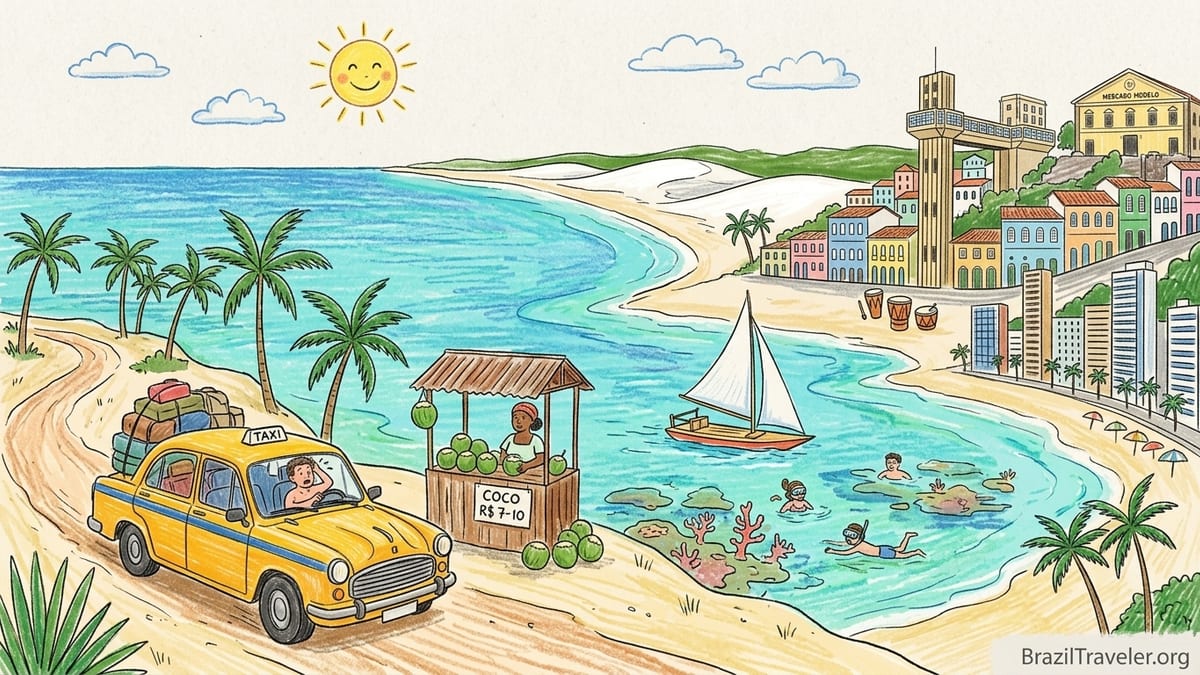
I based myself in Pelourinho and in the Barra neighborhood on two separate stays, and the contrast between them set the tone for how Bahia works. Up in Pelourinho I was walking cobblestones, hearing drums at night and dealing with steeper hills than I expected. At sea level in Barra I had an easy promenade along Praia do Porto and Farol da Barra, with sunset crowds and kiosks selling ice-cold coconut water at about 7 to 10 reais each. English was hit or miss outside the hotels and more upscale restaurants. My basic Portuguese, especially for ordering food and asking for directions, mattered from day one.
In Salvador I also got my first taste of how local food would shape the trip. I fell hard for moqueca, a fish stew rich with dendê oil and coconut milk, usually for around 80 to 120 reais for two people in a mid-range restaurant. The combination of spice and heat made mid-day sightseeing exhausting, so I quickly shifted my rhythm to early mornings and late afternoons. From here, my route headed north and east along the coast, but the mental image of Bahia’s intensity stayed as the baseline I would compare everything else to.
From a planning perspective, Salvador is still a key domestic hub. As of 2026 there are frequent flights linking Salvador to Recife, Fortaleza and São Luís, usually operated by Gol, Azul and LATAM, with promotional one-way fares often in the 250 to 500 reais range when booked in advance, and higher around holidays. These air links ended up being more important than I expected, because once I started moving along the coast, bus and car distances proved longer, slower and more tiring than they looked on the map.
Recife and Olinda: Culture, Contrast and a Lesson in Distances
My next jump was a domestic flight from Salvador to Recife, landing at Recife/Guararapes International Airport. The plane took about 1 hour, but door to door, including check-in and airport transfers, the travel day easily consumed 4 to 5 hours. A ride from Recife airport into the Boa Viagem neighborhood cost me around 40 to 60 reais by app, noticeably cheaper than Salvador’s airport run. Boa Viagem’s long city beach, lined with high-rises and a busy promenade, felt like a totally different country compared to Salvador’s compact historic center.
I stayed a couple of nights near Boa Viagem before moving to Olinda, and this transfer was when distances surprised me again. On the map, Recife and Olinda look like one urban area. In reality, traffic can turn the 10 to 15 kilometer ride into a slow 40-minute slog, depending on time of day. By app, that ride cost me the equivalent of 30 to 50 reais. In Olinda I based myself in the historic upper town, where I could walk from my pousada to Alto da Sé for views over the tiled roofs, the sea and Recife’s skyline. At night, small bars and simple restaurants served carne de sol plates for around 40 to 60 reais and ice-cold beer for 10 to 15 reais a longneck.
The cultural shift was immediate. Recife felt like a modern Brazilian metropolis with beach, malls and a fast pace, while Olinda slowed everything down. Pacing my days around the heat was vital, especially between December and March when humidity is high. From Recife and Olinda I also learned that public transport, while present, is rarely the best option for visitors carrying luggage or traveling at odd hours. Buses and the metro exist, but between language barriers, safety considerations at night and time lost on slower routes, I mostly used app-based cars within cities and relied on pre-booked transfers or intercity buses for longer legs.
When I planned the trip I underestimated how long it would take to get from Recife up the coast to Porto de Galinhas and then further to Maragogi. On paper these are just short stretches along the same shoreline. On the ground, they required strategic choices between renting a car, arranging private transfers or using slower buses and shared vans. That lesson kept repeating throughout the Northeast: the coast seems continuous, but breaks, rivers and secondary roads make each jump its own small mission.
Porto de Galinhas, Maragogi and Maceió: Tides, Pools and the Reality of Road Travel
From Recife I headed south to Porto de Galinhas in a pre-booked transfer. The drive took close to 1 hour 15 minutes in normal traffic. A private car for two people was in the range of 250 to 350 reais, more in high season, while a shared transfer could drop that cost significantly. I chose a private transfer after hearing about delays with shared vans picking up passengers at multiple hotels. Once in Porto, I stayed in the village area, within walking distance of the main beach and restaurants. This was the first place where tides controlled my daily schedule.
The natural pools of Porto de Galinhas only truly reveal themselves at low tide, and as of 2026 tour operators still schedule jangada raft trips based on daily tide tables. My early-morning pool trip cost around 70 to 100 reais per person, including the short raft ride. The water was crystal-clear on a morning with tide below 0.5 meters, but when I returned a couple of days later with a slightly higher tide, visibility dropped and the corals poked closer to the surface. That contrast taught me to always check tide charts not just for the region, but for the exact dates I planned for places like Porto de Galinhas and later Maragogi.
Continuing south toward Maragogi, which sits in Alagoas near the Pernambuco border, I had my first real experience of just how slow some coastal roads can be. The drive from Porto de Galinhas to Maragogi took almost 2.5 hours, partly because stretches of the PE and AL coastal routes pass small towns, speed bumps and sections where trucks slow everything down. I split the cost of a private transfer with other travelers, paying about 150 reais per person. There is also intercity bus service between Recife and Maragogi, often via companies like Real Alagoas or Progresso, but schedules can be limited and stops frequent, turning the trip into a 4 to 5 hour journey.
Maragogi and nearby beaches such as Barra Grande and Antunes became a masterclass in tide-dependent travel. The famous Galés and other offshore pools sit roughly 6 kilometers from the shore on a reef platform, and in 2026 local guides and tourism sites still emphasize that the best conditions occur when the tide is close to zero. Boat trips to the Galés typically cost around 150 to 220 reais per person, sometimes more for smaller speedboats or inclusive packages. In the dry months from around September to March, the water was glassy and turquoise on my visits, but I met travelers who had come in heavy rain season and found the water cloudy and greenish. That mismatch between expectation and reality is avoidable if you plan dates and tours around low tides and drier months.
From Maragogi I finished this coastal stretch in Maceió, capital of Alagoas, a 2.5 to 3 hour drive south. I stayed in Ponta Verde, where urban beaches were surprisingly pretty, though the water quality varied after heavy rains. By now I had settled into a model for this section of the Northeast: I was not renting a car long-term, but instead patching together private transfers and occasional buses, often costing between 150 and 350 reais per leg depending on distance and whether I shared the ride. With hindsight, I would probably rent a car for at least part of the Pernambuco to Alagoas run, especially for independent access to smaller beaches like São Miguel dos Milagres and Porto de Pedras, where bus schedules are sparse.
João Pessoa, Natal and Pipa: Quieter Cities and Windy Beaches
Moving north from Maceió, I flew to João Pessoa, capital of Paraíba, because the overland route for my exact dates would have meant complicated connections. The shorter flights within the Northeast are often under 1.5 hours in the air, but I learned to budget nearly half a day for each domestic travel leg. In João Pessoa I based myself in Cabo Branco, a quieter stretch with wide sidewalks and a family atmosphere. Prices for meals were noticeably lower than in parts of Bahia or Pernambuco. I regularly found set lunch menus, the classic prato feito, for 25 to 40 reais including meat, rice, beans, salad and sometimes farofa.
João Pessoa’s beaches felt calmer, with fewer international visitors and more local families. My Portuguese helped a lot here, from small talk with taxi drivers to ordering regional dishes like carne de sol com macaxeira and cartola, a dessert with banana, cheese, sugar and cinnamon. English was rare outside hotel front desks. Humidity was still high, but I began to notice more constant wind, especially in the afternoon, which would become a defining feature further north in Rio Grande do Norte and Ceará.
The drive from João Pessoa to Natal in Rio Grande do Norte took about 3 hours by intercity bus. I used a comfortable coach service with air-conditioning and seat reservations. Tickets purchased a few days in advance cost me in the rough range of 80 to 120 reais, and the station areas in both cities felt busy but manageable in daylight. In Natal I stayed in Ponta Negra, which has a classic beachfront strip dominated by the Morro do Careca dune at one end. Here the wind really picked up, particularly from August onward, which kept the heat more bearable but kicked up sand on the beach during gusty days.
From Natal I made a side trip to Pipa, around 90 kilometers south. A shared van transfer cost about 80 to 100 reais one way and took 2 to 2.5 hours including pickups. Pipa’s small-town feel, cliffs and dolphin sightings at Baía dos Golfinhos were a highlight, and I regretted only allocating two nights there. If I repeated the trip, I would give Pipa at least four nights to slow down and account for the variable tides that affect beach access, especially at Baía dos Golfinhos, where parts of the beach disappear at high tide. Crowd levels were very seasonal. In Brazilian school holidays like July and January, Pipa’s narrow streets became jammed at night, and prices for simple pousadas jumped by 30 to 50 percent compared with shoulder months such as May or late August.
Fortaleza, Jericoacoara and a Taste of Piauí: Wind, Sand and 4x4 Journeys
Heading west, I flew from Natal to Fortaleza, one of the major aviation hubs of the Northeast. Fortaleza’s Pinto Martins airport felt busier and more modern than some others, with direct flights linking it to São Paulo, Rio, Brasília and regional hubs like São Luís. I spent a couple of nights based in the Meireles neighborhood, walking the seaside promenade and sampling beachside barracas that served grilled fish, baião de dois and cold beer. Prices were broadly similar to Salvador in more touristy spots, though I found slightly cheaper street food such as tapiocas and pastel sold by mobile vendors in the evenings.
The big surprise in Ceará came when I tried to reach Jericoacoara, which is officially within the municipality of Jijoca de Jericoacoara. On a map, it looks like a straightforward run along the coast. In practice, there is still no regular paved road right into the village itself. The common approach is to travel from Fortaleza to Jijoca by bus or van along highways like the CE-085, taking roughly 4 to 5 hours, then switch to a 4x4 vehicle, often a jardineira truck, for the final hour across dunes and sandy tracks. I booked a combined van and 4x4 transfer door to door, paying about 200 to 300 reais one way. That last section felt more like an excursion than a transfer, with open-air benches, wind whipping across my face and sand streaking past as we crossed stretches of protected area.
Jericoacoara itself felt like a wind and kite-surf capital, with sand streets, low lighting at night and a relaxed mood. I stayed near the main beach to walk easily to the sunset dune and restaurants. Strong winds pick up from about August to January, which is perfect for kitesurfers but can feel harsh for beachgoers who dislike blowing sand. Prices were higher than I expected for a village that is relatively remote. Simple dinners without drinks easily reached 60 to 90 reais per person, and beachfront pousadas were often pricier than equivalent rooms in Fortaleza. English was more common in Jeri than in Pipa or João Pessoa, partly due to the heavy presence of European kite and windsurfers, but most tour desks still worked easiest in Portuguese.
From Jericoacoara I continued west into Piauí on a stretch of the so-called Rota das Emoções, combining beaches, river deltas and dunes. Rather than renting a car, I joined an organized 4x4 transfer that linked Jeri to Parnaíba, a key town in Piauí’s short but interesting coastline. The route stitched together sand tracks, rural asphalt and a boat crossing in the Parnaíba Delta. This leg drove home how complex self-drive can be in this part of the Northeast. Even with experience, driving on sand without local knowledge of tides and soft patches is risky. I was glad to let local 4x4 drivers handle river crossings and dune approaches, even if that meant higher per-day costs.
Piauí felt noticeably quieter and less international than Ceará, with lower accommodation prices in towns like Parnaíba and Barra Grande, a growing kite-surf spot. In Barra Grande I found fresh grilled fish meals for around 50 to 70 reais for two at simple beach shacks, cheaper than equivalent meals in Jericoacoara. Yet the overall logistics of moving from Piauí onward into Maranhão still required patience, with long road stretches and limited direct flight options. In hindsight, I would have added more buffer days here instead of trying to string everything into a tight schedule.
São Luís and the Lençóis Maranhenses: Seasons, Lagoons and New Rules
My final arc took me from the Piauí coast into Maranhão and eventually to the Lençóis Maranhenses National Park. I flew into São Luís Marechal Cunha Machado International Airport from Fortaleza, but many travelers also connect via Brasília or São Paulo. São Luís itself, with its tiled colonial facades in the historic center and a rougher port-city edge, felt different again from the rest of the Northeast. I stayed one night near the Reviver historic district to soak in the atmosphere and then focused on getting to the dunes.
The Lençóis Maranhenses are one of the few places in Brazil where you simply cannot ignore seasons. The park’s lagoons depend on a rainy period that usually runs from about January or February through May. From around June to September, lagoons are typically at their fullest and clearest, creating the postcard scenes of deep blue or green water framed by white dunes. By late September and October, many of the shallower lagoons dry out, although deeper ones around Santo Amaro have water for longer. Recent guidance and traveler reports in 2026 still point to June, July and August as the peak months for full lagoons, with May and September as shoulder periods that can be excellent depending on that year’s rain.
Reaching the park involved a road transfer from São Luís to Barreirinhas, the main tourist gateway. I joined a van transfer that picked up passengers at hotels starting around 7 a.m. and arrived in Barreirinhas after 4 to 4.5 hours, with one rest stop. Prices floated between 120 and 200 reais per person depending on the company and season. Once in Barreirinhas, all official trips into the core dune areas and lagoons must be done with authorized guides and 4x4 vehicles due to park regulations overseen by ICMBio, the federal environmental agency. A typical half-day tour to lagoons such as Lagoa Azul or Lagoa Bonita in a shared 4x4 truck cost around 150 to 250 reais per person in 2026, and days that included both dune hikes and sunset views cost a bit more.
I also took a river trip along the Rio Preguiças by voadeira, a fast boat that runs between Barreirinhas and small communities like Vassouras, Mandacaru and Caburé. That full-day excursion, including stops at dunes and a climb up a lighthouse in Mandacaru, cost roughly 200 to 300 reais. The humidity in this part of Maranhão was intense, and even with breeze on the boat, spending hours in the sun left me drained. Sunscreen, long-sleeved UV shirts and plenty of water were essential. In Barreirinhas itself, restaurant prices were mid-range, with main dishes around 50 to 90 reais. Fresh shrimp and fish, especially camarão grelhado, were local highlights often featured on lagoon day tours where lunch is taken in rustic community restaurants reached by sand tracks and 4x4.
Because I wanted a wilder feel, I also arranged a 4x4 transfer from Barreirinhas to Atins, a small village on the edge of the park and the Atlantic. This involved driving in a jardineira truck, crossing the Rio Preguiças on a short balsa ferry and then following sandy tracks toward the sea. The journey took about 1.5 to 2 hours and cost around 80 to 150 reais, depending on whether it was a private or shared vehicle. In Atins the wind off the ocean was relentless, which kept mosquitoes down but plastered sand to any exposed skin. Internet was weaker and power outages more common than in Barreirinhas. Yet the sunsets over the dunes and the feeling of sleeping so close to the park’s frontier made it worth the extra effort.
In 2026, local authorities and ICMBio continued tightening regulations around where vehicles can drive, which lagoons can be visited and how many visitors certain sectors can receive. Municipalities such as Santo Amaro have also discussed and in some cases implemented local tourism fees, on the scale of around 10 reais per visitor, to support infrastructure and environmental management. The practical effect on my trip was that I had to book tours slightly earlier than I might have years ago, especially in July, and stay flexible in case routes changed based on water levels or conservation rules. If I could reorganize my itinerary, I would give Lençóis at least five full days split between Barreirinhas and either Santo Amaro or Atins, rather than trying to squeeze the experience into three days around other commitments.
Weather, Seasons and When I Would Go Back
Looking back at the journey from Bahia to Maranhão, one thing is clear: timing matters even more in the Northeast than I expected. The region sits close to the equator and is warm year-round, but rainfall and wind change dramatically by state and month. Along the northern arc, in Ceará, Rio Grande do Norte, Piauí and Maranhão, the main rainy period tends to fall roughly in the first half of the year, from about February to May. In these months, afternoons can bring short but intense showers, humidity is extreme and lagoon systems like those in Lençóis Maranhenses are actively filling.
Further south and east, in Bahia, Pernambuco, Alagoas and Sergipe, heavier rains often concentrate between April and July, while the months from around September to February are usually drier and sunnier. For pool and reef destinations such as Maragogi and Porto de Galinhas, I found that visiting in drier months with clear water and low tides made all the difference. Local guides and operators still emphasize consulting tide tables for key dates, especially if your main goal is to see natural pools at or near a 0.0-meter tide, when the reef platforms are shallow and visibility is highest. I now always check both rainfall patterns and tide charts before committing to flights.
Wind is another invisible factor that becomes very visible on sand. The trade winds along the coasts of Rio Grande do Norte, Ceará and Piauí are a blessing for kitesurfers and sail enthusiasts, especially from about August through January, but they can feel abrasive on exposed beaches. In Jericoacoara and Barra Grande I got used to sand pricking my legs by mid-afternoon. For travelers who want calm seas and light breezes, shoulder periods like May or early June can offer a more balanced experience, though at the cost of higher chances of showers in some states.
If I were planning the same route again, I would aim to travel from mid-May through early September, starting in the south around Salvador or Recife when rains there are easing and moving progressively north so that my Lençóis Maranhenses segment lands squarely in June, July or early August. I would avoid planning an entire trip around destinations like Maragogi or the Lençóis between December and March without checking recent rainfall data, as climate variations can make some years wetter or drier than the historical average. Keeping a flexible mindset about swapping beach days and travel days according to local forecasts proved invaluable.
Prices, Language and What I Would Do Differently Next Time
Across all these states, prices varied more than I expected, not just by destination but by exact neighborhood and season. Salvador and Fortaleza felt like big cities with wide price ranges. In Salvador, I paid as little as 25 reais for a simple street-side meal of acarajé and soft drink and as much as 150 reais per person in a stylish restaurant in Rio Vermelho. In Jericoacoara and the Lençóis gateways, remoteness pushed up the cost of almost everything, from bottled water to basic dinners. Barreirinhas and Atins often charged 70 to 100 reais for a simple fish plate, and a night in a mid-range pousada during lagoon peak season could easily run from 300 to 600 reais for a double room.
On the other hand, places like João Pessoa, Natal and Pipa offered better value, at least when I avoided peak Brazilian holidays and long weekends. In João Pessoa I regularly found comfortable, clean rooms a couple of blocks from the beach for under 250 reais per night outside New Year and Carnival. Bus tickets between capitals rarely broke the 150 reais mark for standard coaches, and domestic flights bought well in advance through Brazilian airlines’ own sites often proved cheaper than I had feared, sometimes falling below 300 reais for one-way legs like Salvador to Recife or Fortaleza to São Luís during promotions.
Language shaped the trip at a deeper level. In Salvador, Fortaleza and Recife, I could sometimes find English speakers at hotel receptions, tourist restaurants and tour agencies. However, once I moved into smaller beach towns and interior gateways such as Barreirinhas, Atins, Santo Amaro, Barra Grande and parts of Pipa, English largely disappeared. My functional Portuguese was crucial when negotiating tour prices, asking about road conditions, understanding safety briefings before 4x4 dune trips and clarifying pick-up times that changed based on tide windows. If I had arrived without any Portuguese at all, I would have felt much more dependent on formal agencies and hotel staff.
If I could redesign the route, I would slow down in three places. First, I would spend fewer nights in big capitals that I used mainly as transit points and redistribute those days to Pipa, Jericoacoara and the Lençóis Maranhenses. Second, I would choose one section of coast to self-drive, probably between Recife, Porto de Galinhas, Maragogi and Maceió, where paved roads dominate and interesting beaches lie close to each other, while still relying on drivers and boats for sand and dune sectors in Ceará, Piauí and Maranhão. Third, I would leave at least one completely unscheduled day between long transfers to absorb weather changes, road delays or the simple desire to stay longer somewhere that charmed me more than expected.
The Takeaway
Traveling from Bahia through Pernambuco, Alagoas, Paraíba, Rio Grande do Norte, Ceará, Piauí and Maranhão gave me a sense of the Northeast as a chain of very distinct regions rather than a single coastal strip. Salvador’s dense history and rhythms, Recife and Olinda’s cultural layering, the reef pools of Porto de Galinhas and Maragogi, the quieter city beaches of João Pessoa, the cliffs and tides of Pipa, the wind of Jericoacoara and Barra Grande, and the surreal dunes and lagoons of the Lençóis Maranhenses each demanded different logistics, budgets and levels of planning.
The biggest surprises were how much distances and transfers would shape the trip, how seasons and tides could make or break signature experiences, and how essential even basic Portuguese became once I left the major capitals. At the same time, the rewards were huge. I swam in lagoons framed by white dunes at sunset, rode small rafts over coral pools, watched dolphins from under cliffs, crossed deltas by boat and fell asleep to drums, forró and the sound of the sea. With realistic expectations about costs and transport, and a careful look at weather and tide data before you book, a traverse of the Northeast can be both logistically feasible and deeply memorable.
If you are planning your own route, think in terms of clusters instead of trying to string together every famous name. Combine Salvador with nearby Bahian beaches or Chapada Diamantina, pair Recife with Porto de Galinhas and Maragogi, link João Pessoa and Natal with Pipa, consider Fortaleza as a hub for Jericoacoara and perhaps Barra Grande in Piauí, and give the Lençóis Maranhenses the time, season and respect they deserve. That approach will let you experience the very different personalities of each state without spending your entire holiday on planes, buses and vans.
FAQ
Q1. What is the best month to visit the Lençóis Maranhenses based on your experience?
From my experience on the ground and current conditions, I would aim for June, July or August, when the rainy season has recently ended and the lagoons are typically full and clear, with more sunny days and still-manageable crowds.
Q2. Do I need to speak Portuguese to travel across Northeast Brazil?
You can get by with only English in big cities like Salvador, Recife and Fortaleza, especially in hotels and some restaurants, but in smaller beach towns and park gateways such as Pipa, Jericoacoara, Barreirinhas and Atins, basic Portuguese helps a lot for tours, buses and everyday interactions.
Q3. Is it worth renting a car, or can I rely on buses and transfers?
I managed using a mix of domestic flights, intercity buses and private or shared transfers, but on another trip I would rent a car at least for paved coastal stretches such as Recife to Maceió to have more freedom for beach stops, while still relying on local 4x4 drivers for sand and dune areas.
Q4. How expensive did you find food and accommodation in the region?
Prices vary widely, but I regularly paid 25 to 40 reais for simple lunches in cities like João Pessoa, 70 to 100 reais for fish plates in remote spots like Atins and 300 to 600 reais per night for mid-range pousadas in popular areas such as Jericoacoara and Barreirinhas during high season.
Q5. How important are tide tables for planning Porto de Galinhas and Maragogi?
Tide tables are crucial if you want clear, shallow natural pools. In both Porto de Galinhas and Maragogi, I planned boat trips for mornings when the tide was close to zero, which produced calm, transparent water and fully revealed reef platforms.
Q6. What surprised you most about distances and transport?
On the map, destinations like Recife, Porto de Galinhas, Maragogi and Maceió look close, but road speeds, traffic, speed bumps and occasional slow sections turned short-looking hops into 2 to 3 hour drives, and dune sectors such as Jericoacoara or Atins always added an extra hour or more in 4x4 vehicles.
Q7. How did the climate feel as you moved from Bahia to Maranhão?
It stayed hot and humid everywhere, but I noticed more steady trade winds the farther north I went, especially in Rio Grande do Norte, Ceará and Piauí, while Maranhão’s interior around the Lençóis felt extremely humid, with strong sun and less ocean breeze away from the coast.
Q8. Did you feel safe traveling between states and cities?
I felt reasonably safe by following common-sense precautions: avoiding isolated urban beaches after dark, using registered taxis or app cars at night, keeping valuables out of sight on buses and choosing central, well-reviewed pousadas, especially in larger cities.
Q9. How many days would you recommend for the Lençóis Maranhenses alone?
After doing it once, I would recommend at least five full days devoted to the Lençóis region, split between Barreirinhas and either Santo Amaro or Atins, to see different lagoon circuits, take a Preguiças River trip and have flexibility for weather changes.
Q10. If you had to choose only three bases for a first Northeast Brazil trip, which would they be?
If I had to simplify, I would pick Salvador as a cultural and urban base, a beach cluster around Recife, Porto de Galinhas and Maragogi for reefs and pools, and the Lençóis Maranhenses via São Luís and Barreirinhas for the dune and lagoon experience that exists nowhere else.