


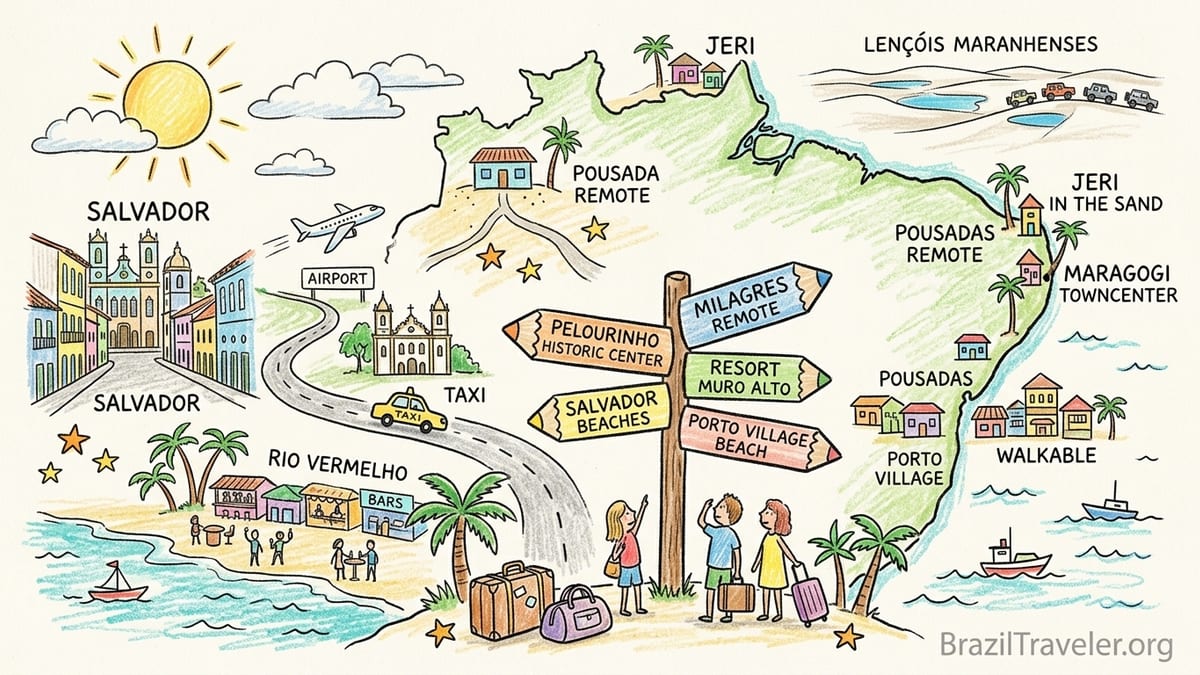
I spent just over a month moving slowly up Brazil’s northeast coast, sleeping in fourteen different hotels and guesthouses between Salvador and the dunes of Lençóis Maranhenses. In theory, each stop looked perfect on the map. In practice, some places made my days flow naturally, while others trapped me in long transfers, dark side streets and expensive taxis. This guide is about those bases: where staying on the sand really pays off, where you are better off in town, and what I would do differently next time.
How I Chose My Bases Along the Northeast Coast
My route followed a fairly classic arc for first-time visitors to Northeast Brazil: Salvador, Porto de Galinhas, Maragogi and Maceió, São Miguel dos Milagres, Pipa, Jericoacoara, then Barreirinhas and Atins for Lençóis Maranhenses, with a brief stop in Santo Amaro. I was not trying to sleep everywhere. I wanted a handful of smart bases that would keep transfers reasonable, put food and cash machines within walking distance, and still give me easy access to the postcard beaches I came for.
Before booking, I looked at three things: airport proximity, how spread out the hotels were relative to the town center, and how tours operated. On much of this coast, tours pick up from central points rather than every pousada, and a difference of two or three kilometers can mean a hot, dark walk along an unlit road if you miscalculate.
Because this region relies heavily on domestic tourism, I also paid close attention to Brazilian school holidays and long weekends. Around New Year and Carnival, some beach villages more than double their room rates and minimum stays jump to three or four nights. In low and shoulder seasons, the same hotels offer promotions and midweek discounts, which can affect whether an on-the-sand upgrade makes sense.
What follows is not a ranking of individual hotels. It is a comparison of the experience of basing yourself in each place, with concrete examples from my own stays: how long it actually took to arrive from the airport, when a rental car helped, when Uber vanished after dark, and which locations I would choose differently now.
Salvador: Historic Center Versus Beachfront Suburbs
Salvador was my entry point, landing at Salvador Bahia Airport, which sits about 15 miles from the historic center. With light traffic, a rideshare or taxi into the Pelourinho area took around 30 to 40 minutes, longer in rush hour. There is also a metro connection from the airport to downtown, but with luggage and a late afternoon arrival I opted for a car straight to my hotel near Largo do Pelourinho.
Staying in the historic center made walking to sights and restaurants incredibly easy. Within ten minutes on foot I had casual moqueca restaurants, live music bars and small supermarkets. Tour operators running city tours and day trips to Praia do Forte or the islands of Baía de Todos os Santos used Pelourinho and the nearby Comercio district as pickup points, so I was usually the second or third stop of the day. At night, however, the steep cobbled streets emptied quickly. My pousada sat on a side lane that felt very quiet after 9 p.m. If I went to dinner in the newer Rio Vermelho neighborhood, I took a taxi both ways and was dropped a short block from my door to avoid walking alone on dark stretches.
On a second pass through the city I tried staying in Rio Vermelho, a seafront neighborhood known for its bars and restaurants. Here the experience flipped. I could walk along the waterfront to multiple dinner options, grab drinks in busy squares and have late-night acarajé from street stalls without worrying about deserted alleys. Supermarkets and pharmacies sat on the main avenues, and ride-hailing cars were constantly available. The trade-off was sightseeing time. Getting into Pelourinho now took 25 to 40 minutes in traffic, and early-morning tour pickups sometimes looped through Barra and Ondina before reaching me, adding half an hour to the start of my day.
If I were planning a first-time stay again, I would split Salvador between the two bases: two nights in a small hotel steps from Pelourinho for the historic feel and easy daytime exploring, then two or three nights in Rio Vermelho or Barra for beaches, sunset walks and nightlife. What I would avoid now is a bargain hotel on a highway near the bus station or shopping malls. Those locations can look central when you zoom out on a map, but in reality they leave you crossing multi-lane roads to reach anything on foot and add taxi time in every direction.
Porto de Galinhas: Village Center Versus Isolated Resorts
From Salvador I flew to Recife and continued by road to Porto de Galinhas. Recife’s airport sits roughly 60 to 65 kilometers from Porto, and my private transfer took just over an hour in mid-morning traffic. Shared vans and air-conditioned buses are cheaper options, with bus tickets often under the equivalent of 5 to 10 US dollars, but they involve a short walk to the bus stand and a drop-off at the village entrance rather than at specific hotels.
On my first visit I made a classic mistake: I booked an attractive resort on a quieter beach stretch a few kilometers north of the village, near Muro Alto. Photos of loungers facing the reef and a semi-private strip of sand convinced me. In practice, the location made everything except relaxing more complicated. There was no real sidewalk, so walking to the village at night was not appealing. Each dinner away from the hotel required a round-trip taxi, and prices rose after dark, when drivers returning from Recife airport looked for higher fares. Supermarket access was limited to a small on-site convenience shop with higher prices than town.
The resort worked well for two specific things: waking up early to walk a nearly empty beach at low tide, and taking a full day to enjoy the pool without thinking about logistics. Tour pickups for the classic jangada raft rides in the natural pools and buggy rides along the coast still included us, but we were usually the first stop, so pick-up times felt very early and returns later than guests staying in the center. This matters when the tide charts dictate early departures.
On a later stay, I chose a pousada a few minutes’ walk from the main village square and the beach access near the natural pools. I paid less per night than at the resort and gave up the huge pool, but my trip became dramatically easier. I could walk to highly rated seafood restaurants, grab snacks and bottled water in larger supermarkets, and be on the sand within five minutes. When I booked an afternoon trip to Maracaípe or a full-day tour north toward Carneiros, the vans found me quickly and drop-off after dark left me on lit streets busy with other travelers. If beach time is your top priority and you are traveling outside peak holidays, paying extra to be directly on the sand near the village center is, in my experience, worth every real. The combination of walkability and sea access is hard to beat.
Maragogi and Maceió: Deciding Where to Sleep on the Alagoas Coast
From Porto de Galinhas, many travelers continue to Maragogi for its much-photographed natural pools. The village lies roughly midway between Recife and Maceió, and my transfer from Porto took about two hours along coastal roads. The arrival surprised me. Maragogi has a compact center with simple restaurants and beach kiosks, but many higher-end pousadas sit scattered along nearby beaches like Ponta de Mangue and Peroba, several kilometers from town. I stayed in one of these outlying stretches, thinking it would feel secluded and special.
Secluded it was. After dark, the road back toward the center felt too isolated to walk, with sparse lighting and stretches of vegetation between properties. The hotel restaurant became my default dinner choice, and while the food was perfectly fine, prices reflected the captive audience. When I wanted to explore another beach or take a boat trip, I relied entirely on taxis or private transfers. There was no supermarket within walking distance, so small needs like sunscreen or snacks turned into errands that required a car.
By contrast, on arrival in Maceió later in the trip I based myself in the Ponta Verde area, about 25 kilometers and 30 to 40 minutes from Maceió’s airport. Here the experience was the opposite. My mid-range hotel, one block from the main urban beach, put me within an easy walk of oceanfront kiosks, bars popular with locals, and a large supermarket behind the main avenue. City tours and day trips up and down the coast, including to the famous Gunga beach and the Frenchman’s Beach area, all used set pickup points along Ponta Verde and neighboring Pajuçara, so I rarely waited more than a few minutes.
After balancing both, my advice to anyone not seeking complete isolation is to consider two nights in Maragogi’s town center if natural pools are essential, then base in Maceió for broader exploring. If you prefer to stay in Maragogi itself, look carefully at distances on a detailed map and consider small pousadas within a short walk of the town pier, even if they are not directly on the sand. The convenience of wandering out for dinner or catching a boat early in the morning compensates for less glamorous beachfront views from your room.
São Miguel dos Milagres: When Being Remote Really Means Remote
São Miguel dos Milagres, part of the so-called Rota Ecológica on the Alagoas coast, had been on my list for years. Reaching it from Maceió’s airport by road took around two hours, depending on whether we followed the inland AL-105 or the more coastal AL-101. The final approach slopes down toward small villages, coconut groves and narrow access roads leading to the sand. There is no single, dense town center like in Porto de Galinhas or Pipa. Instead, the area spreads along several beaches separated by short drives.
This geography has real consequences once you arrive. I chose a charming beachfront pousada facing a calm stretch of sea and reefs, lured by images of hammocks under palms. The setting delivered exactly that. At low tide, I could walk far out over sandbanks and book a rustic jangada ride to nearby piscinas naturais straight from the beach in front of the property. But apart from a handful of neighboring pousadas, there was little else in walking distance. The nearest cluster of simple restaurants sat nearly three kilometers along a narrow road, with minimal lighting after sunset.
During the day, rental cars or pre-arranged drivers make sense here. The coast is dotted with tiny beaches, each with a different feel, and a car lets you hop between them at your own pace, stopping at beach bars with basic grilled fish and fresh coconut. Without one, you depend on your pousada to call taxis or organize private transfers every time you want to leave. At night, I ended up eating most meals in-house or at one or two nearby spots reachable in a short taxi ride, which added to the overall bill. Supermarkets are scarce, so simple self-catering is not really an option.
If I returned, I would first ask myself what I wanted from Milagres. For a romantic break focused on quiet, being directly on the sand absolutely justified the higher rate. For a more active base, I would look at pousadas a little closer to the villages of São Miguel dos Milagres or Porto de Pedras, even if they were one or two blocks back from the beach. That compromise would keep beach access while making it easier to walk to simple snack bars, bakeries and any small shops that have sprung up since my last visit.
Pipa: Hilltop Charm, Cliffs and Late-Night Logistics
Pipa, in Rio Grande do Norte, turned out to be one of the most atmospheric bases on my route, but also one where location matters enormously. Coming from Natal’s airport, the distance is roughly 80 to 90 kilometers along the main highway, with direct car transfers usually taking between an hour and a half and two hours, depending on traffic and where in Pipa you are staying. Regional buses and shared vans leave from Natal’s bus station and city stops, taking a bit longer but costing significantly less than a private car.
The village itself sits on a cliff above the ocean, with steep streets leading down to the main beaches. On my first stay I booked a pousada partway up one of those hills, a ten-minute walk from the main street. Daytime was fine. I could walk into the center for brunch, stop at a small supermarket for fruit and water, and then descend the stairs to Praia do Centro or the more scenic Praia do Amor. Surf schools and buggy tour operators all had storefronts on the main drag, so arranging activities was a matter of stopping in as I passed.
After dark, the story changed. Pipa is known for nightlife, and its main street fills with live music, cocktail bars and late dinners. Walking back uphill to my pousada after midnight on a warm, humid night was more effort than I expected, and although the town felt lively and reasonably safe where people were around, a couple of side streets between the center and my hotel emptied quickly. On one evening it started to rain heavily, and I ended up taking a short taxi for what would normally have been a ten-minute walk, simply to avoid the dark, slippery slope.
If I went back, I would aim for a small hotel either directly on the main street or very close to the stairs leading down to the central beach, even at a slightly higher rate. That would keep me within easy walking distance of restaurants, nightlife and beach access, while still allowing me to retreat to quieter corners during the day. What I would avoid is a hotel that advertises sea views from atop the cliffs but sits more than a kilometer from the main street without direct stair access. Those locations are beautiful in photos but can feel cut off after dark, particularly if ride-hailing services are scarce during busy weekends when drivers favor longer trips.
Jericoacoara: In the Sand, With and Without Infrastructure
Jericoacoara, in Ceará, is legendary for its dunes and sunsets, as well as for its remoteness. For most travelers, getting there involves flying into Fortaleza and then taking a road transfer of four to five hours, part of it on paved roads and the final stretch on sand. Newer regional airports exist closer to the village, but flights are limited and schedules change, so I based my plans on Fortaleza. The long transfer makes your choice of base within Jeri even more important. Once you are there, you do not want to spend time commuting inside the village as well.
The village is small and largely car-free, with sandy streets and most movement on foot, by quad bike or in small jardineira trucks. My first stay was in a pousada very close to the main beach, a two-minute walk from where people gather each afternoon to watch the sun dip behind the dune. This location simplified everything. I could walk barefoot to the water in the morning, return to my room to rinse off, and then wander through shaded streets to find lunch. Kitesurf schools, dune buggy operators and sunset horseback rides all had kiosks within a few blocks, and meeting points were always central.
The downside was noise. With bars and restaurants close by, music and conversations drifted up well past midnight, especially on weekends and during holiday periods when Brazilians flock to the village. On another visit, I tried a pousada set farther back from the beach, about ten minutes’ walk from the center along sandy alleys. Nights were quieter and starrier, but the walk back after dinner involved dimly lit paths and occasional puddles after afternoon rains. When I forgot to buy water or snacks, there was no supermarket around the corner, so I had to plan purchases during daytime outings.
In Jericoacoara, being within a very short walk of both the beach and the main sandy square is, in my view, worth higher rates if you are staying only a few nights. Transfer in and out already consumes a day on each side, and shaving ten minutes off every walk to dinner or sunrise paddle session adds up. If you are staying longer and value sleep quality above all, a pousada slightly behind the busier blocks can work, provided you are comfortable walking in soft sand at night and you stock up at the few small markets whenever you pass them.
Barreirinhas, Atins and Santo Amaro: Bases for Lençóis Maranhenses
The Lençóis Maranhenses region was the most logistically intense part of my trip, and choosing bases there makes an outsized difference. I flew into São Luís, then continued by road to Barreirinhas, the main gateway town, in a transfer that took about four hours with a short rest stop. Barreirinhas itself is a simple riverside town with basic tourism infrastructure: small hotels, riverfront restaurants, banks and supermarkets. Most tours into the dunes depart from here in 4x4 vehicles, with pickups at central hotels or meeting points near the river.
For my first visit I stayed in a hotel by the river, a short stroll from the pier where sunset boat trips depart. This was the right call. I could walk to several restaurants, including simple eateries serving grilled fish and rice, and had easy access to pharmacies and ATMs. My early-morning 4x4 tours started with direct pickup at the hotel gate, and I could be back in my room with a shower running less than half an hour after a hot, sandy afternoon in the dunes. The town lacks charm compared with the beaches further east, but as a practical base it worked well.
Encouraged by photos of hammocks over shallow lagoons, I then arranged a night in Atins, a much smaller village closer to the ocean, reached by a combination of boat and 4x4. The journey itself felt like an adventure, but once there I noticed how spread out everything was. My pousada sat almost on the sand, a few minutes from the water, but other restaurants were spaced widely along sandy tracks. After dark, the streets had minimal lighting. If wind picked up, the walk back from dinner turned into a slow push through soft sand with gusts in my face. There were no real supermarkets, just small convenience shops with limited stock and higher prices.
Santo Amaro, which I visited on a day trip rather than as an overnight, offered another perspective. It is closer to some of the most spectacular dune-lagoon combinations but has a smaller selection of accommodation and restaurants than Barreirinhas. Access roads are improving, yet the last stretch can still be rough after heavy rains. If I were to return and had more time, I would combine two or three nights in Barreirinhas for straightforward logistics with a one or two-night stay in either Atins or Santo Amaro, fully aware that once there I would depend almost entirely on my pousada for meals and information.
Across all three, rental cars did not feel particularly useful. Road access is limited, and much movement into the dunes is restricted to authorized 4x4 operators. I was happy to rely on organized transfers and tours, keeping my focus on timing excursions around the rainy season, when lagoons fill, and the drier months, when they shrink. When comparing rates, I saw clear seasonal swings, with Brazilian holiday months commanding higher prices in all three bases, which made simple town hotels in Barreirinhas even more attractive from a value perspective.
The Takeaway
Looking back over these weeks on the road, the clearest pattern is that “on the beach” is not always better, and “in town” is not always louder or less scenic. In some places, like São Miguel dos Milagres or an isolated stretch near Maragogi, being right on the sand delivered exactly the kind of seclusion I wanted, but it also meant relying on hotel restaurants, arranging drivers for simple errands, and accepting that streets would be very dark once the sun went down. In others, such as Porto de Galinhas village, Ponta Verde in Maceió and central Pipa, staying close to the action gave me better beach access and easier evenings without sacrificing safety or sleep quality.
Airport transfer times shaped more of my days than I expected. A one-hour drive from Recife to Porto or from Maceió to the Alagoas beaches felt manageable, especially if I arrived by late morning and could still enjoy an afternoon swim. Four or five hours each way to Jericoacoara or Lençóis Maranhenses, on the other hand, effectively turned into travel days, which made me value central, walkable bases in those destinations even more. Cheap, scenic hotels several kilometers away from the heart of things rarely justified the extra transfers.
For future trips, I will prioritize three criteria whenever I pick a base in Northeast Brazil. First, the ability to walk to at least a couple of dinner options without crossing highways or long, unlit stretches. Second, easy access to tour pickup points, whether that means being near a main square, a pier, or the coastal avenue where vans circulate. Third, a realistic sense of how isolated the accommodation feels after dark, especially in villages where sidewalks are sandy and Uber is not guaranteed. When I willingly trade those conveniences for a hammock on a quiet beach, I will do it with open eyes, knowing what the trade-off looks like in practice.
FAQ
Q1. Is it better to stay in Salvador’s historic center or by the beach?
For a first visit, many travelers combine both. Staying near Pelourinho puts you close to major sights and daytime tours, while two or three nights in Rio Vermelho or Barra offer easier beach access, more walkable nightlife and better access to supermarkets and casual restaurants.
Q2. Do I need a rental car in Porto de Galinhas?
Most visitors manage well without a rental car in Porto de Galinhas if they stay near the village center, where beaches, restaurants, supermarkets and tour departures are all within walking distance. A car is more useful if you choose a resort in quieter areas like Muro Alto or want to explore the coast independently.
Q3. Should I base myself in Maragogi or Maceió to see the Alagoas coast?
Maragogi works well if your focus is its natural pools and you choose a pousada near the town center. For broader exploring along the coast, Maceió’s Ponta Verde and Pajuçara neighborhoods offer more dining options, better tour logistics and easier access to supermarkets, making them a more practical base.
Q4. Is São Miguel dos Milagres too remote for a first trip?
São Miguel dos Milagres is more spread out and quiet than hubs like Porto de Galinhas or Pipa, which some first-time visitors love and others find too isolated. It suits travelers comfortable relying on their pousada for most meals and transport, or those renting a car to connect the small villages and beaches.
Q5. Where should I stay in Pipa for easy access to beaches and nightlife?
Staying close to Pipa’s main street and the stairs leading down to Praia do Centro or Praia do Amor gives the best balance of beach access, nightlife and safety. Hotels on steep hills or far from the center can feel inconvenient, especially when walking back after dark or in heavy rain.
Q6. Is Jericoacoara worth the long transfer from Fortaleza?
Many travelers consider Jericoacoara worth the four to five-hour transfer for its dunes, sunsets and relaxed atmosphere. Because the journey is long, choosing accommodation within a short walk of the beach and main sandy square helps you make the most of your time once you arrive.
Q7. Which town is the most practical base for visiting Lençóis Maranhenses?
Barreirinhas is the most practical base for Lençóis Maranhenses, with more accommodation options, riverfront restaurants, basic supermarkets and tour agencies that include hotel pickup. Atins and Santo Amaro offer more immersive dune experiences but have fewer services and require accepting greater isolation.
Q8. Are airport transfers in Northeast Brazil usually private or shared?
In larger hubs like Salvador, Recife, Maceió and Natal, you can choose between private transfers, ride-hailing cars where available, and shared vans or buses. In more remote destinations such as Jericoacoara or Lençóis Maranhenses, transfers are often organized through agencies or pousadas and may be shared 4x4 vehicles or minibuses.
Q9. When does paying extra to be on the beach really make sense?
Paying extra to be directly on the beach makes the most sense in places where there is little evening infrastructure and you intend to spend most of your time relaxing at your pousada, such as parts of São Miguel dos Milagres, isolated stretches near Maragogi, or beachfront spots in Atins. In towns with compact centers and easy beach access, like Porto de Galinhas village or Ponta Verde in Maceió, staying one or two blocks back can provide nearly the same experience for less.
Q10. How far in advance should I book accommodation in these destinations?
For popular periods such as New Year, Carnival and Brazilian school holidays in July, booking several months in advance is wise, especially in small villages with limited rooms like Pipa, Jericoacoara and São Miguel dos Milagres. Outside peak dates, you often find more flexibility and occasional discounts, though booking at least a few weeks ahead still helps secure well-located bases.