


I did my first long loop through Northeast Brazil with a backpack, a shaky Portuguese vocabulary and a wish list far longer than my vacation days. Since then I have returned to the region several times, watched airport connections multiply, park rules tighten and once "secret" beaches turn into polished destinations with beach clubs and selfie drones. Looking back, a few stops defined my trip far more than others. If I had to design that itinerary again today, with the benefit of experience and updated info, this is how I would choose between Salvador, Recife and Olinda, Porto de Galinhas and Maragogi, São Miguel dos Milagres and Maceió, João Pessoa, Natal and Pipa, Fortaleza and Jericoacoara, São Luís and Lençóis Maranhenses, and the distant dream of Fernando de Noronha.
How I Chose My Northeast Brazil Bases
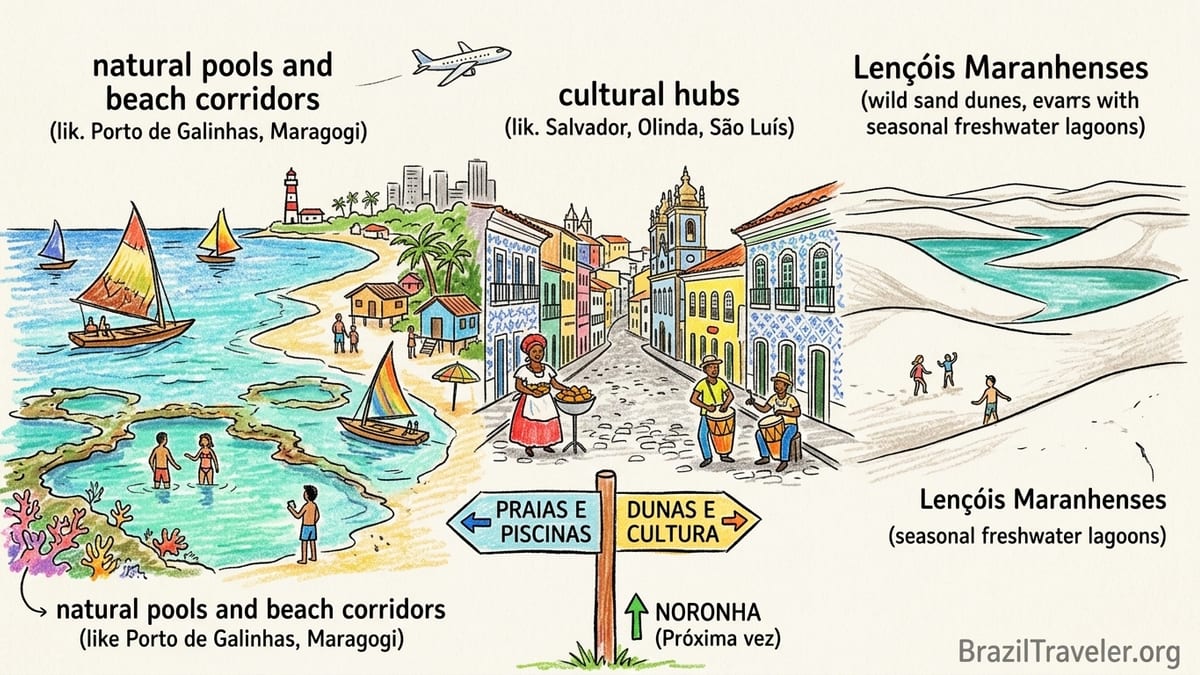
My goal on that first loop was simple in theory and impossible in practice: combine Afro-Brazilian culture, colonial cities, shallow natural pools, wild sand dunes, party beaches and at least one remote paradise into three weeks of travel. I quickly realized I could not meaningfully “do” every big name on the map. That forced a distinction that still shapes how I think about Northeast Brazil. There are cities that are destinations in their own right, like Salvador and São Luís. There are beach corridors, like Porto de Galinhas to Maragogi and Maceió to São Miguel dos Milagres, where you pick a base and day trip. There are gateway cities like Recife and Fortaleza that shine for short stopovers. And then there are once-in-a-lifetime side trips like Fernando de Noronha and Lençóis Maranhenses that require extra cash, planning and weather luck.
On that first trip I stayed in Salvador, Recife and Olinda, Porto de Galinhas, Maragogi, Maceió, São Miguel dos Milagres, Natal and Pipa, Fortaleza and Jericoacoara, and São Luís with a side trip to Lençóis Maranhenses. Fernando de Noronha remained a researched but unreachable dream for budget reasons, and I have still not stayed overnight in João Pessoa, although I have passed through and followed it closely while planning future itineraries. Where I write in the first person about arrival, accommodation, food and crowds, it is based on my own visits. Where I describe Noronha and João Pessoa, it reflects current research and conversations with recent travelers rather than my own nights on the ground.
Today, with more direct flights and better information available, I would not try to string all of these into a single rushed loop. Instead I would build around one cultural hub, one or two beach corridors and at most one “special effort” destination such as Noronha or Lençóis Maranhenses. In practical terms that often means flying into Salvador or Recife, choosing either the southern Alagoas and north Pernambuco pools (Porto de Galinhas, Maragogi, São Miguel dos Milagres, Maceió) or the Rio Grande do Norte corridor (Natal and Pipa), and then deciding whether the extra cost and logistics of Jericoacoara, Lençóis Maranhenses or Noronha truly fit the time and budget.
Salvador: My Cultural Anchor in the Northeast
I still remember my arrival in Salvador: a late evening flight into Salvador Bahia Airport, then a metered taxi that climbed toward the historic center as drums echoed somewhere uphill. Today Salvador is even easier to plug into a Brazil itinerary, with new connecting banks that link it overnight to cities including São Paulo, Belo Horizonte, Natal, Maceió, Recife and Fortaleza. That makes it a practical starting or ending point if you want Afro-Brazilian culture, colonial architecture and a soft landing before beaches.
I stayed in the Pelourinho area the first time, in a simple guesthouse on a cobbled side street. It meant dealing with some late-night noise and the usual warnings about petty theft, but I could walk to evening drum rehearsals, capoeira rodas on the squares and live samba in tiny bars without worrying about late taxis. On a later trip I tried staying in Barra instead, closer to Praia do Porto da Barra and Farol da Barra. That area felt more local and residential, with sunset walks along the waterfront and easier access to buses and ride-hailing for beach day trips, but a longer ride back from the old town at night.
What made Salvador unforgettable for me was not one monument but the layering of daily life. I spent mornings on the waterfront eating tapioca and drinking strong cafezinho, afternoons sweating through the Elevador Lacerda steps to the lower city and Mercado Modelo, and evenings wedged into a tiny bar in Pelourinho listening to live samba-reggae. I joined a candomblé house visit with a local guide rather than stumbling in on my own, which helped me understand it as a living religion rather than a show. Foodwise, my trip memories are soaked in dendê oil: moqueca, acarajé bought directly from a baiana on the street, and vatapá served so hot I burned my tongue.
If I were planning again, Salvador would get a minimum of three nights and ideally four or five. It is the destination I recommend most strongly for travelers whose priority is culture rather than beaches, and for families with teenagers who can appreciate history and music. For pure resort relaxation, however, the city beaches are not the most impressive in the Northeast. Families seeking an all-inclusive environment often prefer to base themselves at a resort stretch like Praia do Forte or Imbassaí north of the city and visit Salvador as a day trip. For nightlife, Salvador offers a deep, mostly Brazilian scene, especially around carnival season, but it is less about glossy clubs and more about street parties, neighborhood bars and live music.
Recife and Olinda: Urban Energy and Hillside Charm
Recife for me was a functional arrival point that surprised me with its energy. I landed at Recife/Guararapes International Airport on a midday flight from the southeast, collected my bag and in less than an hour was in Boa Viagem checking into a midrange hotel a block from the beach. Recife has increasingly become a key air hub for the Northeast, including direct links not only to Brazilian cities but to destinations such as Cabo Verde, which opens interesting transatlantic combinations for travelers willing to route creatively. For most tourists, though, Recife is primarily a bridge to Olinda and to the beaches of southern Pernambuco.
I split my stay between Boa Viagem and Olinda and in hindsight I would have skipped sleeping in Recife altogether. Boa Viagem’s long urban beach is convenient for a first dip and evening stroll on the calçadão, but I felt more drawn to Olinda’s color and human scale. In Olinda I stayed in a restored colonial house near the Alto da Sé, with a shaded courtyard and a hammock that quickly became my favorite reading spot. From there I could walk the steep cobbled streets, pass by ateliês and churches, and linger over tapioca crepes from the nightly stalls at the viewpoint.
What fixed Olinda in my memory was an afternoon when the heat had driven everyone into the shade and a group of frevo musicians started rehearsing on a side street. Kids chased each other with tiny umbrellas, older neighbors leaned on doors and I realized that carnival here is not a single event in February but a year-round rehearsal and identity. At night I found low-key bars with live forró on simple stages, the sort of place where outsiders are noticed but welcomed once they make an effort in Portuguese.
Today I would allocate two to three nights to Olinda, using Recife mainly for the airport. This pairing works well for travelers looking for culture in a more compact setting than Salvador, and for families who prefer a quieter old-town vibe with the option of day-tripping to Porto de Galinhas. For resort-style beaches and shallow natural pools, though, you need to keep heading south along the coast.
Porto de Galinhas, Maragogi and Maceió: Natural Pools and Family-Friendly Resorts
Porto de Galinhas was my first encounter with the glassy “piscinas naturais” that define so much of the Pernambuco and Alagoas coastline. I arrived by shared transfer from Recife, watching sugarcane fields give way to small beach towns. In Porto I based myself near the village center, a short walk from the main beach. That area can feel busy in high season, but being able to walk to restaurants and early-morning boat departures for the natural pools was worth it. I woke before sunrise one day for a jangada ride out to the reefs at low tide, standing in waist-deep clear water surrounded by small fish and a semi-circle of other visitors in bright lifejackets.
From Porto I continued by road to Maragogi, which has grown from sleepy stop to a national star for its “Galés” reef pools. I stayed in a simple pousada set back from the beach rather than one of the higher-end beachfront resorts. The town itself feels more stretched along the road, and the best experiences come from heading out along the coast to beaches like Antunes or Barra Grande rather than lingering in the center. The boat trips to the offshore pools are tightly regulated in terms of departure times and boat numbers, and prices for a half-day excursion can quickly rival a nice dinner out for two, especially when you add photos and snorkel rental.
Maceió, further south, surprised me by being better as a base than a destination in itself. I stayed in Ponta Verde, a neighborhood with a palm-lined urban beach, good sidewalks and plenty of casual restaurants. From there I used organized tours and private drivers to reach postcard beaches like Praia do Francês, Gunga and, on a longer day, São Miguel dos Milagres. The city’s orla has a relaxed evening scene, with people out for walks and food stalls open late, but it never felt overwhelming or particularly rowdy.
If my goal was to maximize time in natural pools and family-friendly beaches with infrastructure, I would now plan five to seven nights split between this corridor. Families with children often prefer to anchor themselves in a comfortable resort near Porto de Galinhas or Maragogi, where pools, kids’ clubs and half-board dining make logistics easy, and then add one or two organized outings to the pools. Couples and independent travelers might instead choose a smaller pousada in São Miguel dos Milagres or a quieter stretch of Maragogi, accepting that they will need transfers or rental cars to move around. Either way, this region shines for calm water, snorkeling, stand-up paddle rentals and lazy days rather than nightlife or adventure sports.
São Miguel dos Milagres and Quiet Alagoas Beaches
São Miguel dos Milagres felt, on my visit, like the antithesis of a big Brazilian resort town. I arrived by road from Maceió, the last stretch along narrower coastal roads where the landscape turned into coconut groves and scattered houses. My pousada sat a short walk from the sand, with a handful of bungalows, a small pool and a restaurant that served moqueca and grilled fish according to whatever came in fresh. There were no high-rises in sight, few streetlights and a sky dense with stars at night.
The beaches here, including Praia do Toque and Praia do Riacho, impressed me less as dramatic postcards and more as spaces where time slows down. At low tide the sea retreats and leaves long sandbanks where you can walk far from shore, sometimes ankle-deep for minutes before the water deepens. A few operators offer jangada trips to small natural pools, but the experience felt smaller-scale and more intimate than in Porto de Galinhas or Maragogi. The tradeoff is that there are fewer independent bars and restaurants right on the sand, so many evenings revolve around the pousada restaurant or a short taxi ride to another inn’s dining room.
For me, the defining moment in São Miguel dos Milagres was renting a bicycle from the pousada and riding along the dirt tracks that parallel the beach, passing small chapels and herds of goats. I went hours without hearing English. That sense of seclusion is precisely what makes the area attractive for couples seeking a romantic break or anyone who wants to disconnect without full-on wilderness camping.
If you are choosing where to sleep in this part of Alagoas, São Miguel dos Milagres and nearby villages like Porto de Pedras make sense for travelers who value quiet over convenience. I would allocate three to four nights if it is your main relaxation stop. Those craving more nightlife, variety of restaurants and cheaper accommodation may be happier basing in Maceió or Maragogi and visiting Milagres as a day trip. Families with small children can enjoy the calm water here, but should be prepared for limited playgrounds, kids’ activities and medical facilities compared with larger cities.
Natal and Pipa: Dunes, Buggy Rides and Cliffside Sunsets
Natal entered my itinerary as a transport node and revealed itself as a classic Northeast beach city. I flew into Natal’s airport after a connection from Salvador and headed to Ponta Negra, the main tourist neighborhood. My guesthouse overlooked the curve of the beach with the Morro do Careca dune anchoring one end. The area has a dense strip of hotels, restaurants, tour agencies and beach kiosks, which makes life easy if you want to organize buggy rides, day trips to Genipabu’s dunes or boat tours without planning weeks in advance. It also means crowds, music until late and a constant hum of vendors.
The Genipabu area, reached by buggy from Natal, gave me my first taste of the classic Northeast “buggy over the dunes” experience. Riding over the sand, stopping at small freshwater lagoons with zip lines and simple bars, and watching other buggies crest the hills was undeniably fun, but it felt very built for tourism. I enjoyed it as a one-time adrenaline and photo day rather than the heart of my trip.
Pipa, by contrast, charmed me enough that I extended my stay. I arrived by shared transfer from Natal, winding through increasingly green hills until the road suddenly dropped toward the sea and a jumble of guesthouses, restaurants and surf shops. I stayed on a side street near the main avenida, within walking distance of Praia do Centro and Praia do Amor. During the day I alternated between these beaches and Praia do Madeiro, accessed by a long staircase through the vegetation to a cove where dolphins often appear just offshore. At sunset the cliffs near Chapadão turned orange, and the whole town seemed to drift that way for the view.
What I remember most from Pipa is the mix of people. There were Brazilian families, long-stay Argentines and Europeans working remotely, surfers comparing swells in basic hostels and couples checking into boutique pousadas. The nightlife is livelier than in São Miguel dos Milagres or Maragogi, with bars and small clubs spilling music into the streets, but it rarely felt out of control. I felt comfortable walking back to my guesthouse at midnight, sticking to the main lit streets.
If I were designing an itinerary focused on beaches plus some nightlife and accessible adventure, Pipa would get four to five nights, with Natal providing one or two nights as a gateway if flight times demanded it. Pipa suits couples, groups of friends and families with older children who can handle cliffs and stairs. Natal works for families who want a city beach environment with many tour options and are less concerned about crowds or authenticity.
Fortaleza and Jericoacoara: Weighing the Effort for Wild Dunes
Fortaleza struck me as a city of contrasts. I landed at Pinto Martins Airport, took a taxi to the Meireles area and spent my first evening on the Beira-Mar promenade, where runners, families, food stalls and beach bars converge. The city has several urban beaches, but the waterfront is as much about people-watching and eating grilled cheese on a stick as about swimming. Many travelers use Fortaleza mainly as a starting point for beach runs to Cumbuco, Canoa Quebrada or Jericoacoara.
My own goal was Jericoacoara, the famously remote beach village set amid dunes. When I first went, reaching it involved a long overland day, including a stretch in a 4x4 vehicle across sand. More recently, road improvements and organized transfers have made the journey smoother, but it still takes most of a day each way from Fortaleza. I stayed in a small pousada on a sandy side lane a few minutes’ walk from the main beach. There are no paved streets, so your suitcase wheels dig into the sand as you walk. That inconvenience is part of the charm.
Days in Jericoacoara followed a sleepy pattern. Mornings at the beach or on a stand-up paddleboard in the calm water, afternoons on excursions to nearby lagoons with hammocks strung over the water, and late afternoons climbing the Duna do Pôr do Sol to watch the sun sink into the Atlantic with a crowd. Kitesurfers carved the horizon on windy days. At night, forró bars and caipirinha stalls kept the sandy streets busy until late. Over the years, Jericoacoara has gained more upscale pousadas, beach clubs and Instagram-driven crowds, but the sense of being in a pocket of sand and sea, removed from highways and big malls, remains.
If your trip is under two weeks and you are already including Salvador and one beach corridor, Jericoacoara may be too costly in time. The journey effectively requires at least three to four nights on site to justify a full travel day in and another out. I would recommend it most for travelers who prioritize kitesurfing, wind sports or a dune-and-lagoon landscape with a developed bar and restaurant scene. Families with small children should think carefully about the long transfers and the amount of sun and sand. For those who love the idea but are short on days, dunes near Natal or Lençóis Maranhenses can provide a taste of similar scenery with simpler logistics.
São Luís and Lençóis Maranhenses: Planning Around Weather and Rules
São Luís felt different from everywhere else on my Northeast circuit, both culturally and visually. I arrived on a domestic flight and stayed in the historic center, in a small hotel within walking distance of the tiled facades of Rua Portugal. The city’s colonial core is full of azulejo-covered buildings in varying states of restoration, with music floating from bars and cultural centers at night. It is a fascinating stop for travelers interested in Brazilian history and the specific Afro-Indigenous mix of Maranhão, but my main goal was the side trip to Lençóis Maranhenses.
To reach the park I joined a transfer to Barreirinhas, the most common gateway, and from there booked 4x4 outings into the dunes and lagoons. Every part of that experience is shaped by weather and regulation. The National Park is a protected area of dunes and seasonal freshwater lagoons, and access for visitors is controlled through authorized vehicles and guides. Private cars cannot simply drive into the dunes. On my trip I visited iconic lagoas near Barreirinhas, arriving in late afternoon when the sun softened and the water turned shades of turquoise and blue.
What I did not fully appreciate until I started planning, and what matters even more today, is how strongly seasonality affects Lençóis Maranhenses. The main lagoon-filling rains typically fall from roughly the beginning of the year through around April, with June and July often considered peak months to see the lagoons at their fullest. As the dry season advances toward September and October, the water level in many smaller lagoons drops, although deeper ones can retain enough for swimming later into the year. Park authorities emphasize that the area is remote, with limited reference points and no marked hiking trails through the dunes, so independent trekking without a guide is strongly discouraged.
In practical terms I would now plan at least three nights around Lençóis Maranhenses, split between Barreirinhas and, if time allows, Santo Amaro do Maranhão, which offers more direct access to certain lagoons and slightly fewer crowds. São Luís itself deserves at least two nights for travelers interested in culture. This combination tends to suit adventure-minded travelers and photographers more than families with small children, given the heat, sand and logistics. It also pairs well with a broader route that includes Jericoacoara or a quieter Alagoas base, giving you both dune wilderness and green coast in one trip.
Fernando de Noronha and João Pessoa: Researched Highlights I Still Haven’t Slept In
Fernando de Noronha was the great “maybe next time” of my first Northeast itinerary and remains the place I know best through research, planning and vicarious reports from friends. Reaching the archipelago requires a flight from mainland cities such as Recife or Natal, and once you land you are entering a tightly regulated environment divided between a Marine National Park area and a broader Environmental Protection Area. Two separate charges shape every visit. First, an environmental preservation fee, often referred to as the Taxa de Preservação Ambiental, is charged per day of stay and collected by the district government. Recent figures for 2026 put that daily fee above one hundred reais per person, with the total increasing progressively the longer you stay, so a week can represent a substantial line in the budget.
Second, to access many of the island’s most famous beaches and trails inside the Marine National Park, including spots like Praia do Sancho and Praia do Leão, visitors need to purchase a park admission ticket administered by the federal conservation agency. That ticket is valid for a set period, commonly cited as around ten days, and recent official information indicates prices on the order of a little over one hundred reais for Brazilian visitors and roughly double that amount for foreigners. These values can be updated by official portarias, so anyone planning a trip should confirm the exact amounts and validity period before purchasing flights.
Beyond the fees, Noronha also has rules around daily visitor numbers, guided access for certain trails, and advance booking requirements that have tightened over the years. Diving, boat tours around the island, sunset cruises and even some beach access points may require pre-booked slots in high season. Friends who have gone in the last couple of years describe a place of extraordinary wildlife encounters, such as snorkeling with sea turtles and watching spinner dolphins from designated viewpoints, but also a destination where a simple two-tank dive or boat circuit can cost as much as a several-day tour package on the mainland. Accommodation skews toward pousadas and small inns, with a relatively limited number of budget beds compared with the tens of thousands of visitors passing through annually.
Because I have not yet slept there, I think of Noronha as a destination that earns its place only when you are willing to center the entire trip around it. For a first Northeast itinerary focused on culture and variety, I would still prioritize Salvador, Olinda and at least one mainland beach corridor. If I planned a return trip with a stronger dive or wildlife focus and a higher budget, I would combine a few nights in Recife or Natal with at least five to seven nights in Noronha, accepting the fees and logistics as part of the cost of seeing some of Brazil’s most protected waters.
João Pessoa, in contrast, sits quietly between giants like Recife and Natal and is often praised by Brazilian travelers as a more relaxed, family-friendly capital. I have not yet stayed overnight, but when planning future trips I have been drawn to the reports of urban beaches like Tambaú and Cabo Branco with calmer vibe, a historic center that feels manageable in size, and a sunset ritual on the river at Jacaré beach accompanied by live saxophone. Flight connections tend to be fewer than Recife or Fortaleza but sufficient from major Brazilian hubs. For travelers who want an easier, calmer base and do not need the full intensity of Recife’s traffic or Natal’s nightlife, João Pessoa looks increasingly like an appealing alternative.
The Takeaway
Looking back at my own route and at how travel in Northeast Brazil has evolved, the main lesson is that you cannot and should not try to do everything at once. Instead, start by choosing your anchor. If culture, music and Afro-Brazilian history are your priorities, Salvador remains the best base, with São Luís as a complementary option for those interested in a different colonial story. If you want shallow, turquoise natural pools and resort comfort, build around Porto de Galinhas, Maragogi, Maceió and perhaps São Miguel dos Milagres. If you care more about surf, cliffs and relaxed nightlife, Pipa is the standout, with Natal as a gateway. For dunes and wild landscapes, weigh the logistics and seasons for Jericoacoara and Lençóis Maranhenses. And if you are ready to commit serious budget and planning to marine wildlife and protected beaches, Fernando de Noronha may deserve its own dedicated trip.
On a two-week itinerary today, my personal allocation would be something like five nights in Salvador, three in Olinda with a side trip to Porto de Galinhas, four in Pipa or São Miguel dos Milagres, and three around Lençóis Maranhenses if the season allowed. For a more relaxed, family-focused holiday I would lean toward a week in a resort near Porto de Galinhas or Maragogi, three nights in João Pessoa or Olinda for a taste of culture, and perhaps a shorter stay in Salvador or São Luís at the beginning or end. For an adventure-minded pair focused on scenery and kitesurfing, I would prioritize Jericoacoara and Lençóis Maranhenses and keep cities to bare essentials.
The good news is that flight connections across the Northeast have grown denser, park authorities publish clearer guidance on access and rules, and online trip reports make it easier to avoid outdated assumptions. The challenge is that some of the region’s most beautiful places now carry higher price tags, stricter regulations and heavier crowds in high season. By distinguishing between the destinations I have actually experienced and those I know only through research, my hope is to help you make deliberate choices about what to include, what to skip for next time, and how many nights to give each stop so that your own memories of Northeast Brazil are defined by moments on the ground rather than hours in transit.
FAQ
Q1. How many days should I spend in Salvador on a first trip?
For a first visit focused on culture and food, three nights is an absolute minimum and four to five nights allow time for both the historic center and nearby beaches.
Q2. Is it better to stay in Recife or Olinda?
For most leisure travelers I recommend sleeping in Olinda, which has a walkable historic center and calmer atmosphere, and using Recife mainly for its airport and occasional city visits.
Q3. Which destination is best for families with small children?
Resort areas around Porto de Galinhas, Maragogi and Maceió work especially well, with calm water, natural pools, kid-friendly hotels and easy access to medical services and supermarkets.
Q4. Where should I go for the clearest natural pools?
Porto de Galinhas, Maragogi and the São Miguel dos Milagres area are prime choices, with organized jangada trips to reef pools on low-tide days when the water is calm and transparent.
Q5. Is Jericoacoara worth the long journey from Fortaleza?
It is worth it if you prioritize dune and lagoon landscapes, kitesurfing and a sandy-village vibe, and can commit at least three to four nights; otherwise, consider closer dune areas instead.
Q6. When is the best time to visit Lençóis Maranhenses?
In most years the lagoons are fullest from roughly June to August, after the main rainy months, so I would aim for that window and avoid leaving it to the very end of the dry season.
Q7. How expensive are the environmental fees in Fernando de Noronha?
Expect to pay a daily environmental preservation fee in the low hundreds of reais per person plus a separate park ticket over one hundred reais, and always verify the latest official amounts.
Q8. Is João Pessoa a good alternative to Recife or Natal?
Yes, if you prefer a calmer capital city with family-friendly urban beaches and a manageable historic center; it has fewer flights but a more relaxed overall atmosphere.
Q9. Which destinations have the best nightlife?
Salvador excels for live music and street parties, Pipa and Jericoacoara offer lively bar scenes in compact beach towns, and Recife has a stronger club and concert scene in the wider metro area.
Q10. Can I combine Fernando de Noronha with a short Northeast itinerary?
You can, but the per-day fees and flights mean it makes most sense on a trip of at least a week centered on Noronha, with just a few nights on the mainland in Recife or Natal.