


When I finally booked a 4x4 expedition from Palmas to Jalapão, I wanted to know what it would really feel like. Not just the postcard images of turquoise fervedouros and apricot dunes, but the dust, the bumps, the early starts, the short showers and the tired legs. In 2026, operators are selling polished 2 to 6 day packages with glossy photos and vague promises of “comfortable vehicles” and “rustic charm.” This is what a complete Palmas to Jalapão loop actually felt like on a four day, all inclusive tour.
How Jalapão Tours from Palmas Work in 2026
In 2026, Jalapão expeditions from Palmas are almost entirely sold as multi day packages, usually between 3 and 6 days, with transport in 4x4 vehicles, accommodation, most meals, entrance fees and a guide all bundled together. Agencies such as Veredas do Jalapão, Pacotes Jalapão, and Top Expedições publish year round departures, but their own material and the state’s tourism promotion still highlight May to September as the most reliable window, when the dirt roads are drier and river beaches are at their best. Outside that period, many operators still run tours, but they warn that rain quickly turns the sandy tracks into deep ruts and mud, slowing travel and increasing the chance of getting stuck.
From Palmas, the classic loop connects Ponte Alta do Tocantins, Mateiros and São Félix do Tocantins, plus outlying attractions such as Lagoa do Japonês and Pedra Furada. The precise order changes between agencies and even between departures, because guides shuffle stops to avoid crowds at the fervedouros and to adapt to road conditions or pousada availability. When I compared recent 4 day itineraries advertised for 2026, several shared the same backbone: departure from Palmas around 6:30 to 8:00 on day one; Lagoa do Japonês and Pedra Furada that afternoon; canyon, Rio Novo and dunes on day two; a string of fervedouros plus Cachoeira da Formiga on day three; one more fervedouro, a viewpoint such as Serra da Catedral or Poço Encantado, and the long drive back to Palmas on the last day.
Prices in 2026 for a four day all inclusive 4x4 package from Palmas generally run in the range of about 2,000 to 3,600 reais per person, depending on season, group size, vehicle configuration and room category. I saw basic 4 day shared departures with simple pousadas advertised from just over 2,000 reais per person in low season, and premium small group versions above 3,500 reais in the heart of the dry season. These figures include almost everything on the ground once you are in Palmas: transport, guide, accommodation, breakfast and dinner every day, lunch stops in local communities and entrance fees to main attractions. What they do not include is your flight to Palmas, drinks, and extra activities such as stand up paddle or optional rappelling where available.
Road conditions and access rules are the other pillars that shape current itineraries. Official and operator material still strongly recommends a proper high clearance 4x4 and experienced drivers, even for the main access roads. A recurring theme in 2024, 2025 and early 2026 trip reports and agency briefings is that the region is seeing more patches of new asphalt on the access from Palmas, but the internal loops between Ponte Alta, Mateiros and São Félix remain largely unpaved, with long stretches of deep sand, washboard corrugations and hidden potholes. Many operators also mention environmental rules that cap times at some fervedouros and limit group sizes or require pre booked time slots, which is why your schedule can feel surprisingly tight despite the apparent remoteness.
Hotel Pickup and the Reality of the 4x4 Vehicle
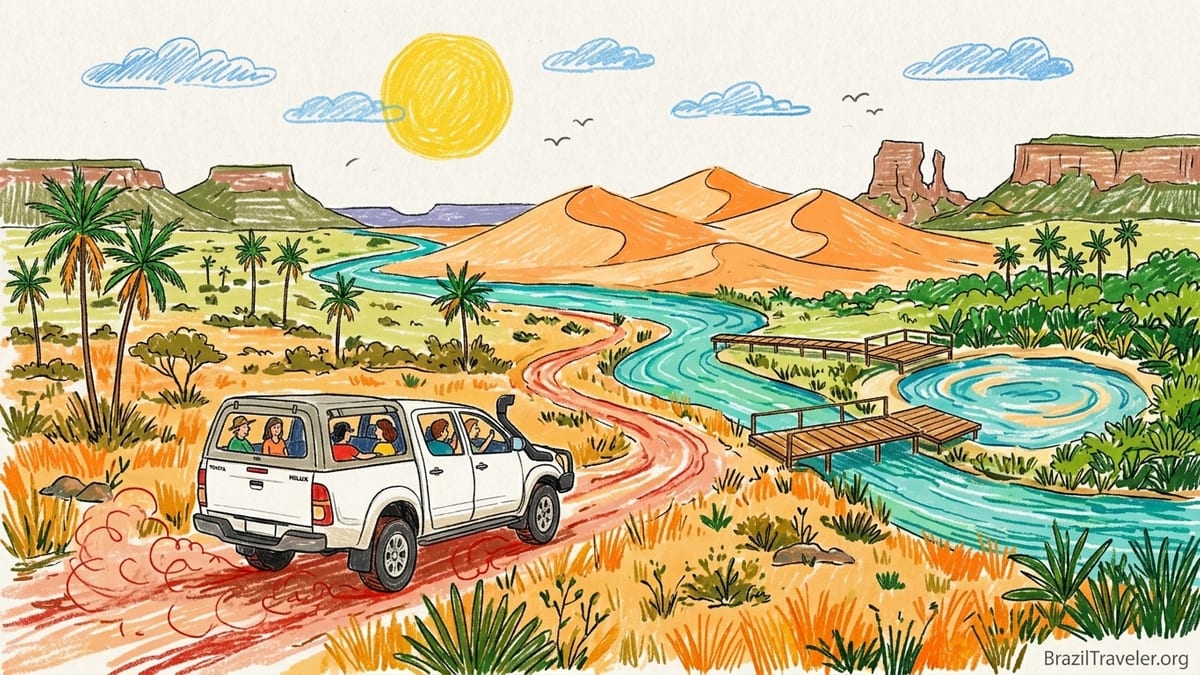
My own expedition started in Palmas, where the agency had told us to be ready in the hotel lobby at 7:00. The guide arrived around 7:20 in a white diesel Toyota Hilux with a snorkel and reinforced suspension. It had four doors and two rows of seats in the cabin, plus a covered bed fitted with a custom metal frame, side tarps and two benches facing each other. The company advertised “vehicles up to 6 passengers” and that is exactly how they ran it: three guests in the back seat of the cabin, three on the benches in the covered bed. I was in the cabin on day one and rotated to the back on day two, a system the guide managed strictly to keep things fair.
Inside the cabin, the air conditioning worked well and the ride felt close to a firm but normal road trip during the asphalt portion leaving Palmas. In the back, under the canvas, the experience was rougher and much louder. The benches were padded, but you needed to brace your feet and hold the side rails over the worst corrugations. Agencies like Jalapoeiros Ecotour and several others that target mixed age groups highlight that they use closed or semi closed 4x4s with air conditioning and seating for six, but that does not mean SUV comfort on city streets. You are in a truck built for utility first, passenger comfort second.
Luggage arrangements are surprisingly orderly, provided you follow the packing rules that most operators now send in advance. Our main bags went in the very back, strapped under a waterproof tarp and net. Each person was allowed a small daypack in the cabin or on their lap in the back. Hard suitcases are discouraged, and I understood why as I watched the guide and driver wrestle big wheeled cases into the truck on another group’s departure at our Palmas hotel. There is simply not enough flat space to stack them securely in a vehicle that will spend many hours at an angle in sand and ruts.
The pickup itself felt brisk and businesslike rather than ceremonial. The guide checked our names against a printed list, confirmed our dietary restrictions and explained the rough timing of bathroom breaks. There was no city tour of Palmas or stop at a panoramic viewpoint. Within 30 minutes of leaving the hotel, we were on the road south and then east, the city blocks giving way to scrubland and small ranches as the driver pointed the hood of the Hilux toward Ponte Alta and the edge of the Jalapão region.
Day by Day: Distances, Dust and How Tired I Really Felt
The first day was the longest in terms of hours in the vehicle, but not the roughest. From Palmas to Lagoa do Japonês we spent about three hours on a mix of paved highway and reasonably graded dirt, with one coffee and bathroom stop at a roadside restaurant that also sold cold coconut water and simple snacks. The last stretch to the lagoon was already rough enough that our guide switched the truck into four wheel drive, but it still felt manageable. By the time we swam in the clear turquoise water of Lagoa do Japonês and had lunch at the on site restaurant, I felt pleasantly worn from the early start, not exhausted.
After lunch, the drive to Pedra Furada and then onward to Ponte Alta transitioned from occasional bumps to sustained corrugation and sand. Over this half day, we spent close to four hours off asphalt. The dust became a constant factor as we joined a loose convoy of other agencies whose departure times from Palmas had been similar. Even with the windows up, fine red dust seeped into the cabin each time we opened a door. At the end of that first day, my clothes and backpack had a faint reddish film, and my throat felt dry from hours of speaking over the roar of the road. Fatigue was more mental than physical: my body was fine after a swim and short walks, but my head hummed from the constant vibration.
Day two and three, which covered Cânion Sussuapara, Rio Novo, the dunes and, later, Cachoeira da Formiga and the fervedouros around Mateiros and São Félix, were more chopped up. Each driving block tended to last 60 to 90 minutes, followed by 30 to 60 minutes at a site. However, the road surfaces themselves were harsher. Several agencies warn of deep sand and washboard dust on these internal links, and that matched my experience. Over the course of each of those middle days, we probably spent six to seven hours in the truck, nearly all of it on dirt. By late afternoon I could feel the continuous shaking in my back and legs even after getting out, and I was happy our pousadas in both Mateiros and São Félix had firm mattresses and real walls instead of simple dorms or tents.
The final day back to Palmas included one more fervedouro and a scenic stop before a long return ride on a mix of track and highway. Once we were back on decent asphalt, the ride became calmer and the idea of a hot shower and air conditioning in Palmas pulled everyone’s mood up. Overall, over four days, I estimate we spent between 22 and 26 hours inside the 4x4, perhaps two thirds of it on unpaved, bumpy roads. It was not unbearable, but it was demanding enough that I would hesitate to recommend a compressed two day version to anyone who does not tolerate long drives well.
Fervedouros and Dunes: Schedules, Rules and What They Really Feel Like
The fervedouros are the main reason many people put up with the long approach to Jalapão, and operators know it. Our third day was almost entirely built around visiting them. Because of capacity limits designed to protect the fragile springs and to ensure everyone actually gets to float, most tours now follow timed slots of about 15 to 20 minutes per group inside each pool, with extra time for photos in the surrounding decks and rest areas. One detailed 6 day expedition briefing I reviewed before traveling even spelled this out: 15 to 20 minutes in fervedouros, up to one hour in bigger attractions like dunes and waterfalls. That description matched what we experienced on the ground.
We reached our first fervedouro, Ceiça, in the late morning. The entrance was through a rural property with a simple reception hut where our guide paid the fee in cash and noted our arrival time. A staff member then led us down a short, shaded trail to a deck encircling the spring. Only our group of six and another couple from a different agency were present. We were asked to shower quickly with cold water, wear no sunscreen or insect repellent into the spring, and avoid stirring the sand at the edges. The rule that surprised me most was the request not to dive or try to swim hard against the upwelling. The staff member explained in Portuguese that the idea was to float upright or on your back, not to treat the pool like a regular swimming area.
Entering the water felt both effortless and slightly disorienting. The fine white sand under my feet began to rise and swirl as if someone were blowing air from below. Within two or three steps, the pressure from the spring lifted me so that I bobbed upright against the force, unable to sink. Any attempt to push down with my feet sent sand plumes swirling up around my legs. The water was clear enough that I could watch the sand boiling under me like a slow motion geyser. The sensation was closer to hovering in a thick, cool gel than to standing in a pool.
Photography rules varied slightly between fervedouros, but there were common patterns. At Ceiça, phones and cameras were allowed, but tripods and drones were prohibited and one staff member in the deck asked everyone to avoid using flashes and to keep devices in hand, not on selfie sticks, when the pool was crowded. At another spring later that afternoon, Macaúbas, they enforced a no drone policy and asked that guests leave larger cameras on the deck and only carry phones into the water to speed up group rotation. In busy times, such as school holidays within the May to September dry season, operators reported that waits of 30 to 40 minutes to enter some of the more famous fervedouros are common, even with timed slots, which is why they try to schedule at least one early morning or late afternoon visit when crowds thin out.
The dunes offered a more open ended experience. We approached them late on the second day, in the classic golden hour window that almost every agency prefers. There was a short walk from the parking lot over loose sand that left everyone breathing slightly harder, then a wide slope of apricot colored dunes rising toward a serrated ridge line. Guides generally allow around one hour in the area. We scrambled up to the main crest and watched the sun sink behind a line of low hills while the sand cooled rapidly under our bare feet. Here, there were fewer strict rules beyond not sliding down the steepest faces to protect the vegetation below. Photos were unrestricted, and several people in our loose cluster of groups launched small drones from the flatter patches near the base, which staff tolerated more than they did over the fervedouros and waterfalls.
Waterfalls, Communities and Where the Tour Felt More Basic Than Advertised
Two sites stood out for the contrast between their natural beauty and the basic infrastructure around them. The first was Cânion Sussuapara, visited on the morning of our second day. From the roadside, a short but steep path plunged into a shaded cleft of rock where a thin stream dripped over fern covered walls. There were simple wooden steps in the trickiest section, but no handrails in parts, and the humidity made surfaces slippery. The canyon itself was magical, cool and green compared with the dry scrub above, yet I could see how anyone with knee or balance issues might find the access more challenging than the brochure photos suggested.
The second was Cachoeira da Formiga, probably the most famous waterfall pool in Jalapão. The water here glows an almost unnatural turquoise against the red soil and vivid green foliage. Access is via a private property with a parking area, restaurant and simple bathrooms. On our visit, the facilities were clean but very basic: concrete stalls, cold showers, no soap dispensers and spotty water pressure. The agency had promised “comfortable support structure,” which was not entirely inaccurate, but it felt more like a rustic weekend site than a resort. Inside the water, the flow of people was controlled informally. Our guide suggested we keep our time to about 40 minutes to fit lunch and the drive to the next fervedouro, but there was no whistle or staff member chasing people out as there had been at some springs in other Brazilian regions.
Meals along the route were solid and hearty, centered on all you can eat buffets in small restaurants attached to family run properties or community cooperatives. The most memorable were the lunches in quilombola communities near Rio Novo and the fervedouros. Typical spreads included rice, beans, grilled or stewed chicken, beef or fish, salads, farinha and sometimes local sweets based on pumpkin or coconut. Our agency had confirmed that water served in jugs at restaurants was filtered, and they kept a large cooler of bottled mineral water in the truck for refills between stops. Breakfasts and dinners at the pousadas followed a similar pattern, with simple breads, cake, tropical fruit and cold cuts in the morning and more buffets at night.
The pousadas themselves were modest but adequate. In Ponte Alta and Mateiros we stayed in small guesthouses with private bathrooms, air conditioning, decent mattresses and patchy but usable Wi Fi. São Félix was simpler, with a smaller room and a more basic bathroom where the water took a long time to heat and the shower drain struggled to keep up. All of this matched the pre trip briefing that described accommodation as simple but with private facilities, yet anyone expecting hotel chain polish might be disappointed. What elevated the experience were the people: staff members who welcomed us with fresh juice and quick stories about their lives in the region, and artisans selling capim dourado crafts whose income is increasingly tied to the flow of 4x4 tours from Palmas.
Breakdowns, Long Drives and the Emotional Shape of the Expedition
One of the realities of Jalapão travel is that mechanical issues are not rare. On our second afternoon, about 40 minutes after leaving Rio Novo toward the dunes, our Hilux struck a deep hidden hole at low speed and one of the rear tires developed a slow leak. The driver noticed the wobble quickly, pulled over and changed the tire in under 20 minutes with the help of the guide and two passengers. This did not feel catastrophic. Every vehicle we saw on the route carried at least one full size spare, and most agencies require drivers to know basic off road maintenance. Still, the incident underlined how far we were from major services. The nearest real workshop was back in Ponte Alta, several hours away.
Beyond minor mechanical hiccups, the main difficulty for many travelers is the cumulative effect of long, noisy days in the vehicle. Even with scenic stops and swims, the second and third evenings brought a kind of quiet fatigue over the group. Conversations at dinner were shorter, and several people skipped the optional post dinner strolls around the village squares. The guides seem accustomed to this rhythm. They encouraged early bedtimes and were strict about departure times around 7:30 or 8:00 each morning to avoid driving in the dark, repeating the point that cattle, sudden sandy patches and even loose car parts on the road are far more dangerous at night.
Emotionally, the arc of the trip rose and fell with the marquee attractions. The first real glimpse of the dunes at sunset and the first session in a fervedouro delivered pure delight that temporarily erased any complaints about dust or bumps. The third or fourth spring, visited under a high afternoon sun with more people milling around the decks, felt less magical and more like a timed theme park attraction, even if the water remained otherworldly. Several Brazilian travelers in our group commented that once you have floated in two or three fervedouros, the rest blend together and can be skipped on a repeat trip, a sentiment echoed in recent online trip discussions about the region.
By the time we rolled back into Palmas around 19:00 on the fourth day, my main feeling was a mix of gratitude and relief. Gratitude for having seen such unique landscapes under the guidance of people who know the routes intimately, and relief at being able to stand under a long hot shower and sleep without the faint background hum of a diesel engine still rattling in my bones.
Two, Three, Four or Six Days: What I Would Choose After Doing It
After experiencing a four day loop, looking at current itineraries and talking with guides who also run shorter and longer versions, I would make the following choices. If I had to recommend one format to a first time visitor who wants the classic highlights without rushing every moment, I would pick four days and three nights. This configuration, sold by many agencies in 2026, usually includes Lagoa do Japonês, Pedra Furada, Cânion Sussuapara, Rio Novo, the dunes, Cachoeira da Formiga and at least three or four fervedouros. It is still intense, but it gives each site enough time to feel more than a quick photo stop.
Two day packages, which a few operators from Palmas advertise for travelers with very limited time, strike me as more of an appetizer than a full experience. Given the distances involved and the current road conditions, packing dunes, at least one fervedouro and a waterfall into two days means spending the majority of your short trip inside the 4x4. There is appeal if you are already in Palmas on business and only have a weekend, but if you are flying across Brazil or internationally primarily for Jalapão, I would strongly hesitate to invest that money and effort for such a compressed schedule.
Three day routes can work for those who want something more balanced than a whirlwind but still need to limit time away. Many 3 day itineraries from Palmas focus on dunes, one or two fervedouros and a couple of waterfalls, occasionally skipping Lagoa do Japonês or limiting time in communities. You save one night of accommodation and a slice of cost, but you also accept fewer chances to catch key spots at quieter hours. In high season, that can mean encountering more crowds at the fervedouros because your guide has less flexibility to reshuffle visits.
Six day expeditions are the natural choice for travelers who dislike long, uninterrupted driving days and want to explore more slowly or add lesser visited springs and communities. Operators running 5 and 6 day versions often build in more time in São Félix and extra fervedouros, or combine Jalapão with nearby regions such as Serras Gerais. Costs rise accordingly, and you need to be the kind of traveler who enjoys repeating the pattern of early starts and multiple swims and hikes day after day. Personally, after doing the four day loop, I could see myself returning for a longer stay only if combining Jalapão with another region, but for a first, focused visit, four days felt like the best balance of intensity, cost and reward.
The Takeaway
Jalapão from Palmas in 2026 is not a gentle sightseeing circuit. It is an off road expedition in real 4x4s, with many hours on dirt each day, basic yet honest accommodation, limited connectivity and a daily rhythm defined by sunrise departures and early nights. In exchange, you float in springs where the ground literally refuses to let you sink, watch the sunset turn dunes into sheets of fire and swim in rivers so clear they seem lit from within. The trip feels more like a small expedition than a typical escorted tour, even when everything is packaged neatly by agencies that manage logistics and permissions for you.
For most travelers interested in the famous fervedouros, dunes and waterfalls, a four day expedition from Palmas offers the best compromise between time, cost and physical wear. It is long enough to cover the classic circuit and adjust to the road rhythm, but not so long that dust and corrugations overshadow the wonder. Two days risks becoming a blur of vehicle windows and short stops. Six days is a deeper exploration that makes the most sense for those who already know they enjoy remote, rustic travel and want to linger.
If you arrive in Palmas prepared for genuine off road conditions, willing to accept that fervedouros now operate with timed sessions and simple rules, and open to meeting the communities whose land you cross, Jalapão rewards the effort many times over. The bumps, dust and long drives fade surprisingly quickly, while the memory of hovering weightless over a boiling sand spring stays with you long after you have washed the red dust from your shoes.
FAQ
Q1. How much does a Jalapão 4x4 tour from Palmas cost in 2026?
In 2026, shared 4x4 packages of four days and three nights with transport, guide, accommodation, most meals and main entrance fees usually range from about 2,000 to 3,600 reais per person, depending on season, inclusions and room type. Shorter two or three day tours can cost a bit less overall but often work out more expensive per day.
Q2. What is the best month to visit Jalapão from Palmas?
Most operators and official tourism material still highlight the period from May to September as the best window. Roads are drier, river beaches are nicer and rain related disruptions are less common. Outside these months, tours still run, but you should expect a higher chance of mud, slower driving and occasional changes in itinerary.
Q3. How many days do I really need in Jalapão?
For a first visit focused on the classic highlights such as dunes, several fervedouros and Cachoeira da Formiga, four days and three nights is the most balanced option. Two days is very rushed and dominated by driving, three days is workable if you accept seeing fewer sites, and five or six days suit travelers who enjoy slower, more in depth trips and do not mind repeating the off road routine.
Q4. What kind of vehicle is used on Jalapão tours from Palmas?
Most agencies use high clearance 4x4 pickup trucks or similar vehicles, often Toyota Hilux or comparable models, usually configured to carry up to six guests plus driver and guide. Cabins have air conditioning, while covered rear sections are more exposed to heat and dust but offer good views. Proper off road tires, a snorkel and at least one full size spare are standard kit.
Q5. Are the roads to Jalapão very rough or dangerous?
The main paved access segments from Palmas are straightforward, but long stretches inside the Jalapão loop are unpaved, with deep sand, ruts, corrugations and occasional potholes. In the dry season, these roads are bumpy but generally passable in a proper 4x4 with an experienced driver. In the rainy season, mud and standing water can make some sections more difficult and slow. Most tours avoid driving after dark to reduce risks.
Q6. How long do you get in each fervedouro?
Due to environmental rules and demand, time inside each spring is usually limited to about 15 to 20 minutes per group, with additional time to shower, wait on the deck and take photos. Some properties enforce these time slots strictly, especially at peak times, while others are more flexible in low season or late in the afternoon when there are fewer visitors.
Q7. Can I use a drone or professional camera in Jalapão?
Policies vary by attraction. Many fervedouros prohibit drones entirely and restrict tripods or large camera setups to protect visitors’ privacy and speed up rotation. At the dunes and some viewpoints, drones are more tolerated, though still subject to local rules and basic safety considerations. Compact cameras and phones are widely accepted, but always follow the guidance of your guide and local staff.
Q8. What are the accommodations like on Jalapão tours?
Accommodation is usually in small pousadas in towns such as Ponte Alta, Mateiros and São Félix. Rooms are simple, with private bathrooms, air conditioning or fans, and basic but adequate bedding. Wi Fi, when available, can be slow or intermittent. You should expect rustic comfort rather than luxury, with the focus on hot showers, a clean bed and early nights.
Q9. Do I need to be very fit to do a Jalapão expedition?
You do not need to be an athlete, but you should be comfortable with long days sitting in a moving vehicle, short but sometimes uneven walks to canyons, waterfalls and dunes, and climbing basic steps or sandy slopes. People with significant mobility issues or back problems may find the constant vibration and some access paths challenging. Discuss any concerns with your chosen operator before booking.
Q10. Is it better to self drive or join a guided 4x4 tour from Palmas?
Self driving in a rented 4x4 is possible for experienced off road drivers who speak Portuguese and are comfortable with navigation, variable road conditions and basic mechanical troubleshooting. For most travelers, a guided expedition from Palmas is safer and more convenient, since agencies handle permits, fervedouro time slots, route choices, local community arrangements and vehicle preparation.