


I boarded a small regional tour boat in Santarém expecting a sharp brown and blue line where the Amazon and Tapajós Rivers meet. What I actually saw on the water that morning was more complex and subtle, but no less memorable. This is what the Meeting of the Waters in Santarém really looks and feels like when you go out by boat, how it differs from the more famous Rio Negro–Solimões confluence near Manaus, and whether it justifies carving precious hours out of a short stay in western Pará.
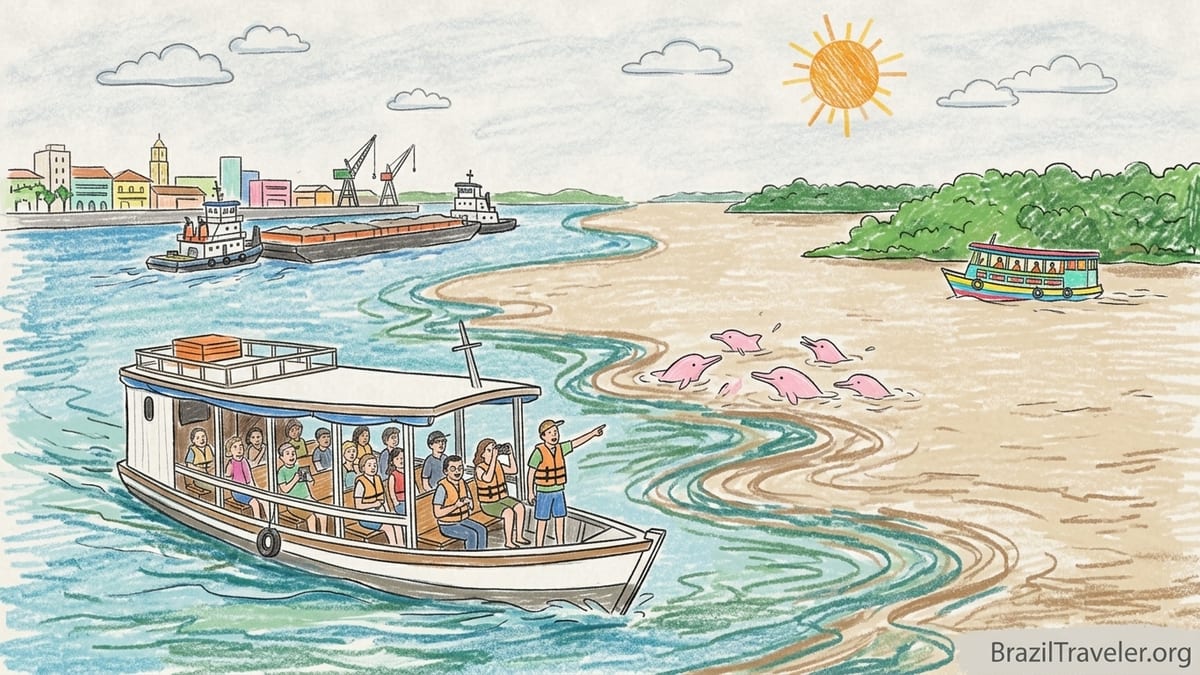
Boarding in Santarém: How I Actually Reached the Confluence
On a clear dry-season morning I walked down to the riverfront near the Port of Santarém, where most short excursions depart either from the municipal pier area in the city center or from the small beach by the Tapajós campus of the Federal University of Western Pará, known locally as UFOPA. My tour operator, a Santarém-based company that specializes in river expeditions and sports tourism, had confirmed departure the night before via messaging, warning that the itinerary could change with wind, rain or river conditions.
The boat that day was a covered regional launch with open sides, wooden benches and a small upper deck for photography. It was not one of the larger overnight Amazon-style boats with hammocks, but a simple vessel designed for half-day outings. There were roughly a dozen passengers, almost all Brazilian, and one local guide who spoke Portuguese and basic English. Life jackets were handed out as we boarded and the crew did a brief safety explanation before pushing away from the riverside.
For this specific city departure, the Meeting of the Waters segment was part of a combined city and river tour that also circled Santarém’s waterfront. On the date of my trip in 2026, the advertised price for a half-day group excursion that included the confluence section was in the region of 200 to 250 Brazilian reais per person, with payment accepted in cash and on local cards. Prices in Santarém have shifted in recent years with fuel and demand, so visitors should always confirm current rates directly with local operators or the municipal tourism office.
From casting off in central Santarém to the moment we reached the most striking stretch of color contrast took about 35 minutes of easy navigation. Wind was light, the river surface only mildly ruffled, and the morning haze over the Amazon limited very distant visibility but softened the light, which affected how the colors of the two rivers appeared to the naked eye and in photographs.
First Sight of the Meeting of the Waters
Leaving the Santarém waterfront, the boat followed the broad blue-green sweep of the Tapajós downstream, keeping the city’s riverfront promenade and port infrastructure off the port side. The Tapajós is a classic clearwater river, with relatively low sediment loads and higher transparency, which gives its surface a darker, greenish to bluish tone when seen from above. Scientific work on Amazon Basin water types classifies the Tapajós as a clearwater system with suspended sediment concentrations far lower than the sediment-rich Amazon main stem, and that difference is where the visual contrast at Santarém begins.
Ahead of us, the horizon filled with the pale, café-au-lait band of the Amazon River flowing in from the west. Hydrological studies describe the Amazon in this reach as a whitewater river, fed by Andean tributaries that carry heavy loads of fine sediment and dissolved solids, which give its waters a light brown, turbid appearance. Satellite imagery and field measurements show that the Amazon here can carry orders of magnitude more suspended sediment than the Tapajós, and that when the two meet, their different temperatures, densities and flow velocities slow the mixing process.
From the passenger deck, there was no perfectly ruler-straight line between colors. Under the hazy mid-morning light, the contrast was most obvious in broad, sweeping patches: nearer our Tapajós side the water remained darker and more transparent, while toward the Amazon the surface became visibly milkier, with turbulence and tiny streaks of foam marking the interface. On this particular day the transition zone looked more like a series of merging bands than a crisp border.
The captain eased the boat across the gradient so both sides of the vessel could lean over and compare. Looking straight down, you could see several tens of centimeters into the Tapajós water, enough to distinguish suspended particles and subtle green tones. Once we crossed into the Amazon side, the visibility dropped sharply. The water was opaque and beige-brown, and anything below the surface disappeared within a short distance. The difference was striking, but it depended heavily on the angle of the sun and the reflection of the sky on the surface.
How Close We Got and What It Felt Like On the Water
Our pilot brought the launch very near the most visible part of the color boundary, then began to trace a slow S-shaped path along it. At the narrowest point of apparent contrast, the Tapajós-toned water brushed right up against the bow, while just off the starboard quarter the water was distinctly lighter. Although many brochure photos make this phenomenon look like a solid painted stripe, the reality is dynamic. Small eddies and shear lines constantly tug at the border between the two water masses, so some moments the demarcation looked sharper, other moments more diffuse.
In terms of comfort, there was no alarming turbulence. Hydrological research in this stretch shows complex interactions between the Amazon’s powerful main flow and the broad, ria-like valley of the lower Tapajós, but at the surface on a calm day the effect on a small tourist launch is mainly a gentle, irregular rocking as you cross subtle current lines. No one on board appeared seasick, and standing at the rail for photos felt safe as long as you held the handrails. In stronger winds or at higher discharge levels, especially during peak rainy season flows, passengers may feel more chop and spray, something worth considering for those sensitive to motion.
The best photographic viewpoints on our boat were from the elevated stern and the bow. From the stern deck you could look back along the boat’s wake, which acted like a brush, pulling arcs of clear Tapajós water into the muddy Amazon surface and highlighting the difference in tones. From the bow, kneeling to reduce glare, I could frame the floating color boundary against the distant shorelines and cargo barges, creating context that pure aerial shots often lack. A polarizing filter would have helped cut surface reflection, but even with a smartphone, it was possible to capture the textural difference between the two water bodies.
What the Guide Said About the Rivers and What Science Confirms
Our guide described the Tapajós as a clear, “light” river flowing out of forested plateaus, and the Amazon as a dense, sediment-heavy giant coming in from faraway mountains. He explained that the Amazon’s whitewater carries large quantities of suspended mineral particles and nutrients that color the water and feed productive floodplain ecosystems, while the Tapajós’s clearer waters, with lower sediment and different chemistry, support somewhat different aquatic communities.
Hydrological and ecological studies broadly support this explanation, with important nuances. Scientific literature identifies three main Amazonian river water types: whitewater, clearwater and blackwater. The Amazon near Santarém is a classic whitewater channel, rich in suspended sediments derived from erosion in the Andes and other upland areas, which gives it a lighter brown color and higher turbidity. The Tapajós is classified as a clearwater river, with relatively low suspended sediment loads and comparatively higher transparency, often with greenish or bluish hues due to its depth and the way light interacts with dissolved substances.
Researchers who have measured suspended sediment and water chemistry in the Tapajós and Amazon near Santarém find that the confluence acts as an efficient sediment trap. The drowned valley of the Tapajós near its mouth, sometimes described as a ria, captures much of the Tapajós’s own sediment and also sequesters a portion of the Amazon’s load that intrudes into the system. Other studies show that temperature differences, current speeds and sediment concentrations between the rivers prolong the visible separation of water masses, which is what tourists perceive as the Meeting of the Waters.
The ecological implications go beyond color. Clearwater rivers like the Tapajós tend to support different assemblages of fish, plankton and aquatic plants compared with the more turbid, nutrient-rich whitewater channels. Genetic and biogeographic research suggests that the major rivers of the basin, including the Amazon and Tapajós, act not only as physical barriers to terrestrial species but also as ecological gradients for aquatic organisms. Our guide simplified these ideas for the boat audience, but the general outline of his commentary matched what hydrologists and ecologists describe in scientific work on the region.
Life on the River: Boats, Work and Wildlife
While everyone on our launch focused on the water colors, the confluence itself was busy with everyday river life. Large, boxy cargo barges pushed by tugboats rumbled along the Amazon channel, stacked with containers and bulk goods moving between Manaus, Santarém and Belém. Smaller steel-hulled freighters and regional passenger vessels followed marked routes, their hulls often stained in the same beige as the river that carried them. Watching these ships glide from turbid into clearer water and back again emphasized that the Meeting of the Waters is more than a visual phenomenon; it is a working crossroads for the interior of northern Brazil.
Closer to Santarém, wooden river buses painted in bright colors ferried residents to communities along the Tapajós and downstream Amazon. Several passed close enough for us to see hammocks strung side by side on open decks and improvised shade awnings over the bow. Small motorized fishing boats wove through this traffic, some casting nets near the edges of the color boundary where, as our guide noted, differences in water clarity and current can influence where certain fish feed.
Wildlife sightings at the confluence during our visit were modest but genuine. A pair of river dolphins surfaced several times off the port bow as we idled near the transition zone, their backs a soft gray-pink against the muddy Amazon water. A few black vultures circled over a sandbar further away, and distant kingfishers darted low over the clearer Tapajós side. The guide mentioned that bird activity can be more impressive at dawn or late afternoon, and that in high-water season parts of the adjacent floodplain hosts herons and egrets, but our late-morning, mid-season timing focused more on the hydrology than on wildlife.
From the water, the broader landscape framed the spectacle. To one side, the low bluffs and urban skyline of Santarém rose above the river, with grain silos and port cranes visible along the waterfront. On the opposite bank, continuous green forest and low-lying islands defined the horizon. It felt like a meeting not just of waters but of land uses: city and port on one side, expansive forest and rural communities on the other.
From Shore vs From Boat: Two Different Encounters
Before taking the boat, I had already walked along the Santarém waterfront, where locals gather on benches and promenades to watch the Meeting of the Waters unfold directly in front of the city. From shore, you see the confluence at a distance, almost like a painting. The band of paler Amazon water sweeps in from the left, the darker Tapajós surges in from the right, and where they meet, a distinct though somewhat blurred transition arcs across the river’s width. In late afternoon light, the contrast can stand out sharply, especially on clear days.
But standing on the promenade, that difference is more of a broad aesthetic impression. You are too far to peer into the water and judge transparency, and atmospheric conditions can wash out the finer subtleties of color. It is a wonderful free experience, and for travelers passing through with no time or budget for a tour, simply watching from shore absolutely conveys the basic phenomenon. Many Santarém residents experience the Meeting of the Waters this way, as a daily backdrop to life in the city.
On the boat, the encounter becomes embodied and layered. You feel the air cool slightly as your boat crosses closer to the Amazon’s main flow, and you can literally lean over and see the difference in clarity. You notice how the wake pulls and swirls the two waters together, how the interface curves and shifts with every eddy. You also gain a better sense of scale. From shore, it is difficult to appreciate how wide the combined river is; from mid-channel, with cargo ships as reference, the sheer breadth of the confluence feels almost oceanic.
If time is extremely limited, the waterfront viewpoint is a legitimate alternative, but it is a different experience. The land-based view is contemplative and static; the boat view is sensory and dynamic, anchored in the physics of moving water under your feet. For travelers keen on photography, especially those wanting close-up shots of the contrasting waters and working river traffic, the excursion on the water offers far more possibilities.
Side Trips to Lago do Maicá and Nearby Channels
Some Santarém operators combine the Meeting of the Waters with extensions to nearby channels and lakes, particularly Lago do Maicá, an area of flooded forest, channels and oxbow-like environments located upriver from the city. On my outing, the confluence itself was the focus, but I spoke with crew and travelers who had taken combined tours. They described half-day and full-day itineraries that first visit Maicá for birdwatching, glimpses of river dolphins and exposure to traditional riverside communities, then swing past the Santarém confluence on the way back.
Lago do Maicá and similar side trips add variety and ecological depth, especially for those interested in Amazonian wetlands. Seasonal fluctuations in Amazon and Tapajós water levels, influenced by regional rainfall and even tidal effects that propagate far upstream, flood and drain these backwater areas, creating rich habitats for fish, birds and aquatic plants. Guides point out how the suspended sediment from the Amazon and the clearer waters entering from tributaries shape water color and visibility in these lakes.
It is important, however, not to assume that every confluence excursion automatically includes Maicá or other secondary stops. Many short tours departing directly from Santarém or Alter do Chão simply navigate to the Meeting of the Waters, linger for photography and explanations, and return the same way. Others emphasize beaches along the Tapajós or Alter do Chão’s river islands, with only a brief pass near the confluence at the end. Travelers should read itineraries carefully and ask operators whether Maicá is part of the specific departure they are booking, and how much time is actually spent at the confluence itself.
From a time-management perspective, adding Maicá usually turns a straightforward 2 to 3 hour confluence outing into a half or full day program. For visitors with only a single night in Santarém, this may be more than they want to commit, especially if arrival and departure logistics are tight. For those staying longer or deeply interested in Amazon floodplain ecology, the combination can be extremely rewarding.
Costs, Private Boats and How Much Time You Really Need
On my visit in 2026, group excursions from Santarém that specifically advertise the Meeting of the Waters generally clustered in the 200 to 300 reais per person range for half-day trips, depending on inclusions such as hotel pickup, city tour segments or extended stops. Prices fluctuate with fuel costs, season and operator, and some smaller outfits or sports-oriented experiences such as outrigger canoe trips quote different rates. Travelers should view any figure as a snapshot and verify current pricing on site or through local tourism channels rather than relying on older guidebooks.
Private tours are readily available either through agencies or by negotiating directly with boat owners along the waterfront. A small private boat with captain suitable for a couple or small group might cost several hundred reais for a 2 to 3 hour trip, often negotiable based on time of day and whether weekends or holidays are involved. A private charter offers the advantage of timing your visit for the best light, lingering longer at the most photogenic patches of contrasting water and composing shots without competing for rail space.
Is the added cost of a private boat necessary for good viewing? In my experience, not strictly. Our shared launch was not overcrowded, and the captain made a clear effort to give both sides of the boat repeated views. For travelers serious about photography or video, especially those wanting sunrise or sunset conditions, a private arrangement does deliver more flexibility. For most visitors, a regular group tour in mid-morning or mid-afternoon suffices to appreciate the phenomenon.
In terms of time, the confluence segment itself can be appreciated meaningfully in about 30 to 45 minutes of slow navigation once you reach the area. Factoring in departure, transit to and from the city waterfront and potential weather or traffic delays, a realistic door-to-door timeframe for a basic boat-based Meeting of the Waters experience is around 2 to 3 hours. That makes it a feasible excursion even for those with only an overnight in Santarém, as long as flights or long-distance buses are not tightly clustered around dawn or late evening.
Comparing Santarém’s Meeting of the Waters with Manaus
Years before visiting Santarém, I had joined a boat tour to the famous Meeting of the Waters near Manaus, where the dark Rio Negro meets the sandy-colored Solimões, which downstream becomes the Amazon. That confluence, widely photographed and marketed as a major regional attraction, offers a different visual drama. The near-black, tannin-stained Rio Negro contrasts sharply with the pale Solimões, and the line between them can appear remarkably clean and straight over several kilometers, especially from the air or high-decked boats.
In Manaus, the phenomenon is driven by pronounced differences in temperature, speed and density between the two rivers, as well as contrasting sediment loads and dissolved organic matter. On a clear day, the line between the dark and light water masses can look almost artificial, which is why images from Manaus often go viral. The boat trip there usually includes other stops, such as floating houses and flooded forest walks, but the main event is that sharply delineated color front.
Santarém’s Meeting of the Waters is subtler. The color difference between the turbid Amazon and the blue-green Tapajós is significant, but because the Tapajós is clear rather than black, the overall palette is softer. The transition between colors, at least during my visit, presented as wide, complex mixing zones rather than a long, crisp frontier. Where Manaus’s confluence feels like a dramatic border between two very distinct personalities, Santarém’s feels like a broad negotiation between a dominant, sediment-laden giant and a deep, clear tributary spreading into a drowned valley.
From a traveler’s perspective, Manaus delivers the more instantly photogenic, high-contrast spectacle, while Santarém offers a more nuanced, spatially expansive scene that integrates naturally into the daily life of the city. Having seen both, I found Santarém’s confluence more interesting in terms of understanding river processes and the geography of the lower Amazon. It feels less like a staged attraction and more like a living intersection of waterways, ports and communities.
The Takeaway
Arriving in Santarém, I imagined the Meeting of the Waters as a simple postcard image: brown and blue-green rivers divided by a neat, ruler-straight line. Standing on the boat with the wind in my face and the murmur of engines beneath my feet, the reality proved more layered. The contrast was absolutely visible, but it shifted with sun angle, wind ripples and our position relative to the current. Some stretches looked close to the classic promotional photos; others resembled a wide, turbulent patchwork where colors blended in slow motion.
From the excursion, I learned how two of the largest rivers in the world differ not just in color but in sediment load, temperature, clarity and ecological roles. The Amazon carries vast amounts of fine material scraped from distant mountains and floodplains, feeding nutrient-rich floodplains downstream. The Tapajós arrives clearer and deeper, its ria-like lower valley acting as a sink for sediments and a corridor of distinct aquatic communities. At Santarém, they meet in a broad, dynamic handshake that you can see, feel and, with some luck, photograph in ways that reflect its complexity rather than just its postcard image.
Was the paid boat trip necessary? For anyone with more than a passing interest in rivers, geography or photography, I would say yes, within reason. Watching from the Santarém waterfront is beautiful and completely free, and it gives a strong sense of the basic phenomenon. Yet only on the water can you appreciate the changing textures of the interface, the work of the currents under the hull and the everyday choreography of cargo ships, ferries and fishing boats that ply this junction. The cost of a group excursion is significant but not prohibitive for many travelers, and it compresses a remarkable amount of Amazon-scale geography into a few hours.
For travelers staying only one night in Santarém, I would weigh timing carefully. If your arrival and departure leave a solid half-day of margin, a simple boat outing focused on the confluence is a worthwhile use of that time, especially if you have already seen Alter do Chão’s beaches elsewhere or are particularly drawn to big-river landscapes. If your schedule is tight or your budget constrained, an evening stroll along the waterfront, watching the wide river surface where Amazon and Tapajós meet in front of the city, still offers a memorable and authentic impression of this singular place.
FAQ
Q1. Where do most Meeting of the Waters boat tours depart from in Santarém?
Most short tours depart from the central Santarém waterfront near the municipal pier or from the small beach area by UFOPA’s Tapajós campus, both within easy reach of the city center.
Q2. How long does a typical boat tour to the Amazon–Tapajós confluence take?
A straightforward group excursion that focuses on the confluence usually takes around 2 to 3 hours door to door, including navigation time from and back to the Santarém waterfront.
Q3. How much does a Meeting of the Waters boat trip cost?
In 2026, many half-day group tours that include the confluence cost in the region of 200 to 300 Brazilian reais per person, though visitors should always confirm current prices locally.
Q4. Is it possible to see the Meeting of the Waters without taking a boat?
Yes. The confluence is clearly visible from Santarém’s riverfront promenade and viewpoints in town, providing a free and still impressive way to experience the phenomenon from shore.
Q5. Are private boat tours worth the extra cost?
Private tours offer more flexibility for photography, timing and how long you linger at the color boundary, but most travelers will be well served by a regular small-group excursion.
Q6. How does Santarém’s Meeting of the Waters differ from the one near Manaus?
Near Manaus, the very dark Rio Negro meets the pale Solimões with a sharp, high-contrast line, while in Santarém the muddy Amazon meets the blue-green Tapajós in a broader, subtler transition zone.
Q7. When is the best time of day to photograph the confluence?
Early morning and late afternoon tend to offer softer light and stronger color contrast, though visibility also depends on weather, haze, surface ripples and the time of year.
Q8. Will I always see a perfectly sharp line between the rivers?
No. The clarity of the boundary varies with wind, sunlight, river levels and sediment distribution. Some days it looks crisp; other days it appears more diffuse and patchy.
Q9. Do all Meeting of the Waters tours include Lago do Maicá?
No. Some excursions add Lago do Maicá or other channels, while others visit only the confluence. It is important to check each itinerary to confirm exactly which stops are included.
Q10. Is the Meeting of the Waters boat trip suitable for travelers with limited time?
Yes, if you can spare a few hours. A focused 2 to 3 hour excursion fits into a single overnight stay, but those with very tight schedules can still appreciate the view from the Santarém waterfront.