


The Brazilian Amazon is one of the hardest cruise regions to compare. A three-night loop from Manaus on a traditional riverboat, a week on a new 32-passenger expedition catamaran and a 30-day ocean cruise from North America that dips briefly into the Amazon can all appear side by side when you search. Yet they offer profoundly different experiences, price points and levels of immersion in the rainforest. This guide focuses on the best Amazon River cruises in Brazil for the 2026–2027 seasons, with verified examples of routes, prices and ships so you can match the right style of voyage to your expectations and budget.
Understanding the Brazilian Amazon: Main River vs Rio Negro vs Solimões
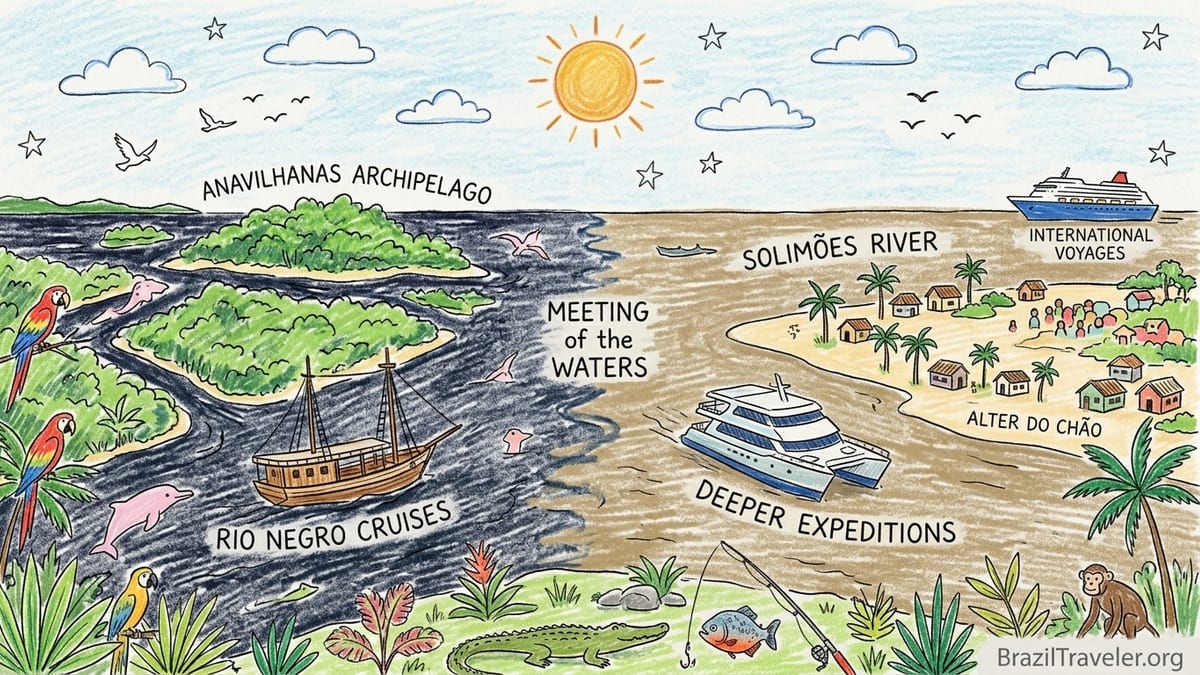
Before comparing ships and prices, it is essential to understand where in the Brazilian Amazon you will actually sail. Many itineraries marketed as “Amazon cruises” from Manaus primarily explore the Rio Negro, a dark-water tributary that joins the milky-brown main Amazon at the famous Meeting of the Waters just outside the city. Others head west along the Solimões, the local name for the upper Amazon in Brazil, while longer expeditions and international ships follow the main Amazon east between Manaus, Santarém and the Atlantic.
Rio Negro cruises, such as those operated by MV Desafio and Amazon Clipper, often focus on the Anavilhanas Archipelago northwest of Manaus. Here, blackwater channels, flooded forests and sandy beaches create a relatively mosquito-light environment because the acidic water is less favorable to larvae. Wildlife viewing tends to emphasize birdlife, river dolphins and forest walks rather than dense mosquito swarms, which many travelers appreciate in the humid equatorial climate around Manaus.
By contrast, cruises that follow the main Amazon between Manaus, Santarém, Alter do Chão and Belém, including the new RV Brasilian Dream and long Holland America itineraries, travel through greener floodplain regions with more villages, broader sandbars and higher mosquito potential. These routes feel more like a journey across a vast river nation, with repeated stops in riverside communities, long panoramic stretches and a stronger sense of human life along the banks.
Solimões routes, used by some regional operators out of Manaus, head west into a maze of channels and lakes that form the upper Amazon inside Brazil. These itineraries can be superb for birdwatching and primate spotting, but they are less common on international booking platforms than Rio Negro loops. When you compare cruises, always check whether your ship’s map shows mainly Rio Negro, Solimões or the trunk of the Amazon River itself, because this shapes the environment, villages visited and wildlife you will encounter.
Short 3–4 Day Cruises from Manaus: Classic Rio Negro Experiences
Three- and four-day cruises from Manaus are the most accessible introduction to the Brazilian Amazon for travelers with limited time. These itineraries typically depart in the afternoon from central Manaus and return three or four days later, after visiting the Meeting of the Waters and several sites in the Anavilhanas Archipelago on the Rio Negro. MV Desafio and the Amazon Clipper fleet are among the best known options in this category, with scheduled dates already listed into 2026 on Brazilian and international booking channels.
MV Desafio operates a charming sailing-style vessel with a wooden schooner profile and cabins fitted with air conditioning and private bathrooms. The Maguari 4-day / 3-night route, for example, departs Manaus at 14:00 from the riverfront pier and spends the next days exploring islands and channels of the Rio Negro before returning to the city. Recent 2026 rate tables for this itinerary show prices on the order of 6,000 to 7,500 Brazilian reais per person for a standard double cabin, depending on season and cabin category, which is roughly the midrange of Manaus-based cruises for this duration.
Amazon Clipper offers at least two main products from Manaus: the Amazon Clipper Traditional boats and the more modern, higher-comfort Amazon Clipper Premium. Both typically run 3-day / 2-night and 4-day / 3-night cruises from Manaus on the Rio Negro, with occasional extensions along the Amazon near the Meeting of the Waters. Traditional vessels carry fewer guests in simpler, compact cabins, while Premium ships have larger outside cabins, often with panoramic windows and more contemporary fittings. Public information for current and recent years suggests that 3-day programs on the Traditional boats often start around 900 to 1,100 US dollars per person, while Premium itineraries of the same length can be closer to 1,300 to 1,700 US dollars per person in the 2026–2027 timeframe, excluding flights.
Short Manaus cruises are immersive in terms of daily activity. Most schedules include dawn birdwatching by canoe, forest walks with a naturalist guide, piranha fishing, nighttime caiman-spotting and visits to small communities or rubber-tapping demonstrations. However, the ships never travel far from Manaus geographically, and you will not reach remote Amazon settlements like Santarém or Alter do Chão. For travelers comparing these options to a long ocean cruise that briefly enters the Amazon, it helps to understand that you are trading a modest sailing distance for very dense time on the water and in the forest.
Six- and Seven-Day Small-Ship Expeditions: Deeper Exploration with Fewer Guests
For travelers who want more time in the rainforest without committing to multi-week voyages, six- and seven-day small-ship expeditions are often the sweet spot. The upcoming RV Brasilian Dream stands out as one of the most interesting new options for 2026–2027. Operated for the European company CroisiEurope and featured by specialist expedition agencies, this twin-hulled catamaran is purpose-built for the Brazilian Amazon and carries only around 32 guests, a notably low passenger count for the region.
RV Brasilian Dream is designed with all-outside cabins, private bathrooms, air conditioning and large windows suitable for wildlife viewing from your bed. Promotional specifications indicate compact but comfortable cabins around the size of a good European river-cruise stateroom, with contemporary decor rather than nautical wood paneling. Public descriptions emphasize the ship’s shallow draft and high maneuverability, which allow it to enter smaller tributaries and sandbank-guarded channels that are inaccessible to larger vessels. Operations are scheduled to begin with itineraries in late 2026 and 2027, including combinations of the main Amazon, the Tapajós River and stops such as Alter do Chão and Santarém.
Price examples for RV Brasilian Dream in 2026–2027 show week-long packages such as a Rio de Janeiro plus Amazon and Tapajós itinerary, often marketed as 8 days including hotel nights, with cruise-only segments priced broadly in the 2,500 to 3,800 US dollar range per person for standard cabins. Exact figures vary by departure date and whether airfare and pre- or post-cruise hotel nights are bundled. Because the ship carries only 32 passengers, the per-person cost is higher than many Manaus-based short cruises, but in exchange you receive a longer route, a lower guest-to-guide ratio and more varied environments.
Other regional operators from Manaus and Santarém offer week-long expeditions on vessels of 20 to 40 passengers, often combining Rio Negro blackwater sections with main Amazon segments near Santarém or on the Tapajós. These itineraries typically include all meals, daily guided excursions and filtered drinking water, while alcoholic drinks and optional kayak or stand-up paddleboard rentals may carry an extra charge. For 2026 and 2027, base rates for such seven-day programs commonly range from about 2,000 to 3,000 US dollars per person, depending on the vessel’s comfort level and the strength of the dollar against the real at the time of booking.
Extended Manaus–Santarém Cruises and Main-River Routes
Extended Brazilian itineraries that link Manaus, Santarém, Alter do Chão and sometimes Belém provide a very different atmosphere from Rio Negro loops. Instead of remaining close to Manaus and focusing heavily on Anavilhanas, these routes travel along the main Amazon River itself and offer a stronger sense of long-distance journey. RV Brasilian Dream is emblematic of this style for 2027, with programs that connect coastal Brazil and the heart of the Amazon, often including flights between Rio de Janeiro and Manaus as part of a larger package.
Along this central corridor, stops like Santarém and nearby Alter do Chão deliver a change of scenery. Alter do Chão is widely known in Brazil for its white-sand river beaches and clear waters of the Tapajós, which contrast with the brown Amazon. Cruises that call here often schedule beach time, swimming and sunset drinks on sandbars, which some travelers consider as memorable as wildlife-viewing sessions. In villages like Boca da Valéria, further downriver toward the Atlantic and included on many international lines’ calls, guests usually encounter a more touristed showcase of local life, with school visits, artisans and informal cultural performances.
Extended Manaus–Santarém cruises often last from 7 to 12 nights and can be booked either as standalone cruises or as segments within larger voyages. Cabins usually remain compact but all en suite and air conditioned, with two lower beds or one double, and the small passenger count, commonly under 100, helps maintain an expedition feel. Prices for such itineraries during the 2026–2027 seasons, excluding bundled air and city hotels, typically sit between about 3,000 and 5,000 US dollars per person in double occupancy, depending on ship standard and length. Travelers comparing these to a 30-day international itinerary should note that almost every day on these routes is spent actually within the Brazilian Amazon system, rather than at sea or in the Caribbean.
Excursions on main-river cruises balance nature and culture. You may start the morning with a sunrise small-boat ride looking for pink river dolphins and macaws, then spend the afternoon visiting a caboclo farming community to learn about manioc processing. At night, some ships organize talks in English and Portuguese about deforestation, conservation and regional history. Given the smaller scale, guides often learn guests’ interests and can tailor commentary toward birdwatching, photography or social issues, which is harder to achieve on a 1,000-passenger ocean ship.
Premium All-Inclusive Amazon Packages and Launch of RV Brasilian Dream
Premium all-inclusive packages combine high-comfort ships with bundled logistics that reduce planning stress. These are particularly attractive for travelers flying long-haul into Manaus who prefer to have transfers, hotels and most drinks included in a single contract. For 2026–2027, the launch of RV Brasilian Dream is prompting several European and North American agencies to offer inclusive itineraries pairing a Brazil city stay, domestic flights and a week-long cruise.
For example, a sample “Rio de Janeiro, the Gentle Amazon and the Tapajós River” program built around RV Brasilian Dream for 2027 may cover 9 to 11 days including hotel nights in Rio and Manaus, escorted domestic flights and a week on the Amazon. Price indications from recent brochures show per-person rates for these full programs in the range of roughly 4,000 to 6,000 US dollars for standard cabins, with wine and beer included at meals and soft drinks available throughout the day. Such packages are positioned firmly in the premium segment, targeting guests who might otherwise choose a European river cruise or Galápagos yacht.
Other operators from Manaus, including some running Amazon Clipper Premium vessels, also market all-inclusive-style packages with one or two hotel nights in Manaus, airport transfers, a 3- or 4-night cruise and occasionally a post-cruise rainforest lodge stay. In these cases, short itineraries on the river may account for only half of the total package length, but nearly all of the on-the-water experience. Package prices for 6- to 7-night land-plus-river combinations in 2026–2027 typically cluster between 2,500 and 4,000 US dollars per person excluding international airfare, though figures vary with hotel category and whether alcoholic drinks are included.
Compared with booking a short Manaus cruise alone, premium packages deliver clarity on total cost and reduce surprise extras. Most include port taxes, onboard gratuities and basic excursions, though massage treatments, private photo tours and top-shelf spirits usually remain optional. English is widely spoken among staff on these premium vessels, and naturalist guides often rotate between Portuguese, English, Spanish and French during daily briefings. Travelers with strong preferences about language should still confirm in advance whether their primary language is guaranteed on their departure date.
International Ocean Cruises Entering the Brazilian Amazon
Several ocean cruise lines, notably Holland America and Oceania, operate multi-week voyages that travel from North America or the Caribbean into the Brazilian Amazon and back. For 2026–2027, Holland America’s Volendam is scheduled to run 27- and 30-day Legendary Amazon Explorer itineraries, with departure examples such as November 22 and November 25, 2026, roundtrip from Fort Lauderdale or starting in New York. These cruises sail south through the Caribbean, cross the Amazon River bar near the Atlantic, then follow the river inland with calls at ports such as Santarém, Boca da Valéria, Parintins, Alter do Chão and Manaus before turning back.
On these ocean itineraries, only a portion of the voyage takes place on the Amazon itself. For instance, crossing the bar, calling at Santarém, Boca da Valéria, Parintins and spending an overnight in Manaus might occupy roughly 8 to 10 days of a 27- or 30-day itinerary, with the remaining time spent at sea or in Caribbean ports like Martinique, Barbados and Curaçao. Recent price snapshots for these 30-night Amazon Explorer cruises, depending on cabin category and promotions, often show lead-in inside cabins in the region of 4,000 to 6,000 US dollars per person, with veranda and suite accommodations rising significantly higher.
Oceania and other premium ocean lines periodically schedule similar Amazon-inclusive itineraries, commonly 20 to 25 days in length and starting from US ports, San Juan or Caribbean islands. These trips are usually marketed to guests already familiar with ocean cruising who want to add the Amazon to a broader collection of destinations. Cabins are larger than on most Amazon riverboats, often 18 to 30 square meters for balcony categories, and amenities include multiple restaurants, spas, theaters and large swimming pools. Excursions in Amazon ports emphasize half-day boat rides into side channels, village visits and cultural shows rather than full days of deep forest exploration.
This is where the fundamental difference between a three-day Manaus cruise and a 20- or 30-day international voyage becomes clear. On a short Manaus-based trip, you will spend nearly every hour within the Amazon ecosystem, waking to forest sounds and navigating narrow channels in small boats each day. On a long international cruise, you will experience the Amazon more as a series of intensive shore days and scenic river transits embedded within a traditional ocean-cruise rhythm of sea days, shows, casinos and varied ports. Neither style is inherently better, but they suit very different expectations.
Cabins, Comfort, Excursions and Onboard Life: How Ships Compare
Cabin size and design are among the key variables that influence price. On regional Amazon vessels such as Amazon Clipper Traditional, MV Desafio and similar boats, standard cabins are compact, often in the range of 8 to 12 square meters, configured with bunk beds or small doubles, and efficiently fitted with private bathrooms and individual air-conditioning units. Amazon Clipper Premium and RV Brasilian Dream move closer to European river-cruise standards, with outside cabins typically in the low- to mid-teens of square meters, queen or twin beds and large windows or French balconies that admit abundant light and views.
Ocean ships like Holland America’s Volendam and Oceania’s mid-size vessels dramatically increase cabin space. Inside cabins may be comparable in size to premium Amazon river cabins, but balcony staterooms run larger and feature seating areas, full-sized wardrobes and larger bathrooms. Suites provide living rooms, multiple balconies and bathtubs that are virtually never found on small Amazon expedition ships. However, this space comes at the cost of intimacy. An ocean ship carrying more than 1,000 passengers, even when partly empty, will not deliver the same quiet, low-impact experience as a 32-passenger catamaran watching pink dolphins at dusk.
Naturalist guiding is another major differentiator. Dedicated Amazon expedition ships such as MV Desafio, Amazon Clipper and RV Brasilian Dream typically carry resident naturalist guides who accompany almost every excursion and deliver evening lectures on flora, fauna and local culture. Group sizes for outings may range from 8 to 16 guests per guide, allowing detailed Q and A and flexibility. On international ocean ships, guiding is handled through contracted local operators in each port, and groups on popular excursions can be larger, sometimes 20 to 30 passengers per guide, which can feel less personal, especially for serious birders and photographers.
Meals and drinks follow similar patterns. Most regional Amazon cruises are technically full board, with three meals daily and filtered water included. Non-alcoholic drinks and coffee are often free or inexpensive, while beer, wine and cocktails are charged separately. Premium products like Amazon Clipper Premium and RV Brasilian Dream increasingly include house wine and beer with lunch and dinner. International ocean lines usually operate on a full-board basis but sell drink packages or a la carte alcoholic beverages. Specialty restaurants may require supplements. Travelers concerned about overall cost need to factor in drinks, gratuities and optional excursions when comparing a 1,500 dollar short expedition to a 4,500 dollar month-long voyage.
Health, Safety, Cancellations and Practical Logistics
Health and safety considerations in the Amazon focus on mosquitoes, heat and access to medical care. Rio Negro itineraries, including many MV Desafio and Amazon Clipper cruises, benefit from the river’s dark, acidic water, which supports fewer mosquito larvae than whitewater regions. However, no Amazon trip is entirely mosquito-free. Travelers should bring long-sleeved light clothing, high-percentage DEET or other proven repellents, and, where appropriate, seek medical advice about malaria prophylaxis or yellow fever vaccination several weeks before departure. Ships typically provide mosquito nets or screened windows and keep doors closed to limit insects in cabins.
Most regional river vessels have basic medical kits and staff trained in first aid, but they do not carry full medical facilities. In case of serious illness or injury, evacuation to Manaus or another major center is required, often by speedboat and then commercial flight or air ambulance. Ocean cruise ships like Volendam carry more extensive medical centers and doctors, but even there, complex cases are usually stabilized and evacuated at the next port. Comprehensive travel insurance that covers medical evacuation and trip interruption is especially important for 2026–2027 Amazon cruises, as regional aviation and river transport infrastructure can be heavily affected by seasonal water levels and weather.
Cancellation conditions differ significantly between operators. Regional Amazon cruise companies often require substantial nonrefundable deposits within a few days of booking, with final payment due 60 to 90 days before departure and sharply escalating penalty percentages as you approach the sail date. Some international lines, including Holland America, have more flexible refund windows for standard South America cruises but apply stricter terms to long “Legendary” or “Grand Voyage” itineraries that include the Amazon sections. Always confirm the penalty schedule that applies specifically to your chosen sailing dates, as policies can change between 2024 and the 2026–2027 season.
Given limited long-haul flight options into Manaus, many experienced travelers and online trip reports recommend arriving at least one day before any Amazon cruise departure. International flights and Brazilian domestic connections into Manaus frequently arrive after midnight or in the very early hours, and weather-related delays are not uncommon. Booking a hotel night before boarding your ship reduces the risk of missing departure because of late luggage or rerouted flights. Some premium packages include this pre-cruise night and the transfer to the pier, which is worth factoring into total value comparisons.
2026–2027 Comparison Table: Key Amazon Cruise Options
The table below summarizes typical examples of Amazon cruise options in Brazil for the 2026–2027 seasons. Prices are indicative per person in double occupancy, based on rates published or widely advertised in late 2025 and 2026. Exact figures will vary by sailing date, cabin type and currency fluctuations, so treat these as benchmarks rather than fixed quotes.
Example 1: Amazon Clipper Traditional, 3 days / 2 nights, Rio Negro from Manaus. Departure port: Manaus. Duration: 3 days. Route: Meeting of the Waters and Anavilhanas region on the Rio Negro. Passenger limit: generally a few dozen guests. Inclusions: all meals, water, scheduled excursions by motorized canoe and forest walks with a naturalist. Additional charges: soft drinks and alcoholic beverages, crew tips and optional city hotel nights. Typical 2026–2027 price range: roughly 900 to 1,100 US dollars per person for standard cabins.
Example 2: Amazon Clipper Premium, 4 days / 3 nights, Rio Negro from Manaus. Departure port: Manaus. Duration: 4 days. Route: extended Rio Negro loop, often more time in Anavilhanas and additional community visits. Passenger limit: similar or slightly higher than Traditional but with more spacious public areas. Inclusions: all meals, water, excursions and often better cabin furnishings. Additional charges: drinks, gratuities, transfers and pre-cruise accommodation. Typical 2026–2027 price range: roughly 1,300 to 1,700 US dollars per person.
Example 3: MV Desafio Maguari 4 days / 3 nights, Rio Negro. Departure port: Manaus. Duration: 4 days. Route: Rio Negro and Anavilhanas Archipelago. Passenger limit: usually a few dozen, with cozy schooner-style layout. Inclusions: full board, guided excursions, piranha fishing, nocturnal wildlife outings. Additional charges: drinks, optional city tours, hotel nights and tips. Recent 2026 rate sheets in Brazilian reais translate broadly into 1,000 to 1,400 US dollars per person in standard double cabins, subject to exchange rate shifts.
Example 4: RV Brasilian Dream, approximately 7 nights, main Amazon and Tapajós region. Departure ports: often Manaus and Santarém, sometimes included within longer packages starting in Rio de Janeiro. Duration: around 7 nights on board. Route: sections of the main Amazon between Manaus and Santarém, plus the Tapajós River and Alter do Chão area. Passenger limit: 32 guests in outside cabins. Inclusions: all meals, excursions with naturalist guides, water and usually some house wine and beer with meals. Additional charges: premium drinks, optional pre- and post-cruise hotels and international flights. Indicative 2026–2027 cruise-only prices: roughly 2,500 to 3,800 US dollars per person.
Example 5: Holland America Volendam Legendary Amazon Explorer, 27 or 30 nights. Departure port: Fort Lauderdale or New York, with late November 2026 departures among those listed. Duration: 27 to 30 nights. Route: Caribbean islands plus Amazon River calls such as Santarém, Boca da Valéria, Parintins, Alter do Chão and overnight in Manaus. Passenger capacity: around 1,400 guests. Inclusions: accommodation, main meals, onboard entertainment and basic port charges. Additional charges: shore excursions, drinks, gratuities and specialty dining. Indicative 2026 lead-in prices from mainstream agencies: approximately 4,000 to 6,000 US dollars per person for the least expensive inside cabins, with balcony and suite accommodations much higher.
Recommendations by Traveler Type and Value Considerations
Couples seeking a romantic but authentic Amazon experience in 2026–2027 are likely to appreciate 3- or 4-night Rio Negro cruises on MV Desafio or Amazon Clipper Premium. The combination of sunsets over blackwater channels, manageable ship size and frequent wildlife excursions creates an intimate atmosphere without the crowds of a large ocean vessel. Selecting a double cabin with large window rather than bunks particularly suits couples celebrating anniversaries or honeymoons.
Families with older children or teenagers often benefit from slightly larger ships and longer itineraries, such as a week on RV Brasilian Dream or other small expedition vessels operating between Manaus and Santarém. These cruises offer enough cabin comfort and air conditioning for children to rest well, while daily activities like canoe tours, village visits and beach time in Alter do Chão keep interest levels high. Parents should check minimum age policies and whether life jackets and excursion briefings are provided with English explanations.
Serious wildlife enthusiasts, birders and photographers will generally obtain the greatest value from small-ship expeditions of at least six nights, where the ratio of forest time to travel day is highest. A 3-day Manaus loop may feel rushed if your goal is a long checklist of species, while a 30-day international voyage will dilute Amazon viewing with many sea days. Choosing a vessel like RV Brasilian Dream or a comparable 20- to 40-passenger boat, verifying that multiple daily excursions are planned and confirming that guides are experienced naturalists will make far more difference than an extra few square meters of cabin space.
Luxury travelers who prioritize cabin size, varied dining and full spa facilities may find that international ocean cruises such as Holland America’s Legendary Amazon Explorer or comparable Oceania itineraries strike the right balance. These voyages provide balcony cabins, a broad range of restaurants and stable pricing in dollars, while still delivering several days of Amazon River experience and an overnight in Manaus. The trade-off is less immersion in the rainforest and larger excursion groups, but for those who value comfort and predictability over expedition-style intimacy, these ships are compelling.
Travelers focused on overall value rather than the most expensive ship should start by deciding how many days they truly want inside the Amazon. A four-night Manaus riverboat cruise for around 1,200 US dollars per person that spends nearly all its time on the Rio Negro can deliver more concentrated Amazon experience per day and per dollar than a 25- or 30-day ocean voyage where the river is just one segment. On the other hand, if you already budget for a month at sea and want the convenience of a single unpack, a 27- or 30-day international itinerary that combines Caribbean beaches and the Amazon may be your best-value path to adding the rainforest to a broader trip.
FAQ
Q1. How far in advance should I book an Amazon river cruise in Brazil for 2026 or 2027?
For small ships carrying only 20 to 40 passengers, including RV Brasilian Dream and many Manaus-based boats, it is prudent to book 9 to 12 months in advance, especially for peak months such as July, August and late December. Large ocean cruises that include the Amazon often have more inventory and can sometimes be booked closer to departure, but the best-priced cabins usually sell first.
Q2. Is a three-day Manaus cruise enough to really experience the Amazon?
A three-day loop from Manaus provides an excellent introduction to the Rio Negro environment, with multiple wildlife excursions and a visit to the Meeting of the Waters. However, it covers only a small geographic area and does not reach towns like Santarém or Alter do Chão. Travelers seeking a deeper understanding of Amazon cultures and landscapes may prefer at least a six- or seven-day itinerary.
Q3. What is the main difference between Rio Negro and main Amazon River cruises?
Rio Negro cruises explore dark, acidic waters with relatively fewer mosquitoes and many islands and channels, focusing on birds, dolphins and flooded forests. Main Amazon River cruises between Manaus and Santarém or toward the Atlantic encounter greener floodplains, more villages, larger sandbars and higher mosquito presence, offering a stronger sense of human life along the river.
Q4. How much should I budget per person for a quality Amazon cruise in 2026–2027?
As a rough guide, three- or four-day Manaus-based cruises on solid midrange vessels commonly run from around 900 to 1,500 US dollars per person excluding flights. Week-long small-ship expeditions tend to range between 2,500 and 3,800 US dollars, while 27- to 30-day international ocean cruises that include the Amazon often start around 4,000 to 6,000 US dollars for inside cabins.
Q5. Are Amazon river cruises suitable for young children?
Policies vary by operator, but most expedition-style Amazon cruises are better suited to older children who can follow safety instructions and handle heat and humidity. Some ships set minimum ages between 6 and 8 years. Families should check life jacket sizes, cabin configurations and whether flexible meal options are available before booking.
Q6. Do I need vaccinations or malaria tablets for an Amazon cruise?
Many travelers obtain yellow fever vaccination and discuss malaria prophylaxis with a travel-medicine specialist before visiting the Brazilian Amazon, especially when spending time in main-river floodplain regions. Requirements and medical advice can change, so it is important to consult an up-to-date professional source several weeks before departure rather than relying on older information.
Q7. What should I pack for an Amazon cruise from Manaus?
Essentials include lightweight long-sleeved shirts and trousers, a wide-brimmed hat, strong insect repellent, high-SPF sunscreen, closed walking shoes, a waterproof jacket, binoculars and any personal medications. A small daypack and a dry bag are useful for canoe excursions, and many travelers bring a camera with a telephoto lens for wildlife.
Q8. Are meals and drinks included in Amazon cruise prices?
Most regional Amazon cruises include three daily meals and drinking water, with some also offering coffee and basic soft drinks. Alcoholic beverages and premium coffees are normally extra, though a few premium products include wine and beer with lunch and dinner. International ocean cruises include meals but usually sell drink packages separately.
Q9. How reliable are flight connections into Manaus for cruise departures?
Manaus has regular domestic flights from Brazilian hubs and occasional international services, but schedules can change and late-night arrivals are common. Delays due to weather or connections are not unusual, so many operators and experienced travelers recommend arriving at least one day before cruise embarkation.
Q10. Can I easily combine an Amazon cruise with other Brazilian destinations?
Yes. Many travelers pair a short or week-long Amazon cruise with stays in Rio de Janeiro, São Paulo, Salvador or the beaches of the Northeast. Some premium packages, especially those involving RV Brasilian Dream, already bundle city hotels and internal flights, making it straightforward to experience both urban Brazil and the rainforest on the same trip.