


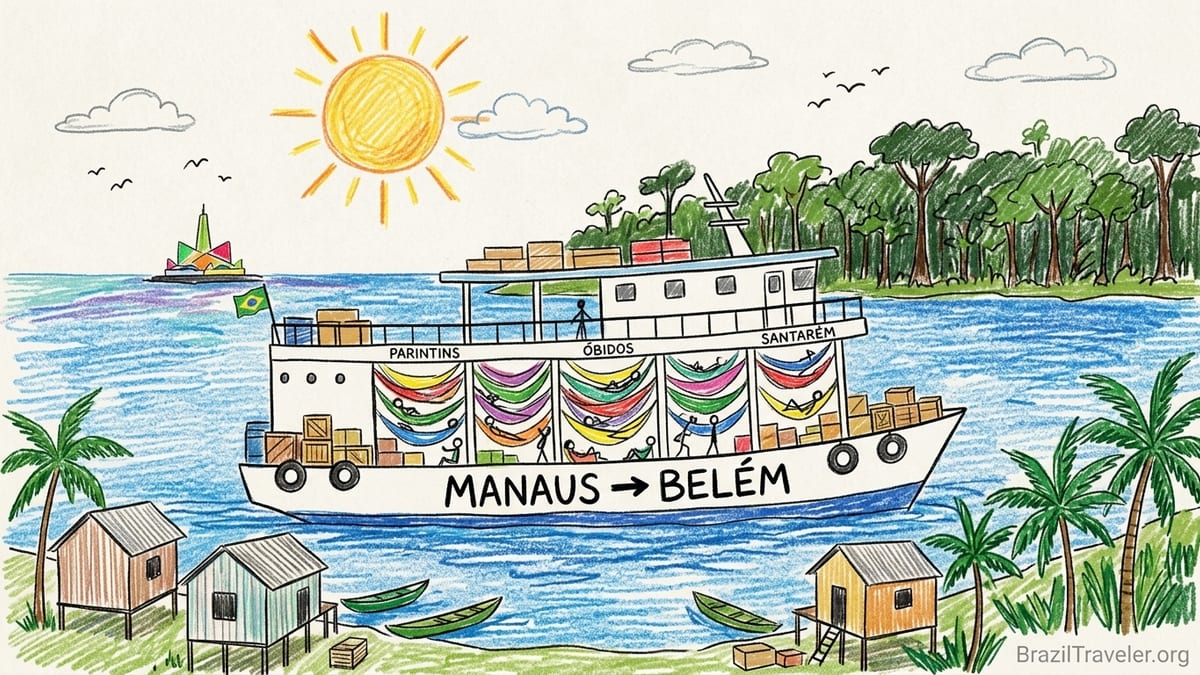
Traveling by river boat from Manaus to Belém is one of the most iconic journeys in the Brazilian Amazon. It is not a luxury cruise but a long, slow trip on a working passenger vessel that links river towns, carries cargo and offers travelers a close look at everyday life on the Amazon. This guide explains exactly how to book and what to expect between Manaus, Parintins, Juruti, Óbidos, Santarém and Belém in late 2026.
Understanding the Manaus to Belém River Route
The Manaus to Belém route follows the main axis of the Amazon River between the capital of Amazonas state and the capital of Pará. Passenger boats sail downstream from Manaus to Santarém and Belém, and upstream in the opposite direction, usually taking between four and seven days for the full journey depending on the vessel, water level and number of cargo stops. For many residents this is the primary way to reach family, markets and medical care, so travelers share the boat with local passengers and freight rather than tourists on a cruise program.
On the classic downstream route from Manaus to Belém the main intermediate ports are Parintins in Amazonas, and then Juruti, Óbidos and Santarém in Pará. Official timetables from Brazilian waterway regulators show licensed passenger vessels on the Manaus to Santarém sector that call at Itacoatiara, Parintins, Juruti and Óbidos in sequence, usually in a single long travel day between Manaus and Santarém. Other boats and ferries connect Santarém to river communities and eventually to Belém, which turns the through journey into a chain of linked segments for most travelers.
The river itself is wide and often featureless for hours, but close to settlements boats move near the banks and you see stilt houses, small canoes, floating fuel stations and forested islands. At night the deck fills with the light and sound of hundreds of hammocks, while cargo crews continue loading and unloading goods at riverside ports. It is an immersive logistical experience rather than a curated wildlife trip, which is why many travelers use it to complement, rather than replace, shorter nature tours from Manaus or Santarém.
Travelers comparing this route with expensive Amazon cruises should understand the core difference. Regional passenger boats are public transport first and an adventure second. They lack structured excursions, naturalist guides and fixed daily programs. In exchange, the ticket price is far lower than a cruise cabin and the experience is closer to how most Amazonians really travel.
Which Operators Actually Run Manaus – Santarém – Belém
Several regional navigation companies are authorized to run long distance services in the Amazon basin, and these services change occasionally as vessels are replaced or reassigned. Licensing documents from the federal waterways agency list companies allowed to run mixed passenger and cargo services between Manaus and Belém, while local schedules show concrete examples of boats such as the ship A Noiva II operating the Manaus to Santarém corridor via Parintins, Juruti and Óbidos on specific days of the week. That particular vessel runs as a classic hammock and cabin passenger boat rather than a fast ferry.
For the full Manaus to Belém journey, one of the most visible companies in 2026 is A R Transporte, based in Belém. Publicly available schedules and recent promotional posts show that A R Transporte advertises regular Belém to Manaus and Manaus to Belém departures, with sample sailings leaving Manaus for Belém on midweek mornings and return departures from Belém in the afternoon of the same day. The company sells a range of accommodations on board, including hammock spaces, bunk style berths and closed air conditioned cabin categories.
In Manaus, an important role is also played by authorized ticket agencies that consolidate different regional operators. One agency widely cited in local information sources is Navegação do Norte, a fluvial ticket broker with an office in downtown Manaus that sells tickets on various boats and fast launches between Belém, Santarém, Tabatinga and many other destinations. Travelers heading from Manaus toward Santarém and Belém commonly visit such agencies to compare boats, dates and accommodation types on a single visit rather than contacting each vessel separately.
Between Santarém and Belém several other companies operate segments that can be combined into a through itinerary. Regional tourism inventories list ferries and boats offering both hammock accommodation and simple suites connecting Óbidos, Juruti and Santarém with downriver ports and overland links to Belém. There are also high speed catamarans on some sectors, for example between Belém and certain upriver towns, which can shorten travel time but usually at a higher price and without the classic hammock deck atmosphere.
Where You Actually Board: Manaus, River Stops and Belém
The physical boarding experience in Manaus is changing due to the large scale redevelopment of the Manaus Moderna river terminal. In May 2026 the federal government announced almost one billion reais in investments to transform Manaus Moderna into a new passenger and cargo terminal, with construction scheduled to run until around 2029. The project aims to modernize floating piers, improve access ramps and reorganize the circulation of trucks and passengers. During the works, however, some boats are being shifted between different berths and provisional floating docks along the central waterfront.
For travelers this means that, although the traditional boarding area remains close to downtown Manaus, you should always confirm the exact pier and meeting point no more than a few days before departure. Ticket agencies in the city center, as well as the port administration office, provide the latest instructions, and many boats display large painted names and routes on their hulls, which helps identify them among the cluster of vessels. On departure day most passengers arrive two to three hours ahead of time to claim a hammock space or settle into cabins before cargo loading gets intense.
Downriver, Parintins is the first major stop on the route. It is famous for the June Boi Bumbá festival, and throughout the year boats travel overnight between Manaus and Parintins, usually taking between 18 and 24 hours depending on the vessel and river conditions. Many boats continue directly through to Juruti and Óbidos, using short port calls only long enough to move freight and passengers. These calls can feel chaotic, with vendors boarding temporarily to sell food and drinks, and passengers rushing to disembark with large bags and boxes.
Santarém, located at the meeting of the Amazon and Tapajós rivers, is the key mid point hub for the whole corridor. It has a busier port infrastructure than the smaller towns and acts as a connection point not only for Belém but also for Alter do Chão and inland road routes. The final approach to Belém is through the labyrinth of river channels in the lower Amazon, and many long distance boats plug into the metropolitan port system managed by the Pará state dock company. Here again boarding and disembarkation points can shift between specific piers and terminals over time, so travelers should rely on confirmed departure information from the operator or ticket agency rather than outdated guidebook descriptions.
Types of Boats, Hammock Decks, Cabins and Tourist Transfers
On the Manaus to Belém route the most characteristic vessel is the two or three deck regional passenger boat. These boats often have open sided lower and middle decks filled with hooks for hammocks, a small dining area, basic toilets and showers, and a limited number of enclosed cabins on the upper deck. A typical boat may carry several hundred passengers when fully loaded and mix freight on the lower deck or bow area. Hammock passengers provide their own hammocks, which they string between hooks as tightly as possible to secure personal space.
Hammock deck accommodation is the cheapest option and the one used by most local travelers. Ticket prices for hammock space are usually quoted as a per person fare without including the hammock itself. Recent reports from travelers and agencies indicate that on a long sector such as Santarém to Manaus downstream, hammock fares can be approximately in the low hundreds of reais, with full Manaus to Belém through tickets priced higher but still significantly below the cost of cabins. Boats do not usually restrict how many hammocks a passenger brings, but available space is finite, and in busy seasons the deck can become extremely crowded.
Private cabins are more expensive but offer a door that locks, air conditioning and a real bed or bunk rather than a hammock. For example, public descriptions of A R Transporte services mention cabin beds and premium suites priced several times more than basic hammocks, with some recent references citing cabin prices in the range of a few hundred reais on long routes. While exact prices change by season and ship, it is a realistic expectation that a private cabin on the full Manaus to Belém route can cost two to four times the hammock fare per person, particularly for double occupancy.
In addition to classic boats, some sectors see faster vessels such as high speed launches or catamarans. These are common on shorter routes, like Manaus to Parintins or Belém to certain delta communities, and cut travel time to a fraction of the slower boats. They offer numbered seats rather than hammocks, and fares tend to be higher than hammock deck tickets but may be competitive with lower end cabin prices. Finally, there are organized tourist transfers sold by agencies or tour companies, which bundle a cabin or hammock spot on a regular vessel with prearranged transfers, translation help and possibly a short hotel stay before departure. These cost more than buying a ticket independently but can simplify logistics for travelers who speak little Portuguese.
How to Buy Tickets and What Documents You Need
There are three main ways to buy tickets for the Manaus to Belém journey and its segments. The first is to purchase directly at the river terminal or port office of each city. In Manaus this usually means visiting the port area near the city center and asking at the ticket windows or on board the boats themselves, which often sell tickets through small kiosks on the quay. In Belém a similar system operates at the state dock facilities. Buying directly can sometimes yield slightly lower prices and makes it easier to see the real condition of the vessel before committing.
The second option is to use an authorized agency that works with several boat companies. Agencies in Manaus such as Navegação do Norte advertise sales of hammock and cabin tickets on multiple routes, including Manaus to Santarém and beyond toward Belém. These agencies can search current schedules, identify which boats are sailing on given days and reserve specific categories such as air conditioned cabins. They may charge a service fee that is folded into the ticket price, but for complex itineraries that include stops in Parintins, Juruti or Óbidos, the convenience is often worth it.
The third route is to book online through emerging digital platforms dedicated to Amazon river travel, or through the online channels of certain operators. Some Brazilian travel sites list boats and ferries such as the catamaran Rondônia between Belém and Manaus, allowing travelers to choose origin, destination, boat and accommodation type. However, online coverage is not yet complete for all vessels, and last minute schedule changes are common. Many experienced travelers therefore use online options to get an idea of routes and prices, but still reconfirm in person at a port office or agency upon arrival in Manaus or Belém.
For documents, Brazilian law requires passengers to carry official identification, which for foreigners normally means a passport and, when relevant, a Brazilian entry stamp. At the time of writing there is no separate river boat permit. When buying tickets, most companies record the passenger name and national ID or passport number, and cabins often require full names of all occupants. Baggage allowances are usually generous because river boats depend on cargo revenue, but excessively large or heavy items may be charged as freight. It is important to clarify at purchase whether your ticket includes a confirmed hammock hook space or simply guarantees boarding, and in the case of cabins to request a written or printed confirmation of the cabin category.
What to Pack, Onboard Comfort, Meals and Connectivity
A successful Manaus to Belém journey depends heavily on what you bring on board. For hammock deck passengers, the most important items are a high quality hammock with strong ropes or straps and a light sheet or blanket. Many travelers buy hammocks at markets in Manaus or Belém shortly before departure, choosing models that are wide enough to sleep diagonally and made of breathable fabric for the humid climate. You also need ropes or straps in case the hooks are too far apart or poorly positioned. Small carabiners are useful for securing the hammock to metal bars.
Drinking water and personal toiletries are essential. Many boats offer a tank of treated water, but it may not always be clearly marked or freshly filtered. Most travelers bring several liters of bottled water or a refillable bottle plus purification tablets or a filter. Toilets and showers on board are basic and shared, with cool water that may be limited during busy periods. Pack toilet paper, soap, a small towel and any menstrual products you might need. Lightweight clothing that dries quickly is ideal, including a long sleeved shirt for sun and mosquitoes, comfortable trousers, and a light sweater for air conditioned areas at night.
Security and sleep quality deserve special attention. A money belt or small lockable bag helps protect passports, tickets and cash. Many people tie their main backpack or suitcase to a structural pole with a cable lock so that it cannot be easily moved while they sleep. Earplugs and an eye mask improve rest on crowded decks where lights and conversations continue late into the night. A power bank is important because electrical outlets are limited and often clustered near the dining area or corridors. Extra extension cords and adapters are sometimes shared among passengers, but you should assume that outlets will not be reliably available at your hammock or cabin.
Regarding meals, most long distance boats include simple food in the ticket price, usually breakfast, lunch and dinner served at set times. A common pattern is coffee and bread in the morning, rice, beans and a protein at lunch and dinner, plus juice or water. Some boats instead sell meals separately at modest prices. In many ports, shore vendors board temporarily to sell fruit, grilled meat, sandwiches, sweets and regional dishes, which expands your options. Mobile connectivity is intermittent. Near larger towns such as Manaus, Parintins, Juruti, Óbidos, Santarém and Belém, cell signals are often available, but in remote stretches there may be no service at all. Boats seldom provide Wi Fi, so offline entertainment and downloads prepared in advance are highly recommended.
Timings, River Levels and a Three to Five Day Cost Comparison
Travel time on the Manaus to Belém route is affected by several factors. Going downstream from Manaus to Belém is faster than upstream, because the current pushes the boat along. On the Manaus to Santarém sector, several traveler reports and recent schedules indicate around 30 hours downstream and well over 40 hours upstream on typical boats. Adding Santarém to Belém by river normally brings the downstream total to approximately four to six days depending on the number of stops and overnight layovers, and an extra day or more if traveling upstream.
Low river levels, which are increasingly common in late dry season months, can significantly slow journeys. Boats may have to navigate more carefully around sandbanks or divert to deeper channels, especially near confluences and islands. Heavy rain or storms can also reduce speed and create delays when visibility is poor. Cargo loading plays a major role. Long port calls to load construction materials, vehicles, livestock or bulk products can add hours at intermediate stops. When planning, it is wise to treat official schedules as optimistic estimates and build at least one extra day of flexibility in case of delays.
For cost comparisons, consider a traveler departing Manaus and planning three, four or five days on the river portion of a broader itinerary. On a three day version, you might ride Manaus to Santarém, then continue by plane or bus toward Belém or other destinations. A sample budget for three days in a hammock could include a river ticket in the low to mid hundreds of reais, approximately fifty to one hundred reais for meals and snacks not covered on board, a basic hammock bought in Manaus for a modest sum, and small costs for port transfers, such as taxi or rideshare between your hotel and Manaus waterfront. Total river related expenses in this scenario might remain below the mid hundreds of reais range for one person, which is still very economical compared with flights booked late or organized cruises.
On a four or five day plan that includes full river travel from Manaus to Belém, add at least one or two extra nights of onboard meals and snacks, plus port charges or tips that occasionally arise at terminals. Choosing a private cabin roughly doubles or triples the cost compared with a hammock, once ticket price and potentially higher agency fees are counted. For example, if a hammock ticket between Belém and Manaus is priced slightly above two hundred reais in public transport studies, it is reasonable to expect that cabin options, where provided, will push total per person costs closer to the high hundreds of reais for the same distance over several days, depending on comfort level and season. Even then, a four to five day cabin journey is often cheaper than a single night in an upscale jungle lodge, which is why some couples and older travelers opt for the upgrade.
Is This Journey Right for Backpackers, Couples and Families
For backpackers, the Manaus to Belém boat is often a highlight of long South America trips. The low cost, social atmosphere on the hammock deck and opportunity to meet local passengers make it a strong value. The trade offs are crowding, limited privacy and basic sanitation. Travelers who are comfortable sleeping in dorms, taking long distance buses and improvising with simple food usually adapt well. Many independent travelers break the trip with a few days in Parintins during festival season or in Santarém and Alter do Chão to enjoy beaches and forest trails before continuing toward Belém.
Couples have a choice between embracing the hammock deck or paying for a cabin. Shared hammocks can be impractical in crowded spaces, so most couples who choose the deck travel with two separate hammocks and share a small area under them for bags. Those who can afford cabins often appreciate the ability to close the door, rest in air conditioning and shower in relative privacy. For a romantic trip, it is sensible to see the boat as a transport experience that precedes more comfortable stays in riverside inns, rather than as a standalone luxury experience.
Families with young children need to weigh safety and comfort carefully. Open railings, crowded walkways and wet decks mean that constant supervision is necessary. On the other hand, children often enjoy the novelty of hammocks and watching the river scenery. Families who opt for the journey usually choose cabins so that children can nap and sleep more reliably. Bringing extra snacks, games and a first aid kit is crucial, as onboard shops have limited selection. Parents should also consider splitting the route into shorter pieces, such as Manaus to Santarém and then flying onward, to avoid spending too many continuous days on the river.
Ultimately, whether the river journey justifies dedicating several vacation days depends on your priorities. If your main goal is wildlife observation, a targeted two or three night jungle lodge stay near Manaus or Santarém with guided canoe outings will deliver more sightings in less time. If, instead, you want to understand how the river links the Amazon region and are curious about daily life on board, the slow boat provides a uniquely authentic perspective. Many seasoned travelers recommend at least one long sector, such as Manaus to Santarém, even if you fly the rest of the way.
The Takeaway
The Manaus to Belém Amazon boat remains one of Brazil’s most memorable public transport journeys, threading through river communities that still depend on long distance boats for goods, services and connection to the outside world. It is a functional infrastructure corridor carried out on aging but hard working vessels rather than a packaged river cruise, and that is precisely its appeal for many independent travelers.
To make the most of it, invest time up front in choosing your boat, verifying current boarding locations in Manaus as the Manaus Moderna terminal is rebuilt, and deciding honestly whether you are better suited to a hammock deck or a private cabin. Factor in that schedules are indicative, not absolute, and that low water, heavy rains or extended cargo stops can stretch a planned four day trip into five or more. Pack deliberately, secure your valuables, and treat the journey as an opportunity to slow down and share space with fellow passengers whose lives are intertwined with the river.
For backpackers, the riverboat is often a budget friendly adventure that fits naturally into overland routes across northern Brazil. For couples and families it can be a shared challenge that leads to strong memories, provided expectations are set realistically and comfort needs are respected. Whatever your travel style, if you approach the Manaus to Belém boat as a living, working artery of the Amazon rather than a floating resort, you are far more likely to step off in Belém or Manaus feeling that the days on board were time well spent.
FAQ
Q1. How long does the Manaus to Belém boat trip usually take?
The full journey typically takes around four to six days downstream and can stretch to a week upstream, depending on the boat, river level, weather and length of port stops.
Q2. Do I need to book my hammock or cabin in advance?
Advance booking is strongly recommended in busy periods, especially for cabins. Hammock spots can sometimes be bought on the day, but early arrival is essential to secure good space.
Q3. Which ports does the classic route between Manaus and Belém include?
The main ports on the classic route are Manaus, Parintins, Juruti, Óbidos, Santarém and finally Belém, with some boats adding smaller intermediate stops along the way.
Q4. Are meals included in the ticket price?
Many long distance boats include simple meals such as breakfast, lunch and dinner, while others sell them separately at modest prices. Always confirm meal arrangements when you buy your ticket.
Q5. What kind of bathroom and shower facilities can I expect on board?
Most boats have shared toilets and cool water showers separated by gender. Facilities are basic, can be busy at peak times and rarely resemble hotel standards, so bring your own toiletries.
Q6. Is the Manaus to Belém riverboat safe?
Licensed operators follow Brazilian safety regulations and the route is widely used by local residents. However, boats can be crowded, and travelers should take normal precautions with valuables and supervise children closely.
Q7. Can I use my mobile phone and get internet on the boat?
Mobile coverage is intermittent. You are likely to get a signal near larger towns such as Manaus, Parintins, Santarém and Belém, but stretches of the river have no service and Wi Fi is rare.
Q8. How much should I budget for the journey compared with flying?
Even with food, port transfers and a new hammock, traveling by boat in a hammock is usually cheaper than a last minute flight. Private cabins cost more but can still undercut upscale cruise or lodge packages.
Q9. Do I need to bring my own hammock?
Yes, for hammock deck travel you are expected to bring your own hammock and ropes. Both can be purchased in markets near the ports in Manaus, Santarém and Belém shortly before departure.
Q10. Is this river trip suitable if I mainly want to see wildlife?
Passenger boats are transport services and do not function as guided wildlife cruises. For focused animal viewing, it is better to combine the boat journey with a stay in a dedicated jungle lodge or guided nature tour.