


From the deck of the ferry leaving Santarém, the Amazon looks like an endless sheet of brown water stretching toward a flat green horizon. It takes the better part of a day to realize that this impression is misleading. Near the small town of Monte Alegre, the river gives way to serras, wind-sculpted rocks and cave mouths that shelter some of the oldest known rock paintings in lowland South America. Reaching them means combining public boats, local buses and a trusted guide, but the reward is the chance to stand a few centimeters from ancient red figures that rewrote what archaeologists thought they knew about the Amazon.
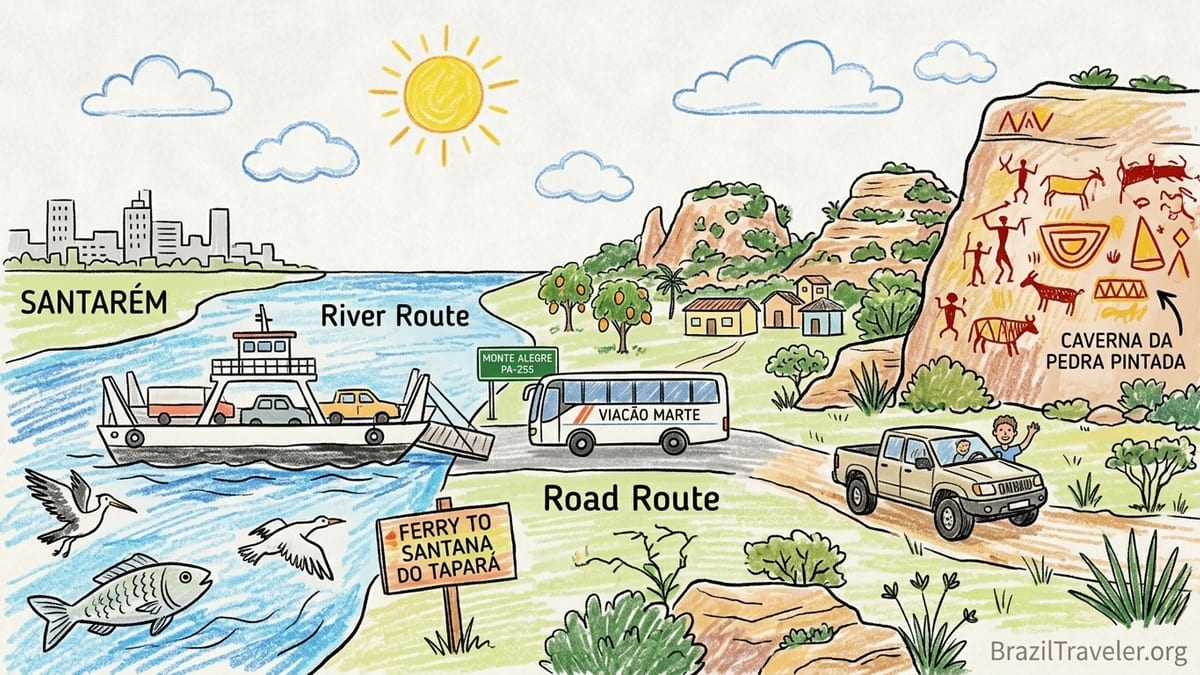
Getting from Santarém to Monte Alegre by River and Road
The modern journey to Monte Alegre’s rock art begins in Santarém, the main hub of Brazil’s western Pará region. Instead of a direct highway, travelers follow the historic river route that still ties riverfront communities to the Amazon. The most reliable crossing today uses the ferry link between Santarém and the district port of Santana do Tapará on the opposite bank, then continues by road to Monte Alegre and the Monte Alegre State Park.
Departures leave from the Porto do DR area in Santarém, where the Camila Navegação ferry makes the short crossing to Santana do Tapará multiple times a day. Current schedules published by Pará’s environmental agency show sailings roughly every few hours from early morning to evening, with the crossing taking about two hours depending on river conditions. The boat is a basic roll-on vessel designed to carry both vehicles and foot passengers, with simple indoor seating and room on deck to watch the city skyline recede behind the river haze.
At the time of writing, local documentation notes this leg as a routine commuter crossing rather than a tourist cruise. Tickets are sold at the pier, usually on the same day of travel, with prices varying slightly by operator and season. For planning purposes, independent travelers should budget the ferry fare as a modest local expense and focus more on coordinating their connection with overland transport at Santana do Tapará, where onward buses typically meet the arriving boats.
From Santana do Tapará, the journey continues overland along the PA-255 highway toward Monte Alegre. Official guidance from Pará’s forestry institute describes the PA-255 as paved and in generally good condition, with average travel time to Monte Alegre around two and a half hours. Buses and shared vans leave from close to the landing and connect to Monte Alegre town, many timed to the arrival of the ferries. Regional companies such as Viação Marte and local operators known simply by family names, like Plínio Tapará, run these services with fares in the range of 25 to 30 reais, paid directly to the driver or at small roadside offices.
From Monte Alegre Town to the Serra Country
Monte Alegre itself feels far removed from Santarém’s busy riverfront. Low houses, mango trees and moto-taxis surround a modest center with banks, bakeries and simple hotels. It is worth planning at least one night here on arrival, both to rest after the journey and to meet the guide who will take you into the park. Accommodation ranges from small family-run pousadas near the main square to more functional business hotels scattered around town. Most offer air-conditioned rooms, a basic breakfast and reliable hot showers, which become welcome comforts after a day of hiking in the heat.
The Monte Alegre State Park visitor center sits about 29 kilometers from the center of town, along a combination of paved road and sandy side tracks that climb into the serras. Official information from the park’s managers describes these side roads as secondary and often sandy, requiring high-clearance or four-wheel-drive vehicles, especially after heavy rain. This is where a local guide is not just helpful but practically essential, since guides either provide transport themselves, arrange 4x4 pickups, or know exactly which stretch can be handled by a regular car on any given week.
In my case, arranging logistics began two weeks before arrival, by contacting a licensed guide from Monte Alegre whose name appeared on recent local tourism articles and who was mentioned at the municipal tourism office. We agreed on a day rate that covered not only his guiding services but also use of his 4x4 pickup from town to the park and between the rock art sites. On the morning of departure, he collected me at my hotel shortly after sunrise, when air temperatures are still relatively mild and the serras glow pink against the pale sky.
The drive out of Monte Alegre quickly reveals how different this landscape is from the stereotype of an unbroken rainforest. Shrub-covered hills, exposed sandstone and stretches of cerrado-style savanna replace the closed canopy one expects of the Amazon. As we approached the park entrance, the guide pointed out isolated rock outcrops with whimsical shapes formed by wind erosion, previewing the kind of formations that make Monte Alegre visually distinct from the riverfront forests around Santarém.
Why You Need a Recognized Guide in Monte Alegre State Park
Despite the rugged surroundings, the Monte Alegre State Park is not an unregulated backcountry. It is a state conservation unit created to protect both its unusual upland ecosystems and a dense concentration of archaeological sites. The official management plan and park overview make clear that visitors may enter only through two formats: monitored visits coordinated with the park administration, or guided visits with recognized local guides who act as accredited conductors inside the conservation unit.
There are several reasons for this policy. First, the rock paintings and archaeological deposits are both extremely old and fragile. In some shelters, archaeologists have documented layers of occupation more than 11,000 years old, including stone tools and organic remains that helped date early human presence in the region. Uncontrolled foot traffic or casual digging can destroy these contexts forever. Second, some areas include steep cliffs, narrow ledges and caves where falling rocks, sudden drop-offs or seasonal flooding can pose real risks for visitors unfamiliar with the terrain.
A recognized guide manages both conservation and safety. My guide signed in our group at the visitor center, where a simple register tracks who enters the park and which trails they intend to walk. He carried a laminated copy of the park’s code of conduct and repeated its essentials before we left the parking area: do not touch any paintings, do not cross tape or rope barriers, do not collect even small fragments of stone or pottery, and do not enter caves or ledges not explicitly cleared for visitation. He also carried a small first-aid kit and kept an eye on the pace and water intake of each person in the group.
Booking a guide can be done in several ways. Visitors already in Santarém sometimes arrange packages through regional travel agencies that include transport to Monte Alegre and a guided day in the park. Independent travelers can contact the Monte Alegre municipal tourism office or search recent press and regional tourism portals for lists of accredited conductors. Importantly, travelers should avoid informal offers from drivers or boatmen who claim they can “show the paintings” as a quick roadside stop. Not all rock art panels lie within protected park boundaries, but approaching any archaeological panel without authorization risks damaging unrecorded sites and undermining local efforts to build sustainable archaeotourism.
Serra da Lua: Open-Air Panels on the Edge of the Cerrado
Our first destination inside the park was Serra da Lua, perhaps the most iconic of Monte Alegre’s rock art sites. From the visitor center, a short drive led to a trailhead at the base of a long sandstone escarpment. Here the landscape feels more like a dry savanna than rainforest: sparse trees, tough grasses and sandy soil that reflects the sun even early in the day. The guide explained that this hill complex is part of the Monte Alegre dome, an uplifted block of older rocks that hosts both the serras and the caves.
The main trail at Serra da Lua is relatively short, roughly one kilometer each way, but almost entirely exposed to the sun. The path begins with a gentle incline through low vegetation, then traverses along the base of a high rock wall. Temperatures during my visit in the dry season climbed quickly past 30 degrees Celsius by mid-morning, and the guide urged us to drink at every brief stop. There are no natural water sources along the route, and visitors must carry all the water they need, with at least two liters per person recommended for the morning’s hike.
About twenty minutes from the trailhead, the first painted panels come into view. At Serra da Lua, the paintings stretch for more than 200 meters along the wall of the Serra do Ererê, creating a continuous outdoor gallery. Most images are executed in shades of red and yellow derived from iron-rich mineral pigments, with some sections showing darker, almost brown figures where the pigment has aged. The guide pointed out human figures with raised arms, stylized animals and abstract motifs that resemble grids, circles and tree-like forms. Many images appear at head height, but others fade higher up where rock has spalled away or the wall curves back under an overhang.
Standing in front of these panels is a layered experience. At first, eyes struggle to distinguish figures from natural stains and lichens. Then, as the sun shifts behind thin clouds, entire scenes emerge: processions of tiny stick-like people, pairs of animals, clusters of dots that archaeologists interpret as possible counting marks or symbolic groupings. The guide, drawing on phrases learned from archaeologists who worked here, described some images as belonging to two main stylistic families. One is more abstract, filled with geometric shapes, while the other is more naturalistic, with recognizable bodies and even hints of movement. Importantly, he emphasized that while researchers classify styles and describe superimposed layers, they are cautious about saying with certainty what any specific figure “means.”
Caverna da Pedra Pintada / Gruta do Pilão: Entering the Painted Cave
After returning to the visitor center and a short pause at its shaded veranda, we drove toward the Serra do Paytuna to visit Caverna da Pedra Pintada, also known locally as Gruta do Pilão. The road climbs steadily into a slightly higher, rockier landscape before ending near a simple parking area. From here, a marked trail leads toward the cave entrance, which lies about 120 meters above the Amazon’s present river level on a hillside overlooking distant forest and river channels.
The approach trail to the cave is steeper than the route at Serra da Lua and covers around 1.5 kilometers, including short but sharp ascents over roots and gritty sandstone. The terrain alternates between shaded segments under small trees and fully exposed stretches where the midday sun hits hard. By this stage, the day’s heat felt intense enough that we stopped in every available patch of shade. The guide checked our water levels twice and reminded us that there are no toilets, taps or shops anywhere near the cave. Any waste, including fruit peels and tissue, had to go back out in our bags.
The cave mouth itself is impressive rather than claustrophobic. It opens as a tall, partially divided arch, with one large passage broken by a central rock pillar. Archaeological studies describe the cave extending nearly 90 meters into the hill, but only a limited front section is currently accessible to casual visitors, cordoned off by ropes and clear signage. Artificial lighting is minimal, so the first impression inside is of cool shadow after the glare outside, along with the smell of damp stone and a faint echo of footsteps on the sandy floor.
Inside this allowed zone, the red and yellow paintings adorn walls and ceiling slabs. Some depict plants and animals of the region, while others form complex arrangements of lines, dots and figures that have caught researchers’ attention. Guides often point visitors to one particularly famous scene interpreted by some archaeologists as representing childbirth: a central figure flanked by supporting forms and framed within other symbolic elements. The pigments here appear slightly darker than those at Serra da Lua, perhaps due to different mineral sources or the more stable microclimate inside the cave. In places where the wall is protected from direct water flow or human touch, figures retain sharp outlines despite their probable age of over 11,000 years.
What Archaeologists Know and What Remains Speculation
Monte Alegre’s rock art did not emerge into the scientific record overnight. Local and regional observers mentioned painted rocks in the area as early as the nineteenth and mid-twentieth centuries, but it was systematic work in the late twentieth century that brought the sites to global attention. At Caverna da Pedra Pintada, excavations led by archaeologist Anna Curtenius Roosevelt in the 1990s uncovered stratified cultural deposits that included stone tools and organic remains. Radiocarbon dating of charcoal and other materials suggested human occupation in the cave more than 11,000 years ago, at the end of the Pleistocene and beginning of the Holocene.
These dates were important because they indicated that people had established complex, long-term use of the Amazon region much earlier than some models had predicted. The combination of occupation debris and rock art hinted at a community that not only lived and worked here but also inscribed symbolic or communicative images on the very landscapes they used. However, archaeologists are careful to separate what is securely known from what is more tentative. While some painted layers can be broadly associated with dated occupation horizons, linking any specific image to a precise year or event remains difficult.
Researchers classify the paintings into stylistic groups, sometimes using names like “abstract” or “naturalistic” to describe repeated patterns across multiple sites. They note that some motifs at Monte Alegre resemble rock art traditions in other parts of northern South America, suggesting long-distance cultural connections or shared symbolic vocabularies. But when it comes to interpreting meanings, such as whether a snake-like figure represents a mythological being, a literal animal or an abstract idea, scholars generally avoid definitive statements. Guides echo this caution in their explanations, distinguishing between what archaeologists have written and local stories passed down in the region.
For visitors, this distinction matters. It is tempting to project one’s own narratives onto the images, seeing “hunters,” “gods” or “maps” in every figure. The best approach, encouraged by both researchers and responsible guides, is to observe closely, ask questions and accept that part of the power of these panels lies in what remains unknowable. The reds and yellows on the rock prove that people stood here thousands of years ago, looking at the same horizon and investing effort in images that meant enough to preserve with carefully prepared pigments. Exactly what they wished to say belongs partly to them alone.
Trail Conditions, Heat and Practical Needs Inside the Park
The romance of ancient art quickly meets the reality of field conditions in Monte Alegre. Trails to Serra da Lua, Caverna da Pedra Pintada and nearby viewpoints such as Pedra do Mirante all share similar challenges: heat, exposure and sandy or rocky footing. Even in the so-called cooler months, daytime temperatures easily surpass 30 degrees Celsius, and the combination of radiant heat from pale sandstone and limited shade can surprise visitors used to shaded rainforest hikes.
Trail distances within the main visitor zone are moderate on paper. A typical circuit that includes Serra da Lua, the visitor center area, the path to Pedra do Mirante and the hike to Caverna da Pedra Pintada might involve eight to ten kilometers of walking, split into separate segments with vehicle transfers in between. None of the individual hikes is technically demanding, but several include short steep sections, loose sand and rock ledges where attention is essential. Good trail shoes or lightweight hiking boots prove more comfortable than sandals, especially when descending dusty slopes on the way back to the vehicle.
Water and sun protection are non-negotiable. There are toilets at or near the visitor center, but there are no facilities at the remote trailheads. Visitors must start each segment carrying all the water they plan to drink, and guides often insist on a minimum of two liters per person for a half day and three liters or more if both main sites are planned in a single long outing. Wide-brimmed hats, long-sleeved light shirts and high-factor sunscreen make the difference between a tolerable hike and a miserable one, as several members of our small group learned when they underestimated the reflection from pale rocks.
The guide’s explanations along the way also shaped how we moved through the landscape. He timed our visits to reach the most exposed viewpoints earlier in the day, leaving shadier cave and gallery stops for later, and he adjusted the itinerary when a late-morning haze threatened thunderstorms. Park rules allow for weather-related changes to opening hours, and during the rainy season some paths may become too slippery or certain sites may be temporarily closed. Checking these conditions with the park administration through your guide a day or two before your hike avoids wasted travel from town.
Respecting the Sites: Visitor Responsibilities Around Rock Art
Many of the rules at Monte Alegre might feel strict compared with casual visits to unprotected rock outcrops elsewhere in Brazil, but there are good reasons for each restriction. Oils and sweat from human skin, even in small amounts, can degrade ancient pigments or encourage algae growth that slowly obscures paintings. For this reason, touching is strictly prohibited, and guides will politely but firmly intervene if anyone leans too close or tries to trace a figure with their fingers.
Climbing on decorated rock surfaces is another serious issue. Some of the most striking panels appear on boulders and low walls that might tempt visitors to scramble for a better photo or to pose for social media. Monte Alegre’s code of conduct forbids stepping onto any painted or potentially painted surface, whether or not images are obvious at first glance. Erosion marks and superficially blank slabs may conceal faint or partially buried figures documented by specialists but invisible to the untrained eye. Staying behind ropes, painted lines and informal guide-imposed “do not cross” markers is part of basic respect for the site.
In caves, restrictions are even tighter. Only certain chambers are open for regular tourism, with deeper zones reserved for research or closed due to safety concerns. Flash photography rules can change with updated management plans, but bright lights and repeated flashes can contribute to gradual changes in sensitive rock or organic films. Visitors are expected to follow their guide’s instructions about where to stand, where to shine headlamps and when to limit the number of people inside a confined space at one time.
Another responsibility concerns rubbish. The park entrance may charge no fee and offer a relatively low-key infrastructure, but that does not mean someone will pick up after careless visitors. Plastic bottles, snack wrappers and used tissues degrade the visual and scientific value of rock shelters that remained clean for millennia. Our guide collected a small bag of trash left by previous groups near one viewpoint and used it as a quiet teaching moment. Anyone able to make the journey from Santarém to Monte Alegre can also carry their garbage back out.
Counting the Cost: Boats, Buses, Guides and Beds
One surprise in planning a Monte Alegre rock art trip is that while park entry itself is officially free, reaching and exploring the sites involves multiple paid legs. Budgeting realistically helps avoid unpleasant shocks. The Santarém to Santana do Tapará ferry fare forms the first cost; prices are set as regulated river transport and are modest by long-distance Amazon standards, but they do vary, so travelers should verify the current rate shortly before travel. Because there are frequent daily departures, it rarely makes sense to pay a premium for private boats for this short crossing.
The Santana do Tapará to Monte Alegre bus or shared van fare comes next. Recent local information suggests values between 25 and 30 reais per person one way, depending on the company and whether the ticket is bought on board or at a small agency. The journey takes around two and a half hours, and some buses are timed to meet the ferries. For visitors who prefer more control, a private car transfer arranged through your Monte Alegre hotel or guide is another option, with a higher per-person cost that depends on the number of passengers and current fuel prices.
Inside Monte Alegre, accommodation choices mostly fall into the mid-range Brazilian provincial bracket. A clean air-conditioned room in a central pousada with breakfast often costs significantly less than similar lodging in Santarém or Belém, but prices change with holidays, local festivals and overall inflation. Because the park requires an early start for comfort and safety, at least one overnight stay in Monte Alegre is strongly recommended. Many visitors choose two nights to allow a full day in the park without rushing and to keep some buffer for weather or transport hiccups.
The largest single expense is usually the guide and vehicle for the day in the park. Licensed guides commonly charge a flat daily fee that includes transport from town, four-wheel-drive access to the visitor center and trailheads, their guiding services and often basic snacks or water. The exact figure depends on the number of people in the group, the distance covered and whether the itinerary includes several separate sites. Travelers should request a clear breakdown in advance and confirm that the guide is recognized by either the park administration or the municipal tourism office. Once all items are added together, a realistic total for a solo traveler or couple, including round-trip transport from Santarém, one or two hotel nights in Monte Alegre, guide services and meals, will amount to a meaningful but manageable multi-day investment rather than a quick, cheap side trip.
The Takeaway: Is Monte Alegre Worth the Journey?
Several aspects of the Monte Alegre visit challenged my preconceptions about the Amazon. I had pictured continuous flooded forest stretching unbroken from Santarém into the distance; instead, I found serras, dry-season heat and a mosaic of cerrado vegetation alongside rock domes. The idea that some of the oldest securely dated human occupations in the Amazon basin lie not in deep forest but on these windswept hills above the river added yet another layer of surprise.
Among the sites I visited, Serra da Lua made the strongest visual impression, with its long outdoor wall covered in red and yellow figures. The sensation of walking along a natural cliff that functions as a gigantic, weathered mural, open to sky and sun, felt unlike any cave visit. Caverna da Pedra Pintada, by contrast, resonated more intellectually. Knowing that its deposits helped transform debates about when and how people settled the Amazon made even the quiet front chamber feel charged with significance, especially when the guide quietly pointed to where excavations had once descended through layers of ash and stone tools.
Was the river-and-road journey from Santarém justified by the experience on the ground. For travelers primarily interested in comfort and quick photo stops, perhaps not. The day involves early starts, heat, modest infrastructure and the need to follow rules that limit free roaming. For those interested in archaeology, landscape and a different view of the Amazon, however, Monte Alegre rewards the effort. It reveals that the world’s largest rainforest is not monolithic, and that humans have been shaping and interpreting this environment in sophisticated ways for many thousands of years.
Most importantly, Monte Alegre deserves more than a rushed same-day dash. While a determined visitor could in theory cross from Santarém in the dawn hours, hike a truncated itinerary with a guide and return on an evening boat, this plan leaves no room for delays, weather or deeper appreciation. A dedicated overnight stay, ideally two nights, transforms the trip into a more relaxed immersion. It allows time not only to stand in front of the paintings, but to sit quietly on a viewpoint rock, watch the light shift over the serras and imagine the long human story that unfolds across their walls.
FAQ
Q1: How do I get from Santarém to Monte Alegre to visit the rock art?
Independent travelers usually take a public ferry from the Porto do DR area in Santarém to the district port of Santana do Tapará, then continue by bus or shared van along the PA-255 highway to Monte Alegre. From Monte Alegre town, a licensed guide with a suitable vehicle drives the final 29 kilometers to the Monte Alegre State Park visitor center and the main trailheads.
Q2: Do I really need a guide to visit Serra da Lua and Caverna da Pedra Pintada?
Yes. The Monte Alegre State Park officially requires that visitors enter either on monitored visits arranged with the park administration or accompanied by recognized local guides. These accredited guides help protect fragile archaeological sites, manage safety on exposed or steep sections of trail, and ensure you only access areas that are open on the day of your visit.
Q3: How difficult are the hikes to the rock art sites?
The main trails are short to moderate in distance but can be demanding due to heat and exposure. The Serra da Lua path is roughly one kilometer each way, mostly on sandy, sun-exposed ground, while the approach to Caverna da Pedra Pintada is steeper and about 1.5 kilometers with some rocky sections. Reasonable fitness, good walking shoes and careful hydration are important.
Q4: What is the best time of year and time of day to visit Monte Alegre?
Visits are most comfortable in the drier months, when trails are less muddy and cave entrances are easier to access. Regardless of season, most guides start early, often leaving Monte Alegre around sunrise to hike the most exposed sections before midday heat. Afternoon visits can be more tiring and may be interrupted by thunderstorms during wetter periods.
Q5: How much water and what gear should I bring into the park?
Plan to carry at least two liters of water per person for a half-day outing and more if visiting several sites in one day. There are no taps on the trails. Light long-sleeved clothing, a wide-brimmed hat, strong sunscreen, closed-toe shoes with good grip and a small daypack for water and snacks are strongly recommended.
Q6: Are there toilets, shops or food options near the rock art sites?
Basic toilets exist at or near the Monte Alegre State Park visitor center, but there are no facilities at the remote trailheads or along the paths to Serra da Lua and Caverna da Pedra Pintada. There are no shops or food stands inside the park, so visitors should eat before entering and carry all snacks and water with them, taking all rubbish back out.
Q7: Can I touch the paintings or climb on the rocks for photos?
No. Touching the paintings or climbing on decorated or potentially decorated rock surfaces is strictly prohibited. Oils from skin, abrasion from shoes and accidental impacts can irreversibly damage pigments and rock. Guides enforce a look-but-do-not-touch ethic, and visitors are expected to stay behind ropes, painted lines and any informal limits indicated by guides.
Q8: How much does a full Monte Alegre excursion typically cost?
Costs vary with exchange rates and group size, but travelers should budget for the Santarém to Santana do Tapará ferry, the Santana do Tapará to Monte Alegre bus or transfer, at least one or two hotel nights in Monte Alegre, meals, and a full-day guide and vehicle inside the park. Park entry itself is free, but guide and transport fees form the largest part of the budget.
Q9: What makes Monte Alegre’s rock art archaeologically important?
Excavations at Caverna da Pedra Pintada revealed dated human occupation layers over 11,000 years old, among the earliest well-documented sites in the Amazon basin. The combination of long archaeological sequences, diverse rock paintings and unusual upland landscapes has helped challenge older ideas that the Amazon was only sparsely occupied by small, mobile groups in the distant past.
Q10: Is Monte Alegre better as a day trip or an overnight stay?
Although a very long day trip from Santarém is technically possible, a dedicated overnight or two nights in Monte Alegre is far more realistic and rewarding. Staying in town allows time to adjust for ferry and bus schedules, weather, trail conditions and the pace of hiking, and it lets visitors appreciate both Serra da Lua and Caverna da Pedra Pintada without rushing.