


When I first planned a trip to see Amazon pink river dolphins, all the glossy brochures out of Manaus seemed to promise the same thing: a guaranteed swim with smiling pink botos that would nuzzle up for photos. On the ground, however, I found a much more complicated reality in Novo Airão, the small Rio Negro town that has become Brazil’s most famous stage for pink dolphin encounters. Between changing federal rules, local experiments with more ethical platforms and a mix of tour styles that still include direct feeding and contact, simply booking “a dolphin tour” is no longer enough for travelers who care about animal welfare.
Getting From Manaus to Novo Airão Without Signing Up to Swim
Pink river dolphin experiences around Manaus are often marketed as quick day trips that bundle a dozen attractions into one long outing. Many agencies in the city center still advertise packages that include the Meeting of the Waters, an indigenous performance, lunch at a floating restaurant and a swim with dolphins stop, all in a single day on the Rio Negro. From a distance, it looks efficient. From a conservation perspective, it tends to prioritize guaranteed photos over the welfare of free-ranging animals.
I wanted something different. Following the latest discussion among Brazilian researchers and conservation authorities about the risks of feeding-conditioned dolphins, I set myself a simple rule: I would only book an activity that followed protected-area regulations, avoided recreational feeding by tourists and did not allow in-water contact. That quickly narrowed the search. Rather than a whirlwind circuit from Manaus, I chose an operator that bases its day in Novo Airão itself and advertises “observação de botos” as wildlife watching, not a swim, and that states in its briefing that visitors do not touch or chase animals.
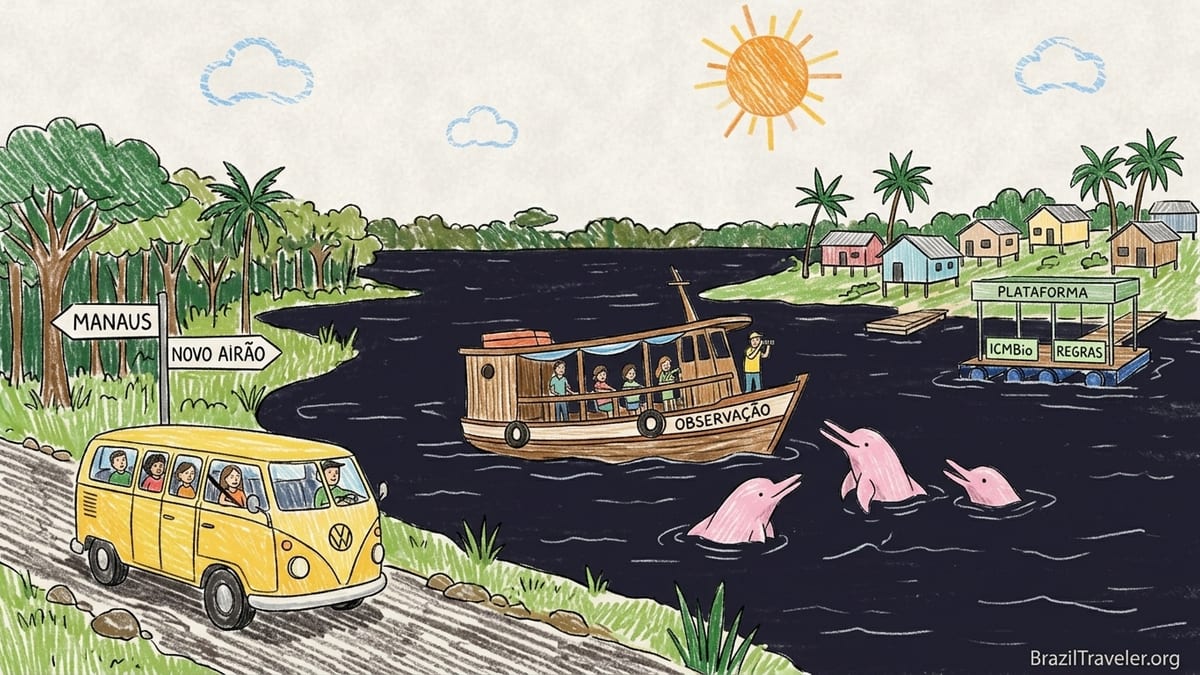
Logistically, getting there still starts in Manaus. Novo Airão sits on the right bank of the Rio Negro, roughly 115 kilometers from the capital in a straight line and closer to 140 kilometers by river. By road, the journey takes about three hours. I joined two other travelers in a shared transfer organized through a Manaus travel agency that partners with a Novo Airão boat operator. The van left from the Ponta Negra area at 7:30 in the morning, crossed the Rio Negro bridge and followed the AM-070 highway before turning onto the AM-352 toward Novo Airão.
The return transfer and dolphin observation excursion together were priced at the equivalent of around 550 to 650 Brazilian reais per person, depending on group size and the season. It was noticeably more expensive than the 300 to 400 reais full-day multi-activity tours that never leave the orbit of Manaus, but the difference reflected longer travel, a slower pace and the promise of less intrusive dolphin watching inside the region’s protected mosaic.
What Current Rules Actually Allow Around Pink River Dolphins
Because so many older travel blogs still describe holding fish in your mouth for dolphins or grabbing their fins for the camera in Novo Airão, it is important to separate outdated anecdotes from the rules that exist today. The dolphins that congregate near the town swim in and around Anavilhanas National Park, a protected river archipelago on the Rio Negro that one of Brazil’s federal conservation agencies, ICMBio, manages. Officially, feeding wild animals in a national park is prohibited, and this includes botos.
At the same time, the reality on the water has evolved more slowly than the written norms. Structured feeding of pink dolphins at floating platforms in Novo Airão began in the late 1990s and for years remained effectively unregulated. Researchers studying the Anavilhanas cases described clear conditioning effects: individual dolphins that rearranged their daily movements to spend long periods around platforms, displayed heightened aggression over fish and showed scars from hooks, boat propellers and close contact with humans.
In response, ICMBio and local authorities began tightening guidance. Managed feeding sites around Novo Airão have gradually shifted to fixed feeding times, limits on visitor numbers and restrictions on direct swimming and touching. Some platforms that once allowed tourists to enter the water alongside feeding dolphins have repositioned themselves as observation-focused experiences, either banning swimming outright or limiting it to non-feeding times. The result for visitors arriving in 2026 is confusing choice. You can still find tours out of Manaus that advertise swimming with dolphins at riverside platforms, especially outside the strict park boundaries, but within the Anavilhanas area, operators increasingly differentiate themselves based on adherence to park rules.
For this trip, I specifically asked agencies in Manaus and in Novo Airão for an observation program that aligned with ICMBio’s guidance: viewing dolphins from a boat or platform without tourists offering food, without in-water handling and without harassing animals to secure close photos. That requirement steered me away from some marketed “interaction” experiences and toward a quieter, slower excursion that happened near a long-established feeding platform, but with visitors remaining on a boat anchored at a respectful distance.
On the River: Briefing, Boat and How Close We Really Got
The dolphin observation portion of the day began at the Novo Airão riverfront, where small tour boats depart for the labyrinth of Anavilhanas islands and for the floating structures that have become synonymous with the town. Our operator used a covered wooden boat with bench seating for about 12 people, but on the day of my visit there were only six guests. Before boarding, the guide gathered us for a ten-minute briefing that, to my relief, started not with selfie tips but with a basic primer on boto natural history and conservation status.
He explained that Amazon river dolphins are long-lived freshwater mammals, with males often larger and pinker than females, and that their color comes partly from capillary density and scarring. He also mentioned that scientists now recognize more than one river dolphin species in Brazil and that the animals’ slow reproduction makes them particularly vulnerable to entanglement, habitat loss and changes in fish populations. Crucially, he addressed feeding. The operator had an agreement to approach an area near a traditional platform at scheduled times but no longer allowed tourists to hand over fish or enter the water with the dolphins. “You will see other tours in the region where people are in the water with the botos,” he said. “We do not chase them, we do not grab them and you should not dangle anything to attract them.”
Leaving the town dock, we motored fifteen to twenty minutes upstream along the Rio Negro’s black water, past low wooden houses and forested banks. The boat slowed well before reaching the platform, cutting its engine to a low idle roughly fifty meters away. The guide asked everyone to stay seated until he understood how many dolphins were present and how they were behaving. Only after several grey-pink backs surfaced near the structure did he allow us to move toward the bow and stand by the rail.
Over the next hour, the dolphins chose the distance. At first, most activity clustered near the feeding platform, where staff carried buckets from which they occasionally tossed fish into the water. Our operator did not provide any fish from our boat and did not approach the platform directly. Instead, the captain alternated between drifting and lightly maneuvering so that we remained about twenty to thirty meters away, using the current to circle slowly without ever cutting in front of the animals. On two occasions, individual botos approached within five to eight meters of our hull, rolling sideways to inspect us before disappearing again into the dark water.
Watching Behavior Without Touching: What the Dolphins Told Us
Standing on a moving deck rather than floating in the water necessarily changes the tenor of a dolphin encounter. There is more squinting at the surface and less sense of communion. Yet that distance also made behavioral differences easier to see. Without a crowd of swimmers jostling for contact, it was possible to notice which dolphins spent nearly the entire session near the feeding area and which cut broad arcs into open water before briefly circling back.
The older, heavily scarred males seemed most committed to the platform. Several had visible marks consistent with propeller contact and at least one bore a deep indentation around the rostrum that looked like a past entanglement. These individuals surfaced repeatedly in front of the platform, waiting expectantly between fish tosses and sometimes jostling one another in tight quarters. Their behavior matched descriptions from long-term studies of Anavilhanas feeding sites, which have documented dominant males monopolizing handouts and occasionally showing aggression both to other dolphins and to people when fish runs low.
Farther from the platform, we watched at least three other dolphins with cleaner skin patterns and more irregular surfacing intervals. They appeared, took a breath, then dove on elongated paths that likely intersected with natural feeding grounds in the flooded forest. One juvenile approached the rear of our boat independently of any feeding, surfacing several times within ten meters before shifting away in a wide loop. The guide used this moment to point out that these more exploratory animals are the ones researchers are particularly keen to protect from becoming fully conditioned to platforms.
Throughout the encounter, no one was tempted to reach into the water because we were never asked to strip down and dive in. Instead, cameras clicked from the deck edge and the soundtrack was the exhale of dolphins rather than the shrieks of swimmers. After about sixty-five minutes, the captain announced that we would leave the area so that the animals could resume their own routines. We returned to Novo Airão without any of us having set a toe in the river, which for some guests felt like a missed Instagram opportunity but for others, including me, felt like an ethical non-negotiable.
Feeding, Swimming and Observation: Why the Distinction Matters
To understand why these nuances of tour design matter, it helps to unpack the three broad models of pink dolphin tourism that visitors around Manaus will encounter. The first is observational, like the excursion I joined in Novo Airão, where boats keep a minimum distance and tourists remain on deck while operators avoid feeding. The second centers on managed feeding sessions at platforms, where staff provide fish at scheduled times, dolphins congregate and visitors may or may not be allowed in the water. The third is the fully immersive swim-with-dolphins excursion, in which tourists hold or toss fish, line up in the water for close photos and sometimes cling to dolphins as they move.
Scientific studies and management plans for South American river dolphins have repeatedly flagged feeding-conditioned tourism as high-risk. When animals learn that platforms or boats reliably dispense fish, they often reduce their natural foraging, spend disproportionate time in small areas and change their daily movement patterns. Individuals that linger around boat traffic are more likely to collide with propellers or become entangled in fishing gear. Conditioning can also increase boldness around humans, raising the risk of bites when food expectations are frustrated.
This is not an abstract concern. Researchers working in the Anavilhanas region have documented dolphins with chronic injuries around their snouts from repeated contact with docks, entanglement marks from lines and scars from sharp hooks used to dangle fish in the water. There have also been reports of botos stealing bait or caught fish from lines near tourist spots, behavior that rarely occurs where no feeding is encouraged. While some managed platforms in Novo Airão have begun to limit feeding frequency and ban swimming in response to this research, swim-with excursions elsewhere in the wider Amazon basin continue to market direct contact as the main selling point, sometimes in places with even less regulatory oversight than the Rio Negro.
Against that backdrop, pure observation may feel less thrilling in the moment, but it keeps a critical line between wild animals and human entertainment. In my case, the dolphins still approached voluntarily, still surfaced close enough for photographs and still created that shock of seeing a pink back break the black water. What was missing was the sense of entitlement that often comes when a ticket price appears to guarantee a specific performance.
Cost, Conservation Value and Whether the Longer Trip Is Worth It
From a budget perspective, travelers will quickly notice that a dedicated Novo Airão day or overnight trip typically costs more than a standard Manaus-area day tour that includes a dolphin stop. Local agencies in Manaus frequently advertise multi-activity packages that run from about 300 to 400 reais per person for a full day, often including hotel pickup, several short boat rides and lunch. These tours usually stop at dolphin platforms closer to Manaus, where high visitor throughput encourages highly choreographed feeding and swimming sessions.
By contrast, the observation-focused Novo Airão excursion, with three hours of road transfer each way and a slower pace on the river, came in roughly 40 to 70 percent more expensive when I priced dates in the current season. Some travelers choose to reduce the per-day cost by staying overnight in Novo Airão, checking into a riverside pousada or one of the region’s small design lodges and booking independent boat outings. An overnight stay can also make it easier to combine dolphin watching with a separate half-day exploration of the Anavilhanas islands without compressing everything into a single exhausting day.
Whether that extra cost represents better conservation value depends on what you prioritize. In my case, the longer trip delivered several things the cheaper multi-stop tours rarely do: a pre-departure briefing anchored in current research, guides who addressed ethical questions unprompted and enough time on site to observe subtler behavior. The operator made clear that part of our fee supported local community initiatives and park management partnerships, and the crew spoke knowledgeably about how ICMBio supervision has changed the way platforms operate.
What you do not get is a guarantee that a dolphin will let your child hug it or that every photo will feature an animal inches from your face. If those are the benchmarks, then you will likely find the observational experience frustrating. For travelers more interested in wild behavior and the long-term future of river dolphins, however, the trade-off is worth the extra reais and hours on the road.
Alternatives: Rio Negro Wildlife Watching and Anavilhanas Boat Trips
Seeing pink dolphins in Novo Airão is not the only option for ethical river dolphin observation around Manaus. Several local and regional operators now offer broader Rio Negro wildlife tours that include chance encounters with botos as part of a larger natural history program rather than a staged activity. Day trips from Manaus that travel to the lower Rio Negro, for example, may cross areas where dolphins surface naturally around channels and sandbars without any feeding or luring, especially during the low-water season when fish are more concentrated.
Multi-day riverboat itineraries that navigate from Manaus up to the Anavilhanas archipelago also create opportunities to see dolphins in passing. One expedition program I reviewed describes several days exploring tributaries such as the Cuieiras River and visiting riverine communities, with a stop in Novo Airão to observe dolphins near town as only one part of a wider circuit focused on birdlife, flooded forest and cultural visits. On these longer journeys, dolphin sightings tend to be more spontaneous and the animals less habituated to human presence, which can be rewarding for patient observers.
For those who base themselves in Novo Airão itself, hiring a small local boat with a licensed guide for a custom Anavilhanas excursion is another strong alternative. Recent traveler reports suggest that full-day private boat hire, with fuel and guide included, often costs in the low hundreds of reais for the boat rather than per person, especially when booked directly on the riverfront. Guides can steer you to quieter channels, white-sand beaches and flooded forests where dolphins feed and travel naturally, with the understanding that sightings are not guaranteed and that the boat will not pursue animals aggressively.
In all these cases, the key questions to ask are the same: Do you feed the dolphins? Do you allow tourists to swim with them during feeding? How close does the boat approach when animals surface? Responsible operators will be able to describe specific rules on distance, boat speed and visitor behavior. If answers are vague or the focus returns instantly to close-up selfies, that is a sign to keep looking.
What I Expected, What I Found and How It Felt on the Water
Going into the tour, my expectations were shaped by two competing images. On one hand, I carried childhood memories of nature documentaries in which rare animals appeared briefly and then slipped back into the wild, indifferent to the camera. On the other, I had scrolled through endless social media posts of travelers in fluorescent lifejackets, grinning as pink dolphins pressed up against their legs or tugged at floating fish. Part of me worried that a non-contact, no-feeding excursion would feel flat by comparison, like watching a concert from the parking lot.
What the operator actually offered was more subtle and, in the end, more moving. The day was structured around the river rather than a single activity. The transfer from Manaus allowed time to see the gradual thinning of traffic and settlement along the highway. The boat ride from Novo Airão lingered over forested islands and sandbars, and even when we neared the platform area, the crew framed it as a place to observe an ongoing human-wildlife experiment rather than a guaranteed spectacle. The rules were explicit: we would not feed, we would not swim, and we would leave if there were signs of excessive crowding or stress.
The animals themselves complicated any simple narrative. Some dolphins clearly associated the platform with easy food and remained in its shadow, displaying competitive and sometimes frenetic behavior that was hard to watch. Others moved more broadly through the area, surfacing in looser patterns and occasionally approaching our quiet boat out of apparent curiosity. The fact that we saw both in a single hour highlighted the gradient that exists between fully conditioned, platform-bound animals and wild-ranging individuals that still spend much of their day hunting away from human structures.
Several moments made me distinctly uncomfortable. Watching platform staff toss fish while a dense group of dolphins jostled below underscored how unnatural the feeding dynamic was, even if it occurred at limited times under some supervision. Seeing deep, healed scars on the backs and heads of certain males, in close proximity to boat traffic and structures, connected the dots between tourism, navigation and injury. Listening to engines from other boats rev as they maneuvered for a better angle closer to the platform, even as our operator stayed back, reminded me how much depends on individual company ethics in the absence of perfectly enforced rules.
Yet there were also quiet conservation lessons. Our guide did not sugarcoat the history of dolphin tourism in Novo Airão. He described how early interactions began informally, how researchers documented negative effects and how ICMBio and local stakeholders have been trying, unevenly, to shift toward lower-impact models. He encouraged guests to support only non-contact experiences in the future and drew a direct line between our behavior as visitors and the survival prospects of river dolphins that already face pressures from fishing, dams and contamination.
The Takeaway
For me, the lesson of swimming with pink dolphins in the Amazon was that the most ethical version of the experience may not involve swimming at all. What I expected was a binary choice between thrilling in-water contact and a distant, unsatisfying glimpse from afar. What I found in Novo Airão was a middle path in which careful operators, heeding both research and regulation, still bring travelers close enough for meaningful encounters without turning wild animals into props.
The operator I chose honored the commitments advertised. We did not feed or touch the dolphins, we stayed at a measured distance and we left the area after a defined period to limit our footprint. The animals’ behavior reflected the mixed legacy of decades of tourism, with some individuals heavily conditioned and others still ranging more widely, but the structure of the visit reduced additional harm compared with full swim-with sessions. What made me uncomfortable was less our own conduct and more the visible scars and crowding that signaled how long the dolphins have already been adapting to human expectations.
From a conservation standpoint, the key lesson is that our choices as travelers influence which models survive. Booking a cheaper tour out of Manaus that advertises direct feeding and swims reinforces exactly the practices that researchers and managers have warned about. Investing a bit more time and money in observation-focused outings in Novo Airão or along the Rio Negro signals demand for experiences that respect park rules and the long-term health of river dolphin populations. It is not a perfect solution, but it nudges the market toward better standards.
Would I recommend the experience? Yes, with caveats. For families, I would suggest framing a Novo Airão dolphin observation outing as a chance to see real wildlife behavior and learn about conservation, not as a petting zoo. For wildlife photographers, I would emphasize that patient, respectful distance can still yield compelling images, especially when combined with quieter Anavilhanas boat trips away from platforms. For travelers simply curious to see pink dolphins without contributing to harmful practices, my advice is clear: ask detailed questions about feeding, swimming and distance before you book, favor operators that keep you on the boat and out of the food chain, and be willing to accept that the most ethical encounters are also the ones the dolphins are free to walk away from.
FAQ
Q1. Can I still legally swim with pink dolphins in Novo Airão?
Local practice has shifted toward limiting or prohibiting swimming at many platforms near Novo Airão, especially where federal protected-area rules apply, but some tours outside strict park zones still advertise in-water encounters. Regulations emphasize avoiding feeding and harassment, so the most responsible operators now keep tourists on boats or platforms rather than in the water.
Q2. How long does it take to travel from Manaus to Novo Airão?
By road, the trip from Manaus to Novo Airão usually takes about three hours each way, using the Rio Negro bridge and the AM-070 and AM-352 highways. Some riverboat itineraries also connect the two, but these are slower and typically part of multi-day expeditions rather than day tours.
Q3. How much does an ethical dolphin observation tour cost compared with standard Manaus day trips?
Observation-focused excursions that include road transfers between Manaus and Novo Airão often cost in the range of the mid-hundreds of reais per person, depending on season and group size. Multi-attraction day tours based closer to Manaus, which may include feeding-based dolphin stops, usually cost less per person but place more pressure on individual animals.
Q4. Are pink dolphin encounters guaranteed on these tours?
No responsible operator will promise a specific number of dolphins or certain behaviors. In places like Novo Airão, the chances of seeing pink river dolphins are high because some individuals are habituated to human presence, but wild animals can always choose not to appear or to stay farther away.
Q5. What questions should I ask a tour operator before booking?
Ask whether tourists feed the dolphins, whether swimming with the animals is allowed, how close boats are permitted to approach, how long the encounter lasts and whether guides explain conservation issues. Clear, specific answers that reference park rules and research are a good sign of an operator that takes welfare seriously.
Q6. Is it better to stay overnight in Novo Airão or visit as a day trip?
Staying at least one night in Novo Airão spreads your activities over more time, reduces the pressure to “do everything” in a single day and allows you to combine dolphin observation with a separate Anavilhanas boat trip. A long day trip from Manaus is possible but can feel rushed and leaves less flexibility for adapting to river or wildlife conditions.
Q7. Are there truly non-feeding dolphin encounters near Manaus?
Yes. Some Rio Negro wildlife tours and longer riverboat itineraries encounter pink dolphins as part of broader nature watching, without any feeding or in-water contact. Sightings are less predictable on these outings, but animal behavior tends to be more natural and impacts lower.
Q8. Is it safe for children to join observation-only dolphin tours?
Observation-focused tours that keep guests on boats or platforms and avoid in-water contact are generally suitable for children, provided standard river safety measures such as lifejackets and supervision are in place. Parents should prepare children in advance that they will not be touching or feeding the dolphins.
Q9. When is the best season to see pink dolphins around Novo Airão?
Pink river dolphins are present year-round on the Rio Negro, but water levels shape how and where you see them. During lower water, sandbars and channels are more exposed and sightings may be concentrated, while higher water spreads animals into flooded forest. Ethical operators adjust routes to seasonal conditions rather than chasing dolphins aggressively.
Q10. How can I be sure my visit supports conservation rather than harming dolphins?
Choose operators that follow protected-area rules, avoid tourist feeding and swimming, limit encounter times and provide clear education about river dolphins and threats they face. Be willing to pay a fair price for slower, lower-impact experiences and to accept that respectful wildlife tourism prioritizes animal welfare over guaranteed close contact.