


I have stayed in both Manaus and Belém on separate Amazon trips, using each city as a base for river travel and rainforest time. Manaus was my first classic jungle-lodge gateway, the place where I finally slept in a hammock under a thatched roof and watched the Rio Negro turn black and glassy at dusk. Belém came later and felt like a different Amazon altogether: tidal rivers, river islands, markets overflowing with açaí and herbs, and meals that were as memorable as any rainforest sunset. What follows is how the two cities actually felt on the ground, where this account is rooted in my own stays, and where I am leaning more on current research to update details or fill gaps.
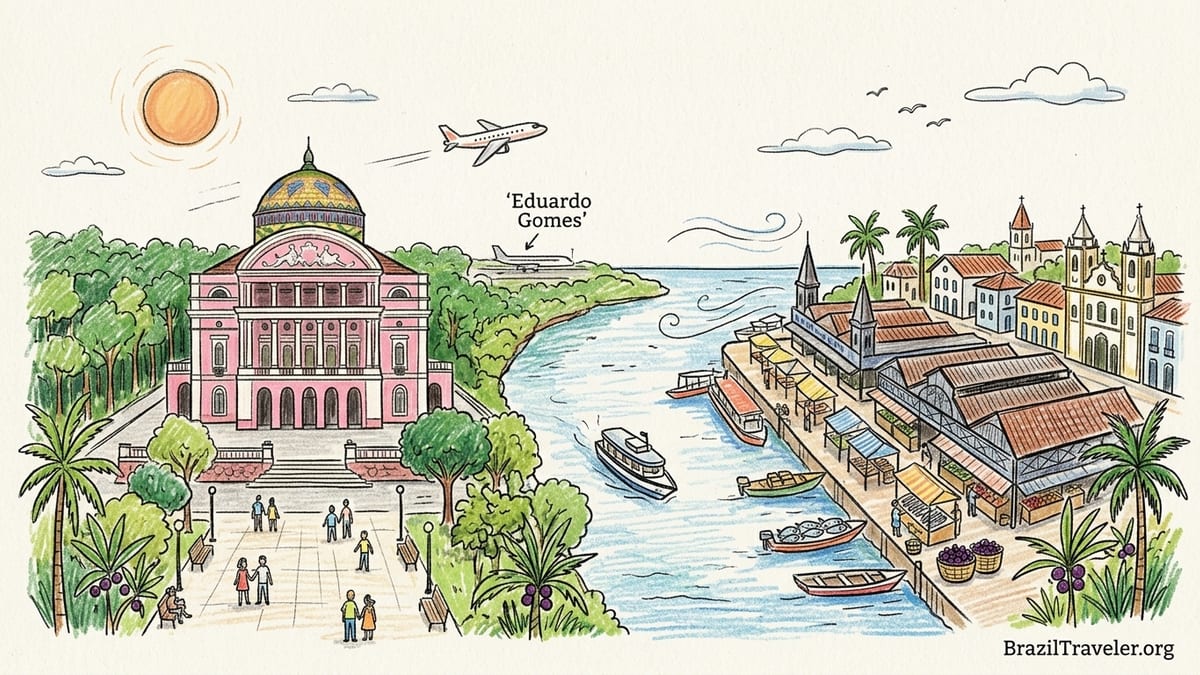
First Impressions: Arrival, Heat and City Layout
Landing in Manaus, I remember the first hit of thick, hot air when I stepped out of the jet bridge, even though the terminal itself was modern and air conditioned. Eduardo Gomes International Airport sits several kilometers from the center, and in both of my entries to the city, I used registered taxis and ride-hailing apps from the arrivals area into town. The ride ran around 20 to 30 minutes depending on traffic, through leafy avenues and past big-box stores, before the city tightened into a denser downtown grid. My base on the first trip was near Praça São Sebastião, a few minutes’ walk from Teatro Amazonas, and on a later visit I stayed closer to the river in an older business hotel with views of the port.
Belém’s Val-de-Cans / Júlio Cezar Ribeiro International Airport felt smaller but equally busy. The humidity when I arrived in the late afternoon was almost coastal, carried on a breeze from the Guajará Bay rather than from the deep forest like in Manaus. My taxi ride into town was quicker, about 15 to 20 minutes to an old mansion-turned-guesthouse near Cidade Velha, and another time to a mid-range hotel walkable to Praça da República and Ver-o-Peso. In Belém the city opens directly onto the riverfront, with low historic buildings and port warehouses. It immediately felt more horizontal and spread along the water, while Manaus felt more like a raised plateau above its port, with the Rio Negro glimpsed between buildings.
Weather-wise, both cities are hot and humid year-round, but the way that heat sits on the body felt different to me. Manaus’s heat felt enclosed, with the forest pressing in and the sky often hazy. In the afternoon, storms could erupt with very heavy rain, then clear just in time for an orange sunset over the river. In Belém, the heat came with more breeze, especially near the waterfront and in open plazas. Sudden showers were just as common, but the presence of the tidal rivers and the proximity of river islands made the air feel slightly more maritime than jungle-bound.
In terms of urban layout, Manaus is where I felt more keenly that I was in a major inland metropolis surrounded by forest. Wide avenues, shopping malls, and residential districts fan out far from the historical core. Belém, although also a large city, brought the river into daily life more obviously. Boats were constantly shuttling to and from nearby islands, ferries horned at the docks, and market life spilled directly onto the waterfront. This difference in first impressions quietly shapes how each city works as a base for travelers.
Staying in the City: Hotel Areas and Neighborhood Feel
In Manaus, I split my time between two classic areas: the historic center around Teatro Amazonas and the more commercial zones closer to major avenues. Staying by the opera house was the more atmospheric choice. My hotel there opened onto cobbled streets where I could walk to the square, evening bars and small restaurants without needing a car. The area felt safe enough to walk at night with normal big-city caution. When I stayed closer to the port, I had livelier street scenes and easier access to day-tour departures, but also more noise and rougher edges after dark.
Belém’s lodging choices told a different story. In Cidade Velha, I stayed in a restored colonial house with high ceilings, patterned tiles, and a leafy courtyard where breakfast included local fruit and freshly blended cupuaçu juice. From there, I could walk to the cathedral, riverside viewpoints, and Ver-o-Peso in about 10 to 15 minutes. On another visit, basing myself closer to Praça da República gave easier access to evening life and felt slightly more polished. The city center did show its age, with faded facades and uneven sidewalks, but the payoff was being embedded in the everyday life that congregates around the plazas and markets.
If I think in terms of first-time visitors, I would say Manaus rewards staying at least one or two nights in the theater area before or after a jungle lodge, just to experience the cultural heart of the city. The plaza fills with families, street performers and musicians in the evening, and it is easy to catch an orchestral concert or local show inside Teatro Amazonas if timings align. Belém, on the other hand, encourages you to be near the riverfront and the historic core so that Ver-o-Peso, Cidade Velha and evening riverfront promenades are part of your daily rhythm, with river-island day trips starting from the piers you can walk to.
From a budget perspective, I found solid mid-range hotels in both cities that ran roughly similar nightly rates, though Belém had a few more simple guesthouses and boutique-style stays in historic buildings. High-end options exist in Manaus, particularly for those connecting to premium jungle lodges that include transfers and sometimes pre- or post-stays in the city. In Belém, top-tier design hotels are fewer, and the splurge experience often shifts to island pousadas on places like Marajó or Mosqueiro rather than in the city proper.
Icons and Everyday Culture: Teatro Amazonas vs Ver-o-Peso and Cidade Velha
My most vivid Manaus city memory is stepping into Teatro Amazonas on a sticky afternoon. From the outside, the pink neoclassical façade and tiled dome rise above the square as if dropped from Europe. Inside, the cool air, polished wood, and ornate balconies feel almost unreal in the middle of the Amazon. I took the standard guided visit, walking through the auditorium and the corridors where Italian marble meets rubber-boom history. Recently, the theater was inscribed as a UNESCO World Heritage site together with Belém’s Theatro da Paz, which matches how it feels in person: not just a local curiosity, but a jewel of global cultural heritage sitting in the rainforest’s capital.
Outside the theater, I spent evenings listening to live music on the plaza, sipping cold beer from plastic cups and eating skewers from street grills. Nearby cultural centers and small museums offered exhibits on regional history, though I found their opening hours variable and sometimes needed to confirm with the hotel before heading out. The city’s own riverside is more about function than romance, with busy docks and tour boats crowding the piers. Manaus’s most compelling cultural symbol is that startling opera house in the jungle and the living memory of the rubber era it represents.
Belém’s cultural anchor, by contrast, is not a single building but a living organism: Ver-o-Peso market. I had to wake very early to see the fish area in full swing. By the time the sun cleared the horizon, the iron roof of the fish market was already echoing with shouts, the floor wet from melted ice, and stalls were displaying river fish of every shape and size. Just outside, boats unloaded açaí by the basket at the Feira do Açaí area, where porters shouldered heavy containers of the fruit that would soon be turned into the thick, unsweetened açaí that Belém is famous for.
From Ver-o-Peso, I wandered up into Cidade Velha, Belém’s oldest quarter. Here, pastel houses, churches and viewpoints over the river tell a quieter story of the Amazon’s colonial past. I visited the cathedral and small museums housed in historic buildings, then circled back for a plate of grilled fish with tucupi and jambu at one of the simple restaurants near the market. While Manaus offers a grand indoor space of European-style culture in the middle of the forest, Belém wraps its cultural identity around this open-air, working-class river market complex, where commerce, food, religion and herbal medicine blur together.
Food Focus vs Jungle Focus: Eating Belém, Escaping Manaus
If I had to summarize the biggest difference between the two cities in one phrase, it would be this: my days in Manaus revolved around getting out into the jungle, while my days in Belém revolved around eating what the river and forest provide. I enjoyed regional dishes in Manaus, from tambaqui ribs grilled in neighborhood restaurants to bowls of tacacá served at plastic tables in the evening. Local eateries near the theater and in residential areas offered hearty portions at reasonable prices, and hotel breakfasts included tropical fruits, tapioca pancakes and fried manioc.
However, once I arrived in Belém, I realized how much more deeply food could interpret the Amazon. In and around Ver-o-Peso, I tasted açaí as the locals take it: thick, almost chewy, without sugar, eaten with fried fish or shrimp and manioc flour. At small eateries and more polished restaurants in the city center, I ordered duck in tucupi, maniçoba cooked for days to remove toxins, and ice creams made from cupuaçu, bacuri and taperebá. The variety of herbs, roots and fruits at the market, from priprioca to andiroba, was overwhelming, and herbal stalls explained uses for body aches, spiritual protection or good fortune.
Restaurant culture reflects this emphasis. Manaus has good regional houses and some contemporary spots, but Belém has built a reputation inside Brazil for its gastronomy, with chefs who elevate traditional ingredients into tasting menus and innovative dishes. I remember one evening in Belém when a plate of smoked pirarucu arrived with a sauce of tucupi infused with forest herbs, feeling as layered and place-specific as any dish I have eaten in major food cities. In Manaus, most of my standout moments with food were either very simple, like a perfectly grilled fish near the port, or tied to experiences outside the city, such as meals at a jungle lodge.
This is not to say you cannot eat extremely well in Manaus, or that Belém is not a gateway to nature. Instead, the weight of each city’s identity leans in a different direction. For a traveler whose main passion is tasting a region through markets and restaurants while still having access to day trips on the water, Belém feels like the stronger fit. For someone whose priority is multiple nights deep in rainforest lodges, with city food as a pleasant prelude or epilogue, Manaus feels more aligned.
On the Water: Riverfronts, Day Trips and Amazon Access
From Manaus, the Amazon that most travelers experience initially is the meeting of waters between the Rio Negro and the Solimões. I joined one of the standard full-day boat tours that bundled a visit to this stark color divide with stops at floating restaurants, a riverside community, and short walks in flooded forest. The boat departed from busy city piers, and within less than an hour, the skyline faded and the channels widened into open river. The highlight was watching the two rivers run side by side, one black and tea-colored, the other brown and milky, without mixing for kilometers.
On another Manaus visit, the real magic came when I used the city as a transfer point to a jungle lodge several hours away by road and boat. Operators collected me from my hotel, drove to a small river village, then transferred everyone onto a motorized canoe. As the city vanished and the river narrowed, kingfishers flashed over the water and wooden houses appeared on stilts. Over the next days, activities included night canoeing in search of caimans, short jungle hikes with guides explaining medicinal plants, and piranha fishing for those who wanted it. This is where Manaus’s logistical advantage is clearest: a dense cluster of lodges of varying comfort and price radiate out from the city, and many package transfers and activities to make rainforest immersion more straightforward.
Belém’s water story is different. The city faces Guajará Bay and the mouth of the Guamá River, and is encircled by dozens of river islands that blend forest, small communities and beaches. My first outing was a simple boat crossing to Combu Island, just across from the city but psychologically far away. In less than 20 minutes by small boat from urban piers, I was walking shaded trails between cacao trees, visiting a family-run chocolate operation and having lunch in a riverside restaurant where tables stood on wooden decks above the tide. The Amazon here feels more braided, full of side channels and tidal currents.
I also took a longer day trip to one of the more distant islands, where the focus was on river bathing and relaxed seafood lunches rather than dense forest. Buses and boats connect Belém with Mosqueiro, an island district known for its freshwater beaches, and onward travel to Marajó is possible by larger boats. Travelers I met were planning multi-day stays on Marajó for beaches, water buffalo and a slower rhythm of life. Compared with the Manaus model of diving directly into dense forest lodges, Belém’s Amazon access often looks like a network of island excursions, river-bath beaches and multi-day journeys that blend rural culture with waterways.
When I tried to arrange more “classic” rainforest experiences from Belém, such as dense jungle trekking and wildlife spotting, I found options, but they were less standardized and more reliant on local agencies and guides rather than large lodge complexes. This matched what I have since confirmed by research: Manaus remains the more established departure point for structured jungle-lodge packages, while Belém combines easier access to river islands, beaches and Marajó with a less formal jungle-tour infrastructure.
Urban Museums, Nightlife and Cost on the Ground
In both cities, I used museums and urban walks to fill days before and after river trips. In Manaus, beyond Teatro Amazonas, I visited cultural centers and small museums dedicated to the rubber boom and regional history. Some were modest in scale but interesting for context. The waterfront itself was more about warehouses and docks, though floating bars and restaurants offered late-afternoon views over the river. Nightlife clustered around the theater square and a few streets with bars, where bands played for mixed crowds of locals and visitors. I felt comfortable out until late with normal awareness, then used ride-hailing apps to return to my hotel.
Belém’s museums and cultural spaces were more tightly interwoven with its historic fabric. In Cidade Velha, I stopped at small museums housed in colonial buildings, saw exhibitions on the region’s indigenous cultures and Portuguese colonization, and walked through restored squares where churches faced the river. The city’s other major theater, Theatro da Paz, is another remnant of the rubber era and, like Teatro Amazonas, has recently been recognized as a UNESCO World Heritage site. Together, these two opera houses bookend the Amazon region with architectural grandeur, one inland and one near the river’s mouth.
For nightlife, I found Belém more about evening strolls, riverfront drinks and live music blended with food rather than standalone clubs. Areas near the historic core had bars that spilled onto sidewalks, and conversations often orbited around what to eat next: tacacá from street stalls, pastries, or grilled fish at informal restaurants. While there are clubs and more intense nightlife in both cities, for most travelers the after-dark experience will likely focus on these everyday gathering places rather than big-ticket venues.
As for cost, my spending pattern involved mid-range hotels, daily meals in simple restaurants and occasional splurges on standout dinners or guided tours. In Manaus, a full-day meeting-of-waters boat tour with lunch ran roughly the equivalent of several modest restaurant meals, while multi-day jungle lodge packages quickly climbed into higher per-day costs once transfers, lodging and guiding were included. In Belém, island day trips to places like Combu were generally more affordable and could be organized with simple boats and riverside restaurants, while journeys to Marajó or longer island stays required more commitment but were still less structured than high-end lodges. Overall, I found daily city costs broadly similar in both places, with jungle-focused experiences accounting for most of the higher expenses in Manaus and multi-day island stays or gastronomy splurges taking that role in Belém.
How Long to Stay and Who Each City Suits
Looking back at my stays, the “right” amount of time felt different in each city. In Manaus, I devoted one full day to the city itself: Teatro Amazonas, neighborhoods, markets, and a riverside sunset. That felt enough for the main urban highlights. The rest of my time, three to five days, I spent linked to a jungle lodge and river excursions. If I were advising another traveler, I would suggest a similar pattern: one or two nights in the city at the start or end of the trip, plus three or more nights in the forest to justify coming all the way to Manaus.
In Belém, I was content to spend more days in the city proper. Ver-o-Peso alone deserved several return visits at different times of day: early for the fish and açaí arrivals, late morning for herbs and fruit tastings, and late afternoon for golden light over Guajará Bay. Add in walks through Cidade Velha, visits to museums and Theatro da Paz, and evenings devoted to restaurants, and I easily filled three full days without leaving the urban area. Additional days could then be assigned to island excursions: a half-day or day on Combu, another to a more distant island for swimming, and, if time allowed, a separate block of two to four days on Marajó.
Personality and priorities should guide which city you choose or how you balance them. Travelers who picture the Amazon mainly as flooded forest, canopy walks, and nights with generators humming in the distance may feel that Manaus aligns better with those expectations. It offers a clear, widely marketed ladder from city to lodge to jungle activity, at varying price points and comfort levels. Those who are drawn to markets, ingredients, riverine everyday life and the meeting point of cultures at the forest’s edge may find Belém more rewarding, especially if they are comfortable seeking out less standardized river and island experiences.
It is also worth considering connections. Manaus is a classic stop for those planning long river travel deeper inland or overland combinations with other parts of the Amazon. Belém, located closer to the Atlantic and ringed by islands, works naturally in itineraries that continue to coastal and island destinations in Pará or combine Amazon experiences with a strong focus on food and culture. Neither city is universally better. They simply cast the Amazon in two contrasting lights: one as a portal into dense forest and lodge-based immersion, the other as a maritime delta of markets, islands and flavors.
The Takeaway
After staying in both cities and then cross-checking details with current information, I see Manaus and Belém less as rivals and more as complementary interpretations of the same vast river system. Manaus gave me the thrill of standing under the frescoed ceiling of Teatro Amazonas, a European-style opera house now recognized as a UNESCO site, then boarding a small boat that carried me into blackwater channels alive with the noise of insects and night birds. This is the Amazon of lodge brochures and nature documentaries, and Manaus remains the clearest springboard into that version of the forest.
Belém, by contrast, wove the Amazon into my daily routine through tastes and textures. Morning at Ver-o-Peso meant walking past baskets of açaí straight from river communities, inhaling the smell of tucupi and herbs, and watching river traffic that has sustained the city for centuries. Afternoons on nearby islands like Combu dissolved the barrier between city and nature, replacing asphalt with wooden walkways under cacao shade. Here the Amazon is not a distant wilderness reached after hours of travel, but a set of waterways and forest fragments threaded directly into urban life.
For future trips, I would choose Manaus again when my goal is serious time in remote rainforest lodges with structured wildlife and forest activities. I would choose Belém when I want to understand how the Amazon feeds and shapes a city, to eat deeply and to explore river islands, beaches and Marajó at a more local pace. Ideally, a traveler with enough time would visit both, starting inland in Manaus to immerse in the forest’s scale and then descending toward the river’s mouth in Belém to taste how that same forest becomes everyday life on the delta.
Whichever city you pick first, arriving with these differences in mind will help you read what you experience. Manaus is the classic gateway to a forest that still dwarfs human plans. Belém is the riverine capital that shows how people have learned to live with that forest, plate by plate and boat by boat. Together, they form a fuller picture of the Amazon than either could alone.
FAQ
Q1. If I can only visit one city, should I choose Manaus or Belém for a first Amazon trip?
For a first trip focused on classic jungle-lodge stays and structured rainforest tours, Manaus is usually the more straightforward choice. If you are more interested in food, markets and river-island culture with some nature on the side, Belém may be more rewarding.
Q2. How many days should I plan in Manaus and its surroundings?
A practical minimum is one or two nights in Manaus itself to see Teatro Amazonas and the city, plus three or more nights at a jungle lodge or on river trips, for a total of four to six nights.
Q3. How long is ideal for Belém, including islands like Combu or Marajó?
Plan at least three full days in Belém for Ver-o-Peso, Cidade Velha and local restaurants, plus one or two extra days for nearby islands. If visiting Marajó, add two to four more days.
Q4. Is it easy to visit the rainforest directly from Belém like from Manaus?
Belém has access to forested river islands and rural communities, but it has fewer standardized jungle-lodge packages than Manaus. You can still arrange forest excursions, but they often involve more custom planning with local guides and agencies.
Q5. Which city is better for food lovers?
Both offer good Amazonian dishes, but Belém has a stronger reputation inside Brazil for its gastronomy, centered on Ver-o-Peso and restaurants that highlight tucupi, açaí and regional fruits.
Q6. Are Manaus and Belém safe for independent travelers?
Both cities require normal big-city caution, especially at night and around ports. Staying in central, well-frequented neighborhoods and using registered taxis or ride-hailing apps after dark made me feel comfortable in both places.
Q7. Do I need to book jungle lodges or island stays in advance?
For Manaus-area jungle lodges, advance booking is strongly recommended, especially in busier seasons. For Belém’s nearby islands, simple day trips can often be arranged on arrival, while Marajó and more involved stays should be reserved ahead.
Q8. Can I combine Manaus and Belém in one itinerary?
Yes. Many travelers fly into one city and out of the other, using Manaus for deeper rainforest experiences and Belém for markets, gastronomy and river islands, if time and budget allow.
Q9. Which airport feels more manageable on arrival?
Both airports are relatively compact. Manaus’s airport sits a bit farther from the historic center than Belém’s, but in both cases I found it easy to hire a taxi or use ride-hailing apps to reach central hotels.
Q10. Do I need Portuguese to enjoy Manaus and Belém?
Basic Portuguese helps in both cities, especially when dealing with local markets, boats and smaller guesthouses. In more tourist-focused Manaus lodges and some Belém hotels, you will usually find staff who speak at least some English.