


I still remember the first night the forest truly drowned out my own thoughts. Somewhere between Manaus and the Rio Negro, I lay in a wooden bungalow, listening to a wall of noise that sounded like static at first and then separated into frogs, cicadas, howler monkeys and sudden heavy splashes just beyond the stilts. Over several trips to Amazonas and northern Brazil, I have stayed in and inspected a range of jungle lodges. Some were deep in blackwater creeks reached by a daisy chain of vans and speedboats, others sat on floating platforms in flooded forest. What follows is a grounded look at the best Amazon jungle lodges you can realistically reach from Manaus and in northern Brazil today, where they excel, where they compromise and how it actually feels to sleep deep in the rainforest.
How Far Into The Jungle Do You Really Want To Go?
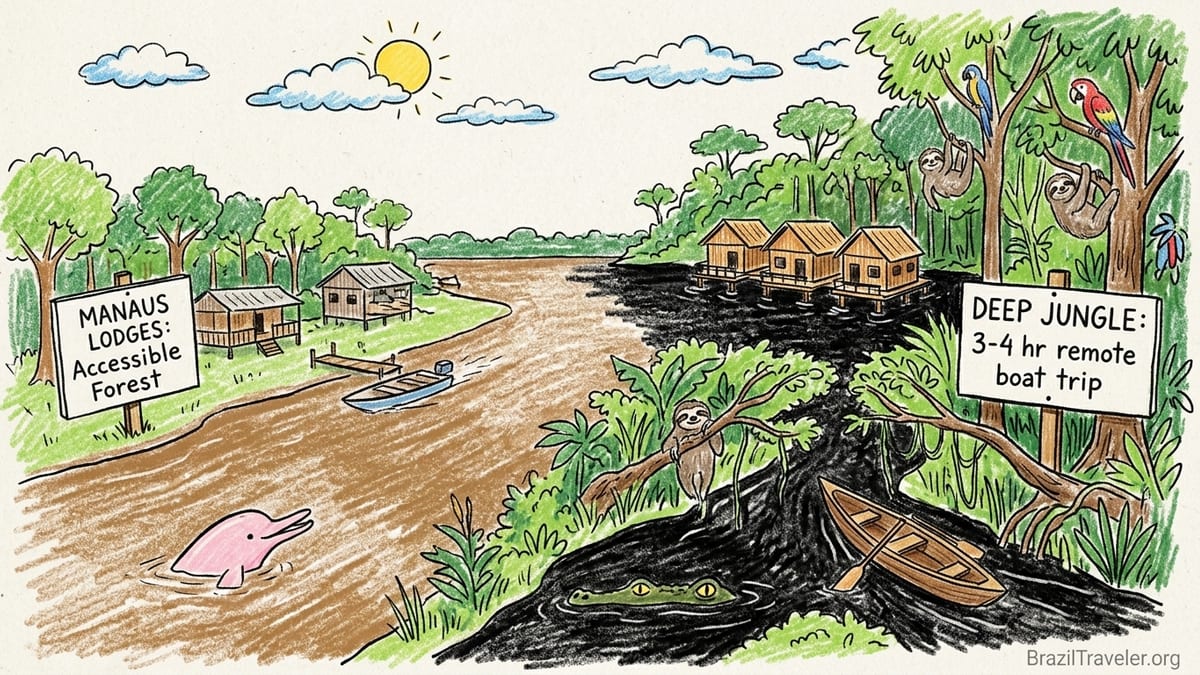
Before choosing a lodge, it helps to decide how remote you truly want to be. Around Manaus, there is a spectrum that runs from relatively accessible forest on the Rio Negro to lodges that require 3 to 4 hours of combined van and boat travel each way. The more remote you go, the darker the night, the louder the forest and the less likely you are to see another tour boat drift past your deck. At the same time, long transfers and isolation can feel tiring if you only book two nights.
On my most recent trip I stayed at and closely inspected a mix of classic Rio Negro and Amazon tributary lodges that work well for international travelers. These included Amazon Ecopark Jungle Lodge on the Tarumã-Açu tributary near Manaus, Amazon Eco Lodge on a blackwater river south of the city and Amazon Turtle Lodge further east toward the Mamori region. I also researched in detail but did not personally overnight at higher-end properties such as Anavilhanas Jungle Lodge in the Anavilhanas Archipelago and Cristalino Lodge in the southern Amazon, because they are important benchmarks for travelers looking for more comfort or specialized birding.
For each lodge I actually stayed in, I will describe the full journey from Manaus, including when the van finally leaves the asphalt, how your luggage makes it across docks and into boats, and what the water looks like under the hull. I will then dive into the details that often matter more than glossy photos: mosquito protection, how cold the air conditioning really gets, food quality, electricity hours, guide depth and what wildlife we genuinely saw on canoe and forest walks. Where I rely on research rather than firsthand stays, I state that clearly and focus on verified 2026 information about prices, inclusions and policies.
My Stay At Amazon Ecopark Jungle Lodge Near Manaus
Amazon Ecopark Jungle Lodge was my soft landing into the rainforest. It sits on the Tarumã-Açu River, a tributary of the Rio Negro, and you reach it in roughly 40 to 60 minutes from central Manaus. My transfer began with a pickup at my hotel around 8:00 in the morning. A minivan threaded its way past Manaus’ port area to a small river pier. There, staff tagged my suitcase and carried it down to a covered motor launch while I boarded with just my daypack. The river at this point is wide and dark, with the brown-and-black meeting of the Amazon and Rio Negro visible if your route includes a short detour. On my transfer the water was calm with small chop from passing cargo boats, and we were under way for about 25 minutes before the boat slipped into a narrower, quieter channel lined with forest.
Landing at the floating dock, I stepped directly onto a wooden boardwalk while porters unloaded bags onto carts. The walk to reception took less than five minutes along shaded paths. My bungalow was one of the traditional rooms in a low-rise structure on stilts, simple but solid. The room had screened windows, a strong ceiling fan and efficient air conditioning that cooled the space quickly in the late afternoon heat. Mosquitoes were present at dusk, but the combination of window screens, a bed net and repellent made them manageable; I collected more bites on the open restaurant deck than inside the room.
The bathroom had a straightforward electric shower with warm water and reasonable pressure. Electricity at Ecopark is available 24 hours and the lodge has Wi-Fi around the reception and restaurant. In my room the signal was weak; I could send messages but not reliably upload photos. Meals followed a buffet format with regional dishes such as grilled tambaqui fish, rice, beans, farofa and salads. Breakfast included fresh fruit, tapioca pancakes and strong coffee. It is not fine dining, but after long humid walks the food felt hearty and honest.
Nights at Ecopark were surprisingly loud. Tree frogs set up a high-pitched chorus and occasionally a howler monkey would call in the distance. On one night a brief storm swept across the river and the sound of heavy rain on the metal roof completely swamped the forest noise for an hour. Guided activities on my package included a daytime forest walk with explanations of medicinal plants, a visit to a monkey rehabilitation area and an evening canoe outing to listen for wildlife. Our guide spoke clear English, grew up in a nearby community and was quick to point out birds like kingfishers, a three-toed sloth high in a cecropia tree and caiman eyes shining red in our flashlight beams. For Ecopark, three days and two nights felt like the right minimum. It allowed one full day of activities and two half days without the transfer feeling disproportionate. Current 2026 rates for a 2-night package booked through established agencies start around the mid hundreds of US dollars per person in a traditional room, including transfers from Manaus, full board and a basic excursion program, with higher prices for superior room categories.
Deeper Into Blackwater Forest At Amazon Eco Lodge
Amazon Eco Lodge lies around 80 kilometers from Manaus on a blackwater tributary and is reached only by a combination of road and river segments. My transfer began with a pickup at my Manaus hotel shortly after 13:00. A van took about an hour to reach a river port, where our luggage was moved to a covered speedboat. After a short crossing of the Amazon near the meeting of the waters, we docked at Careiro on the opposite bank. Here, staff transferred bags to a second vehicle for a drive across relatively narrow rural roads, past small farms and patches of secondary forest. This leg took around 45 minutes on my trip with some bumps but continuous asphalt.
At the end of the road, a narrow pier projected into still, tea-colored water. All luggage went into a long motorized canoe while we slipped into lifejackets and settled onto wooden benches. This final leg lasted about 50 minutes, winding through increasingly narrow channels where overhanging branches brushed the boat. The blackwater was so dark it reflected the sky like a mirror, and in the late afternoon light it was easy to spot kingfishers darting from exposed roots. In total, the journey from Manaus took around three and a half hours door to dock.
The lodge itself is a floating complex of wooden structures connected by walkways above the water. My room was in a stand-alone bungalow with simple wooden walls, a double and a single bed, and screened windows that opened directly onto the flooded forest. There was no air conditioning, only a sturdy ceiling fan and the cross-breeze from the river. At night the air cooled enough that I slept under a light sheet, though in the early evening it remained warm. Mosquito pressure here felt higher than at Ecopark, especially at dusk on the decks. Inside the room, the combination of tight window screens, a bed net and spraying the bathroom before nightfall kept things surprisingly comfortable.
Electricity at Amazon Eco Lodge is generally available in the evenings and early mornings from a generator, with a pause during the middle of the day. This meant planning camera and phone charging around meal times. There was no Wi-Fi during my stay, and mobile reception was patchy to non-existent, which reinforced the feeling of being properly disconnected. Showers were cool but refreshing, drawing directly from the river system, and water pressure was adequate. Meals were cooked by a small kitchen team, served buffet-style but with more of a homestay feeling. On one night we had fried piranha that some guests had caught earlier; on another, chicken stewed with local herbs and plenty of rice, cassava and seasonal fruit.
The soundscape at night here was both denser and more varied than near Manaus. Frogs and insects were almost deafening, and several times in the small hours I woke to heavy splashes right below the bungalow as fish or caiman disturbed the water. Our local guide spoke Portuguese and basic English, but his knowledge of the forest was outstanding. On canoe excursions we saw pink river dolphins surfacing in the distance, brown capuchin monkeys moving through the canopy and a variety of birds including macaws, herons and hawks. On a pre-dawn paddle we glided through mist on a narrow igarapé and watched the forest slowly gain color as the sun rose. Forest walks were more demanding here, with sections of uneven ground and occasional mud when the water level had recently dropped.
In terms of length, I found that three nights and four days struck the right balance at Amazon Eco Lodge. Two nights would have felt rushed given the longer transfer, while four nights provided time for an early-morning canoe outing, an afternoon piranha fishing trip, a night walk and a visit to a nearby riverside community without stacking activities back to back. Package prices for 2026, based on information from Brazilian operators, tend to be quoted in Brazilian reais and include round-trip transfers from Manaus, full board and a defined schedule of canoe and forest excursions. For international travelers converting from US dollars or euros, it is smart to check current exchange rates and whether your package charges separately for drinks or certain optional outings.
Amazon Turtle Lodge: Classic Multi-Day Programs From Manaus
Amazon Turtle Lodge, which I visited to inspect the grounds and speak with staff but did not overnight in, sits deeper into the forest east of Manaus, in an area known for still lakes, igarapés and good odds of seeing river dolphins and caiman. It is reached by a transfer that typically combines a road segment from Manaus to a river port, a speedboat section that may pass the meeting of the waters, another van ride on the Transamazônica highway region toward Careiro, and finally a smaller boat into the Mamori or similar river systems. Travelers who have stayed at Turtle Lodge recently describe the full journey as taking around three to four hours from central Manaus, including all changes and luggage handling, which staff coordinate on your behalf.
The lodge itself offers wooden bungalows on stilts with private bathrooms and fan or air-conditioned options depending on category. During my daytime visit, the rooms felt airy, with large screened windows and mosquito nets available on the beds. The common areas overlook a wide stretch of water where canoes depart for excursions. What stood out in conversation with the team was the focus on structured multi-day programs. A typical 4-day and 3-night package for 2026, as outlined in official Turtle Lodge materials, includes round-trip transfers from Manaus, three meals a day, morning and afternoon activities such as canoe trips, wildlife observation, piranha fishing and visits to local communities, plus a night outing to search for caiman.
Recent rate sheets available from Brazilian agencies list 3-day and 2-night, 4-day and 3-night and longer packages in Brazilian reais, with different prices for standard and comfort-level cabanas. In broad terms, a 3-day and 2-night stay often includes arrival in the morning of day one, an afternoon canoe or forest walk, a full second day of activities and a final morning excursion before returning to Manaus. Given the transfer time, I recommend at least three nights for travelers who want to feel they have truly lived at the lodge rather than simply passed through. Travelers I spoke to who had stayed here reported good sightings of pink river dolphins, macaws, sloths and night caiman, with guides who balanced safety and adventure well.
Mosquito conditions at Turtle Lodge vary by water level and season. Staff emphasized that during the high-water months, when much of the forest is flooded, mosquitoes can be more active near the edges of the lodge, while in drier months the breeze over open water helps. All rooms are screened and guests are encouraged to bring long sleeves, long trousers and repellent, particularly for night outings. Electricity is typically provided for set hours in the evening and early morning, sufficient to charge small electronics and run fans, while air-conditioned categories may have longer power windows. Wi-Fi, when available, tends to be limited to central areas and is not suitable for heavy work, which matches my experience across most remote lodges in the region.
Higher-End Researched Alternatives: Juma, Anavilhanas And Cristalino
For travelers seeking more comfort or a higher degree of service than the simple lodges I stayed in, several standout properties in the broader northern Amazon are worth consideration. I did not overnight at these, but have researched them in detail using 2026 rate sheets and operator information, and they often come up in conversations with guides and travelers in Manaus.
Juma Amazon Lodge, southeast of Manaus in a preserved forest area, is known for stilted bungalows that rise and fall with the river level and for being far enough from the city to feel fully immersed. According to current Brazilian operator information, Juma sells 3-day and 2-night through 6-day and 5-night packages, with substantial price differences by room view category, occupancy and season. Rates are quoted in Brazilian reais and include road and boat transfers from Manaus, full board and a structured program of excursions such as canoe trips, forest hikes, night outings and community visits. Travelers who have reported back in recent seasons highlight well-trained bilingual guides and a good balance between comfort and environmental sensitivity.
Anavilhanas Jungle Lodge, located along the Rio Negro within the Anavilhanas Archipelago about 100 kilometers upstream from Manaus, positions itself in the higher-end category. A 2025–2026 price document indicates packages from 3 days and 2 nights up to 6 days and 5 nights, with rates that include a la carte meals, small-group tours and ground transfers between Manaus and the lodge. Here, you can expect air-conditioned chalets or bungalows, a pool with river views and more curated cuisine, along with excursions such as archipelago boat tours, canoe trips through flooded forest, nocturnal wildlife outings and visits to local communities. The blackwater of the Rio Negro tends to have fewer mosquitoes than sediment-heavy whitewater rivers, which can make evenings on the deck more comfortable than in some other areas.
Outside Amazonas state, Cristalino Lodge in the Alta Floresta region is a serious destination for birders and naturalists. Package information valid through December 2026 describes experiences that include transfers from the local airport, accommodation, meals and guided activities such as hikes and boat outings, with a strong focus on wildlife observation rather than classic Amazon sightseeing. Rates are typically higher than standard Manaus-area lodges, reflecting both the remoteness and the quality of guiding, and are often booked through specialist agencies in Brazil and abroad. If your primary interest is birds, monkeys and photography rather than simply being in the rainforest, Cristalino is one of the most competitive options in northern Brazil, although it sits outside the Manaus access hub.
What Packages Really Include: Transfers, Meals And Excursions
Across the lodges I stayed in and the alternatives I researched, the broad package structure is similar but the details matter. Most programs from Manaus bundle round-trip transfers, accommodation, three meals a day and a fixed schedule of excursions. The differences lie in how seamless the transfer feels, how flexible the activity program is and whether drinks and specialized experiences are extra.
At Amazon Ecopark, my 2-night package included shared transfers from Manaus by van and boat, accommodation, all meals from lunch on arrival to breakfast on departure, and a set of excursions allocated by the lodge operations team. These included a nature hike, visit to the monkey rehabilitation area, a canoe outing and at least one night activity. The exact timing of each was decided locally so groups could be combined. Bottled water was available, but soft drinks and alcohol were charged separately. Check-out was mid-morning, with boat and van transfers back to the city timed to connect with flights where possible.
At Amazon Eco Lodge, the structure was similar but felt more flexible due to the smaller guest numbers. My 3-night package covered all ground and river transfers, accommodation on the floating structures, three daily meals and two organized activities per full day, such as morning canoe trips and afternoon forest walks or piranha fishing. Night outings to search for caiman were included, though participation was optional if you were tired. Coffee, tea and filtered water were provided, but sodas and beers were extra. Because the lodge runs on generator power, staff were clear about electricity hours at check-in so guests could plan showers and charging.
For Juma and Anavilhanas, operator materials for 2026 confirm that their packages include regular transfers from Manaus (by road and boat for Juma, by road for Anavilhanas), full board and a defined set of small-group tours. At Anavilhanas, excursions such as archipelago navigation, piranha fishing and night wildlife spotting are part of the core package, while at Juma, programs include sunrise canoe trips, forest hikes and community visits. Cristalino Lodge packages, in turn, bundle local airport transfers, accommodation, meals and intensive guided activities focused on wildlife, but not the longer domestic flights needed to reach Alta Floresta.
Seasonality also affects inclusions and operations. During high water, roughly December to May, more of the forest around Manaus becomes navigable by canoe, so lodges emphasize igapó and igarapé exploration and wildlife that favors flooded habitats. In low-water months, certain channels become too shallow and boats may use different routes, but beaches appear on riverbanks and some trekking routes open. Lodges sometimes adapt their excursion offerings by season while keeping the basic number of daily activities stable.
How Many Nights Are Enough In The Rainforest?
After several trips and conversations with other travelers in Manaus, a pattern has become clear. Two nights works reasonably well at lodges with short transfers like Amazon Ecopark, particularly if you arrive early in the day. You get an afternoon arrival activity, one full day with morning and afternoon outings, and a short final activity before returning to the city. For travelers who are nervous about the forest environment or short on time, this is a manageable first taste.
For lodges that sit three or more hours from Manaus, such as Amazon Eco Lodge, Amazon Turtle Lodge and Juma, three or four nights are much more satisfying. The longer transfer becomes proportionate, and you gain the spare hours to simply sit on the deck and watch the light change on the river rather than running from one excursion to the next. In my own case, three nights at Amazon Eco Lodge gave me six full outings plus unstructured downtime to listen to the forest at night and to chat with guides about their lives on the river.
Five- and six-night programs, like those offered at Juma, Anavilhanas and Cristalino, make sense primarily for travelers with specific interests: birding, photography, fishing or a deep immersion away from connectivity. Over that time frame, you may repeat certain activities such as sunrise canoe paddles, but you experience different weather conditions, water levels over the day and a wider range of wildlife encounters. They also work well for families who want to slow the pace and take rest periods between walks and boat trips.
One practical point is fatigue. The heat and humidity in Amazonas, particularly from September to November, can be draining, and even comfortable lodges demand more physical effort than a city hotel. When you plan four or more nights, build in time to simply rest in a hammock in the shade, and choose a lodge where room comfort and breezes or air conditioning match your tolerance for heat. That can make the difference between emerging from the forest exhilarated or simply exhausted.
Practical Booking Tips, Prices And Policies For 2026
Prices for Amazon lodges in 2026 span a wide range. At the more accessible end, agencies in Brazil and abroad advertise 3-day and 2-night Manaus-area lodge packages starting in the low to mid hundreds of US dollars per person, based on double occupancy and including shared transfers, simple lodge accommodation, meals and basic excursions. Amazon Ecopark’s own contracted 2-night packages, for instance, are listed through some international resellers at several hundred US dollars per person in traditional rooms, with higher rates for superior categories and single travelers. Dolphin Lodge and other similar properties sit in a comparable band, representing good value for travelers looking for genuine forest without luxury pricing.
Mid-range to higher-end properties like Juma and Anavilhanas typically quote packages in Brazilian reais, with 3-day and 2-night options reaching into four figures in US dollar equivalent for two people, especially in high season and in premium room categories. These prices reflect not only room comfort and food quality but also small-group guiding and infrastructure such as pools, extensive boardwalks and in some cases air conditioning throughout. Cristalino Lodge, positioned as a top-tier wildlife property, often sits above this again in per-night terms once you include local transfers and specialized guiding.
Cancellation policies vary, and it is important to confirm them at the time of booking. Many Brazilian lodges require a deposit to secure reservations, with partial refunds available up to a certain number of days before arrival and credit vouchers offered closer in. Some international agencies selling Amazon packages layer their own terms on top. If you are traveling in the wettest months or at the peak of the dry season, when river levels can affect transfers, consider travel insurance that covers delays and last-minute changes. Lodges and agencies experienced in the region are usually transparent about water level conditions and will advise if any excursion adjustments are expected.
When comparing offers, look for specifics rather than headline prices or dramatic photos. Confirm whether airport pickup is included or only hotel-to-lodge transfers, whether drinks other than water are part of the package, and how many excursions per full day are guaranteed. Ask about group sizes on boats and walks, the language skills of guides and whether specialized interests such as birding or photography can be accommodated without requiring a private guide. These questions will help you match your expectations with what the forest and the lodge can realistically provide.
The Takeaway
Sleeping deep in the Amazon rainforest is one of those travel experiences that reshapes how you think about sound, darkness and the scale of nature. Around Manaus and in the wider northern Amazon, you can now choose from a spectrum of lodges that range from simple floating wooden structures to polished eco-resorts with pools and extensive wine lists. In my own journeys, places like Amazon Ecopark and Amazon Eco Lodge have shown how different the forest can feel depending on distance from the city, blackwater versus whitewater rivers, and whether you have air conditioning or rely solely on fans and mosquito nets.
What matters most is clarity about what is included and honesty about your own comfort levels. If you have only two nights and prefer some connectivity, a shorter transfer to a lodge like Amazon Ecopark or similar properties makes sense. If you have three or four nights and crave true darkness and silence punctuated only by frogs and distant howler monkeys, accepting a longer road and boat journey to Amazon Eco Lodge, Amazon Turtle Lodge or Juma will reward you. For travelers seeking a more refined but still authentic experience, Anavilhanas and Cristalino stand out in the mid to upper price ranges.
The Amazon is not a backdrop. It is an active, humid, constantly shifting environment that will soak your clothes, smudge your glasses and cover your boat in fallen leaves by the end of each day. Go prepared with realistic expectations, a tolerance for some discomfort and a curiosity about life along the rivers, and the forest will almost certainly give you more in return than any brochure can promise. Whether you stay two nights or six, you may find, as I did, that long after the trip ends it is the nighttime sounds and the feeling of stepping onto a gently rocking dock under a sky full of southern stars that stays with you.
FAQ
Q1. How long does it take to reach a jungle lodge from Manaus?
From central Manaus, lodges closer to the city such as those on the Tarumã-Açu River usually take 40 to 60 minutes by combined van and boat. More remote properties like Amazon Eco Lodge, Amazon Turtle Lodge or Juma typically require three to four hours with multiple road and river segments. Very high-end lodges in other parts of northern Brazil, such as Cristalino, add a domestic flight before local transfers.
Q2. How many nights should I book for a first Amazon lodge stay?
If you choose a lodge with a short transfer, two nights can work, giving you one full day of activities and shorter outings on arrival and departure days. For lodges that require longer transfers or if you want to slow down and fully absorb the forest, three or four nights are usually more satisfying. Five or more nights are best reserved for travelers with special interests such as birding, photography or fishing.
Q3. Are mosquitoes and insects really a big problem at Amazon lodges?
Insects are part of any Amazon experience, but well-run lodges are designed to reduce their impact. Rooms and bungalows typically have screened windows, fans or air conditioning, and mosquito nets over the beds. Blackwater rivers like the Rio Negro often have fewer mosquitoes than whitewater areas. Bringing repellent, long sleeves and lightweight trousers for dusk and night outings makes a significant difference.
Q4. Do Amazon jungle lodges have air conditioning and Wi-Fi?
Facilities vary widely. Lodges closer to Manaus and higher-end properties such as Anavilhanas often offer air-conditioned rooms and more reliable Wi-Fi in common areas. Simpler and more remote lodges may rely on ceiling fans and natural ventilation, with generator power only during specific hours and no or very limited connectivity. If climate control and internet access are important for you, confirm these details before booking.
Q5. What is typically included in an Amazon lodge package?
Most multi-day packages include round-trip transfers from Manaus or a regional hub, accommodation, three meals per day and a set schedule of guided activities such as canoe trips, forest walks, piranha fishing and night wildlife outings. Drinks beyond water, specialized excursions and tips are often extra. Higher-end lodges may include a la carte dining and more customized excursions within their standard rates.
Q6. When is the best time of year to visit the Amazon near Manaus?
The Amazon can be visited year-round, but the experience changes with the water level. High-water season, roughly December to May, turns much of the forest into flooded igapó that is explored by canoe, while low-water months reveal beaches and open more trekking routes. Wildlife is present in both seasons, though some species may be easier to see when waters are higher or lower. Personal preference for heat, humidity and rain should guide your choice.
Q7. Is it safe to drink the water and eat the food at Amazon lodges?
Well-established lodges provide treated or filtered drinking water and are careful about food hygiene, especially for international guests. It is generally safe to drink the water offered by the lodge and to eat freshly cooked meals. Many travelers still choose to avoid uncooked salads or ice outside of the lodge environment and to bring a personal water bottle to refill from filtered sources.
Q8. What wildlife can I realistically expect to see?
On a typical 3 or 4-night stay you are likely to see a variety of birds such as kingfishers, herons and macaws, aquatic life like pink or gray river dolphins, and reptiles such as caiman. Monkeys, sloths and a wide range of insects and frogs are also common. Large cats like jaguars are rarely seen near Manaus-area lodges and should be considered an exceptional bonus rather than an expectation.
Q9. How physically demanding are lodge activities?
Most standard programs are designed for travelers with moderate fitness. Canoe outings involve sitting rather than paddling, though some trips use paddle canoes for part of the route. Forest walks can be hot and humid, with uneven ground, roots and occasional mud, but are usually not technical. If you have mobility concerns or prefer gentler activities, choose a lodge that can tailor excursions or focus more on boat-based observation.
Q10. Should I book directly with a lodge or through a tour operator?
Both options can work. Booking direct sometimes gives more flexibility with room choices and special requests, especially if the lodge has an efficient reservations team. Using a reputable tour operator or agency can simplify logistics, bundle domestic flights, provide support in case of delays and sometimes secure promotional rates. For complex itineraries or if you do not speak Portuguese, an experienced operator often adds real value.