


The first time I watched Manaus slip behind the stern of an Amazon riverboat, the city looked like a mirage. The opera house dome glinted above the port cranes, the river spread out in a brown, restless sheet, and the diesel engines began their steady growl. Within an hour, the high-rises were gone and there was only water, forest and sky. I had read about Amazon cruises for years, but nothing prepared me for the slow, hypnotic rhythm of actually living on the river.
Embarking in Manaus: Two Very Different Rivers of People
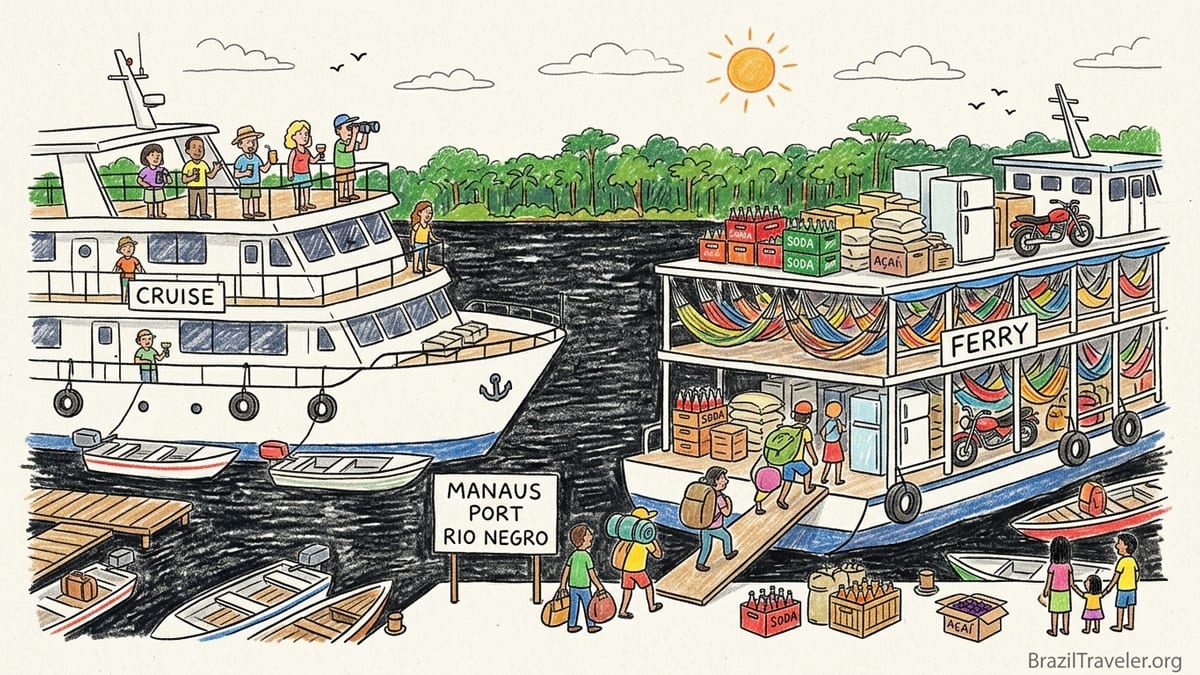
Most travelers first meet the river at the Porto de Manaus, the busy floating port on the Rio Negro. Step through the terminal and you immediately see the difference between an expedition cruise and the local ferries that form the backbone of transport in the Brazilian Amazon. On one side are white-painted expedition vessels with enclosed lounges and sun decks, taking mostly tourists out for three to eight days. On the other are cargo-passenger ferries strung with hundreds of hammocks, loading crates of soda, refrigerators, motorcycles and sacks of açaí. These boats connect Manaus with Santarém, Belém and Tabatinga the way highways connect cities elsewhere.
On my most recent trip, I spent a week aboard a small expedition vessel operating out of Manaus, then followed it with a segment on a local hammock ferry from Manaus toward Santarém. I wanted to feel both worlds and to understand how this river is at once a travel dream and an essential transport corridor. The Amazon navigation route between Belém and Manaus extends for roughly 1,646 kilometers and is officially classified as a federal waterway, carrying everything from deep sea container ships to slow wooden ferries. You feel that scale when you watch a massive cargo ship slide past the flimsy-looking riverboats at dusk.
Boarding the expedition ship felt familiar, almost like checking into a small river cruise in Europe. A crew member took my bag, I signed a passenger list, received a safety briefing in both Portuguese and English, and was shown to my air-conditioned cabin. Over the loudspeaker, the captain announced that we would first head to the Meeting of the Waters, where the dark Rio Negro runs alongside the sandy Solimões without mixing, before turning into the Anavilhanas archipelago of forested islands on the Negro. The plan sounded carefully curated, and it was.
Embarking on the hammock ferry a few days later could not have been more different. I bought my ticket in cash at a crowded booth, walked up the gangway dodging handcarts and families, and found the hammock deck already half-full. Instead of a cabin key, my “space” was whatever patch of metal railing I could tie my hammock to. People carried in Styrofoam coolers, plastic bags of fruit, and cardboard boxes. The boat would serve meals, but many passengers clearly planned to live off their own supplies for the four or five days the journey would take.
Cabins Versus Hammocks: How You Actually Sleep
My expedition cabin was compact but comfortable, a rectangular room with two lower beds that could be pushed together, a small desk, a wardrobe and a window opening directly over the Rio Negro. The air-conditioning was strong enough that I sometimes needed a light blanket at night. There was a private bathroom with a hot shower and flushing toilet, something you appreciate very quickly when you feel how sticky the air gets in the late afternoon. Power outlets charged my camera batteries and phone between outings. It felt like a modest river hotel that happened to move.
On the hammock ferry, sleeping meant adapting to a shared space. The main deck was open on the sides but roofed with corrugated metal. By the time we left Manaus, hammocks were hung three or four deep from every available beam. The boat sold basic hammocks near the ticket office, and vendors at the port did brisk business in slightly better ones. I had brought my own from a market in Manaus, along with an extra rope and a small carabiner so I could adjust the height. Once strung, my hammock became my bed, sofa and storage area. My daypack served as a pillow to keep valuables close.
Sleeping itself was surprisingly restful when the night breeze came up. The first evening, music played from someone’s Bluetooth speaker until about midnight, children darted around, and a baby cried off and on. Earplugs helped. After that, the rhythm settled. The engine noise below deck became white noise, and the knock of water against the hull rocked us all to sleep in a way no hotel can reproduce. I woke several times each night, rolled over carefully to avoid twisting the fabric, and went back under. By the second night, it felt natural.
The difference in privacy was stark. On the expedition cruise, I could close my cabin door, take a shower, spread out my clothes to dry and retreat with a book. On the ferry, privacy meant turning your face into the hammock and hoping your neighbors did the same. Changing clothes required practice and a sarong used as a curtain. Yet there was also a sense of community I never quite found on the more structured cruise. By the end of the ferry leg, I knew the family with the bright yellow hammocks next to mine and we exchanged cups of strong, sweet coffee at sunrise.
Bathrooms, Meals and the Constant Thrum of the Engine
On the expedition vessel, bathrooms were one of the big comforts. My cabin’s shower produced reliably warm water, an impressive feat in a place where everything is drawn from the river and filtered on board. Towels were changed once during the week, and the crew politely asked passengers to conserve water. Common areas included another restroom near the dining room, always kept clean. At the end of a humid day in the flooded forest, stepping into that cool, tiled shower felt like luxury.
Meals on the cruise were served buffet style at set times, with a mix of Brazilian staples and international dishes. Breakfast might include tapioca pancakes, fresh fruit, eggs, pão de queijo and strong coffee. Lunch centered on grilled fish, rice, beans, salads and farofa. Dinner added soups and occasionally a pasta dish. Juice made from regional fruits like cupuaçu and açaí appeared daily. Everything was included in the fare, except for alcohol and specialty drinks. After each morning and afternoon excursion, we returned to neatly set tables and attentive staff, which contrasted sharply with my ferry experience.
On the hammock ferry, bathrooms were shared. There were separate male and female restrooms with a row of toilets and cold-water showers. Tiles were worn, the floor stayed permanently damp, and you brought your own toilet paper. I learned to shower in the mid-afternoon lull, when most passengers were napping in their hammocks and the facilities had just been hosed down. Still, it never felt truly clean in the way the cruise ship did, and flip-flops were non-negotiable.
Meals on the ferry were simple and hearty. The ticket included three meals a day served on metal trays: usually rice, beans, spaghetti or farinha, a piece of chicken or fish, and occasionally salad. Breakfast was bread with margarine and coffee with a lot of sugar. Passengers supplemented this with snacks bought from the small bar on board or from vendors who swarmed up in canoes whenever we stopped at riverside towns. I watched sacks of oranges, grilled fish on skewers and homemade sweets pass from hand to hand between boat and shore, the Amazon version of a drive-through lane.
What both boats shared was the constant engine noise. Deep in the hull, diesel engines worked without rest, sending a steady vibration through deck plates and bunk frames. On the expedition cruise, insulation muted most of the sound inside cabins, but it was still a presence on the open observation deck. On the ferry, the engine was a heartbeat under everything: conversation, music, the slap of waves. It made silence rare, but at night, lying in the hammock or on my cruise bunk, I found the thrum oddly reassuring. It meant we were still moving, still part of the river’s traffic.
Heat, Mosquitoes and the Art of Actually Sleeping
Heat on the river is not a concept, it is a physical weight that settles on you by mid-morning and does not lift until long after sunset. On the expedition ship, air-conditioning in cabins and enclosed lounges buffered it. The upper deck remained open to catch the breeze, andthere were shaded corners where you could watch the treeline drift by without baking. The crew encouraged light clothing and constant hydration. I noticed how quickly people darted from skiff to ship to shower, chasing the cool.
On the ferry, there was no air-conditioning on the hammock deck, only the natural flow of air as the boat moved and a few ceiling fans near the center. At anchor or when maneuvering near a port, the air turned heavy and still. The first afternoon, I lay in my hammock in a sheen of sweat, grateful for every gust. Locals taught me to hang a light cotton sheet diagonally over the hammock to block direct sun without trapping heat. Nights were another story. When the air flowed freely, the temperature dropped convincingly, and more than once I pulled that same sheet over myself against the chill.
Mosquitoes are the invisible question everyone asks about the Amazon. My week on the Rio Negro during an expedition cruise was surprisingly low in biting insects, especially while we were underway. The blackwater of the Negro is less favorable to mosquito breeding than some of the whitewater tributaries, and the breeze on deck helped. Repellent was still necessary at dusk, particularly during skiff excursions into calmer channels and flooded forests. The ship provided light screens on windows and kept exterior lights low to avoid attracting swarms.
On the hammock ferry, bug pressure varied by where we were and whether we were docked. While moving in the main channel at night, mosquitoes were fewer than I expected, though I still used repellent on ankles and arms and slept under a light travel net I could tuck into the hammock edges. When we stopped at small ports for cargo, clouds of insects rose from the floodplain. People covered arms and legs, reached for coils of burning mosquito repellent and joked to take their showers quickly before the “mosquito hour.” The sound of insects hitting the deck lights was constant in those moments.
Comparing the two, sleeping on the expedition cruise was easy, almost too easy. After a day of early starts and steady activity, I dropped into a cool bed and woke naturally before dawn for sunrise excursions. On the ferry, sleep was more fragmentary and social. You went to bed when the boat quieted, usually around midnight, and woke whenever your neighbor got up, a baby cried, or someone’s phone rang with a loud samba ringtone. Earplugs, an eye mask and a willingness to accept imperfect rest were as important as a good hammock.
Out on the Water: Skiff Excursions Versus Watching the Banks Roll By
The most important difference between an expedition cruise and local transport is how much time you actually spend off the main vessel. On my weeklong cruise from Manaus into the Rio Negro and nearby tributaries, we used aluminum skiffs with outboard engines for almost all exploration. Mornings often began with a 5:30 or 6:00 departure in the half-light, when birds were most active and the air felt almost cool. We would glide through narrow channels lined with trees draped in bromeliads, motor into flooded forest where only the canopy tops showed above the tannin-dark water, and cut the engine to drift and listen.
In practice, that meant two main excursions a day, each lasting two to three hours. In the morning, we often focused on wildlife and landscape, in the late afternoon on community visits or sunset viewing. Over seven days, I spent around four to five hours daily in the smaller boats, a significant chunk of time off the main ship. We returned briefly for breakfast, lunch and rest, then headed back out. It felt like a mobile base camp rather than a passive cruise.
Wildlife sightings were real but not cinematic. On the Rio Negro, we saw pink river dolphins surfacing in slow arcs near the bow, especially in confluence areas closer to Manaus. Groups of squirrel monkeys moved through trees along narrow streams, sometimes joined by a few larger capuchins. We shone spotlights at night and saw the red eye-shine of small caimans in backwater lagoons, though they vanished quickly when we approached. Birdlife was constant: herons, egrets, kingfishers, macaws flashing red and blue across the sky, and hoatzins rustling in the riverside foliage. I did not see jaguars, giant otters or anaconda during this trip, and no one on board pretended that was normal.
On the hammock ferry, there were no organized excursions. The boat followed the main navigation channel, stopping briefly at riverside towns to exchange cargo and passengers. I spent hours at the rail with a pair of binoculars, watching islands slip past, sandbanks emerge in the low-water season and distant tree lines burn orange at sunset. Dolphins sometimes appeared here too, especially near where side channels joined the main river, but since the ferry never stopped for them they remained silhouettes and splashes rather than close encounters.
During the Belém to Manaus stretch of the Amazon waterway, the sheer length becomes part of the experience. With around 1,646 kilometers of navigable river between the two ports, the ferry can travel for whole days without sight of a significant town, only small stilt houses, canoes and occasional barges. That continuity is something no short cruise can fully replicate. Yet you are also confined to the boat, watching rather than entering the landscape. There are no daily landings, no guided walks under the canopy, just a long, slow moving balcony view.
Sunrise, Sunset and the Rhythm of River Nights
Amazon light is its own attraction. On the expedition cruise, sunrise became the anchor of each day. I woke before my alarm more often than not, drawn up to the observation deck by the sound of the crew launching skiffs and the smell of coffee. In the gray-before-blue, the forest on both banks looked like a flat black line. Then, as the sun inched up, bands of pink, gold and intense blue peeled back overhead. When the boat lay still near an island, mist curled up from the water surface and the calls of birds layered over each other like a rough choir.
Sunset on the Rio Negro felt more intimate. The blackwater turned mirror-like, reflecting every tone in the sky. We would often end an afternoon skiff trip by killing the engine and drifting while the sun slid behind a wall of trees. The guides poured small plastic cups of caipirinhas or juice, people spoke quietly or not at all, and the only mechanical sound was the faint hum of the main vessel in the distance. Back on board, dinner followed, perhaps a short lecture about river ecology, and then the ship steamed through the dark toward the next morning’s anchorage.
On the hammock ferry, sunrise and sunset were less orchestrated but no less affecting. At first light, before breakfast, the deck stirred as people shifted in their hammocks, children climbed down to play and someone put on music at low volume. I would stand near the bow, coffee in hand, and feel the river widen or narrow almost imperceptibly. The colors at sunrise were softer than on the Negro but lingered longer over the pale Amazonian water. Sunset, by contrast, was more social. People gathered along the railings, chatting and taking photos on their phones. As the light faded, lights in riverside houses blinked on one by one, tiny constellations marking human presence in a vast dark corridor.
Night itself felt different depending on where you slept. On the expedition ship, I lay in a quiet cabin with curtains drawn, hearing only a muffled engine and the occasional shout from crew on duty. It was easy to forget we were in a remote region with few roads and limited emergency infrastructure. On the ferry, the night never fully settled. Someone’s hammock creaked, a television flickered in a corner, a group played cards, and at random hours we would slow for a port call, floodlights flaring as cargo moved. I woke to the slap of a small boat against the hull and the chatter of dockworkers in Portuguese more than once.
Spending nights on the river taught me how fundamental these boat rhythms are to Amazonian life. On both vessels, crew members treated night watch as a normal part of their week, scanning black water for floating logs and unlit canoes. Many had done the Belém to Manaus route dozens of times. For them, the engine’s thrum and the sudden blaze of lights at a 2 a.m. cargo stop were as everyday as rush-hour traffic in a big city.
Seasonal Water Levels, Routes and Today’s Cruise Options
Planning river travel from Manaus means paying attention to the Amazon’s seasons. Around Manaus, the river level can fluctuate by roughly ten meters between low and high water each year. The broad pattern is that water levels rise through the first half of the year and reach a peak sometime between May and June, creating a high-water season when flooded forests are most accessible by small boat. They fall gradually through the second half of the year, exposing sandbars and beaches from roughly August to November in what most operators describe as the low-water season.
These cycles directly shape cruise routes and experiences. During high water, expedition cruises out of Manaus typically spend more time in igapó, the seasonally flooded forests, weaving between submerged trunks and entering channels that are impossible to navigate at other times. Wildlife can be closer because boats can approach trees where monkeys feed and birds roost. During low water, the same itineraries may switch focus to beaches, hiking on firm ground and visiting riverbank communities reachable only when the water recedes. Some larger vessels must also adjust routes or limit how far upriver they go when water levels drop unusually low, as has happened in recent drought years.
Current operators out of Manaus offer a spectrum of choices. Small expedition-style vessels based on the Rio Negro and nearby tributaries typically carry between 12 and 30 passengers, with itineraries of three, four, seven or occasionally ten nights. Cabin types range from compact lower-deck twins to larger upper-deck suites with private balconies. Most include all meals, filtered drinking water, skiff excursions, guided walks and community visits in the fare. Some companies market themed departures focused on birdwatching, photography or cultural festivals, while others emphasize family-friendly activities and softer adventure.
At the other end of the scale, larger ocean-going cruise ships periodically make extended voyages up the Amazon from the Atlantic, including calls at Manaus, Santarém and smaller ports. These trips are more about experiencing the river as part of a longer itinerary than about in-depth rainforest exploration. Shore excursions are shorter and more scripted, and passengers sleep each night in standard cruise cabins with all the familiar amenities of a big-ship line. For travelers who want a taste of the Amazon without giving up the structure of a conventional cruise, these sailings offer one path.
Local passenger ferries remain the most authentic and economical way to move along the river between cities. The Belém to Manaus stretch typically takes around five days downstream or slightly longer upstream, with prices for a hammock space that are often a fraction of what a single night costs on an expedition ship. Some ferries offer simple private cabins as an upgrade, usually with bunk beds and a small private bathroom, though availability and quality vary. These boats are not marketed as tourist experiences, but they form the living infrastructure of the region, carrying goods, mail, students returning home from school, traders and entire families relocating upriver or down.
Riverboat or Jungle Lodge: Which Rhythm Would I Choose Again?
Having slept both on moving boats and at static jungle lodges near Manaus, I am often asked which I prefer. The honest answer depends on what rhythm of life you want to fall into. At a jungle lodge, days are structured around land-based activities. You wake to the sound of forest insects instead of engines, walk to a dining hall on raised walkways, and head out for hikes, canoe paddles on small creeks, fishing or village visits. You return to the same bed each night. The forest feels closer in a literal sense, pressing against the walls of your cabin, and you can hear frogs, cicadas and the occasional monkey in the dark.
On the river, time spreads out differently. The boat is always in motion except when anchored for excursions or ports. Your scenery changes continuously, even when you are doing nothing but sitting on deck with a book. The rhythm is tidal and cumulative: long stretches of steady humming movement punctuated by intense bursts of activity when you climb into a skiff, hike, or slip into the water for a tightly supervised swim. Sleep is lighter and more interrupted, especially on a hammock ferry, but you wake each day in a new place without packing or unpacking.
Comparing the two, I found that the expedition cruise from Manaus gave me a stronger sense of the river as a corridor, a living highway tying scattered communities into a loose whole. The jungle lodge, by contrast, showcased the depth of life in one specific patch of forest. On the cruise, I saw a broader range of landscapes and river conditions in a week than I had in several lodge stays combined. On lodge stays, I had more time to linger with local guides in one ecosystem, following the same trail at different hours and seeing how it changed.
If I had to choose for a next trip, I would return to the river first. There is something about sleeping within that long chain of navigation between Belém and Manaus, knowing that the same channels carry cargo barges, patrol boats, tiny canoes and quiet expedition ships, that feels essential to understanding the Brazilian Amazon. I would, however, choose an expedition-style vessel again rather than another multi-day hammock ferry, reserving the slower transport boats for shorter segments. A week of hammocks taught me a lot, but my back still votes for a cabin with a door.
FAQ
Q1. How long does it take to travel by boat between Belém and Manaus?
For passenger ferries, the journey usually takes around five days downstream and can be slightly longer upstream, depending on river levels, scheduled stops and boat speed.
Q2. Are Amazon river cruises from Manaus the same as the local hammock ferries?
No. Expedition cruises from Manaus are designed for tourism, with cabins, guided excursions and set itineraries, while hammock ferries are basic cargo-passenger boats that function as everyday transport for local communities.
Q3. What kind of cabin can I expect on an expedition cruise out of Manaus?
Most small expedition vessels offer compact air-conditioned cabins with twin or double beds, private bathrooms with hot showers, and at least one window or porthole, with some ships adding larger suites on upper decks.
Q4. Do I need to bring my own hammock if I take a local ferry?
It is wise to bring your own hammock or buy one at the port in Manaus or Belém. Many ferries sell or rent hammocks on board, but availability and quality can vary, especially during busy periods.
Q5. When is the best season for an Amazon river cruise from Manaus?
High water, generally from late December to around May, is best for exploring flooded forests by small boat, while lower water from roughly August to November offers more exposed river beaches and some additional hiking options.
Q6. How much time on an expedition cruise is actually spent off the main ship?
On a typical weeklong expedition cruise in the Rio Negro region, you can expect roughly two excursions per day by skiff or on foot, adding up to about four to five hours daily away from the main vessel.
Q7. Will I definitely see wildlife like dolphins, monkeys and caimans from the boat?
There are good chances but no guarantees. On my trip I saw pink river dolphins, several species of monkeys, caimans at night and a wide variety of birds, but sightings vary with season and itinerary.
Q8. How bad are mosquitoes on the river itself?
On moving boats in the main channels, especially on the Rio Negro, mosquitoes were fewer than many expect, but they increased near calm backwaters, flooded forests and ports, so repellent and light long sleeves were still important.
Q9. Is it safer to stay in a jungle lodge or on a river cruise?
Both can be safe if you choose reputable operators, follow local guidance and understand that medical care and evacuation options are more limited than in major cities, so travel insurance and basic precautions are essential.
Q10. If I can only choose one, should I book a jungle lodge or a river cruise from Manaus?
If you want to feel the Amazon as a vast transport corridor and wake each day in a new stretch of river, choose a cruise. If you prefer to explore one area in depth with more solid sleep and land-based activities, choose a lodge.