


Reaching Jericoacoara felt less like a routine transfer and more like the opening chapter of an adventure. Long before I was floating in a hammock over turquoise water at Lagoa do Paraíso or racing a buggy up the Tatajuba dunes, the journey in from the asphalt to the sand set the tone for everything that followed. In Jeri, access and activities blend into one continuous experience, and understanding how the transfers, park rules and local logistics work can make your days among the dunes far more enjoyable.
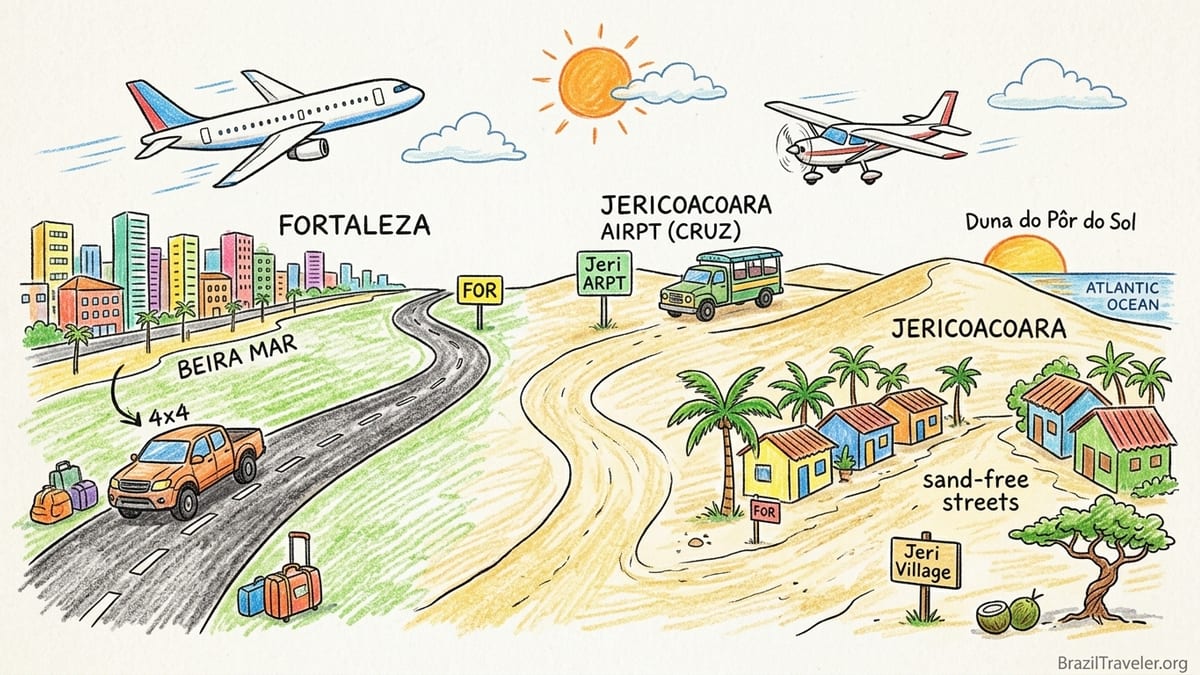
Choosing My Way In: Fortaleza or Jericoacoara Airport
Planning my trip, the first real decision was whether to fly into the small Jericoacoara Airport in Cruz or make the classic overland journey from Fortaleza. I chose Fortaleza, partly for cost and partly because I wanted to experience the full transition from city highway to sand tracks. The airport in Fortaleza has far more flight options and usually cheaper fares from major Brazilian hubs like São Paulo and Rio, which made it easier to piece together an itinerary without awkward overnight layovers.
From Fortaleza, visitors broadly have three choices to get to Jeri: a regular intercity bus plus a 4x4 truck at the end, a shared 4x4 transfer, or a private transfer in a SUV or pickup. I booked a shared transfer through a local agency that uses air conditioned Hilux and SW4 vehicles, leaving Fortaleza around 7:30 in the morning and promising a total travel time of about six hours, including the last stretch through the dunes. Prices in 2026 for these shared transfers were typically in the range of 200 to 280 reais per person one way, depending on the time and whether pickup at the airport or hotel was included.
For travelers short on time, flying directly to Jericoacoara Airport can make sense. Commercial flights connect Cruz to Fortaleza and São Paulo on several days of the week, and from there you can arrange a 4x4 transfer of roughly one hour and a half to the village. When I checked, these airport transfers tended to cost from about 70 to 100 reais per person in a shared vehicle, or several hundred reais for a private car. It is a faster and more comfortable option, but you skip the long transition where dunes slowly replace farms and villages.
In the end, I was happy with the decision to start in Fortaleza. A night there meant I could sleep before the early pickup, spend an evening eating seafood on the Beira Mar promenade, and start the Jeri journey rested. For anyone arriving on a late flight, I would strongly recommend doing the same rather than trying to push through six hours of road and sand in the dark after a long travel day.
From Asphalt to Sand: The Long Road to Jeri
My driver picked me up at the hotel in Fortaleza just after sunrise. Once everyone in the shared transfer had been collected, we left the city on the CE-085 highway. For several hours the ride felt like any other road trip through northeast Brazil: gas stations selling coffee and pão de queijo, stretches of cashew trees and low scrub, occasional small towns where the driver slowed for speed bumps and motorcycles. It is a solid 280 to 300 kilometers to the municipality of Jijoca de Jericoacoara, and with a brief coffee and restroom stop, that portion alone took close to four hours.
The character of the trip changed when we reached Jijoca. Here the paved road and bus connections end for visitors heading into the national park and the village. At the edge of town, we stopped in a dusty parking area where other 4x4s and open sided trucks were waiting. The driver asked us to stretch our legs while he deflated the tires slightly for better grip on the sand. People arriving by intercity bus with companies like Guanabara are also dropped in Jijoca and then transfer into these jardineira trucks or 4x4s for the final stretch, which is why schedules are often aligned so that no one waits too long between connections.
From Jijoca to Jericoacoara, the vehicle finally left the asphalt. We crossed patches of shallow water, followed makeshift tracks over hard packed sand, and occasionally skimmed along the beach depending on the tide. On the day I traveled, much of the route wound through low dunes interspersed with vegetation, with the driver weaving between ruts to avoid softer sections. The last hour from Jijoca to Jeri felt more like a gentle off road excursion than a transfer, and I was glad I had packed my main luggage in a zipped duffel rather than a delicate suitcase. Bags are generally stacked in the back of the 4x4 or in a compartment on the jardineira, so it is worth protecting anything that does not like dust or small bumps.
After about an hour on sand, the 4x4 stopped at the edge of a large parking zone outside the village. This is where most visitors meet the reality that private vehicles are restricted in Jericoacoara. Signs from the municipality and the local environmental authorities explain that only accredited residents, service vehicles and authorized tourist transports can enter the village by car. Everyone else must leave their vehicles in designated parking and continue on foot or by small authorized transport within the village area. That last short walk with my backpack, across sand lined alleys with no cars and just a few carts and bicycles, made it clear that Jeri is intentionally pedestrian oriented.
Arrival in a Car Free Village and Local Rules
The transition from a 4x4 crossing dunes to stepping into a car free village is one of the most striking parts of arriving in Jeri. The streets in the village are sand, without paving, and instead of traffic noise there is the sound of people talking on their way to the beach and music drifting from small bars and pousadas. I checked into a simple guesthouse two blocks off the main beach, where the staff immediately asked if I had already paid the Sustainable Tourism Tax. This is a standard question because, as of September 22, 2026, the municipality confirms that the only visitor tax in force is the Taxa de Turismo Sustentável of 41.50 reais per person, valid for ten days.
I had pre registered online, so I only needed to show the QR code at the control booth near the entrance to the village earlier in the journey. The local tourism authority reiterated in a notice dated September 22 that there is no separate national park entrance fee currently being charged. A proposed park admission managed by a private concessionaire has been suspended by the courts, so visitors entering Jericoacoara National Park for now do not pay a separate conservation ticket beyond the municipal tourism tax. Anyone planning a trip should still verify this close to their travel date, since legal decisions and regulations can change.
Vehicle rules inside the village are stricter than many people expect. Local regulations, supported by federal environmental norms for the Jericoacoara Environmental Protection Area, prohibit the circulation of non authorized cars, buggies and motorcycles on the sand streets. Only vehicles belonging to residents, registered tourist services and essential supply and cleaning trucks can drive in specific designated streets. There is also a municipal regulation that sets daily fees for visitors who park their cars in the official parking area outside the village limits. When I arrived, the rate was posted at around 40 reais per vehicle per day, without in and out privileges, which is an important cost to factor in if you are considering renting a car.
In practical terms, the pedestrian focus means that once you are in Jeri, nearly everything is accessible on foot. The main beach, the dune where people gather for sunset, the cluster of bars and restaurants on the central streets, and the small shops are all within a few sandy blocks. For the longer distances to lagoons or more remote dunes, you rely on accredited buggy drivers, 4x4 jardineiras or quad bikes, all of which must follow preapproved routes inside the protected area. At first this felt restrictive, but after a day or two it became part of the charm and made the village feel more like an island than a busy resort.
My East Side Tour: Lagoa do Paraíso and Hammocks in the Water
My first full day in Jeri was dedicated to the classic east side tour that includes Lagoa do Paraíso. I booked a shared jardineira 4x4 at a small agency near the main square for 80 reais per person, which matched the going rate I had seen on official tourism channels and local operators. The same route by private buggy for up to four people was being quoted around 450 to 550 reais, which can work out cheaper per person for groups of three or four who want more flexibility.
We left the village around 9:15 in the morning in an open sided 4x4 truck with two rows of bench seating. Our guide, a local driver accredited to operate inside the park, outlined the day: first Praia do Preá, then Buraco Azul, followed by Lagoa do Paraíso, and finally a quick photo stop at the famous twisted Árvore da Preguiça on the way back. The initial part of the route hugged the beach east of Jeri, occasionally cutting inland to avoid soft sections. Riding in the jardineira with the wind and sea spray made it clear why this transfer is considered an attraction in itself rather than just transportation.
The first stop was at Preá, a long, windy beach that has become a hub for kitesurfing. We had around forty minutes there, which for me was enough time to walk the shoreline and watch dozens of kites looping over the waves. From there we drove inland to Buraco Azul, an artificial lagoon carved out of former excavations and now filled with vivid blue water. Entry to Buraco Azul involved a separate fee, just under 20 reais when I visited, and the atmosphere felt decidedly built for social media with swings, small platforms and music. I swam for ten minutes, took a couple of photos, and was ready to move on.
Lagoa do Paraíso was the real highlight of the east tour. Our group arrived late morning, and we settled at a beach club with wooden decks, white sand and the famous hammocks set directly into the shallow water. Several establishments line the lagoon, each charging for food and drinks and sometimes a small fee for use of loungers or certain hammock areas. Prices in 2026 for main dishes at these lagoon restaurants ranged generally from 60 to 100 reais, with drinks and snacks on top. We stayed nearly three hours, floating in the clear water, reading in shaded chairs and occasionally watching dune buggies glide past on the distant shore.
Across the entire east tour, we spent about two and a half hours actually driving and four hours at stops, with by far the largest chunk at Lagoa do Paraíso. The only part that felt too touristy for my taste was Buraco Azul, which I would probably skip if I booked a private buggy next time. The lagoon itself, even with its beach clubs and Instagram ready hammocks, still felt relaxed and beautiful, especially once the early crowds dispersed and the afternoon light softened over the water.
My West Side Adventure: Tatajuba, Dunes and Rustic Lagoons
The next day I headed west on a buggy tour to Tatajuba, which turned out to be my favorite outing. This time I joined three other travelers to split a private buggy, paying 150 reais each for a total of 600 reais. That fell within the common price range I had seen locally for a full day west side buggy tour in 2026, usually quoted between roughly 550 and 800 reais depending on negotiation, season and whether pickup from distant pousadas was included.
We left around 9:00 in the morning. The buggy driver took us along the beach towards Guriú, navigating tide dependent stretches of sand where timing matters. This part of the ride felt more adventurous than the east tour, with shallow river crossings and stretches where the buggy climbed and descended medium sized dunes. At Guriú we made our first extended stop at a mangrove area where there is an option to take a small boat trip up the river in search of seahorses. The boat ride cost around 40 reais per person and lasted about forty minutes, adding a quieter, nature focused moment to the otherwise adrenaline filled day.
From Guriú we crossed a small ferry with the buggy and continued towards Tatajuba proper. The landscape became a mix of shifting dunes and patches of vegetation, with the driver frequently adjusting speed to safely climb and descend sandy slopes. A few times he offered to take a more dramatic drop, which the group agreed to once or twice, but he always respected when someone asked for a gentler route. It underscored how important it is to communicate your comfort level with your driver at the start, especially if you have back issues or are traveling with children.
By late morning we arrived at Lagoa Grande in the Tatajuba area, where rustic barracas line the edge of a shallow, warm lagoon. Here the hammocks in the water are less polished than those at Lagoa do Paraíso, with wooden poles and older nets, but the atmosphere felt more relaxed and genuinely local. We chose a simple restaurant that had plastic tables set right at the waterline. Lunch was grilled fish for two at around 120 reais, served with rice, salad and farofa, plus a couple of caipirinhas and coconut water. We lingered for more than two hours, alternating between lying in hammocks, trying a small dune zipline and simply floating in the lagoon.
In total, the west side tour lasted almost six hours, from about 9:00 to 15:00. Roughly three of those were spent in the buggy, with the remaining time divided between the seahorse boat, dune viewpoints and the long lunch and relaxation break at the lagoon. Some parts of West Jeri also flirt with touristy excess, such as certain zipline and toboggan style activities that charge separate small fees, but overall Tatajuba felt less crowded and more rooted in the surrounding communities than the more polished beach clubs at Paraíso.
What I Would Do Differently Next Time
Looking back, there are a few things I would plan differently about my tours and transfers. On the transfer side, I would still choose the overland trip from Fortaleza for the first time, but on a repeat visit with limited days I might fly to Jericoacoara Airport. The hours saved would allow an extra sunset or half day at the lagoon instead of another stretch of highway. If I did use the bus and jardineira combination from Fortaleza, I would book well in advance with a known company and choose a daytime schedule both for safety and to better appreciate the changing landscape.
Regarding dune and lagoon tours, my main adjustment would be to prioritize flexibility. The shared jardineira tour to the east was good value and simple to arrange, but it locked our group into a specific sequence and amount of time at each stop. If traveling with at least one other person, I would now lean toward private buggy tours even at a higher overall price, because splitting 500 to 600 reais between three or four people offers the freedom to skip places like Buraco Azul and instead add more time at a favorite lagoon or a less visited stretch of beach.
I would also consider doing one non motorized activity to balance the days of engines and dunes. Options include guided hikes to Pedra Furada at low tide, stand up paddle sessions on the lagoon, or simply a full afternoon left open to watch the sunset from the Duna do Pôr do Sol and wander the village streets. While the buggy rides were memorable, they are not the only way to experience the landscapes, and reducing one motorized tour can help minimize environmental impact on the fragile dune ecosystem.
Finally, I would pack even lighter. The combination of sand streets, transfers in open vehicles and the need to carry bags a few blocks on arrival and departure makes wheeled suitcases less practical. A single 40 to 50 liter backpack and a small daypack would have been ideal, avoiding the minor hassle of hauling a rolling bag through deep sand after a long travel day.
Practical Tips on Rules, Costs and Booking
Before booking, it is essential to factor in the Sustainable Tourism Tax. As of September 22, 2026, the municipality of Jijoca de Jericoacoara has publicly reaffirmed that the only compulsory visitor tax is the TTS at 41.50 reais per person, valid for ten consecutive days. This fee helps fund cleaning, mobility and organization in the village. It is usually paid online before arrival or at control points and is checked randomly by local staff and occasionally by accommodation providers. The earlier proposal to charge an additional admission for access to Jericoacoara National Park remains suspended by court decision, meaning no official national park entrance ticket is currently collected, though this should be verified before your own trip.
For transfers, shared 4x4 services between Fortaleza and Jericoacoara cost in the low hundreds of reais per person each way, depending on season, vehicle type and pickup location. Private transfers in SUV or pickup trucks are more expensive, often in the 800 to 1,200 reais range per vehicle for up to four passengers, but they offer door to door service and more comfortable schedules. The regular intercity bus plus jardineira combination is cheaper, but often longer and less flexible. In all cases, reputable agencies make clear that the last part of the journey is on sand and that private cars are not allowed into the village itself.
Buggy tours and jardineira excursions form a large part of local livelihoods, so there is a well established system of accredited drivers. Day tours to Lagoa do Paraíso or Tatajuba typically run from around 80 reais per person in shared 4x4 trucks up to 600 or more reais per day for a private buggy for four. Extra activities like boat rides to see seahorses, access to certain lagoons, dune ziplines and specific photo spots may carry additional small fees that are not included in the base tour price. It is worth asking for a breakdown before you leave the village so that you know how much cash to bring.
Because the environment is protected and shifting, routes and access rules can change with tides, weather and regulations. Guides and drivers must follow predefined itineraries authorized by environmental agencies, which helps reduce random tracks over fragile dunes. As a visitor, small choices support this effort: avoid pressuring drivers to go off route for photos, respect no entry signs, and avoid littering anywhere on the sand or at lagoons. These simple behaviors help keep the dunes attractive not just for the next tour but for the generations of travelers who will follow.
The Takeaway
More than most beach destinations, Jericoacoara is defined by the journey it takes to reach it and the way you move once you arrive. The progression from Fortaleza’s busy avenues to Jijoca’s dusty edge of asphalt, then across sand and shallow water to a car free village of dune side alleys, creates a sense of arrival that is hard to replicate elsewhere. Transfers here are not only logistics, but part of the experience, offering an early taste of the landscapes you will explore more deeply by buggy or 4x4.
My days in Jeri were divided between peaceful mornings in the village, energetic hours in vehicles traversing dunes, and long, lazy pauses at lagoons where hammocks, grilled fish and warm water stretched time. Some stops were undeniably built for social media, and a few activities felt like they pushed the line between authentic and overly touristy. Yet the essential combination of car free streets, sunsets from high dunes and the feeling of crossing an entire stretch of sand before reaching the sea remains special.
If I could offer one guiding principle, it would be to treat the transfers, tours and taxes not as obstacles but as part of the rhythm of a protected place that is trying to manage its popularity. Pay the Sustainable Tourism Tax knowing it funds the clean beach you enjoy, choose accredited drivers who respect park rules, and balance days of engines and adrenaline with quieter walks and swims. In doing so, you not only get the best of Jeri’s lagoons and dunes, but also help preserve the conditions that make them worth visiting.
FAQ
Q1. How did you get to Jericoacoara, and how long did it take?
For this trip I traveled from Fortaleza by shared 4x4 transfer, which took around six hours total, including a coffee stop and about one hour on sand between Jijoca and the village.
Q2. Is there really a visitor tax to enter Jericoacoara?
Yes. As of September 22, 2026, the municipality charges a Sustainable Tourism Tax of 41.50 reais per person, valid for ten days, and confirms that this is the only visitor tax currently in force.
Q3. Do I need to pay an extra ticket to enter Jericoacoara National Park?
No separate national park admission is being collected at this time. A previously proposed park fee managed by a concessionaire is suspended by court decision, but travelers should verify this again before their own visit in case rules change.
Q4. Can I drive my own car into the village of Jericoacoara?
In general no. Local rules prohibit private visitor cars from circulating in the village, which is effectively car free. Visitors must leave vehicles in designated parking areas outside and continue on foot or with authorized local transport.
Q5. What are the main transfer options from Fortaleza to Jeri?
You can take an intercity bus to Jijoca followed by a jardineira truck, book a shared 4x4 transfer in vehicles like Hilux or SW4, or pay for a private SUV or pickup transfer, with prices rising as comfort and flexibility increase.
Q6. How much do dune and lagoon tours cost in 2026?
Shared 4x4 tours to Lagoa do Paraíso or Tatajuba usually start around 80 reais per person, while private buggy tours for up to four people generally range from about 500 to 800 reais per day, depending on route and season.
Q7. Which tour did you enjoy more, east to Lagoa do Paraíso or west to Tatajuba?
I enjoyed both, but the west side tour to Tatajuba was more memorable because of the wilder dunes, the small ferry crossing, the rustic lagoon lunch and the slightly less crowded feel compared with Lagoa do Paraíso’s beach clubs.
Q8. How much time is spent driving versus relaxing on these tours?
On my east tour, we spent about two and a half hours in the vehicle and roughly four hours at stops. On the west Tatajuba tour, driving took around three hours, with the remaining time spread across lagoon time, a boat trip and photo stops.
Q9. Are the hammock in the water spots worth it, or are they just tourist traps?
The hammock areas can feel staged, especially at Buraco Azul, but at Lagoa do Paraíso and the Tatajuba lagoon I still found them enjoyable and relaxing, particularly when paired with an unhurried lunch and time to swim.
Q10. What would you change if you visited Jericoacoara again?
I would likely fly into Jericoacoara Airport if time were short, book at least one private buggy tour to control the itinerary, skip Buraco Azul, pack lighter luggage and add one day with no motorized activities to simply walk, swim and watch the sunset.