


When travelers ask me about all-inclusive resorts in Brazil, they are usually surprised to hear that the strongest cluster is not in Rio or the South, but in the Northeast. Fresh research in September 2026 identified 18 of Brazil’s 25 most talked-about all-inclusive resorts in this region, with Bahia and Alagoas leading the pack. Over the last two years I checked into a cross-section of these properties, from family-focused complexes in Bahia to premium coastal strips in Alagoas and new-generation all-inclusives in Pernambuco and Rio Grande do Norte. What follows is not a ranking, but what I actually learned once the wristband was on and the room key was in my pocket.
Where Brazil’s All-Inclusive Scene Is Really Concentrated
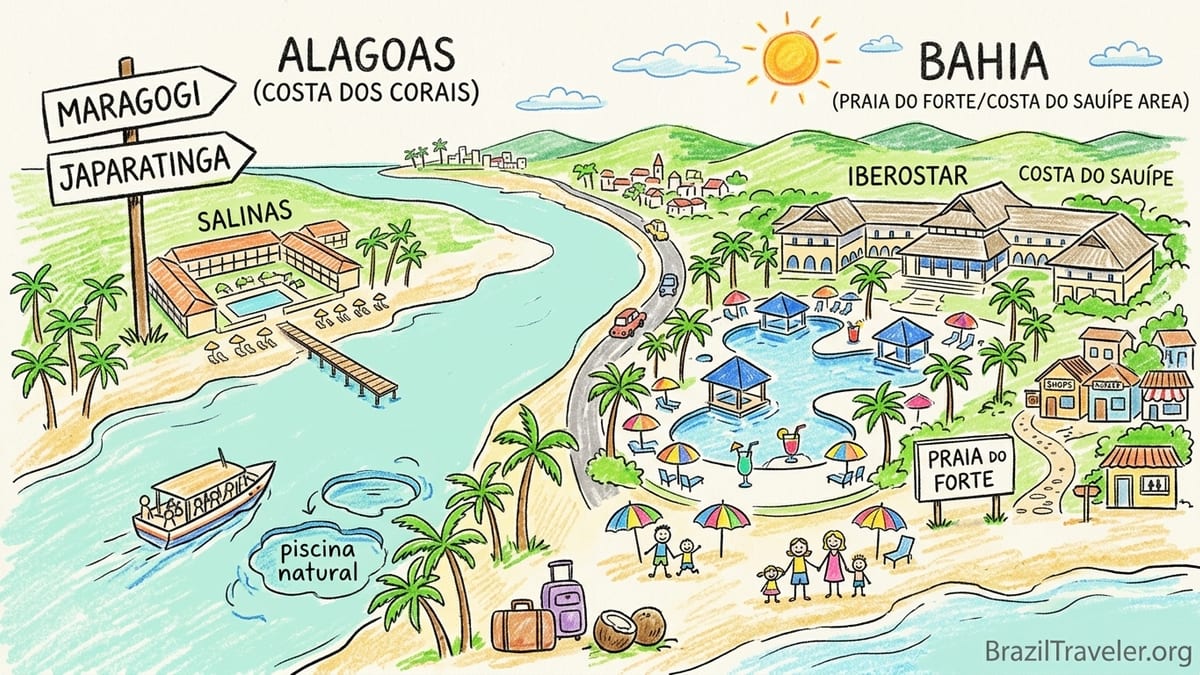
Despite the country’s size, Brazil’s true all-inclusive concentration is surprisingly compact. The densest corridors run along the coast of Bahia, Alagoas and Pernambuco, with smaller but growing pockets around Natal in Rio Grande do Norte and Cumbuco in Ceará. When I overlaid my own stays with recent market roundups from major Brazilian travel outlets, the same names kept repeating: Salinas Maragogi and Salinas Maceió, Japaratinga Lounge Resort, and a series of large complexes around Praia do Forte, Imbassaí and Costa do Sauípe in Bahia. In Pernambuco, Porto de Galinhas is the undisputed focal point, while Rio Grande do Norte’s most visible all-inclusive product now spreads up the coast toward Touros. Cumbuco, in Ceará, adds a wind-and-kitesurf flavor to the model.
Bahia and Alagoas clearly dominate any serious list of all-inclusive resorts in Brazil today. In Alagoas, a September 2026 review of available packages and traveler polls still placed Salinas Maragogi, Salinas Maceió and Japaratinga Lounge Resort in the national top tier, with newer entrants like Maceió Mar Resort All Inclusive and Grand Oca Maragogi rounding out options on the Costa dos Corais. In Bahia, the story is more about large integrated complexes: Costa do Sauípe with its multi-hotel layout, the Imbassaí area with its established Iberostar property, and the Praia do Forte region with upscale beach infrastructure that is increasingly flirting with all-inclusive or nearly-all-inclusive formats.
Understanding this geography matters because the value of an all-inclusive stay is not decided only by room price or bar selection. It depends heavily on how likely you are to leave the property. In places like Maragogi or Japaratinga, where the nearest town is small and the main attractions are boat trips and natural pools, I found myself spending most hours inside the resort or on organized excursions sold on site. In contrast, in Praia do Forte or Porto de Galinhas, the village itself is part of the draw. There I routinely left the resort for dinner or drinks, and the economics of paying extra for a 24-hour buffet and open bar looked very different.
Across my trips I noticed another pattern: Brazil’s all-inclusive resorts are less standardized than their Caribbean counterparts. Some are truly “wallet-free” experiences, while others quietly exclude items that many guests assume will be included, such as certain imported spirits, room service, or minibar refills. To make sense of the differences, it helps to zoom in on how food, drinks and daily logistics actually work once you arrive.
Buffets, Restaurants and What You Really Eat
On paper, nearly every resort I stayed at advertised “diverse gastronomy” and “the best of regional and international cuisine.” The reality varied sharply. In Alagoas, at Japaratinga Lounge Resort’s all-inclusive premium setup, the main buffet leaned into regional food in a way that actually felt distinctive: moquecas with fresh fish, sun-dried beef with cassava, corn-based cakes at breakfast and a daily rotation of local desserts. A recent in-depth feature by a major Brazilian travel magazine in August 2026 echoed this impression, highlighting that guests could go several days without repeating the exact same main dishes and praising the consistent seasoning and freshness in fish and seafood.
At Salinas Maragogi and Salinas Maceió, both owned by the same group as Japaratinga, the buffets on my stays were more clearly oriented toward family volume. Breakfasts were abundant, with stations for made-to-order tapioca, omelets, fresh fruit and cakes, while lunch and dinner emphasized grilled meats, pasta and a daily “regional corner.” Here I found that the food was generous and crowd-pleasing rather than refined. Brazilian and foreign families around me seemed satisfied, but several repeat guests I spoke with, and more recent testimonials collected in 2026, pointed out that while you rarely go hungry, the culinary experience is not the reason to travel there.
In Porto de Galinhas, at Ocaporã All Inclusive and at the newer Westin Porto de Galinhas, the meal structure was more segmented. Ocaporã’s all-inclusive program includes a buffet restaurant for the three main meals and snack points during the day, with sweet and savory options such as mini pastries, cakes and salgados. The Westin pairs its buffet with several themed restaurants and a food truck that turns out burgers, tacos, pizzas and some vegan items during specific windows of the day. Dinner reservations there are required for the specialty venues, and a combination of minimum-stay requirements and loyalty status can unlock additional access to an exclusive restaurant focusing on Northeastern Brazilian cuisine. In practice, that meant I planned my evenings more carefully, knowing that simply walking into any restaurant at any time was not guaranteed.
In Bahia’s Costa do Sauípe, the large complexes I stayed at ran their buffets on a clear schedule, typically breakfast from around 7 to 10, lunch from midday to mid-afternoon and dinner from early evening to 10 p.m. The food was reliable and sufficient for large groups, but less personalized, with heavy emphasis on grilled chicken, rice and beans, salads and simple desserts. For more variety, several properties now offer at least one or two à-la-carte restaurants that require advance booking, often through an app or lobby kiosk. Here the constraint was not availability of food but the friction of reservations: at peak school-holiday periods, I saw queues form in the mornings just to secure a spot at the Italian or steakhouse restaurant for that night.
Bars, Drinks and the Fine Print on “All-Inclusive”
In marketing materials, most resorts I visited describe their plans simply as “all-inclusive” or “all-inclusive premium.” Once you examine the drink lists, however, the differences become clear. At Japaratinga Lounge Resort, an “all-inclusive premium” label translates into a broader selection of branded spirits and a cocktail menu that goes beyond the basics. Guests can order caipirinhas with different fruits, aperol-style spritzes, some classic whisky-based drinks and decent sparkling wines by the glass without extra charge. Several Brazilian travel awards and polls in 2025 and 2026, which surveyed guests about their experiences, singled out Japaratinga’s bars for both speed of service and quality of drinks, a perception that aligned with my own stay.
At family-focused properties such as Salinas Maragogi and Salinas Maceió, beer, simple mixed drinks and soft drinks flowed easily, but imported labels and more elaborate cocktails were either unavailable or limited. The open bar was concentrated in pool and beach kiosks and a main lounge area at night. While the drink list suited guests who simply wanted a cold beer by the pool, anyone expecting top-shelf spirits would likely be disappointed. In Bahia’s large complexes, I encountered another model: local and some national brands were included, but certain imported spirits or special wines were considered extras. This was often explained in fine print at check-in or on bar menus but surprised some first-time guests who assumed every bottle on the shelf fell under the wristband.
In Porto de Galinhas, the contrast between properties was evident. Ocaporã presents its all-inclusive structure around multiple bars that serve national beer, simple cocktails and soft drinks throughout the day, while reserving certain specialty items as paid extras. The Westin, targeting a more international audience, advertised a more extensive cocktail program and used the “all-inclusive” terminology to cover meals and most drinks, with add-ons for premium labels and wine by the bottle. When I asked staff in September 2026, they were explicit that room service, certain minibar items and premium champagnes fell outside the plan, something that international travelers might not expect if they are used to Caribbean-style ultra-inclusive setups.
Snack availability is another factor that quietly shapes value. In Alagoas, Salinas Maragogi and Japaratinga both run near-continuous food service, with poolside snacks such as fries, pizzas, hamburgers and tapioca available between and after main meals. Japaratinga’s food truck concept, serving burgers and street-food-style dishes for much of the afternoon and again late at night, significantly reduced my need to think about off-property meals and justified the higher nightly rate. In Bahia’s more traditional resorts, snack service was more limited in time and variety, occasionally leading guests to purchase packaged items at on-site stores or wait for the next buffet opening.
Minibar, Room Service and Other Quiet Exclusions
One of the most consistent surprises across my stays was how the minibar and room service were handled. Many guests associate “all-inclusive” with the idea that anything in the room’s fridge is included, but in Northeast Brazil that is far from universal. At some Bahia resorts in Costa do Sauípe and Imbassaí, soft drinks and water were included and replenished, but chocolate bars, premium snacks and certain alcoholic items in the minibar were charged at hotel-shop prices. In one case, the minibar was only stocked with water and a few sodas, and guests were told to bring additional cans from the bar if they wanted more variety without extra cost.
In Alagoas, the major all-inclusive properties I stayed at treated minibar inclusion more generously, particularly in higher room categories. At Japaratinga Lounge Resort, soft drinks, water and a few beers were included for guests in certain categories, but not all. During a September 2026 conversation with staff, I was told that the resort had adjusted this policy several times over the previous two years to balance guest satisfaction with costs, and to encourage people to socialize at bars instead of drinking in their rooms. Salinas Maragogi’s standard rooms, by contrast, had a simpler minibar setup oriented around water and soft drinks, with refills clearly described in the check-in material.
Room service is also not automatically part of the deal. At some coastal Bahia resorts and in Porto de Galinhas, room service either was not available or operated strictly as a paid service outside the all-inclusive plan, with menus and prices similar to those in urban business hotels. The Westin Porto de Galinhas clarified at check-in that although the resort operated on an all-inclusive basis for meals and drinks in the restaurants and bars, room service orders and certain in-room dining experiences, such as private gazebo dinners, were surcharge items. This is a reasonable policy, but one that can feel at odds with the phrase “all-inclusive” unless clearly explained.
Another quiet exclusion that affects families is laundry. In none of the all-inclusive resorts I stayed at was laundry included in the daily rate. Prices were comparable to mid-range city hotels, and the service was reliable, but parents of young children found themselves either hand-washing bathing suits and T-shirts in the sink or paying a noticeable extra for laundry after several days of beach and pool. On the flip side, some properties, like Ocaporã in Porto de Galinhas, invested in infrastructure that softens this blow. Their baby kitchen area, equipped with microwave, blender, induction cooktop and utensils, made it easier for parents to prepare food and deal with spills without constantly relying on paid hotel services.
Pools, Beaches and When You Actually Leave the Resort
The headline appeal of Northeast Brazil’s all-inclusive resorts lies in their pool complexes and beachfronts, but the details can change how much time you spend on-site and whether the all-inclusive premium is justified. In Alagoas, resorts on the Costa dos Corais enjoy some of Brazil’s most photogenic waters, especially in Maragogi, famous for its natural pools. Japaratinga, just south of Maragogi, occupies a scenic but slightly river-affected stretch of sand, which makes the sea calm yet sometimes less crystal-clear. Repeat visitors I met there and numerous recent traveler reports agreed on the same pattern: the resort itself is excellent, but the postcard-blue water that appears in promotional photos is more likely to be found on paid boat trips to the offshore pools or on excursions to nearby beaches like Antunes or São Miguel dos Milagres.
At Salinas Maragogi, the beachfront sits directly on a river-meets-sea area. The tide swings are dramatic, and at low tide broad sandbanks emerge, while at high tide the water reaches close to the palm trees. I found that the resort’s advantage lay in logistics: on-site booking of boat trips to the natural pools, with morning excursions timing departures carefully around the tide tables. Because these trips leave from the resort’s own pier or from a short drive away, I rarely had to navigate outside vendors. That convenience, combined with constant availability of food and drink before and after excursions, made the all-inclusive structure feel cohesive.
In Bahia, the pool complexes often overshadow the beaches. Costa do Sauípe and some Imbassaí-area resorts build multi-pool systems with shallow kids’ areas, swim-up bars and quiet zones for adults. The sea there can be rough, with stronger currents and more days of red-flag warnings, especially in certain months. On windy or high-surf days I found myself spending almost the entire time by the pools, and in those conditions the incremental value of unlimited snacks and drinks at the swim-up bar increased. In Praia do Forte, the sea tends to be more forgiving, with natural reef pools forming at low tide, but here the vibrant village and its restaurants tempted me off property at least every other evening, again challenging the financial logic of paying for full-board drink and food coverage.
Porto de Galinhas in Pernambuco occupies a middle ground. The beach in front of many resorts, including Ocaporã and the Westin, offers swimmable sections protected by reefs and easy access to the village by taxi or hotel shuttle. From both all-inclusive and non-all-inclusive bases, I and other travelers regularly dipped into town for dinners, beachside barracas or simply a change of scene after days of buffet dining. As a result, even in all-inclusive properties there, guests often ended up double-paying for some meals. This is not a failure of the resorts so much as a reflection of the destination’s pull as a standalone beach town with its own food and nightlife ecosystem.
Entertainment, Kids’ Clubs and Who Each Cluster Suits Best
Entertainment programming is where Northeast Brazil’s all-inclusive resorts diverge most visibly. In Bahia’s large complexes, nighttime shows, pool games, live music and children’s activities follow a familiar pattern, with a strong emphasis on families traveling during Brazilian school holidays. My stays in Costa do Sauípe coincided with July vacation periods, and the resort’s main square turned into a nightly hub of music, dance shows and kids’ activities that felt closer to a small theme-park village than a beach resort. For parents, the value was obvious: structured kids’ clubs, organized sports and nightly shows meant several hours each day when adults could relax by the pool or at the bar while staff entertained their children.
In Alagoas, the mood shifts slightly. Salinas Maragogi and Salinas Maceió run robust kids’ clubs, complete with scheduled arts and crafts, games, beach activities and early-evening mini-shows. However, Japaratinga Lounge Resort has deliberately positioned itself more as a premium, relaxed environment. It still offers activities for children and families, but recent awards and guest feedback in 2025 and 2026 consistently described its atmosphere as somewhat more adult-friendly, with fewer water-park-style structures and a stronger focus on quiet pools and curated music. During my stay I noticed couples and groups of friends making up a significant share of guests, using the all-inclusive setup more for long dinners and cocktail hours than for animated kids’ programming.
In Porto de Galinhas, Ocaporã and the Westin both run daily entertainment programs, but the scale is smaller than in Bahia’s mega-resorts. Evening entertainment may consist of live music by the pool, themed nights in the buffet restaurant or a show in a small theater space. One interesting nuance I observed at the Westin was the effort to integrate Northeastern cultural elements, such as forró nights and local dance performances, into an otherwise international resort format. This kind of programming adds intangible value and helps differentiate the experience from generic sun-and-sand packages elsewhere in the world.
Farther north, around Natal and Touros in Rio Grande do Norte and Cumbuco in Ceará, all-inclusive offerings blend with strong niches like kitesurfing and dune excursions. In Cumbuco, the resorts around the lagoon and beachfront attract a mix of families and international water-sports travelers. Many of these properties use a modified all-inclusive system that includes meals and drinks but charges separately for sports lessons and motorized excursions. Given the active nature of the typical stay there, with guests spending several hours a day on the water or on dune-buggy trips, the overall value of all-inclusive depends on how heavily you use the open bar and snack stations outside activity hours.
Does All-Inclusive Actually Make Financial Sense Here?
After multiple stays, I started tracking my daily spending as if I had chosen a bed-and-breakfast or half-board plan instead of an all-inclusive rate. In Alagoas, at properties like Salinas Maragogi, Salinas Maceió and Japaratinga Lounge Resort, recent package prices from Brazilian and regional tour operators in 2025 and 2026 indicated that a five-night all-inclusive stay for two adults often started around the low to mid thousands of Brazilian reais per person, depending on season and room type. When I broke that down, the implicit daily cost covered not only three buffet meals but also continuous snacks, an open bar from late morning into the night and access to non-motorized activities like kayaks or stand-up paddleboards in some cases.
In isolated areas where alternative restaurants are scarce and excursions are typically purchased through the hotel anyway, I found that it would have been difficult to match the all-inclusive value by paying as I went. A realistic day of three restaurant meals in coastal Alagoas, plus a handful of drinks and a couple of snacks per person, would quickly approach or even exceed what the all-inclusive supplement represented when compared with half-board rates, especially for guests who drink alcohol or travel with teenagers who graze constantly. Add in the convenience of not signing checks or doing mental currency conversions, and the case for all-inclusive in these hubs becomes strong.
In destinations with lively nearby villages, the math shifts. In Praia do Forte, Porto de Galinhas and certain parts of Bahia close to Salvador, local restaurants serve everything from moqueca and grilled fish to pizza and sushi at prices that, while not cheap, compete favorably with the per-day food cost embedded in all-inclusive rates. During my stays in these towns, I regularly chose to dine out, either for variety or to enjoy a quieter, more atmospheric meal. Each time I did, I effectively paid twice: once in the form of the all-inclusive daily rate, and again in the restaurant bill. For travelers who enjoy exploring local food scenes and are comfortable managing their own expenses, a half-board or breakfast-only plan may represent better value in these particular clusters.
Family configuration also matters. Large Bahia complexes and Salinas-branded resorts in Alagoas often run promotions where children below a certain age stay and eat free in their parents’ room, at least outside peak holidays. For families of four sharing a room, these offers can tilt the balance firmly in favor of all-inclusive. Parents save on snacks, drinks and kids’ desserts, and children can move independently between buffets, pools and kids’ clubs without parents constantly approving separate charges. Solo travelers, light eaters or couples who drink little alcohol may find that they are subsidizing heavier consumers and would do better choosing a different plan.
The Takeaway
After logging repeated stays in the main all-inclusive clusters of Bahia, Alagoas, Pernambuco, Rio Grande do Norte and Ceará, I came away convinced of two things. First, Northeast Brazil genuinely competes as a regional all-inclusive destination, particularly along the Costa dos Corais corridor of Alagoas and in Bahia’s large resort complexes. Second, the label “all-inclusive” hides more variation here than in many Caribbean or Mexican markets. The true value lies in the specifics of food quality, drink policies, snack availability, minibar rules, entertainment and how likely you are to eat or drink outside the property.
In relatively isolated beach stretches such as Maragogi, Japaratinga or certain parts of the northern Bahian coast, all-inclusive made both financial and practical sense for me. The combination of on-site activities, boat excursions managed through the resort and the reality that there are few competing restaurants within walking distance meant that I rarely felt the urge to leave, and I almost never needed my wallet. In more urbanized or village-oriented destinations such as Praia do Forte and Porto de Galinhas, all-inclusive worked best for travelers who prefer to settle in, enjoy the resort infrastructure and only occasionally sample the local dining scene. Those who see food exploration as a core part of their trip may find a good breakfast and selective dinners more rewarding.
Ultimately, the strongest all-inclusive resorts in Northeast Brazil excel not just by piling up buffets and bars, but by aligning what is included with how guests actually live on vacation. Properties like Japaratinga Lounge Resort and the Salinas pair in Alagoas, or the better-run complexes in Costa do Sauípe and Porto de Galinhas, show that when meal plans, entertainment and the surrounding destination work in harmony, the all-inclusive bracelet can represent genuine value rather than a marketing slogan. The key is to choose the right cluster for your travel style, understand exactly what your plan covers before you arrive and then relax into the rhythm of the Northeast coast, where the biggest daily decision often becomes whether to head for the pool, the beach or the next plate of moqueca.
FAQ
Q1. Are drinks really unlimited at all-inclusive resorts in Northeast Brazil?
Most resorts include unlimited draft beer, simple cocktails, soft drinks and juices, but premium spirits, bottled wines and room service drinks are often charged separately, so it is important to confirm the bar list before booking.
Q2. Which areas offer the best value for all-inclusive stays: Bahia or Alagoas?
Alagoas generally offers stronger value if you plan to stay on property, especially around Maragogi, Japaratinga and Maceió’s northern beaches, while Bahia may be better if you want large complexes and easier access to nearby towns.
Q3. Is the food at Brazilian all-inclusive resorts comparable to the Caribbean or Mexico?
The overall standard is solid but less standardized, with some standout resorts focusing on regional Brazilian cuisine and others aiming for high-volume family buffets, so experiences can vary more than in traditional Caribbean chains.
Q4. How important is it to book à-la-carte restaurant reservations in advance?
In larger resorts, securing à-la-carte dinners early is crucial, especially during school holidays, because popular venues and time slots can fill quickly and same-day availability is not guaranteed.
Q5. Do Brazilian all-inclusive resorts usually include airport transfers and excursions?
Airport transfers and most excursions are normally sold as extras or bundled by tour operators, not directly included in the resort’s all-inclusive plan, so you should budget separately for transport and tours.
Q6. Are Brazilian all-inclusive resorts a good choice for travelers who rarely drink alcohol?
They can still be worthwhile in remote areas where you will eat every meal on-site, but light drinkers may find better value in half-board or full-board plans in destinations with good nearby restaurants.
Q7. How family-friendly are the main all-inclusive clusters in Northeast Brazil?
Clusters in Bahia and Alagoas are very family-friendly, with kids’ clubs, dedicated pools, early meal times and frequent promotions where children stay or eat free when sharing a room with parents.
Q8. Is the sea calm enough for children at these resorts?
Conditions vary: stretches in Alagoas and parts of Porto de Galinhas are usually calm and shallow at low tide, while parts of Bahia and Rio Grande do Norte can have stronger waves and red-flag days that push families toward the pools.
Q9. Are there true “wallet-free” all-inclusive resorts in the Northeast?
Some resorts in Alagoas and parts of Bahia come close, with almost everything except spa services and premium labels included, but most still charge extra for laundry, special dinners and certain imported drinks.
Q10. When is the best time of year to stay at an all-inclusive resort in Northeast Brazil?
The driest and sunniest months typically run from around September to March, with regional variations, and these periods usually offer the best combination of beach weather and full resort programming, although prices are higher over holidays.