


I boarded my Amazon River boat in Manaus expecting a quirky adventure. What I found over five days to Belém was something more complex: a moving village, a vital transport lifeline and a surprisingly meditative routine of hammocks, rice and beans, long brown water and conversations that only really make sense when you have nowhere else to be.
Buying the Ticket in Manaus and Choosing My Boat
I started this journey on a humid Monday morning in Manaus at the riverfront area known as Manaus Moderna, where most long-distance regional boats depart. There are several boats each week connecting Manaus and Belém, usually taking around five days in the dry season. After checking recent departures with a local agency close to the port and asking three different sellers, I settled on a passage aboard the regional boat Amazon Star, operated by a Manaus-based river company that locals recommended as safe and fairly organized.
Tickets for this route are not sold like cruise berths. On the Amazon Star I had two options. One was a hammock space on the main passenger deck, which meant bringing or renting my own hammock and sleeping shoulder to shoulder with everyone else. The other was a small private cabin on the upper deck. In mid-2026, a hammock ticket from Manaus to Belém on a working passenger boat typically started around the equivalent of 500 to 650 Brazilian reais, while a basic fan-cooled cabin for two people ran roughly three times that amount. I chose the hammock option, paid in cash at the dockside ticket office and had my name scribbled into a lined notebook that functioned as the passenger manifest.
The ticket included the full river passage but not meals, bedding or drinking water beyond a simple onboard dispenser. For anything extras I would pay as I went. The ticket seller told me to arrive on embarkation day at least three hours before the scheduled midday departure. That turned out to be necessary, not because boarding formalities were slow, but because on a hammock boat your comfort for the next five days depends almost entirely on how early you claim a good patch of deck.
On the morning of departure I took a taxi from central Manaus down to the port and passed through a quick bag check at the terminal entrance. Port authorities looked more interested in bulky cargo than in backpacks. After a cursory scan of my ID at the company counter, I was waved down the concrete ramp to the hull of the Amazon Star, already buzzing with porters, boxes of instant noodles and toddlers tugging on parents’ hands.
Boarding at Manaus: Hammocks, Chaos and First Impressions
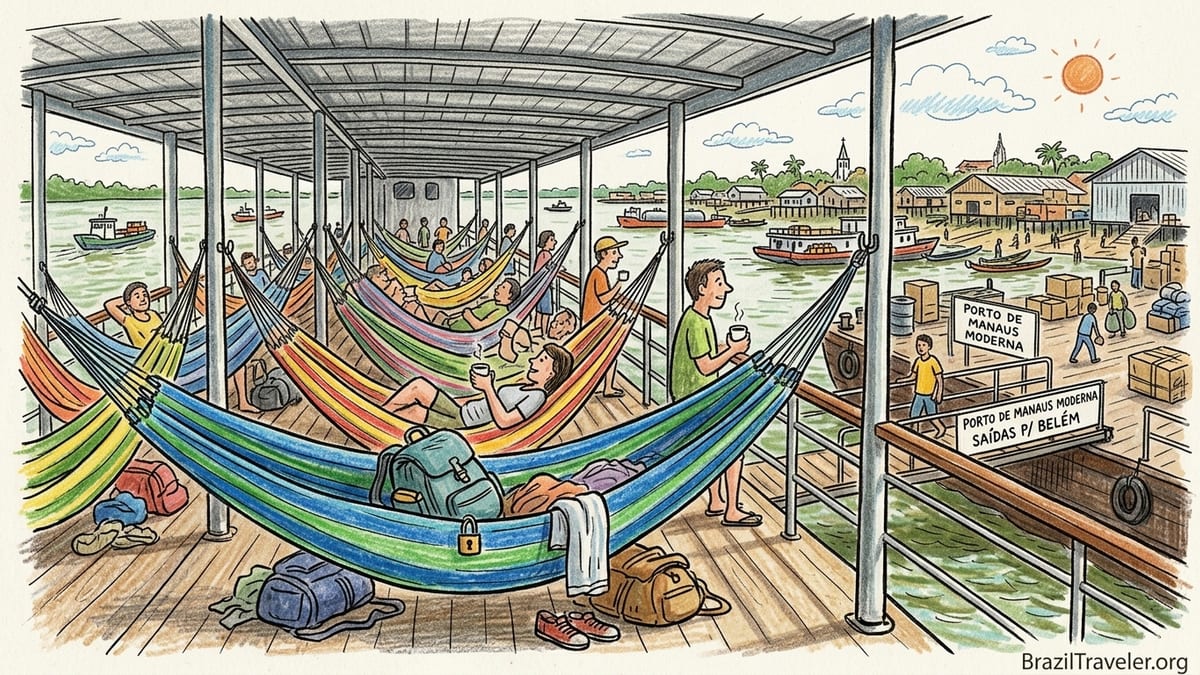
The Amazon Star’s main passenger deck was an open-sided hall with metal beams overhead and tie-on points welded along the roof. By the time I walked up the short gangway, the space had turned into a forest of nylon and cotton. Hammocks were hung in tight parallel rows, some at neat chest height, others crisscrossed closer to the ceiling. Loud forró played from a small speaker near the onboard snack bar, blending with the constant scrape of cardboard boxes and shouts of porters delivering last-minute cargo.
Hammock space is not pre-assigned. The etiquette is simple but ruthless: whoever arrives first chooses the best spot. Following advice from experienced travelers I had brought a sturdy Brazilian hammock bought in Manaus, some extra rope and two lightweight sheets. I walked the length of the deck twice, looking for a compromise between airflow, distance from the toilets and not being directly under a strip light. Eventually I tied my hammock near a steel pillar, close enough to a window opening to catch a breeze but not so exposed that night rain would blow in.
Personal space on a working Amazon ferry is more a concept than a guarantee. When I first hung my hammock, there was roughly half a meter between me and my closest neighbors on each side. By the time the crew called everyone to board and departure approached, new passengers had squeezed in every remaining gap. Children ended up sharing hammocks with parents, backpacks were slotted into the narrow floor space below, and improvised clotheslines appeared overhead. When someone climbed in or out, the whole row of hammocks swayed in sympathy.
The scheduled noon departure slipped to almost 2 p.m., which nobody appeared to find surprising. From the rail I watched forklifts maneuver pallets of cooking oil, crates of soft drinks and bundled sacks of rice into the lower cargo deck. Delivery boats pulled up alongside to offload last-minute cartons, and vendors walked on board selling insulated water jugs and cheap flip-flops. When the engines finally rumbled to life and Manaus’ waterfront began to slide past, passengers left their hammocks to lean against the rails, waving toward the stilt houses and fuel barges as if this were a small-town bus, not the start of a nearly thousand-kilometer river crossing.
Life on the Hammock Deck: Sounds, Smells and Social Rules
The passenger deck settled into a sensory routine within the first evening. The dominant sound was the constant thrum of the engines, a background vibration you stopped noticing only when you dozed off. Over that came bursts of conversation in rapid Brazilian Portuguese, the clatter of plastic plates in the cafeteria and the high-pitched calls of children racing between hammocks. At night a television near the bar played soap operas and football matches at a volume that ignored the existence of sleep schedules.
Hammocks were packed in three main blocks, each separated by a narrow passage barely wide enough for two people to squeeze past chest to chest. Some passengers constructed small privacy barriers by hanging sarongs or towels from the beams. Others leaned fully into the communal arrangement, chatting over the gaps with neighbors, sharing biscuits and occasionally swapping hammocks so that couples could sleep closer together. People treated the deck like a shared living room and bedroom combined. During the day they sat sideways in their hammocks reading or watching the shore, at night they curled diagonally to make room for a child or a bag.
The social rules took a day or two to interpret. Shoes were usually left under hammocks or hung by the ropes. Walking between others’ hammocks required an apology or at least a nod, especially if you accidentally brushed someone who was sleeping. Most people respected an invisible perimeter around valuables. Bags were kept close, often with a strap wrapped around a wrist or tied to a hammock rope, but open theft did not feel like a constant threat, more a background possibility that required simple precautions.
The atmosphere varied with each port stop. When we approached larger towns like Parintins and Santarém, the deck briefly turned into a transit terminal. Some people disembarked with all their belongings, hammocks removed and folded in minutes. Others arrived carrying plastic-wrapped televisions or sacks of produce, scanning the tangle of ropes for the smallest gap. Crew members occasionally intervened to stop unsafe overcrowding, but in practice the number of hammocks per square meter increased slightly each day as we drew closer to Belém.
Daily Rhythm on the River: From Sunrise to Nightfall
The Amazon Star’s timetable was not posted anywhere obvious, but the boat followed an internal clock. Before sunrise the first movement on the deck came from the galley below, the smell of coffee and frying dough drifting up the stairwell. Around 5 a.m. someone from the crew began walking through the hammocks with a broom, sweeping stray flip-flops and toys away from the aisles. By 6 a.m. the horizon glowed pink and orange between low cloud banks, and most people were awake, cupping small plastic cups of sweetened coffee bought from the cafeteria window.
Breakfast for me rarely cost more than a modest sum and usually consisted of strong coffee, a bread roll with margarine and, on better days, a slice of simple cake. The galley staff served basic set meals at fixed times, dishing out rice, beans, grilled chicken or river fish onto reusable plastic plates. Lunch and dinner were similar, with little variation beyond the cut of meat. Prices were budget-friendly but added up over five days, so many locals brought their own food: tubs of cooked manioc, thermos flasks of soup and plastic containers of fried snacks bought at previous ports.
Midday was the hardest time on the hammock deck. When the boat crossed wider sections of river and the wind dropped, the heat under the metal roof became thick and unmoving. Most people retreated into their hammocks to nap, read or simply lie still, fanning themselves with whatever was at hand. I adopted the local tactic of taking a cold shower just before lunch, then sitting on the open side of the deck with wet hair to maximize the little breeze that existed. Afternoons slowly blurred into card games, low conversation and long stretches of staring at the passing water.
Evenings brought the reward that had drawn many of us here in the first place. Around sunset the sky often exploded into streaks of gold and purple reflected on the broad river surface. Prams were pushed to the rail, teenagers leaned on the guard rope with their phones, and even the kitchen staff emerged for a few minutes to breathe air that finally felt cool. After dark, the deck lights stayed on until late, but eventually the volume of conversation dropped. Around midnight the only sounds came from the engines, the occasional thud of a crew member’s footsteps above and the soft rustle of hammock fabric as people turned in their sleep.
Understanding the Scale of the Amazon From the Water
Traveling between Manaus and Belém by river reveals scale in quiet ways. At its broadest, the river felt like a slow moving inland sea. There were stretches where both banks disappeared beyond the earth’s curve, and the Amazon Star felt small and solitary despite carrying hundreds of people and tons of cargo. Even in narrower channels near islands, we rarely hugged the shore. The navigation channel stayed deep and central, leaving a permanent strip of distance between us and the dense green wall of forest.
The boat threaded between innumerable islands, some covered with primary forest, others low and grassy with a few wooden houses on stilts. From the hammock deck I watched small aluminum canoes with outboard motors darting across the wake to reach us. Families came alongside in these narrow boats so close that I could see the expressions on their faces. Crew members or passengers would toss down tied plastic bags of food and supplies bought upstream. In return, fish and fruit sometimes came aboard in small exchanges that seemed to have been repeated for years.
We stopped at working river towns rather than curated visitor attractions. Parintins, famous for its Boi-Bumbá festival, appeared first as a patch of low buildings and a few church spires lifting from the trees. The Amazon Star tied up at a busy municipal dock where other ferries were already moored two and three deep. While cargo was handled below, passengers disembarked for an hour to buy fresh fruit, phone credit and hot snacks from vendors who knew exactly when each boat arrived. Later, Santarém and Óbidos offered similar scenes: bustling waterfronts, church bells drifting over the water and a constant movement of goods between the river and low-slung trucks waiting onshore.
What struck me most was how completely intertwined the river is with daily life. We passed working boats stacked with timber, fuel barges being pushed by squat tugboats, small passenger launches darting between villages and the occasional sleek tourist vessel in its own insulated world. From the deck of a regional ferry, the Amazon’s size was not a statistic. It was the number of hours between ports, the way one bend in the river could take half a day to round and the sense that even after five days, we had only crossed a fraction of this waterway’s network.
Facilities on Board: Food, Water, Bathrooms and Connectivity
In practical terms, life aboard a regional Amazon ferry is more public-transport functional than cruise comfortable. The Amazon Star had a single cafeteria that served three main meals a day on a fixed schedule, plus occasional snacks and drinks between services. The menu revolved around rice, beans, pasta, simple salads and either chicken or fish. Portions were generous but repetitive, and the hygiene standard, while acceptable, was basic. After a couple of days, I adopted the strategy of alternating cafeteria meals with fruit and packaged snacks bought at intermediate ports to keep both costs and culinary boredom in check.
Drinking water was available from a communal chilled dispenser near the galley. Most passengers carried either reusable bottles or the brightly colored insulated jugs sold in Manaus markets. Safe water is essential in the heat, and refilling regularly became part of my daily circuit around the deck. Soft drinks and sweetened fruit juices were sold at a small markup compared with city prices, while canned beer appeared mainly in the evenings, enjoyed in moderation by a subset of passengers watching football on the communal television.
Bathroom facilities were simple but adequate when used considerately. On the Amazon Star, men’s and women’s bathrooms were separated and located at opposite ends of the passenger deck. Each one contained a few toilet stalls and cold-water showers. Early in the morning, after the first cleaning, the tiled floors were relatively dry and the stalls stocked with paper. By evening, especially after busy port stops, conditions deteriorated. The showers themselves were a blessing, offering reliable cold water that felt luxurious in the heat. Many locals took multiple quick showers a day, stepping out still dripping to cool off on the open side of the deck.
Ventilation came mainly from open sides and occasional ceiling fans. On dry, breezy days this was enough for the hammock deck to remain tolerable, but when rain forced the crew to roll down plastic tarpaulins the air quickly turned humid and stale. Electrical outlets were scattered along the walls in small clusters and often in constant use. Passengers queued unofficially to charge phones, sometimes unplugging fully charged devices and politely relocating them to make way for others. Mobile phone coverage came and went. Near major towns a 4G signal allowed quick messages and map checks. In the long empty stretches, phones became alarm clocks and cameras only.
Comfort, Safety and the Emotional Reality of Five Days Afloat
From the perspective of a visiting traveler, five days on a ferry like the Amazon Star felt both adventurous and surprisingly ordinary. The adventure lay in the unfamiliar sleeping arrangements, the sheer length of the trip and the sense of moving slowly through a landscape that still carries a lot of mythic weight. Yet much of daily life on board was repetitive and practical. People cooked instant noodles with hot water tapped from the galley, worryingly watched babies navigate steep metal stairs and lined up to refill water jugs just as commuters might line up at a city bus stop.
Respecting that this was a lifeline for residents was crucial. Many of my fellow passengers were not here for an experience. They were going home from seasonal work, traveling for medical appointments in larger towns or delivering merchandise to river communities. I tried to keep my photography discreet and focused on landscapes rather than faces unless I had explicit permission. When I did chat with people who were happy to talk with a foreigner, the conversations turned less to the so-called romance of the Amazon and more to practical concerns like fuel prices, school options in Belém and whether the river level that year was higher or lower than they remembered.
Sleep quality depended on expectations and on your hammock. The constant hum of the engines and the rocking of the boat quickly turned into white noise. The real challenge was light, heat and proximity to others. Bright fluorescent tubes stayed on well into the night, and even after they dimmed there were enough glowing screens and corridor lights to keep the deck vaguely illuminated. Earplugs and an eye mask helped enormously. I slept in broken segments rather than full nights, waking when the boat stopped at a loud port in the small hours or when a neighbor climbed in and out of their hammock.
Safety felt largely a matter of common sense. I kept my passport and main bank card in a money belt while my backpack with clothes and non-critical items stayed under my hammock, secured with a cable lock to a metal beam. The crew enforced basic rules like no open flames on deck and no climbing on the railings. Lifejackets were stored in visible stacks near the stairs, and safety briefings were informal at best, but the local familiarity with the river and the boat’s routines inspired more confidence than scripted announcements might have.
Costs, Delays and the True Price of the Journey
Financially, traveling from Manaus to Belém by regional ferry remains one of the most cost-effective long-distance journeys in Brazil, particularly if measured per kilometer. Over the five days I kept simple notes on expenses. The hammock ticket from Manaus to Belém accounted for the bulk of the cost. On top of that I spent modest, predictable amounts each day on cafeteria meals, cold drinks, fruit at intermediate ports and occasional snacks like tapioca pancakes or grilled skewers purchased from dockside vendors who came aboard whenever we tied up.
I also paid for a few practical extras. In Manaus I bought a mid-range hammock and nylon ropes which I considered an investment for future bus and boat journeys in the region. At the port a man offered to install my hammock for a small fee, but with plenty of time before departure I decided to do it myself and saved the cost. Some travelers chose to rent a hammock on board instead, paying once and returning it at the end of the trip, which avoided carrying it onward but offered less control over quality and comfort.
Delays are part of river time. On my journey, the Amazon Star left Manaus almost two hours behind schedule and arrived in Belém late in the evening of the fifth day instead of mid-afternoon as originally suggested. That meant one unplanned extra night. I decided against navigating an unfamiliar port city in the dark with all my luggage and chose a simple hotel within a short taxi ride of the docks. This added another moderate expense to the total cost of the trip but bought me a secure room, a hot shower and one uninterrupted night in an actual bed.
When I added everything up at the end of the week, the total expenditure for five days and four nights on the river, including the post-arrival hotel, meals, snacks, bedding, local transport on both ends and a small buffer for unexpected purchases, came in lower than what a single domestic flight between Manaus and Belém often costs when booked at short notice. Financially it made sense. What it cost more of was time and a willingness to relinquish control over precise schedules.
The Takeaway
Looking back, the most memorable day of the journey was not a dramatic one. It came midway, on a long uninterrupted stretch between Santarém and the lower reaches of the river. The sky stayed overcast, softening the light on the water. The deck was quieter than usual. A group of teenage passengers played cards near the rail, an older woman shelled beans into a plastic bowl, and a man in a Flamengo shirt explained the intricacies of river navigation while pointing out distant sandbanks barely visible to my untrained eye. For several hours the monotony turned contemplative rather than tedious, and the river felt not like a barrier but like a broad slow-moving street connecting thousands of lives.
The hardest part of living aboard for five days was the lack of personal space. Even for someone accustomed to hostels and overnight buses, sharing a dense grid of hammocks with dozens of strangers takes adjustment. Small inconveniences add up. You queue for bathrooms, time your showers around cleaning schedules, eat what is served rather than what you crave and develop improvisational strategies for hanging damp towels and charging devices without getting in anyone’s way.
I carried a few things I did not really need. A heavy fleece stayed buried in my backpack the entire time; even at night, the combination of engine warmth and human bodies kept the deck well above cool. A bulky travel pillow turned out to be redundant because I ended up using a rolled-up sweater. On the other hand, there were items I wished I had brought more of. A second quick-dry towel would have been handy, as would extra power-bank capacity to reduce dependence on the limited electrical outlets. A lightweight mosquito net designed to hang over a hammock might have provided extra comfort when the boat moored near marshy riverbanks at dusk.
Would I repeat the full five-day route from Manaus to Belém? For a first-timer who has the time and curiosity, the long passage offers a rare immersion into everyday Amazonian life and a deep, slow sense of distance. However, I now understand why some travelers choose to break the voyage into shorter segments, perhaps traveling from Manaus to Santarém by boat, spending a few days onshore in riverside communities and then continuing by another boat or even by air. The full route demands patience and an openness to boredom as part of the experience, but it also grants the steady, hypnotic satisfaction of watching the world gently slide by at river speed rather than jet speed.
FAQ
Q1. How long does the boat from Manaus to Belém actually take?
The journey on a working regional passenger ferry usually takes about five days, though departures and arrivals can be delayed by loading times, river conditions and port congestion.
Q2. Is it better to book a hammock space or a cabin on the Amazon ferry?
A hammock space is cheaper and more social, but less private. Cabins cost significantly more and offer doors, beds and sometimes air conditioning, which can be worthwhile if you value quiet and privacy.
Q3. Do I need to bring my own hammock, or can I rent one on board?
You can usually do either. Many locals bring their own hammocks from home, while some travelers rent one at the dock or directly on the boat. Bringing your own lets you choose the style and quality.
Q4. How safe is it to travel alone on the Manaus to Belém ferry?
Solo travelers, including women, do use this route. Basic precautions are important, such as keeping valuables on your person, locking larger bags and choosing a hammock space close to other families or women.
Q5. What is the food like on a typical Amazon River ferry?
Meals are simple and repetitive, usually rice, beans, pasta and either chicken or river fish. Portions are filling, hygiene is basic, and many passengers supplement with fruit and snacks bought in port.
Q6. Are there showers and clean bathrooms on board?
Yes. Boats have separate men’s and women’s bathrooms with toilets and cold-water showers. Cleanliness is best in the morning after cleaning, and conditions can deteriorate later in the day.
Q7. Will I have mobile phone and internet coverage during the trip?
Coverage is intermittent. Near larger towns such as Parintins and Santarém you can usually catch a mobile signal, but in remote stretches there may be no service for hours at a time.
Q8. How much money should I budget per day for food and extras?
If you eat most meals in the boat’s cafeteria and buy occasional drinks and snacks, expect to spend a modest but noticeable daily amount. Bringing some food from Manaus helps keep costs down.
Q9. Can I get off the boat at intermediate towns and rejoin later?
You can disembark briefly at scheduled stops to buy food or stretch your legs, but the boat will not wait for long. Leaving the journey mid-route and rejoining usually requires separate tickets and planning.
Q10. Is the Manaus to Belém river journey right for every traveler?
This trip suits travelers who value slow, local experiences and can tolerate heat, crowds and basic conditions. Those with very limited time or a strong need for privacy may prefer shorter segments or flying.