


The river journey between Manaus and Santarém is one of the classic sections of the Amazon, short enough to feel manageable yet long enough to give you a true taste of life on the water. In 2026 you can choose between traditional overnight ferries with hammocks, faster point to point boats and an increasing number of direct flights. Each option has its own rhythm, cost and comfort level, and the right choice depends on how much time you have and how river focused your trip will be.
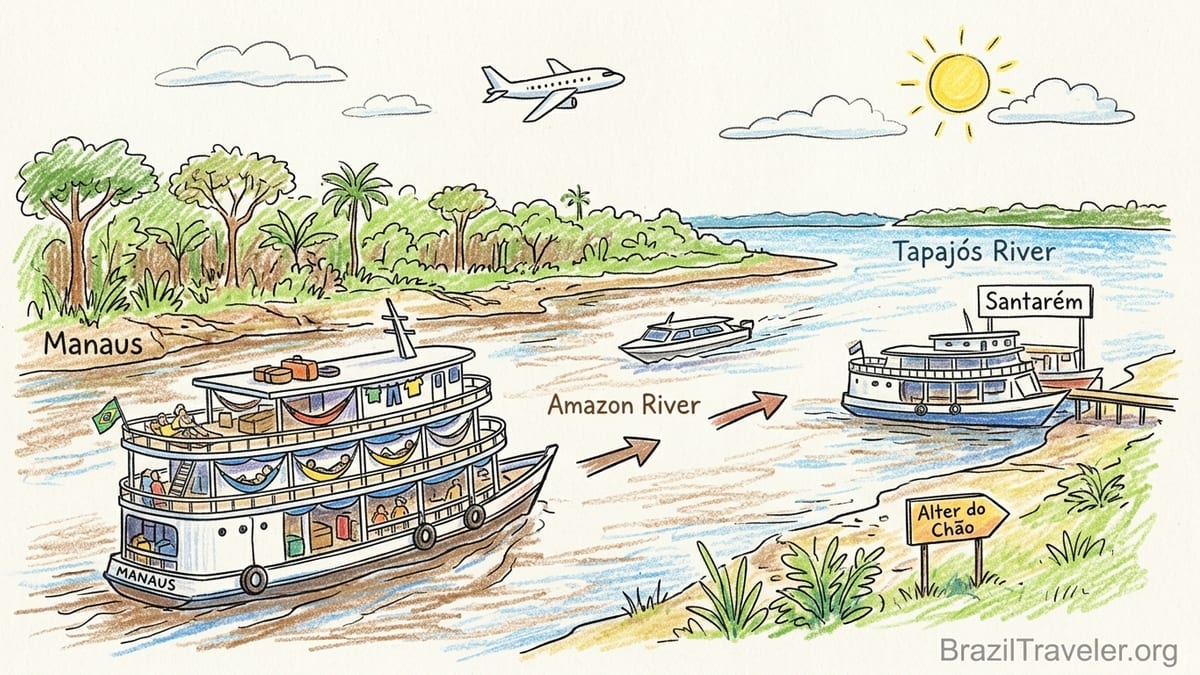
Route overview: Manaus to Santarém in 2026
Manaus and Santarém sit roughly 750 kilometers apart along the Amazon River, with Santarém slightly downstream where the clear Tapajós meets the muddy Amazonas. That downstream direction matters because boats descending from Manaus to Santarém usually travel a bit faster and burn less fuel than boats going back upstream. For visitors, this makes the Manaus to Santarém leg an ideal introduction to long distance Amazon travel without committing to the full multi day haul to Belém.
In practice, the route today is served by three main transport types. First are large overnight riverboats known locally as navios or barcos, which carry hundreds of passengers in hammocks and a smaller number in private cabins. Second are faster lanchas or catamarans on certain authorized lines, which cut several hours off the trip but have airline style seating and fewer opportunities to wander the decks. Finally, there are multiple daily flights linking Manaus Eduardo Gomes International Airport and Santarém Maestro Wilson Fonseca Airport, operated mainly by Azul and Gol.
Unlike older guidebook references that claimed every boat took a fixed 24, 30 or 36 hours, current authorized timetables published by Brazil’s waterway regulator ANTAQ show important variations between vessels. One scheduled passenger boat on the Manaus–Santarém line, A Noiva II, is authorized to leave Manaus on Wednesday at 06:00 and arrive the same day in Santarém at 18:00, a planned journey of about 12 hours with multiple intermediate stops. The northbound return from Santarém to Manaus on the same vessel is authorized to depart Friday at 05:00 and arrive in Manaus at 19:00, a slightly longer scheduled time because the boat is traveling upstream.
Because operators can request timetable modifications and additional boats can be authorized, travelers should treat these examples as reference points rather than rigid guarantees. What matters is that each vessel publishes an official schedule on its license, and that schedule shows whether you are boarding a relatively fast, limited stop service or a traditional slow riverboat that may take a day and a half or more with extended pauses in river towns.
Ports, check in and how the boats actually run
Passenger boats between Manaus and Santarém normally use the central city ports managed by the regional dock companies. In Manaus, long distance riverboats depart from the floating Port of Manaus on the Rio Negro waterfront near the historic center, reached easily by taxi or app based car from most hotels in 15 to 30 minutes depending on traffic. In Santarém, boats dock at the main river terminal along the Amazon riverfront, not far from the junction with the Tapajós. Both terminals feel busy rather than polished, with porters, vendors and family members crowding the quayside whenever a big boat is in.
Check in procedures remain fairly consistent in 2026. For overnight hammocks boats, ticket counters inside or just outside the terminal begin boarding formalities roughly two hours before departure. If a boat is scheduled for 11:00, independent tour operators selling cabins or hammock space often suggest reaching the port between 08:30 and 09:30. This gives time to buy or confirm your ticket, pay port fees if required, label your luggage and find a good spot to hang your hammock on the open decks.
Faster passenger boats operating as lanchas or semi express services sometimes use a more controlled boarding process with fixed numbered seats. On these, check in can resemble a domestic flight. You show your ID, have luggage tagged and stored in a separate compartment and receive a boarding card with a seat number. Boarding usually starts 30 to 45 minutes before the published departure time and ramps close sharply a few minutes before the engines are throttled up.
Actual sailing times depend not only on engine power and hull design but also on the number and duration of intermediate calls. The authorized schedule for A Noiva II illustrates this clearly: the boat is scheduled to leave Manaus at 06:00, call at Itacoatiara at 08:00, Parintins at 10:00, Juruti at midday, Óbidos at 14:00 and arrive in Santarém at 18:00. On the northbound return, similar stops are authorized in reverse order, but the same distances take longer because the vessel moves against the current. Other boats may include extra calls or longer layovers, dramatically stretching total travel time even on the same river section.
Overnight hammock ferries: cabins, comforts and costs
For many travelers the classic Amazon experience is the overnight riverboat with rows of hammocks slung side by side. On the Manaus–Santarém route, these ferries are still the backbone of local travel, used by families, traders and students moving between river communities. Brazilian port authorities in Manaus publish a maximum fare table for each authorized passenger vessel, listing the approved price from Manaus to Santarém as an intermediate destination on longer routes to Belém. In late 2025 and early 2026, typical maximum economy class fares on large boats from Manaus to Santarém were around 230 Brazilian reais for hammock space when bought directly at the port ticket office, with Belém through tickets priced higher and short hops like Parintins lower on the same vessel.
That base price usually covers your right to board and hang a hammock in the designated passenger decks, use shared toilets and showers and drink water from the large onboard dispensers. It does not normally include the hammock itself. Many locals bring their own, but portside stalls in Manaus sell simple cotton hammocks in the 60 to 120 reais range depending on size and material. Staff can help you tie it correctly if you are unsure. On crowded departures, arrive early to claim a space away from toilets, stairwells or speakers and leave some breathing room between neighboring hammocks.
Most long distance boats also offer a limited number of private or semi private cabins on an upper deck. These can appeal to couples, older travelers or anyone who prefers to lock the door at night. Prices fluctuate with demand, but on the Manaus–Santarém section they often range from roughly 500 to 900 reais per cabin for two or three people on popular boats, including simple beds with sheets, air conditioning during night hours and sometimes a small private bathroom. Some regional tour companies sell cabin packages that bundle port transfers, hammock backup and meals for foreign visitors who prefer not to negotiate everything at the dock.
Meals on these ferries follow a predictable pattern. A tiny cafeteria or galley sells plates of rice, beans and meat, portioned breakfasts with coffee and tapioquinha, and occasional snacks and soft drinks. A full meal may cost in the region of 25 to 40 reais, similar to a simple restaurant ashore. There is rarely much vegetarian variety, so travelers with dietary restrictions often bring fruit, nuts and packaged food. Drinking water from the boat’s dispenser is usually included, but bottled water, beer and soft drinks cost extra. Security instructions generally require you to keep the passageways clear, avoid leaning over open railings at night and store valuables such as passports and phones in a money belt or locked bag inside your cabin or hammock area.
Fast boats and how they compare
The term fast boat on the Amazon typically refers to lanchas or catamarans fitted with powerful engines and enclosed passenger cabins. These do not operate every day on the Manaus–Santarém route, and some focus more on cargo than people, but ANTAQ has maintained authorizations in 2026 for high speed passenger lines linking the two cities with fewer stops and shorter schedules. Regional transport documents and tourism material from Pará’s state tourism department reference vessels such as Ana Karoline IV on nearby routes as faster passenger craft, highlighting the growing role of this style of boat on Amazonian rivers.
When a true fast passenger boat does operate directly between Manaus and Santarém, the published schedules can be significantly shorter than the 30 to 40 hours quoted for traditional multi stop boats. Timetables may show point to point times close to the 12 hour example seen for A Noiva II, or sometimes an hour or two faster when running almost non stop downstream. The trade off is that passengers remain largely in aircraft style seats in an enclosed, air conditioned cabin rather than wandering outside, and luggage is stored out of reach until arrival.
Fares on these faster boats are typically higher than hammock space but still below most last minute air tickets. Recent examples on comparable Amazon fast boat routes suggest prices often sit somewhere between basic hammock passage and a shared cabin, reflecting the shorter travel time and higher fuel consumption. Exact current fares between Manaus and Santarém vary by operator, season and how you buy. Foreign travelers should be prepared to pay slightly more when booking through agencies that accept international cards and communicate in English, while locals who pay cash at the pier may access promotional deals.
For photographers and river enthusiasts, the key question is whether speed or flexibility matters more. From a fast boat window you still see the changing river landscape, but you are less able to move between decks, meet families from interior communities or photograph life on the open stern. If your time in the Amazon is limited to five or six days and you want at least one long stretch on the water before heading to Alter do Chão or back to a big city, a fast boat in one direction combined with a flight in the other can be an efficient compromise.
Timetables, direction of travel and intermediate stops
The effect of current direction is visible when you compare authorized downstream and upstream schedules on the same vessel. On A Noiva II, for instance, the downstream run from Manaus to Santarém is scheduled at about 12 hours with five intermediate stops, while the upstream run from Santarém back to Manaus is scheduled at around 14 hours with the same sequence of ports. The extra hours reflect both the struggle against the Amazon’s current and longer port handling times when climbing back toward Manaus.
Not every boat is as brisk as this example. Many classic hammock ferries on the combined Manaus–Santarém–Belém corridor continue to advertise journey times of 30 hours or more for the downstream sector, particularly when they are carrying heavy cargo or staying longer at popular towns such as Parintins and Óbidos. Port timetables in Manaus still classify Santarém as an intermediate destination on certain boats that continue east, and the official fare table reflects this by listing separate maximum prices for passengers disembarking before Belém.
For travelers, the key is to ask precise questions before buying a ticket. Instead of accepting a generic claim that the boat takes “about a day and a half,” request the scheduled departure and arrival times in writing on your ticket or a printed slip, and confirm whether the vessel is sailing directly between Manaus and Santarém or routing via additional cargo calls not shown on the main license. It is also wise to check if your chosen boat normally stops at Parintins or Óbidos, especially if you are considering breaking the trip in one of these towns.
Technically, it is possible to get off at an intermediate town such as Parintins, Juruti or Óbidos and continue later on another boat. However, this almost always requires buying a new ticket for the onward leg and can involve a long, uncertain wait, since boats on this corridor do not follow an hourly or even daily timetable in every direction. Travelers with tight itineraries, especially those aiming to reach Alter do Chão for a specific weekend, should avoid counting on same day onward connections by river from intermediate ports.
Booking tickets, language barriers and security on board
In 2026 most Brazilians still buy riverboat tickets for the Manaus–Santarém route in person at the port a few days or sometimes only hours before departure. Ticket booths in the Port of Manaus display the names of vessels, destinations and departure days, while informal touts and porters circulate outside offering guidance. For foreign travelers with limited Portuguese this scene can feel overwhelming, but it is manageable with preparation. Writing “Manaus para Santarém, só ida, hoje ou amanhã” on your phone and showing it at an official booth usually gets you to the right window. Staff will ask for a passport or Brazilian ID number to print on the ticket.
A growing number of regional travel agencies and tour companies now offer advance reservations on specific boats, especially for private cabins. These agencies may maintain websites or social media pages where you can send a message in English and pay a deposit by card or international transfer, then collect a physical boarding pass at the port on the day of travel. This approach costs more but can be valuable in high season or when you have only one day in Manaus before heading to the river.
Fast boat tickets tend to be more structured, with fixed seat numbers and often a digital manifest submitted to authorities in advance. Some operators allow booking through messaging apps, with confirmation sent as a QR code or reference number to present at check in. In all cases you should double check the boat name, date, departure time and class of service printed on your ticket, and keep a photo of it on your phone. If a schedule change occurs due to low water, mechanical issues or river police inspections, announcements are usually made in Portuguese over loudspeakers. When in doubt, show your ticket to uniformed staff at the gate and ask “Ainda sai hoje?” to confirm that the sailing is still happening that day.
Security on board is governed by a mix of federal maritime rules and operator policies. Most boats require passengers to remain off the vehicle decks while underway, keep aisles free of baggage and avoid smoking outside designated areas. Lifejackets are stored under benches or in lockers and their locations must be marked. At night, it is prudent to lock passports, cash and electronics in a small bag secured to a metal rail near your hammock or inside your cabin. Petty theft rather than violent crime is the main concern, and foreign travelers who remain alert, keep valuables out of sight and avoid intoxication on deck tend to report uneventful journeys.
Flights between Manaus and Santarém
Direct flights between Manaus (MAO) and Santarém (STM) have become more frequent in recent years, making this one of the easiest city pairs to connect in the Brazilian Amazon by air. As of October 2026, both Azul and Gol operate multiple weekly non stop services, with schedule aggregators listing roughly thirteen direct departures per week on the route. Typical flight times are around one hour and twenty minutes in the air, a striking contrast with even the fastest riverboats.
Recent fare examples from airline booking engines and Brazilian flight comparison sites show one way economy tickets for Manaus to Santarém starting around 420 to 700 reais on promotion, with many dates in November and December 2026 displaying prices near 700 to 800 reais for basic economy on Gol and around 950 reais or more on Azul when demand is higher. These base fares usually include at least a small cabin bag, but checked luggage may carry an extra fee depending on fare class. When comparing costs with river travel, remember to factor in a taxi or app car to Manaus airport and from Santarém airport into town, which together can add 60 to 120 reais to the journey between two people.
For visitors heading directly to Alter do Chão and the Tapajós beaches, flying often proves the most convenient choice. After landing in Santarém, you can ride a taxi or private car straight to Alter do Chão in roughly 40 minutes and settle into a pousada the same afternoon. Doing the same journey by river from Manaus takes at least a full long day, commonly 24 to 36 hours door to door when check in, disembarkation, and taxis are included. If your Amazon time is limited to five or seven days, trading one river segment for extra nights on the Tapajós can deliver more swimming, canoeing and forest walks.
Nonetheless, flights lack the slow immersion into river life that many travelers seek. You board at a modern airport, sit in a pressurized cabin, glimpse the forest mosaic through a window and land with little sense of the communities scattered along the riverbanks. This is why some visitors choose a hybrid approach, flying one way and taking the boat the other, gaining both efficiency and experience without stretching the calendar.
Choosing the right option for your style of trip
When comparing real costs between boats and flights, think beyond face value tickets. A hammock fare around 230 reais from Manaus to Santarém seems much cheaper than a 700 reais flight, but you may also need to buy a hammock, pay for meals on board and spend an extra night in a port city at one end of the trip. A private cabin may cost roughly the same as or more than a promotional air ticket, yet it doubles as both transport and accommodation for one or two nights and includes the river experience.
Solo travelers on tight budgets often gravitate toward hammock space on the slower overnight boats, especially if they speak some Portuguese and do not mind basic conditions. Couples frequently decide between a private cabin and an economy flight depending on schedule fit and how passionate they are about river travel photography. Photographers and writers tend to favor at least one downstream segment by boat, since the lighting, boat traffic and river villages are easier to capture when you can move freely on deck and are not pressed for time.
Time in Brazil’s Amazon is another decisive factor. With only five days in the region, a common pattern is to fly into Manaus, explore the city and nearby forest for two days, then fly to Santarém and base in Alter do Chão with perhaps a single fast boat excursion on the Tapajós. With seven days, it becomes more realistic to insert a river segment between the cities. One popular design is to spend two nights in Manaus, take a hammock or cabin boat downstream to Santarém, then enjoy three or four nights in Alter do Chão before flying back out.
Finally, consider your tolerance for uncertainty. River schedules can change on short notice due to low water, mechanical checks or inspections. Even with authorized timetables, departures may leave late or arrive after dark. Flights are also subject to weather and operational delays but tend to be more predictable and are easier for non Portuguese speakers to navigate thanks to standardized airport signage and procedures.
The Takeaway
The Manaus–Santarém leg is short enough that you do not have to treat it as an extreme expedition, yet long enough to show you how central the river remains in everyday Amazonian life. Current authorized schedules confirm that some boats are significantly faster than others, with vessels like A Noiva II scheduled for about half a day downstream and a little longer upstream, while traditional multi stop ferries and cargo boats may still take well over 24 hours. Downstream toward Santarém is usually quicker and smoother; upstream back to Manaus demands more time and fuel.
Choosing between a fast boat, hammock ferry or flight depends on what you want most from your time in northern Brazil. If your priority is to reach Alter do Chão’s beaches quickly and you have less than a week in the region, direct flights between Manaus and Santarém are usually worth the higher fare. If your dream is to watch river life unfold from a swaying hammock, chat with families from interior towns and photograph dawn over brown and blue water, then at least one boat journey is hard to beat.
For many visitors the most satisfying arrangement is a mix. Travel downstream by boat from Manaus to Santarém to experience the river at a human pace, then fly back upstream at the end of your stay to save days on your itinerary. Whatever you choose, building in an extra cushion of time around river departures, keeping plans flexible and approaching the journey with patience will help you enjoy the Manaus–Santarém corridor as more than transport: it becomes one of the core memories of your Amazon trip.
FAQ
Q1. How long does the boat from Manaus to Santarém take in 2026?
On faster authorized passenger boats such as A Noiva II, the official timetable shows around 12 hours downstream from Manaus to Santarém, with stops in towns like Parintins and Óbidos. Traditional multi stop hammock ferries can still take 24 to 36 hours or more depending on cargo, intermediate port calls and river conditions.
Q2. How much does a hammock ticket cost between Manaus and Santarém?
Recent fare tables from the Port of Manaus list a maximum economy price around 230 reais for hammock space from Manaus to Santarém on large passenger boats, with final prices varying slightly by vessel and whether you buy directly at the port or through an agency.
Q3. Do I need to bring my own hammock, or is it included?
Hammock passage usually covers only the space on deck, not the hammock itself. Many travelers bring their own, while others buy a simple cotton hammock from stalls outside the port in Manaus or Santarém, typically for tens rather than hundreds of reais.
Q4. Are there private cabins on the Manaus–Santarém boats?
Yes. Most larger riverboats offer a limited number of private or semi private cabins on upper decks, often with air conditioning and simple beds. On the Manaus–Santarém section cabin prices are commonly several hundred reais per cabin, sometimes comparable to or a bit higher than a promotional air ticket for two people.
Q5. Can I get off in Parintins or Óbidos and continue later on another boat?
It is usually allowed to disembark at intermediate towns such as Parintins, Juruti or Óbidos, but you will need to buy a separate ticket for the onward journey and may wait many hours or even a day or more for the next suitable boat. Travelers on tight schedules should not rely on quick same day river connections.
Q6. How do boat prices compare with flights between Manaus and Santarém?
Hammock tickets around 230 reais are generally cheaper than direct flights, which in 2026 often run between 420 and 800 reais one way depending on airline and date. Private cabins can cost similar to or more than discounted flight seats, but they include accommodation for a night and the full river experience.
Q7. Which option is best if I mainly want to visit Alter do Chão?
If your focus is Alter do Chão and the Tapajós beaches and you have limited time, a direct flight from Manaus to Santarém is usually most convenient. You can then take a short road transfer to Alter do Chão and start enjoying the river beaches the same day instead of spending a full day or more on the boat.
Q8. Is it difficult to travel this route if I do not speak Portuguese?
It is manageable but requires patience. Port staff and boat crews mostly speak Portuguese only, yet key words like “Santarém,” “cabine” and “rede” are understood quickly. Writing your destination and date on your phone to show at ticket counters, confirming times twice and using translation apps helps a lot. Airports tend to be easier for non Portuguese speakers than river terminals.
Q9. How early should I arrive at the port before my boat leaves?
For hammock ferries, plan to reach the Port of Manaus or Santarém at least two hours before departure to buy or confirm your ticket and secure a good hammock space. For faster, seat based boats, arriving 60 to 90 minutes before sailing is normally enough to check in luggage and board without stress.
Q10. Is it safe to sleep on deck in a hammock on these boats?
Serious incidents are rare on authorized passenger boats, and the main risk is petty theft rather than violence. Choose a spot near other families, lock valuables in a small bag secured to the structure, avoid leaving phones or cameras unattended, and follow crew instructions regarding lifejackets and restricted areas. Using common sense, most travelers complete the Manaus–Santarém journey without security problems.