


On my first night in a hammock on a Brazilian river ferry between Manaus and Santarém, I lay awake listening to snoring, forró music and the thrum of the engines, wondering if I had made a mistake. A year later I stood on the deck of a small expedition cruise on the Rio Negro, sipping strong coffee after a dawn canoe outing where we watched pink river dolphins and scarlet macaws. Both were Amazon river journeys. Both were memorable. Yet the prices I paid differed by thousands of dollars, and what I actually got for my money was so different that they almost belong in separate categories of travel.
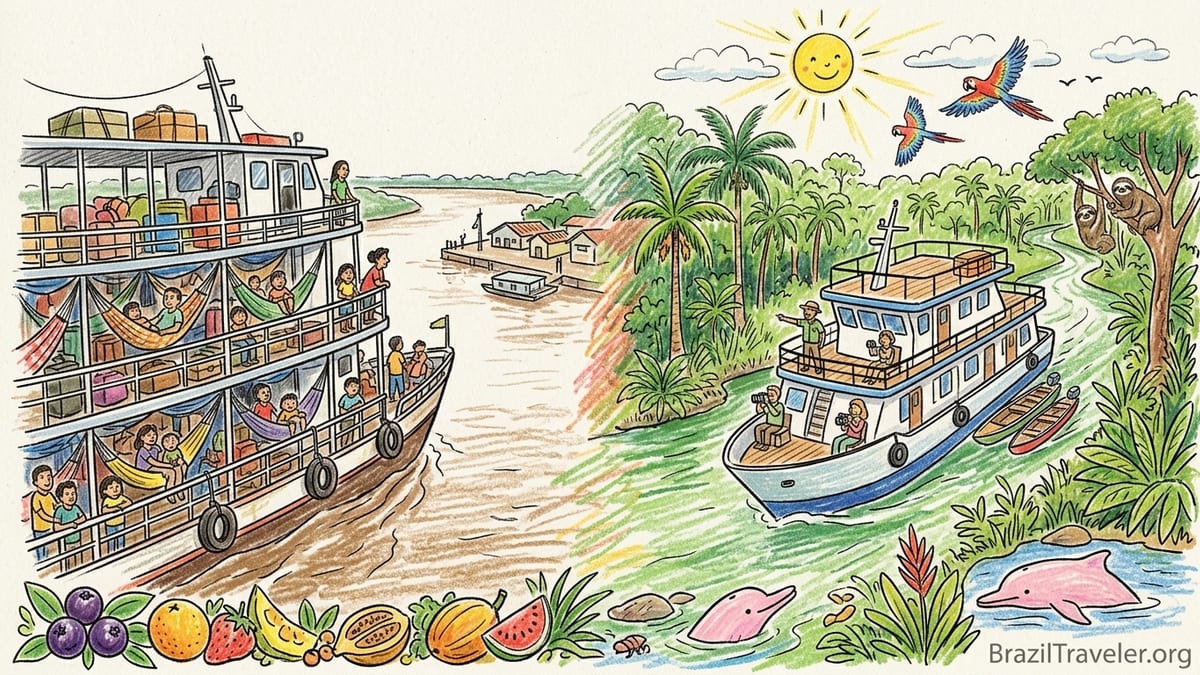
What I Expected From an Amazon River Journey
Before I ever set foot on a boat in the Brazilian Amazon, I had a romantic but very muddled picture of what “an Amazon cruise” meant. Travel brochures and social media posts made it look like a single product: a boat, jungle on both sides, sunset over a chocolate colored river, maybe a caiman or sloth in the distance. Prices, however, were all over the place. In the same week of research I saw slow regional boats from Manaus to Belém quoted at under 1,000 reais for several nights in a hammock, and small ship expedition cruises on the Rio Negro and upper Amazon advertised at the equivalent of several thousand US dollars per person for a week.
I assumed the price difference mostly reflected comfort levels. I expected the passenger boat to be noisy but colorful, a cheap way to “live the river” for several days and maybe spot wildlife from the deck. I imagined the expedition cruise would add more polished service and air conditioning, then bolt on a few excursions, but still be essentially about drifting along the main channel watching the jungle slide by. In short, I thought I was choosing between economy class and business class on roughly the same experience.
That assumption turned out to be wrong. After completing one major regional boat journey and one organized small ship cruise, I realized these are not simply cheaper and more expensive versions of the same thing. They serve different purposes, attract different travelers, and are structured around different ideas of what the Amazon should be: a transport corridor that locals rely on every day, or a carefully curated natural and cultural destination.
The result is that travelers comparing prices can be misled. A hammock ticket for 800 reais and a 5 day cruise for 9,000 reais per person are not competing products in the way an economy seat and a business seat on the same flight are. To understand which one is “worth it,” you have to start with what each boat is actually designed to do.
Inside Brazil’s Regional Passenger Boats: Hammocks, Cargo and Everyday River Life
The passenger boat I took from Manaus toward Santarém looked nothing like a polished cruise vessel. At the port, it sat low and wide at the dock, metal hull flanked by stacks of cargo. Pickup trucks and pallets of goods were being craned aboard. Families arriving from the bus station carried huge sacks of food, plastic fans, flat screen televisions. Somewhere inside all of this, I knew, was the deck where I would sling my hammock for the next couple of nights.
On these regional boats the Amazon is not a backdrop. It is the highway. Government and academic descriptions of the Solimões–Amazonas waterway make clear that it carries the vast majority of passenger and cargo traffic between river cities such as Tabatinga, Manaus and Belém. In practice that means the ferry’s primary role is to move people, animals, vehicles and goods, with travelers like me simply slotting into that existing system. There is usually a hammock deck, sometimes several, where travelers string their own hammocks between steel beams until they form a dense patchwork only an arm’s length apart. Some boats also offer a limited number of simple cabins along the sides of the vessel for those who want a door and private bathroom.
My ticket in hammock class from Manaus to Santarém cost the equivalent of around 300 to 400 reais when bought at the port, depending on the specific boat and date. For comparison, I spoke with other travelers who had paid similar amounts for the first leg from Belém to Manaus, a journey of roughly five days, and around 700 to 800 reais for a simple cabin on certain routes. The structure is fairly consistent: you pay for transport and a place to sleep; food is sometimes included in the ticket, sometimes sold separately from a small cafeteria serving rice, beans, meat and strong sweet coffee. On my boat only breakfast and a basic lunch were included, and other meals ran around 20 to 30 reais a plate.
Life on board is a slow, immersive routine. Days were spent reading in my hammock, chatting with neighbors, and walking to the open sides of the deck to watch the forested banks slip by. The scenery is magnificent in a broad, contemplative way, but often the boat travels far from shore, so wildlife sightings from the big vessel are rare. Instead, the focus is on ordinary river life: small villages at the water’s edge, family canoes, fishers, and other cargo boats passing in the night. Loud music played in the afternoons, children swung in hammocks, someone always had a thermos of coffee. As a foreign traveler, I woke up looking at a ceiling of hammocks and realized I had paid less than the price of one mid range hotel night in Manaus for several days of transport, bed and river scenery.
What Life Was Really Like On Board the Passenger Boat
The practical details of the passenger boat are where the romance of the idea meets its limits. Sleeping in a hammock among dozens or hundreds of other travelers means almost no privacy. Lights often stay on late into the night, and even if music stops, engine noise and snoring do not. I slept in short stretches, earplugs jammed in, occasionally woken by announcements or the thump of cargo being shifted in the lower decks. When it rained, crew members dropped tarps along the open sides of the deck, trapping in humidity and diesel fumes. Showers were simple stalls with cold river water. Toilets could be adequate or grim, depending on the vessel and how many days had passed since departure.
Cabins, when available, are a clear step up. On another route I inspected a basic double cabin priced around 700 to 900 reais per person for multiple nights. It offered two narrow beds, a fan or small air conditioning unit, and a private bathroom. Compared with a hammock, it was quieter and more secure, but still far from luxury. Walls are thin, the boat’s engines vibrate through the structure, and you are only a few meters away from the same crowded decks. In both hammock and cabin class, valuables need attention. Some travelers I met used simple cable locks to secure backpacks to metal rails; others entrusted larger bags to a locked storage room near the crew area.
The food on board reflected the boat’s role as basic transport. Plates of rice, beans and chicken were filling and inexpensive but repetitive. Vegetarians had to be flexible. Drinking water was provided from large mineral water jugs, but some travelers preferred to bring their own filter or sealed bottles. Air conditioning on the hammock deck, if present at all, might be limited to a few wall units. On one trip a passenger who strung their hammock directly under a unit spent a freezing night; others, far from the machines, sweated in the heavy air. The upside was that the open sides allowed a constant breeze whenever the boat was moving.
Crucially, there were no planned wildlife or cultural stops for passengers like me. The boat called at small ports to collect and drop cargo and local travelers, not to provide excursions. I watched river dolphins from the side of the deck at dusk and saw macaws streak past overhead, but nobody stopped the boat or launched a canoe for closer observation. When we docked briefly en route, passengers were primarily concerned with buying snacks, stretching their legs, or helping load goods. For travelers whose main goal is to see animals, walk in the forest and learn from guides, this can be a disappointment. For those who want a slice of everyday Amazonian river life and a very economical way to cover huge distances, the passenger ferry delivers exactly that.
The Small-Ship Expedition Cruise: Guided Nature and Structure
The small ship expedition cruise I joined out of Manaus on the Rio Negro felt almost like a different planet. The vessel carried only a few dozen passengers in air conditioned cabins with private bathrooms. Instead of hammocks and sacks of cargo, the lower deck stored motorized canoes for excursions. The itinerary was built around daily activities rather than simply getting from point A to point B. Each evening, naturalist guides gathered passengers in the lounge to brief us on the next day’s plan and give short talks on topics such as floodplain ecology or indigenous uses of medicinal plants.
Prices reflected this shift. In Brazil in 2025 and 2026, multi day expedition style cruises out of Manaus on the Rio Negro and adjacent waterways commonly ranged from around 8,000 to 10,000 reais per person for roughly a week in a double cabin, sometimes more on high end vessels that bordered on luxury. Special thematic trips combining cruising with activities such as nature illustration workshops advertised similar boat costs of about 8,800 reais per person in a shared cabin, with single cabins costing over 14,000 reais. In that figure, however, almost everything was bundled: accommodation, all meals, non alcoholic drinks, guided canoe trips, forest walks, community visits and airport or hotel transfers on embarkation and disembarkation days.
On my cruise, a typical day started with a 6 a.m. wake up call, coffee and fruit in the lounge, then a two to three hour excursion by canoe into narrow igarapés where the main vessel could not go. Guides interpreted bird calls, pointed out squirrel monkeys and sloths, and stopped to show us giant lily pads or medicinal vines. After a full breakfast back on board, there might be a short forest walk from a remote landing, followed by lunch while we motored to the next area. Afternoons included more outings or a visit to a small riverside community, then sunset on the top deck and an evening lecture. Actual time away from the main boat on some days exceeded six hours.
The comforts were real. Cabins had proper mattresses, effective air conditioning, hot showers and 24 hour electricity. Meals were varied, with fresh fish, salads and desserts presented buffet style or plated. There were quiet corners to read, a bar serving caipirinhas, and staff who cleaned cabins daily. But the biggest difference, once on board, was not the comfort level. It was the presence of experienced guides and a tightly planned program of activities that brought us closer to the forest and its wildlife than any large regional ferry could.
Where the Money Goes: Transport vs Guiding, Comfort and Activities
Looking at the raw numbers, the price gap between a regional passenger boat and a small ship expedition cruise is striking. On my main regional journey I spent around 400 reais for a hammock ticket plus another 150 to 200 reais on meals and snacks over several days. Added to that were transfers and a night or two in a port city hotel before and after sailing, which might add another 300 to 600 reais depending on comfort level. My total outlay for the transport segment remained well under 1,500 reais.
By contrast, the expedition cruise cost over 8,000 reais per person for a week in a shared cabin, not counting flights to and from Manaus or extra hotel nights. On paper it looked five or six times more expensive per night, and for some vessels and seasons the multiplier would be even higher. However, the added cost is not simply for a softer bed and better food. The cruise fare bundled in professional guiding, use of smaller boats, fuel for frequent excursions, permits, park and community fees where applicable, and a high staff to guest ratio. In other words, much of what you are paying is not transportation at all, but a structured experience that puts you in the forest, on small waterways, and in conversations with local people who are prepared for visitors.
On the regional boat, any extra nature or cultural experience had to be arranged and paid for separately. I booked an independent day trip from Manaus into the flooded forest and another half day birdwatching excursion near Santarém, each costing the equivalent of several hundred reais. When I added these to my ferry ticket, port transfers by taxi or app based car service, and hotel nights, the total for my budget “river experience” began to approach, though not match, the lower end of organized multi day lodge packages in the region. It still did not include multi hour daily excursions or specialist guiding.
This is the critical financial distinction. A passenger ferry fare buys you movement and a shared space on a working riverboat. Everything else is optional and unstructured. An expedition cruise fare buys you a floating base camp with dedicated staff whose whole job is to get you off the main river, into smaller habitats, and back with some understanding of what you have seen. For travelers comparing prices, it helps to think of the ferry as equivalent to a long distance bus and the expedition cruise as a package of transport, hotel, restaurant, guiding and activities combined.
Comfort, Privacy, Safety and Flexibility: Side by Side
When I compare the two trips beyond price, each has clear strengths and weaknesses. In terms of sleeping comfort, the expedition cruise obviously wins. A proper bed in a cool cabin, with predictable quiet hours and housekeeping, is a relief after a humid hammock deck where lights and conversations may go late. Even an inexpensive cabin on a regional boat offers an upgrade in privacy over hammock class, but cannot match the sound proofing or bedding standards of a dedicated cruise vessel that targets international visitors.
Noise and privacy are closely linked. On the ferry, daily life unfolds in public. I chatted with families, watched card games, shared food and stories, and felt woven into a temporary river community. That was a highlight and a cultural encounter I could not have scripted. The trade off was that there was almost nowhere to withdraw except my own hammock or a brief walk to a quieter corner of deck. On the cruise, I could always retreat to my cabin or to a small lounge to read. It felt more like a floating hotel, less like a rolling neighborhood.
Sanitation and safety are nuanced. Regional boats vary widely in maintenance and crowding. I inspected toilets and looked for life jackets and fire extinguishers before committing to a particular vessel, and I recommend that other travelers do the same. Local authorities and media occasionally highlight issues with overloaded boats or safety lapses, particularly during holiday peaks. That said, these ferries are the default way millions of Brazilians move between river cities, which speaks to their essential reliability as transport. On the cruise, safety briefings were formal, guides carried radios on excursions, and the company had documented protocols for medical issues and evacuations. For families and risk averse travelers, that level of structure can be reassuring.
Itinerary flexibility cuts both ways. With the passenger boat I had to adjust to its schedule, which meant fixed departure days and multi day segments that could not be shortened. If I got bored on day three of a five day leg, that was my problem. On the other hand, I had total freedom in what I did in each port and how long I stayed before catching the next boat or flight. The cruise offered variety within the week but fixed the overall shape of my days. I did not choose when to wake, where to go at dawn, or how long to stay at a community visit. That was determined by the guides and the logistics of operating a small ship with limited daylight.
Who Really Gets Better Value: Solo Travelers, Couples and Families
To decide which option offers better value, it helps to look at specific traveler profiles. As a solo budget traveler, I could cross large chunks of the Amazon basin by ferry, sleeping in a hammock, for figures that remained below what a single night on a mid range expedition cruise would cost. Even when I added reasonable spending on food in port towns, simple hotels, and a couple of independent day trips into the forest, the per night cost stayed relatively low. For someone with more time than money, who is comfortable with basic conditions and uncertainty, the regional boats are an extraordinary, cost effective way to see how the river actually works for its residents.
Couples sit somewhere in the middle. Two hammock tickets plus shared costs for food and port hotels keep budgets modest, but many couples I met preferred to upgrade to a cabin on at least one long leg, quickly doubling or tripling the price compared with hammock class. Meanwhile, expedition cruises typically price per person in a double cabin. A five to seven night cruise at 8,000 to 10,000 reais per person becomes a very significant sum for two. Some operators offer shoulder season promotions, but this will still be one of the most expensive weeks of a Brazil itinerary. For couples for whom the Amazon is the primary reason for the trip, and who place high value on guided wildlife experiences and comfort, this can still be money well spent. For others it may crowd out time and budget for the rest of Brazil.
Families of four face additional constraints. Many expedition cruises set minimum ages for children, often around eight years or older, sometimes higher on more upscale vessels. Some charge reduced rates for younger children sharing a cabin with parents, while others apply near adult pricing. When multiplied by four, a week long cruise fare can approach or exceed the cost of an entire month of independent travel elsewhere in the country. On the positive side, the structure, safety protocols and educational guiding can make an expedition cruise a powerful, family friendly experience when children are old enough to engage with it and handle early mornings and heat.
By contrast, regional ferries have no specific age based restrictions for families beyond common sense and any safety advisories. I saw children of all ages on board. The low fares make it possible for parents to give older kids an immersive river experience at a small fraction of cruise prices. The trade off is that you must manage your own security, entertainment and comfort for several days in a crowded, noisy environment that can be challenging for very young children. It is essential to think carefully about whether your family is ready for that, especially overnight in hammock class.
My Disappointments, Surprises and Final Verdict on Value
Both experiences surprised me in ways I did not expect. On the regional boat, I was disappointed by how little wildlife I saw from the main deck after imagining I would be drifting in among tree trunks with herons at arm’s length. In reality, most of the time the boat traveled mid channel, far from shore. The scenery was still dramatic but the sense of remoteness was more visual than ecological. I was also frustrated at times by the relentless noise and lack of darkness at night. Even with earplugs and an eye mask, deep sleep was hard to come by.
Yet the same journey gave me moments no organized cruise could have engineered. Sharing strong coffee at dawn with a family heading home to a river village, talking to a truck driver who was accompanying his vehicle downriver before driving it onward from Belém, watching an impromptu football match on a tiny riverside pitch as we paused at a small port. Those unscripted interactions, layered over days of slow progress, made me feel I was witnessing the Amazon as a living, working river rather than just a backdrop for a checklist of animals.
On the expedition cruise, my main disappointment was different. While the guiding was excellent and I saw far more wildlife in a single dawn canoe outing than in my entire ferry journey, I sometimes felt insulated from ordinary local life. Community visits were planned and structured, with clear lines between hosts and guests. We learned a lot but did not linger. Prices also imposed a psychological pressure: when you are paying that much per night, it can be hard to relax on deck with a book and simply watch the river, because you feel compelled to participate in every activity to extract full value.
Nonetheless, when I looked back at the notes I had kept on time spent off the main vessel, the cruise was far ahead. Many days involved six or more hours in small boats or on forest trails, with real opportunities to observe birds, monkeys and vegetation at close range and ask endless questions of guides who had grown up on these rivers. For wildlife oriented travelers with limited time, or those who may never return to the Amazon, that intensity of experience starts to justify the price in a way that raw accommodation comparisons cannot capture.
The Takeaway: Which Journey I Would Repeat and Who Should Choose What
If I strip each experience down to the question “which offered better value for what I paid,” my answer depends entirely on the purpose of the trip. For pure transportation between river cities, spiced with an authentic look at everyday Amazonian life, the regional passenger boat is unquestionably worth the money. The cost per night, even when you factor in meals and pre and post trip hotels, is low compared with covering the same distance by air and staying in budget accommodation. You will not see as much wildlife as the word “Amazon” suggests, but you will see the human river that makes this region function.
For an immersive natural history experience focused on wildlife observation, forest walks and expert interpretation, the small ship expedition cruise delivered far more of what I hoped the Amazon would feel like. The price is high, sometimes very high, but a large share of that cost genuinely goes into guiding, fuel for small boat exploration, staff salaries and logistics for operating far from large towns, not just into white linens and air conditioning. In terms of meaningful time spent off the main vessel in interesting habitats, the cruise provided many times more value than the ferry.
Personally, I would repeat the regional passenger boat if I had at least a couple of weeks in the region and wanted to move slowly, practicing my Portuguese and watching river life unfold. I would repeat the expedition cruise if I had a defined window of one week, a dedicated budget for this part of my trip, and a priority on seeing wildlife and learning from specialists. Both are “worth it” within those frames. Neither is a good substitute for the other.
For backpackers and long term budget travelers, I recommend starting with a regional passenger boat journey and using the money saved to fund a couple of focused day trips with reputable local guides out of cities such as Manaus or Santarém. For families with school age children and limited vacation time, a carefully chosen small ship cruise that accepts children and offers strong guiding can be a highlight of a Brazil itinerary, provided you are comfortable with the overall cost. Couples who prioritize comfort and shared experiences may find that a mid to high end expedition cruise justifies its price if the Amazon is a once in a lifetime destination, while those with tighter budgets might blend one shorter cruise or lodge stay with regional boat travel.
Wildlife enthusiasts who dream of birds, primates and flooded forest ecosystems should lean strongly toward an expedition cruise or a specialist lodge, perhaps saving the regional boat for a separate transport segment if time allows. Luxury travelers will almost certainly prefer the consistent comfort, food quality and service of an upper tier cruise vessel, some of which add spa treatments, fine dining and very spacious cabins to the mix. Finally, visitors who care most about the Amazon River itself as a living artery, who find fascination in cargo being unloaded at midnight or in the web of human connections between river communities, are likely to find the regional passenger boat the most honest and revealing choice. The key is to understand, before you book, that you are choosing not just a price point but a fundamentally different way of meeting the greatest river on earth.
FAQ
Q1. Is a Brazilian Amazon passenger boat safe for solo travelers?
Passenger boats are the primary way locals move between Amazonian cities, and most trips are uneventful. As a solo traveler you should still assess each vessel at the port, looking for life jackets, accessible lifeboats, fire extinguishers and reasonable crowding on the hammock deck. Keep valuables in a money belt or small daypack you can use as a pillow, and consider locking larger bags to fixed structures. Women traveling alone often report curious attention but also generous help from families on board, especially if they speak some Portuguese.
Q2. How much should I budget per day on a regional passenger boat?
Once you have paid your ticket, daily spending mainly covers food and drinks. On recent routes between cities such as Manaus, Santarém and Belém, simple onboard meals have typically ranged from about 20 to 40 reais per plate, with cheap snacks and coffee available. If some meals are included in your fare, you might spend 50 to 100 reais per day on extras. Add to that the cost of a basic port city hotel before or after your journey, which can run from roughly 150 to 300 reais per night for budget or mid range rooms if booked in advance.
Q3. Do regional boats in the Amazon stop for wildlife viewing?
No. Regional passenger ferries exist to move people and cargo efficiently along the river corridor. They may slow down or pause near ports, but they do not launch canoes or adjust their schedule for wildlife viewing. You may still see river dolphins, birds and occasional monkeys from the deck if you watch carefully, especially at dawn and dusk, but the crew will not organize wildlife focused stops. If close wildlife encounters are important to you, plan separate day trips or an expedition cruise.
Q4. What kind of cabin and bathroom can I expect on a small ship expedition cruise?
On Brazilian Amazon expedition vessels sailing from Manaus and similar hubs, cabins generally have real beds with hotel style mattresses, individual air conditioning, private bathrooms with flush toilets and hot showers, and 24 hour electricity. Some higher end ships add floor to ceiling windows or balconies. Cabins are smaller than typical hotel rooms but far more comfortable than any space on a working ferry. Housekeeping usually services cabins daily, and bath amenities are commonly included.
Q5. Are Amazon expedition cruises suitable for children?
Policies vary by operator. Some small ship cruises welcome families and set minimum ages around five to eight years old, sometimes offering reduced rates for younger guests sharing a cabin with parents. Others restrict departures to older children or adults only because of safety, noise and itinerary demands. Before booking, check minimum age rules, typical daily schedules and whether guides are experienced in working with children. Families should make sure kids can handle early starts, heat, insects and long periods in small boats.
Q6. How do costs compare for a week on a passenger boat versus a week on a cruise?
On a regional ferry, even if you string together multiple segments and include all meals and simple hotels in port towns, a week on the river can often be managed for well under 2,000 reais per person, especially in hammock class. A week on a Brazilian Amazon expedition cruise commonly starts around 8,000 to 10,000 reais per person in a shared cabin, with more luxurious vessels charging higher rates. The ferry is dramatically cheaper, but the cruise price bundles guiding, activities, accommodation and most meals into one package.
Q7. Will I see more wildlife from a ferry or from a small ship cruise?
In my experience and that of most travelers I have spoken to, you will see far more wildlife on a dedicated expedition cruise. The key is that cruises use small motorized canoes to access narrow channels, lakes and flooded forests where animals are easier to spot and less disturbed by noise. Guides know where to look for birds, primates and caimans, and they plan outings at dawn and dusk when activity is highest. Ferries stay in the main river for efficiency and safety, so many animals remain too distant to observe well with the naked eye.
Q8. Can I combine a passenger boat trip with guided excursions instead of booking a cruise?
Yes. Many travelers choose to ride a regional ferry for the transport and cultural experience, then book separate day trips from cities such as Manaus, Santarém or Belém. These excursions might include canoe outings, forest walks or visits to protected areas and can cost several hundred reais per day depending on group size and operator. This hybrid approach still comes in well below the price of a weeklong cruise, though it usually offers fewer hours of guided exploration overall and may require more logistical planning on your part.
Q9. How uncomfortable is sleeping in a hammock for several nights?
If you have never slept in a hammock, the first night can be an adjustment. On the Amazon ferries it is crucial to hang the hammock with a deep sag and lie diagonally to keep your back flat. Bring a light blanket or sleeping bag liner, a small pillow or clothing bundle, and an eye mask and earplugs. After a night or two many people sleep reasonably well, though engine noise, lights and nearby conversations can interrupt rest. If you are a very light sleeper, consider paying extra for a cabin on longer legs.
Q10. Which option should I choose if the Amazon River itself is my main interest?
If your primary fascination is with the river as a working artery of Brazilian life, with its cargo, communities and long horizons of water, a regional passenger boat is the better choice. You will live at the river’s pace for days, surrounded by local travelers, and watch how goods and people move between far flung towns. If instead you are most drawn to the forest and wildlife that surround the river, and you want to maximize close encounters with animals and learn from naturalist guides, a small ship expedition cruise or a stay at a well run jungle lodge will serve you better, even if it costs more.