


Over the past year I travelled twice along the Brazilian Amazon by public river ferry, once on a classic hammock ticket from Santarém to Manaus and later in a private cabin on a comparable boat in the opposite direction. Both routes followed the same busy stretch of river and used working regional ferries that locals rely on, not tourist cruise ships. The experiences could not have been more different. If you are staring at two prices at the ticket window right now, wondering whether to sling a hammock on the open deck or pay several times more for a small air conditioned cabin, this is the comparison I wish I had before I boarded.
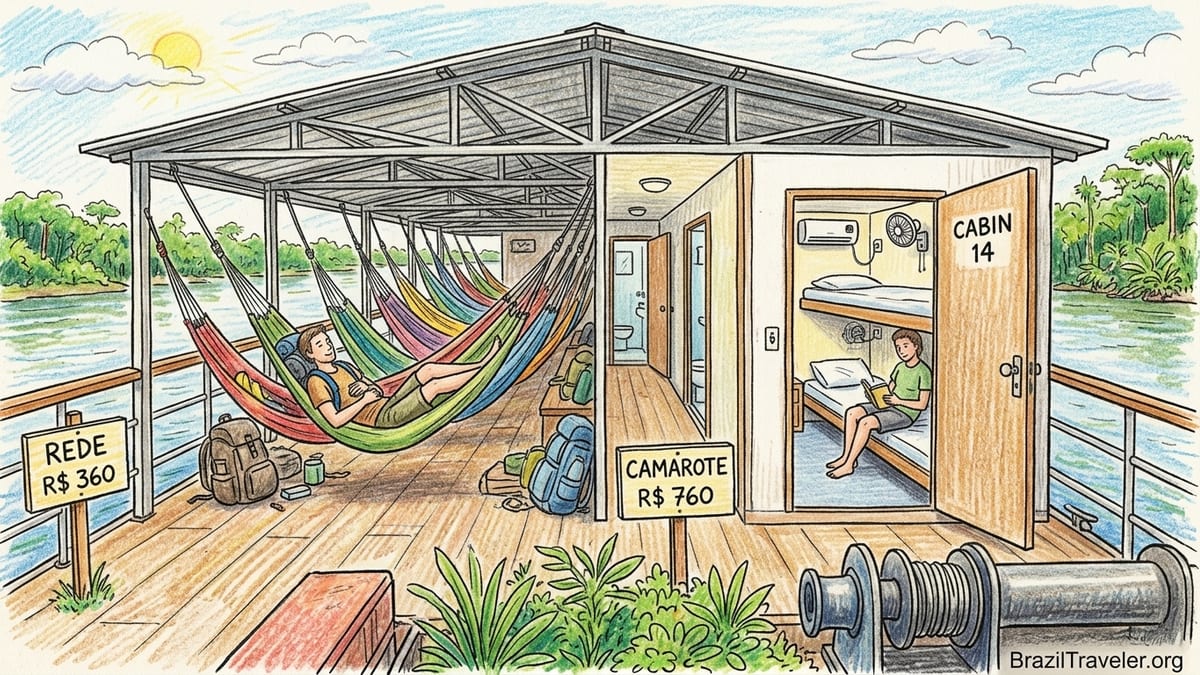
Buying the Ticket: What “Rede” and “Camarote” Really Mean
My first trip was a four night journey from Belém to Santarém, followed a few weeks later by a two night hop from Santarém to Manaus. On both routes the ticket choice at the river terminals was essentially the same: “rede” (hammock class) or “camarote” (cabin). At the Belém dock, the agent for a midrange company quoted me 360 reais for a hammock ticket to Santarém and 760 reais for a basic cabin for the same route, in line with published price tables for regional lines that list hammock fares between roughly 350 and 400 reais and cabins from about 700 reais upward on this sector as of mid 2026. On the slightly shorter Santarém to Manaus leg the spread was similar when adjusted for distance.
These prices only covered transport and a place to sleep. On both boats I still had to buy my own hammock, food, and extras like drinking water and snacks. In the hammock class I was simply buying the right to claim a section of the shared passenger deck, nothing more. For the cabin I was paying for a private or semi private room with bunks, a fan or air conditioning, power outlets and a locking door. Meals varied by company. On my Belém to Santarém ferry meals were not included in the basic fare and were sold from a cafeteria, while on the Santarém to Manaus boat simple buffet style meals were bundled into the cabin price but hammock passengers paid per plate.
One surprise for many first timers is that a hammock ticket very rarely includes an actual hammock. At the Belém terminal a simple fabric hammock on the day of departure cost about 60 reais at a riverside stall, while more robust models in town shops started closer to 80 or 90 reais. Ropes came extra. Hooks were already welded to the overhead metal bars on the boat, so I did not need to carry hardware, only the hammock itself and cords to adjust the length. When I traveled in a cabin I still saw backpackers hunting for hammocks in the terminal because some chose to sleep in a hammock during the day and retreat to the cabin at night.
Another key detail is that neither of my hammock tickets came with any assigned space. The ticket simply allowed me through the turnstile. Space allocation was a free for all that rewarded those who boarded early. For the Belém departure, regulars arrived two to three hours before scheduled sailing to grab hooks along the breeziest edges of the deck. By contrast, my cabin ticket for the later trip listed a specific cabin number and bed. I could arrive closer to departure knowing I had a door and mattress waiting, something I appreciated after seeing just how tightly hammock decks can fill.
Hammock Deck Reality: Heat, Noise and Neighbours
Stepping onto the hammock deck for the first time felt like entering a colorful forest of swinging fabric. By the time we left Belém there were roughly two hundred hammocks on my deck, arranged in dense rows hung from metal beams. Guides and recent reports often warn that these decks can be crowded; looking around, that was no exaggeration. Hammocks overlapped, some touching shoulder to shoulder. My own ended up about twenty centimeters from my nearest neighbor on one side and almost brushing another on the other side.
Heat was the main challenge. In the afternoon the open sides of the boat allowed some breeze, especially when the vessel was under way in mid channel, but when we stopped at riverside ports the air quickly turned still and humid. Overhead, fluorescent lights and a low metal roof held the warmth. Sweat became a constant companion. Even at night, when the air finally cooled a little, the combined heat of so many bodies kept the deck warm. On the Santarém to Manaus stretch, slightly shorter at around forty eight hours, the pattern was similar, although a brief rainstorm one night brought welcome cooling air through the open railings.
Mosquitoes were less of an issue than I feared while the ferry was moving. Local passengers insisted that the combination of wind and the boat’s distance from shore kept most insects away, and my own experience matched that apart from a few bites near river towns at dusk when the boat slowed. Noise, on the other hand, was impossible to avoid. Children played under the hammocks, radios played Brazilian pop music well past midnight and cargo winches clanked during late night loading stops. Travelers used to hostels might adapt easily, but anyone who needs silence to sleep will struggle. I wore earplugs and still woke repeatedly.
Luggage security on the hammock deck felt somewhere between a busy hostel dorm and a long distance bus. Most locals kept their biggest bags on the floor under their hammocks and slept partially on top of them. I used a small cable lock to attach my backpack to a metal pole, kept my passport and wallet in a hidden pocket and tried not to leave my things unattended for long. A Brazilian passenger pointed out that occasional thefts are reported when boats get crowded, particularly at night or during longer stops when strangers can slip onboard. Nothing of mine went missing, but the constant need to keep an eye on my gear made it hard to fully relax.
The toilets for hammock passengers on both boats were located at the ends of the deck. On my first boat the men’s bathroom had two squat style toilets, one cold water shower and a small sink. Cleanliness fluctuated a lot over the day, from barely acceptable after the morning cleaning to grim by late evening. On the second boat, which was slightly newer, there were sit down toilets and separate shower cubicles, but water pressure was inconsistent and hot water nonexistent. Walking to the bathroom at night involved stepping around sleeping children on the floor and ducking through a forest of hammocks, which older travelers in particular found awkward and occasionally risky when the boat rolled.
How I Actually Slept in a Hammock
On paper, a hammock sounds romantic. In practice, my first night between Belém and Santarém was short and restless. I slung my hammock diagonally, following advice from experienced passengers to avoid a banana shape that bends the back. I also used a small inflatable camping pillow and a light cotton sheet instead of a sleeping bag. Even with that, I woke up almost hourly. Heat, sudden loud conversations when we pulled into ports after dark and the metallic creak of the boat were constant interruptions.
By the second night, however, my body had started to adapt. I shifted to sleeping slightly off center, one leg bent, which relieved pressure on my lower back. I also learned to time my showers for just before bedtime. Rinsing off the day’s sweat in cold river water made the initial hour or two of sleep noticeably more comfortable. I still woke during noisy loading stops, but I managed perhaps five or six hours of broken sleep instead of three or four.
On the shorter Santarém to Manaus trip, I was already used to the routine and slept a bit better from the start, although a bright fluorescent tube that stayed on all night above my row made an eye mask essential. The biggest issue on this leg was proximity to strangers. In the tight central section of the deck my neighbor’s hammock actually brushed mine when either of us shifted. This made side sleeping awkward at times and left me mindful of other people’s personal space. Couples I spoke with said privacy was nearly impossible in the hammock area. One pair chose to hang their hammocks directly above each other to at least keep their bags and shoes in one tiny shared space.
Despite these downsides, there were enjoyable aspects. Lying in the hammock during the early morning, watching mist rise from the rainforest as the first light spread over the water, felt unforgettable. Conversations sparked easily. A family from Pará shared homemade tapioca pancakes with me at breakfast one day and insisted I try their strong coffee. Students traveling home from Manaus happily answered my questions about river towns and pointed out tributaries as we passed. These social connections almost made up for the poor quality of my sleep.
Inside the Cabin: Bed, Air Conditioning and Actual Rest
My cabin experience was on the return route between Santarém and Manaus, this time in a twin bed camarote on a regional ferry of similar size and age. The published fare for a cabin on this section in early 2026 hovered around double the hammock price when booked at the port, and slightly higher when arranged by phone with an agent. At the ticket window I paid just under 700 reais for a two night trip in a shared cabin, compared with a little over 320 reais being quoted for hammock class on the same sailing.
The cabin itself was small but functional. Two narrow single beds were fixed to the wall with basic foam mattresses about ten centimeters thick. A sheet and pillow were included, though I was glad I had brought my own light sleeping bag liner for extra cleanliness. The room had a simple split unit air conditioner mounted high on the wall, plus a small ceiling fan. A single window opened over the river, but in practice the crew advised keeping it closed most of the time to let the air conditioning work and to avoid spray entering the cabin when the boat turned into the wind.
Electricity was available through a standard Brazilian outlet below the window. It stayed on throughout the journey except for a brief power cut of about fifteen minutes during a night time stop at Itacoatiara. Lighting came from a bright overhead LED that I mostly kept off in favor of a small travel lamp so my cabin mate could sleep. Cleanliness was noticeably better than on the open deck, though still far from hotel standards. There were a few scuff marks on the walls and some dust in corners, but the sheets looked freshly laundered and there was no visible mold.
This particular cabin category did not include a private bathroom. Instead, cabin passengers used a dedicated bathroom shared among several cabins, separate from the main deck toilets. It had sit down toilets, doors that locked properly, and two shower stalls with cool water. They were cleaned at least twice daily. The improvement in hygiene and ease of access during the night was significant. On some other Amazon ferries I researched before booking, more expensive “suite” level cabins do offer private bathrooms and slightly wider beds, but these cost closer to three times the hammock fare on longer Belém to Manaus runs and were not available on my dates.
Most important, the cabin delivered much more reliable comfort than the hammock deck. With the air conditioning on low, the temperature remained pleasant even during the hottest afternoon hours. Noise from the corridor and neighboring cabins was moderate, and the door blocked most of the deck music. For the first time in days on the river I slept a full six or seven hours in a row, waking only briefly when the engine note changed during a night stop. After arriving in Manaus early in the morning I felt rested enough to explore the city immediately, something that had not been true when I disembarked from the hammock deck earlier in the month.
Daytime Life Onboard: Social Deck vs Cabin Retreat
When comparing hammock and cabin, it is easy to focus only on the nights, but daytime life is just as different. On the hammock deck passengers essentially live in public. During the day they sit in or under their hammocks reading, chatting or watching the river pass. Children play along the aisles, vendors wander through selling snacks, and the smells of instant coffee and frying fish drift up from the galley. The atmosphere is lively and sometimes chaotic. I rarely spent more than a few minutes alone before someone asked where I was from or offered me a slice of cake or a cup of sweetened coffee.
The cabin changed my daytime rhythm. I still spent much of my time on the open deck, but I now had the option to retreat to my room when I needed quiet or cooler air. After lunch, when the sun beat hardest on the metal roof and the air over the deck shimmered with heat, I would go below, close the door and nap or read for an hour. Some cabin passengers barely left their rooms except for meals and photo stops, emerging only on arrival. They traded the social immersion of the deck for the controlled comfort of a private space.
For me the ideal balance turned out to be both worlds. I spent sunrise and sunset outside, often standing at the rail or sitting with hammock passengers I had met. These were the hours when pink river dolphins sometimes surfaced near the bow and when small stilt houses along the shore glowed in the low light. In the middle of the day I appreciated the cabin as a refuge. If you are an introvert or someone who recharges in solitude, having a door to close can dramatically improve your overall experience, while extroverts may find the constant energy of the hammock deck more rewarding.
One thing a cabin did not automatically provide was a better view. Some suites on the upper deck opened directly onto an exterior walkway facing the river. My more modest cabin sat on an internal corridor with a small side window. I still chose to watch scenery from the common areas outside rather than through glass. In practice, both hammock and cabin passengers shared the same open bow and stern spaces whenever something special appeared on the horizon.
Counting the Extras: Water, Food and Comfort Purchases
The headline ticket price is only part of what you will spend on an Amazon ferry. On the hammock leg between Belém and Santarém I tracked my additional expenses closely. Before boarding I bought a hammock for about 60 reais, two strong synthetic ropes for 20 reais and a simple eye mask and earplugs set from a pharmacy in Belém for roughly 35 reais. At the port supermarket I stocked up on five liters of bottled water, crackers, fruit and instant coffee sachets, which came to just under 70 reais. Onboard, hot water for coffee was free from large thermos tanks near the galley.
Food from the canteen averaged around 20 to 30 reais per meal, depending on portion and whether I added a soft drink. Over four days and nights I ate two canteen meals per day and supplemented with my own snacks, spending perhaps 220 reais total on food and drinks. Showers on that boat were included in the fare, but some other operators on the Amazon charge a small fee for hot water showers or for using a better bathroom section, so it is worth asking at the ticket office.
On the cabin leg, some expenses shifted. The cabin fare included three simple meals per day served at set times, typically rice, beans, a piece of fried chicken or fish and salad. This meant my onboard food spending dropped to perhaps 60 or 70 reais total for extra snacks, coffee outside meal hours and the occasional soda. I still bought bottled water before departure, but I needed less because drink dispensers in the dining room offered filtered water. Since bedding was provided in the cabin, I did not need to buy an extra blanket, though I did end up purchasing a small additional pillow from a vendor in Santarém for comfort at around 30 reais. In both classes, cash was essential, as card machines frequently went offline once the boat left major ports.
These numbers show how the true cost difference between hammock and cabin narrows slightly once you factor in meals and gear. On my four night hammock journey my total outlay including ticket, hammock, food and basic supplies reached around 730 to 750 reais. The cabin trip of two nights, with most meals and bedding included, came to somewhere near 800 reais in total. Per night, the cabin was still more expensive, but not outrageously so when I considered the sleep and comfort it provided, especially on the second, shorter route.
Accessibility and Who Each Option Suits
Many travelers underestimate how physically demanding hammock travel can be. In Belém and Santarém I climbed steep gangways between floating docks and the ferry’s side, often over uneven planks without handrails. Once onboard, the hammock deck on both boats was one or two levels above the main loading area, reachable only by narrow staircases. Carrying a large backpack or suitcase up these stairs while avoiding swinging hammocks required balance and patience. For anyone with knee problems, reduced mobility or a fear of crowded spaces, this part of the journey would be challenging.
Hanging the hammock itself also took some physical effort. I needed to lift my arms above my head, tie firm knots and occasionally adjust tension by retying one end. Moving in and out of the hammock several times a day meant swinging my legs over the edge and standing on a floor that might be moving slightly with the boat. Bathroom trips at night demanded stepping over ropes and around other passengers sleeping on the ground. I watched older Brazilians do this with ease, but I also saw one man in his seventies misjudge a step and nearly fall when the boat lurched during a docking maneuver.
Cabins improved some of these accessibility issues but not all. On my Santarém to Manaus boat cabins were located down a short flight of stairs from the main deck. The gangway boarding process was the same for everyone. However, once inside the cabin area, corridors were clear, floors were level and beds were fixed and low enough to sit down on easily. The private or semi private bathrooms for cabin passengers meant shorter, safer walks at night. For an older couple I met, this was the decisive factor in choosing a cabin despite the higher price. They told me they were curious about the hammock experience but felt their joints would not forgive them after several nights.
From an accessibility standpoint, hammock accommodation is realistic for reasonably fit travelers who are comfortable with stairs, heat and basic facilities. Cabin travel is better suited to older passengers, people with back issues, or anyone who cannot easily get in and out of a hammock or navigate through crowded decks in low light. If you have significant mobility challenges, even cabins on public ferries may not be ideal, and a shorter sector or a more structured cruise style trip with ramps and staff assistance could be a better option.
Two Nights vs Four Nights: Solo Traveler and Couple Scenarios
Experiencing both a four night and a two night journey helped me understand how comfort needs compound over time. For the four night Belém to Santarém sector in hammock class, my sleep deficit grew each day. By the third morning I felt sluggish and irritable, less inclined to chat and less appreciative of the scenery. The minor aches from sleeping in a slightly curved position also built up. Had I travelled as a couple, sharing that dense deck space for almost a week might have increased tension. There was simply no private corner to retreat to if either person needed solitude after an argument or a long hot day.
On a theoretical four night cabin journey for a couple, assuming a midrange regional operator quoting around 360 reais per person in hammock class and 760 to 920 reais per person in a standard outside cabin on the Belém to Santarém route, a pair would be looking at 720 reais combined for hammocks versus perhaps 1,520 to 1,840 reais combined for a cabin. That is a substantial difference, but it buys shared quiet space, climate control and better bathrooms over nearly a week. From conversations with Brazilian couples on board, many considered this worth the price on longer segments, especially if they had limited vacation time and wanted to arrive reasonably rested.
For a shorter two night trip such as Santarém to Manaus, the calculus shifts. When I did this leg as a solo traveler in a cabin, cabin fares were about double hammock fares. If space on the hammock deck was not overly crowded and if I were comfortable treating the trip as an adventure rather than transport, I could have saved meaningful money by choosing a hammock for just two nights. I would lose some sleep, but I would likely recover quickly on land. For a couple, however, even two nights in hammocks can be a strain, especially if one partner sleeps lightly or values privacy. In that case, budgeting for a cabin might preserve harmony and energy for exploring Manaus or Santarém afterward.
This comparison rests on several assumptions: that operators maintain the same approximate fare ratios reported in mid 2026, that cabins are available at booking time, and that you do not face last minute price spikes during peak holiday weeks. Availability in particular can affect the decision. On one journey I met a pair of travelers who had intended to book a cabin from Santarém to Belém, but by the time they reached the terminal all cabins were sold out. They spent five consecutive nights in hammocks and told me they would plan further ahead next time specifically to secure a cabin on the longest segment.
The Takeaway: What I Would Book Again
Looking back, both the hammock deck and cabin gave me memorable experiences, but for different reasons. The hammock journey connected me directly to everyday river life. I shared food with families from small Amazon towns, listened to local gossip about water levels and fishing seasons, and felt the river breeze on my face from dawn to late at night. These things would have been harder to experience if I had stayed behind a closed cabin door. At the same time, the heat, noise, lack of privacy and light sleep took a real toll on my energy after several nights.
The cabin, in contrast, turned the same river into a calm moving hotel of sorts. I slept almost as well as I do on land, woke refreshed, and could step into controlled air conditioning whenever the sun became oppressive. The trade off was spending less time in the organic chaos of the hammock deck and paying a fare that was roughly twice as high per night. Not every cabin on every vessel in the Amazon basin offers equal standards. Some are little more than partitioned compartments with bunks and a fan instead of full air conditioning. Others, marketed as suites, can feel close to budget hotel rooms. Assessing recent reviews and, if possible, peeking into a cabin before handing over cash is wise.
If I were choosing again specifically for a 24 hour journey, such as a shorter overnight hop between two regional towns, I would personally choose a hammock, provided I could board early enough to secure a good spot near the middle of the deck with some airflow. One night of imperfect sleep is an acceptable price for the social atmosphere and for saving money that I could spend later on a jungle excursion or a better hotel on land. I would bring my own quality hammock, eye mask, earplugs and plenty of drinking water, and I would treat the discomforts as part of the adventure.
For a five day voyage, for example the full Belém to Manaus route that many boats still cover in four to five nights, I would choose a cabin if my budget allowed. Arriving in Manaus after nearly a week on the river with my back intact and my sleep bank full is worth paying significantly more, especially if I planned onward hikes, wildlife trips or long bus rides. If money were tight, I might compromise by taking a hammock on the shortest segment and investing in a cabin on the longest, or by sharing a twin cabin with another traveler to split costs.
Ultimately, your decision should match your body, your budget and your priorities. If you are young, healthy, comfortable with basic conditions and eager for contact with Brazilian river life, a hammock may give you the richer story to tell. If you value rest, privacy and the ability to step away from constant noise and heat, a cabin will likely make the Amazon feel more like a moving base than a test of endurance. Having tried both, I am grateful for the hammock memories, but on my next multi day Amazon ferry I expect to hand over the extra reais for a small, humming box with a cool breeze and a door that closes.
FAQ
Q1. Do I need to bring my own hammock for Amazon river boats?
In most cases, yes. Public ferries along routes such as Belém to Manaus or Santarém to Manaus usually sell only the space on the hammock deck, not the hammock itself. You can buy a hammock at river terminals or in city markets before departure, and you will typically need ropes but not hooks, since hooks are fixed to the boat structure.
Q2. How crowded are the hammock decks on Amazon ferries?
Crowding varies by season and route, but it is common to see hundreds of hammocks slung close together, with very little personal space. On busy sailings hammocks may almost touch each other, so do not expect the kind of separation you might have in a hostel. Arriving at the boat two or three hours before departure improves your chances of finding a more comfortable spot.
Q3. Is a cabin on an Amazon river boat air conditioned?
Many standard cabins have air conditioning or at least a strong fan, but standards differ between companies and individual boats. Some vessels offer simple cabins that are essentially small, ventilated compartments with bunks, while others have hotel like suites with full air conditioning and private bathrooms. Always confirm what type of cabin you are paying for before you buy the ticket.
Q4. Are meals included in the ticket price?
It depends on the operator. On some ferries hammock passengers pay for each meal separately at the onboard cafeteria, while cabin fares on the same boat may include three simple meals per day. On other routes no meals are included for any class. Ask at the ticket office or check the posted information at the dock so you can budget for food or buy groceries before boarding.
Q5. How safe is my luggage on the hammock deck?
Luggage security on the hammock deck is similar to a very crowded hostel dorm. Most travelers keep their main bags on the floor under their hammocks, sometimes secured with a cable or strap to a fixed point, and carry valuables in money belts or small daypacks that stay with them even when they sleep. Petty theft can occur on busy routes, especially at night or during port stops, so basic precautions are recommended.
Q6. Is hammock travel suitable for older passengers?
It can be, but only if the person is reasonably fit and comfortable climbing gangways and navigating crowded decks. Getting in and out of a hammock, walking to the bathroom at night and moving up and down narrow stairs can be difficult for people with joint problems or limited mobility. Many older travelers prefer to book cabins so they have fixed beds, clearer corridors and closer bathrooms.
Q7. How much more does a cabin cost compared with a hammock?
On common routes like Belém to Santarém or Santarém to Manaus, published fares in 2026 show cabins costing roughly twice, and sometimes close to three times, the hammock price for the same sailing. The exact difference depends on operator, season, cabin type and whether meals are included, so prices at the ticket window on your travel date are the figures that matter most.
Q8. Will I see more of the river from a cabin than from a hammock?
Not necessarily. Both hammock and cabin passengers can access shared outdoor decks and the bow and stern viewing areas where the best river views are found. Some higher category cabins have large windows facing the river, but many standard cabins are inside rooms with small portholes. If scenery is your priority you will probably spend most of your time on the open decks regardless of where you sleep.
Q9. What should I bring to sleep comfortably in a hammock?
A quality hammock, two sturdy ropes, an eye mask, earplugs, a light sheet or sleeping bag liner and a small pillow can all make a big difference. Many travelers also pack a compact travel fan, plenty of drinking water and basic toiletries. Buying these items in Belém, Santarém or Manaus before you board is usually cheaper and easier than trying to find them mid river.
Q10. For a five day Amazon trip, is the cabin worth the money?
For many people, yes. Over four or five nights, the extra rest, cooler temperatures and better bathroom access can greatly improve your overall experience and leave you with more energy for exploring when you arrive. If your budget can comfortably handle paying roughly double the hammock fare, a cabin is often the more sustainable choice for long stretches.