

On a muggy April morning on the lower Amazon, our mid‑size ship dropped anchor off a nameless bend in the river and lowered its tenders toward a scattering of wooden houses on stilts. This was Boca da Valéria, a tiny riverside community between Santarém and Parintins that appears in glossy cruise brochures as an authentic Amazon village encounter. I went ashore on one of those tenders, spent just under three hours in the village, joined a locally arranged canoe trip, and kept close track of what I spent and how the visit felt for both visitors and residents.
Getting Ashore: Tenders, Timing and First Impressions
Our call at Boca da Valéria came between Santarém and Parintins, on a longer Amazon itinerary sailing from Manaus toward the Atlantic. Like every large cruise ship visiting this remote stop, we anchored offshore and relied on tenders. The first tender was advertised for 8:00 a.m., but the actual clearance came closer to 8:20 a.m., after local authorities and ship staff confirmed the water level and current at the village landing. The ride itself took about 10 minutes across a wide, milky brown reach of the Amazon.
The weather was already heavy by then. The ship’s announcement at 8:00 a.m. reported 30 degrees Celsius, with humidity above 80 percent and only high cloud cover. On Amazon itineraries, Boca da Valéria is typically a half‑day call, and our departure was set for 12:30 p.m. That short window, combined with tendering, meant most people either went ashore in the morning or opted to stay on board and enjoy the river scenery from shaded decks.
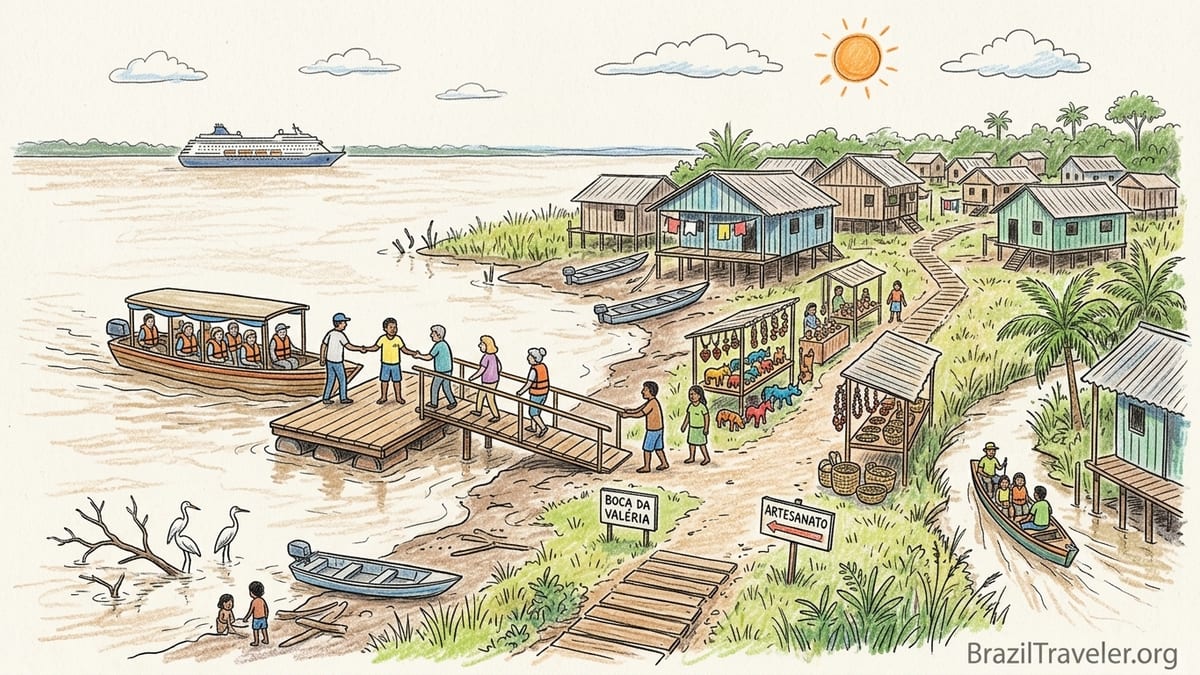
Accessibility at the landing varies with the river. In our case the tenders tied to a floating wooden platform positioned a short distance off the riverbank. From there, a plank and basic handrail led onto soft, damp ground. The surface was uneven, muddy in places and not ideal for anyone with limited mobility, although crew and villagers offered a steadying hand. I saw a small wheelchair successfully brought ashore, but the guest relied on two companions and a crew member to manage the ramp and the ruts.
Our ship carried just over 1,200 passengers; by my count, taken from tender tickets and a chat with shore staff, roughly 500 to 600 went ashore at some point during the call. Tenders ran in a continuous loop, every 15 to 20 minutes at peak times, but there was a clear early‑morning rush followed by a lull before the last hour, when crew began reminding everyone that the last tender back would leave at noon.
Walking the Village: Paths, Houses and River Life
Boca da Valéria is not a purpose‑built tourist village. It is a small Amazonian riverside settlement that has adapted to cruise visits. Official Brazilian tourism documents list it as a stop in the Amazonas state cruise corridor, but the onshore reality is spare: a single main path parallel to the water, short spurs leading to houses and the interior, and a modest community building set back from the river.
From the tender platform, I stepped onto a sandy‑muddy clearing backed by a few open‑sided stalls made from rough timber and corrugated roofing. Behind them, the land rose only slightly before dissolving into tall grass and low jungle. The main path into the village was a packed‑earth trail, occasionally reinforced with wooden planks, with simple wooden houses on stilts to either side. Most homes were one or two rooms, unpainted or washed in faded blues and greens, with laundry strung under the eaves and small aluminum boats pulled up on the mud below.
With the ship in, the village was busy. Adults and teenagers had set up tables displaying carved wooden animals, seed necklaces, woven baskets and small paintings. Prices were often written in marker on scraps of cardboard: 20 to 30 Brazilian reais for a small carving, 10 to 15 reais for bracelets, and up to 80 or 100 reais for larger decorative pieces. Many sellers accepted small U.S. dollar bills and did the conversion on the spot, usually rounding in the visitor’s favor but not always. I chose to carry Brazilian reais, which made each interaction feel more like buying in any local market rather than a cruise‑ship sideshow.
A few minutes’ walk from the landing, where the path narrowed and the crowd of passengers thinned, daily life came more clearly into focus. Women rinsed clothes at the riverbank or in plastic basins under raised houses, men repaired outboard motors or sorted through coiled fishing lines, and older children ferried water in large containers. Before raising my camera, I asked permission either verbally in simple Portuguese or with a questioning gesture. When someone declined, I lowered the camera and moved on. In one case, a woman washing clothes smiled but shook her head firmly, and that was the end of it.
Expectations vs Reality: Beyond the Cruise Brochure
The language used by several cruise lines to promote Boca da Valéria is strikingly similar: an untouched village, a chance to meet “real Amazon people,” and a “window onto traditional river life.” Some brochures describe scenes of children in colorful local dress and casual meetings with families under the trees. They suggest a quiet, contemplative stop between the more developed ports of Santarém and Parintins, where visitors stroll unhurriedly through a timeless community.
The reality felt more complicated. Boca da Valéria today exists in a kind of partnership with cruise tourism. On ship days, people arrive from neighboring settlements by wooden boat. Some bring handicrafts, some dress in elaborate feathered costumes, and some accompany children who carry animals or wear face paint. Cruise visitors, primed by brochure language, may step ashore expecting spontaneous cultural encounters, but what they often find is a semi‑organized marketplace responding very directly to the presence of hundreds of foreigners with cameras and cash.
I spoke briefly with a middle‑aged man who introduced himself as João and said he lived up the Valéria River, about an hour away by small motorboat. He came down with his wife and teenage daughter to sell bracelets and to arrange canoe trips. In his words, translated through a ship’s Brazilian crew member, “On days with a ship we can make in a morning what in fishing might take a week.” It was an honest statement about economic opportunity, but it also highlighted that the day we visited was not a typical village morning. Many adults were clearly focused on tourism, and local children seemed to have time off school when ships arrived.
Compared with a port like Santarém, which has a working commercial waterfront, roads, and independent tour operators, Boca da Valéria is informal and unregulated. There are no official tour kiosks or licensed guide offices. Visitors used to structured shore excursions with vetted local partners may find the scene confusing. The key difference from the brochures is that this is not a curated museum of Amazon life. It is a working community that switches, for a few hours, into a cruise‑day economy.
Canoe Excursions: Guides, Prices, Safety and Scenery
One of the main activities advertised in pre‑cruise materials and on board is a short canoe trip on the Valéria Channel. Cruise lines often do not sell these trips directly. Instead, they note that “local boats may be available for independent hire” and stress that such arrangements are at the traveler’s own risk. Once ashore, I found exactly that. A cluster of wooden motorized canoes lined the smaller channel just beyond the main landing, each with a driver calling out short offers in Portuguese or basic English.
Prices were surprisingly consistent. Most boatmen quoted 5 U.S. dollars or 25 to 30 Brazilian reais per person for a 25 to 30 minute ride, with a minimum of four passengers. One group negotiated a slightly longer trip of 45 minutes for 10 U.S. dollars each, but generally, bargaining was limited by the short call and the fact that new groups of passengers kept arriving. I joined a mixed group of eight, paying 30 reais in cash and confirming the length of the trip and where we would go before stepping into the boat.
Safety standards were basic. The boat itself was a long wooden canoe with a small roofed section and an outboard motor. Life jackets were available, stacked under the roof, but some were clearly well used and mismatched. Our boat had enough jackets for everyone, and the driver encouraged us to wear them, although not everyone did. I chose to wear mine the entire time and would advise others to do the same. I did not see any formal inspections or official harbor authority presence during boarding.
The route, however, was quietly beautiful. Once we left the busy landing, the canoe turned into a narrower side channel lined with dense, bright green vegetation and scattered palm trees. We passed a few smaller houses on stilts, chickens scratching in their shade, and family boats tied to simple wooden posts. Kingfishers flashed blue over the water, and we spotted a couple of egrets wading near submerged branches. The driver cut the engine a few times to let us listen to birdsong and the soft slap of water against the hull. It was not a wildlife safari, and we did not penetrate deep into the flooded forest, but it was a calm, scenic slice of river life that felt more authentic than the hectic scene back at the landing.
What the canoe ride was not, on our visit, was a set of staged encounters. We did not stop so that children could climb aboard for photos, and we did not visit a mock “traditional house” built solely for tourists. That said, fellow passengers who had taken earlier boats reported that some operators slowed deliberately near children on banks or near villagers holding animals, clearly anticipating tips if photos were taken. Choosing a driver who focuses on scenery rather than photo setups is one way to steer your money toward quieter, more respectful tourism.
Photos, Wildlife and Ethical Dilemmas
Even before reaching the village, I had read first‑hand accounts describing children at Boca da Valéria holding baby sloths, small caimans and parrots in exchange for a dollar or two per photo. That practice was still very much present during our call. Within minutes of stepping off the tender I saw several young children, some no more than five or six years old, carrying animals in their arms or on their shoulders. Adults stood nearby, often just out of frame, watching the interactions.
I chose not to pay for or photograph any of these scenes. Separating a wild animal, particularly a young sloth, from its habitat for hours so that it can be passed from person to person is difficult to reconcile with responsible wildlife tourism. There is also the longer‑term incentive structure: as long as visitors pay for those photos, there is strong motivation for families to continue capturing and displaying animals. One Brazilian crew member later told me that cruise staff have repeatedly asked passengers not to encourage the practice, and some lines now include short reminders in their daily programs.
Photography of children created another ethical challenge. Many cruise brochures and social media posts feature close‑up shots of children from Boca da Valéria in face paint or traditional dress, often unnamed and presented primarily as colorful local detail. On the ground, I made a simple rule: I would not photograph children unless a parent or guardian clearly gave consent, and I would not exchange money for a child’s likeness. This meant missing some images that might have looked striking, but it also helped me avoid turning residents into photo props.
Over the course of the morning I saw some passengers slipping U.S. dollars directly into children’s hands for photos and then moving off quickly, as well as others attempting to negotiate the price of a picture. The mood among the children was a mix of excitement and calculation; they understood perfectly that each visiting ship brought an opportunity. If you do carry a camera ashore, it is worth deciding your own ethical boundaries in advance instead of making split‑second decisions in front of a hopeful child with an animal in their arms.
Money, Facilities and How the Visit Felt
In total, I spent the equivalent of about 170 Brazilian reais during my visit. Of that, 30 reais went to the canoe trip, 100 reais to handicrafts from three different stalls, and 40 reais to small donations at the community building and church. I did not buy any drinks or snacks ashore, choosing instead to follow advice from crew and official guidance that recommended eating and drinking on board unless food and water were clearly provided through a trusted arrangement.
Facilities in the village were minimal. There were basic toilets inside the community building near the main path, with a nominal charge of a few reais to help with cleaning and supplies. There was no formal medical post visible, no café or restaurant, and no reliable mobile data signal for most foreign phones, although some Brazilian crew reported patchy coverage. If you have mobility issues, need air‑conditioned spaces or depend on strong connectivity, Boca da Valéria will feel far more rustic than ports like Santarém, which has paved streets, shops and waterfront bars.
Did I feel welcome? On balance, yes, within the framework of a community used to hosting cruise passengers. Most interactions were warm and straightforward. Vendors accepted a polite “no, thank you” without pressure. Several people were willing to chat briefly about their lives in Portuguese, and a few teenagers, clearly eager to practice English, asked where I was from and what the ship was like inside. At the same time, there was no mistaking that our presence transformed the village into a temporary marketplace. We were guests, but also an economic event.
I left the village with mixed feelings. The short canoe ride and the quiet stretches of path away from the landing offered meaningful glimpses of river life. The sight of very young children handling wild animals for money, and the occasional passenger treating villagers like living exhibits, made me uncomfortable. That tension is at the heart of Boca da Valéria as a cruise stop: it offers access to a small Amazon community, but the form that access has taken raises questions about where the line lies between visit and intrusion.
Stay on Board or Go Ashore: Weighing the Options
Because Boca da Valéria is a tender port with a short call, staying aboard is a practical and, for some travelers, a responsible option. The Amazon itself is constantly in motion, and scenic cruising around the time of a village call can be surprisingly rich. From the open decks I saw floating islands of vegetation drift past, watched local ferries packed with hammocks move along the shipping channel, and listened to the low rumble of rainstorms sliding across the forest in the distance.
If the idea of walking into a small community that receives only a handful of ship calls each year makes you uneasy, you can choose to experience this part of the river from the ship without guilt. The cruise line still pays port fees and local arrangements for the call; your personal choice not to disembark does not cancel the economic benefit of the ship’s presence, although it does redirect your individual spending back on board rather than into village stalls and boat operators’ pockets.
For those who do go ashore, planning helps. Wear shoes you do not mind getting muddy, carry small denomination reais or U.S. dollars for crafts and canoe rides, and decide in advance how you will respond to requests for paid photos and animal encounters. Consider setting a personal spending plan that prioritizes handicrafts clearly made by adults and services like canoe trips that do not involve wildlife handling.
Compared with developed Amazon stops such as Santarém or festival‑famous Parintins, Boca da Valéria offers almost no infrastructure. There are no dockside tour desks, no city walks, and no museums. That simplicity can be refreshing if you have already experienced busier ports earlier in the itinerary. It can also feel limiting, especially for families who prefer structured activities or travelers who need clearer guardrails around what is and is not appropriate.
How Boca da Valéria Compares to Other Amazon Cruise Stops
To place Boca da Valéria in context, it helps to look at how it differs from larger Amazon ports on the same itineraries. In Santarém, ships usually dock or tender to an established commercial port. From there, passengers can choose ship‑run excursions into the Tapajós region, visit the bustling fish market, or simply walk along urban streets with shops, banks and restaurants. The interaction with local life is more diffuse and less centered on individual families or children.
Parintins, reached later on many cruises, is best known for its Boi Bumbá festival, a major regional event that has generated an entire cultural industry. Even outside festival dates, excursions often focus on staged performances at the purpose‑built Bumbódromo stadium or on folkloric shows designed specifically for visitors. There is still a strong cultural element, but the infrastructure is larger scale and the economic benefits, while not evenly distributed, spread through a more complex local ecosystem of performers, costume makers and service workers.
Boca da Valéria, by contrast, is small enough that a single ship call is immediately visible everywhere you look. There is no anonymity as you walk the main path, no way to simply blend into a crowd. You are face‑to‑face with the individuals whose economic prospects are tied, in part, to how visitors behave on the day your ship arrives. That intimacy can be powerful. It can also magnify any discomfort you feel about the dynamics of tourism, especially when it involves children and wildlife.
In that sense, Boca da Valéria is not an easy port to categorize. It is neither the heavily staged folkloric experience of some festival towns nor the entirely unscripted wander of a larger working city. Instead, it sits somewhere in between, a living village that has learned to perform certain aspects of its identity on ship days. Understanding that nuance before you disembark can help you respond with more empathy and care once you are ashore.
Conclusion: Promise vs Reality and Whether I Would Go Again
The cruise line’s description of Boca da Valéria promised an intimate window into traditional Amazon river life. It spoke of a small village where time seemed to slow, of opportunities to meet local families and see how they lived along one of the world’s great rivers. The accompanying images showed children smiling by wooden boats, church spires against a backdrop of forest and sky, and narrow channels framed by lush greenery.
The village I actually visited was both more complex and less romantic than the brochure. Yes, I walked muddy paths between stilt houses, watched laundry drip from lines strung under eaves, and glided along a narrow waterway where birds flashed between low branches. I also saw a place that reorganizes itself around arriving ships, with children carrying animals for cash, adults dressing in costume with the clear expectation of payment for photos, and an economy that compresses much of its tourism income into a few hours whenever the anchor drops offshore.
In terms of spending, I left about 170 reais in the village, which at the time of my visit translated to a modest but not insignificant contribution to several households and the community fund. The money that felt most meaningful was what I spent on handicrafts and the canoe ride, because those transactions were tied to skills and services rather than to the display of children or captured wildlife. The few reais I left as donations at communal spaces also felt appropriate, acknowledging shared facilities rather than any one individual.
What made me uncomfortable was the way some interactions seemed to turn people, especially children, into attractions. Watching a toddler clutching a lethargic baby sloth while adults encouraged passing tourists to take photos was a moment I kept coming back to after we sailed. I also found it disquieting to hear fellow passengers discuss the village primarily in terms of how “authentic” it looked in their photographs, rather than what they had learned about life along the river.
Would I disembark again? I would, but with conditions. If the daily program and on‑board briefings made clear efforts to discourage wildlife photos and explained how to interact respectfully with residents, I would go ashore again to walk the quieter paths, support artisans and perhaps take another canoe ride focused on scenery. If, instead, the tone on board framed Boca da Valéria as little more than a photo opportunity filled with cute children and exotic animals, I might choose to remain on deck and watch the river instead, allowing my personal spending to stay aligned with my values.
The Takeaway
Boca da Valéria is not a must‑see Amazon port in the conventional sense. There are no headline attractions, no museums or grand cathedrals, and no long list of shore excursions. Its power lies in its scale. You can see, in a morning, how a small riverside community has woven cruise tourism into its fabric, for better and for worse.
For cruise passengers, the decision to go ashore should rest less on fear of missing out and more on a clear‑eyed look at what the visit entails. Expect heat, mud, simple facilities and unscripted encounters. Be prepared to say no to some offers and yes to others in ways that respect both your boundaries and the dignity of the people you meet. Consider carrying local currency, setting an intentional budget, and directing your spending toward crafts, services and community spaces rather than toward interactions that depend on children or captured animals.
Families with young children may find Boca da Valéria challenging, because the ethical dilemmas are visible and immediate. Photographers will find striking scenes, but the task is to document without exploiting. Travelers interested in community tourism can use this stop as a real‑world case study in how tourism reshapes small places, listening more than they speak and remembering that a camera is not a passport to every moment.
If you approach Boca da Valéria with humility, patience and a willingness to walk past the performances toward the quieter corners of the village, the visit can offer a brief, genuine insight into life along the Amazon. If you prefer clear structure, polished infrastructure and carefully managed interactions, you may be happier watching from the rail as the village slips by, letting the river itself be your destination.
FAQ
Q1. Where exactly is Boca da Valéria on an Amazon cruise route?
Boca da Valéria is a small riverside community in the Brazilian state of Amazonas, typically visited between the larger ports of Santarém and Parintins on Amazon River itineraries.
Q2. How long do cruise ships usually stay at Boca da Valéria?
Most ocean‑going cruise ships schedule Boca da Valéria as a short half‑day call, often anchoring in the morning for roughly four to five hours, with passengers spending two to three hours ashore at most.
Q3. Is Boca da Valéria suitable for passengers with limited mobility?
Accessibility is limited. Tenders use a floating platform and a simple ramp to a muddy, uneven shoreline, and village paths are mostly packed earth with occasional wooden planks, which can be difficult for wheelchairs and walkers.
Q4. Are the local canoe excursions safe and organized?
Canoe trips are arranged informally with village boat operators. Boats are basic, life jackets are present but may be worn, and there is no visible formal regulation, so travelers should assess conditions and their comfort level before joining.
Q5. How much money should I plan to spend in Boca da Valéria?
Many visitors spend the equivalent of 100 to 200 Brazilian reais on a combination of canoe rides, small handicrafts and modest donations, paid mostly in cash and often in small denominations.
Q6. Is it acceptable to photograph children and animals in the village?
Photographing children or captive wildlife in exchange for money raises ethical concerns. A more respectful approach is to seek adult consent, avoid paying for such photos and focus instead on broader village scenes and landscapes.
Q7. What facilities are available ashore for cruise passengers?
Facilities are basic, usually limited to simple toilets near the main path and a few covered areas for shade. There are no formal restaurants, medical clinics or air‑conditioned public spaces dedicated to visitors.
Q8. Can I buy food or drink safely in Boca da Valéria?
Some residents sell drinks or snacks, but many cruise lines advise passengers to eat and drink on board, where water and food safety are controlled. Following that guidance is usually the simplest option.
Q9. Is visiting Boca da Valéria a good choice for families with children?
Families should be prepared for heat, mud and some potentially uncomfortable scenes, such as children handling wildlife for photos. The stop can spark important conversations, but it is not a conventional family attraction.
Q10. When is it more responsible to stay on the ship instead of going ashore?
If you feel uneasy about informal tourism, wildlife handling or photographing local children, choosing to remain on board and simply enjoy the Amazon scenery is a reasonable and sometimes more comfortable decision.