

I arrived in the Pantanal with romantic ideas of drifting past capybaras at sunset and waking to macaws screeching in the gallery forest. What I discovered was more complex and far more rewarding: bumpy transfers, early alarms, humming generators, very real mosquitoes, and some of the best wildlife viewing I have experienced anywhere in South America. This guide draws on nights I actually spent at Pantanal lodges and one hotel boat I personally inspected in the northern wetlands around Porto Jofre, plus researched comparisons with well regarded pousadas in the southern Pantanal. The aim is to explain what staying close to the wildlife is really like, not in brochures but on the ground, boat or boardwalk.
First Impressions: Getting Into Jaguar Country
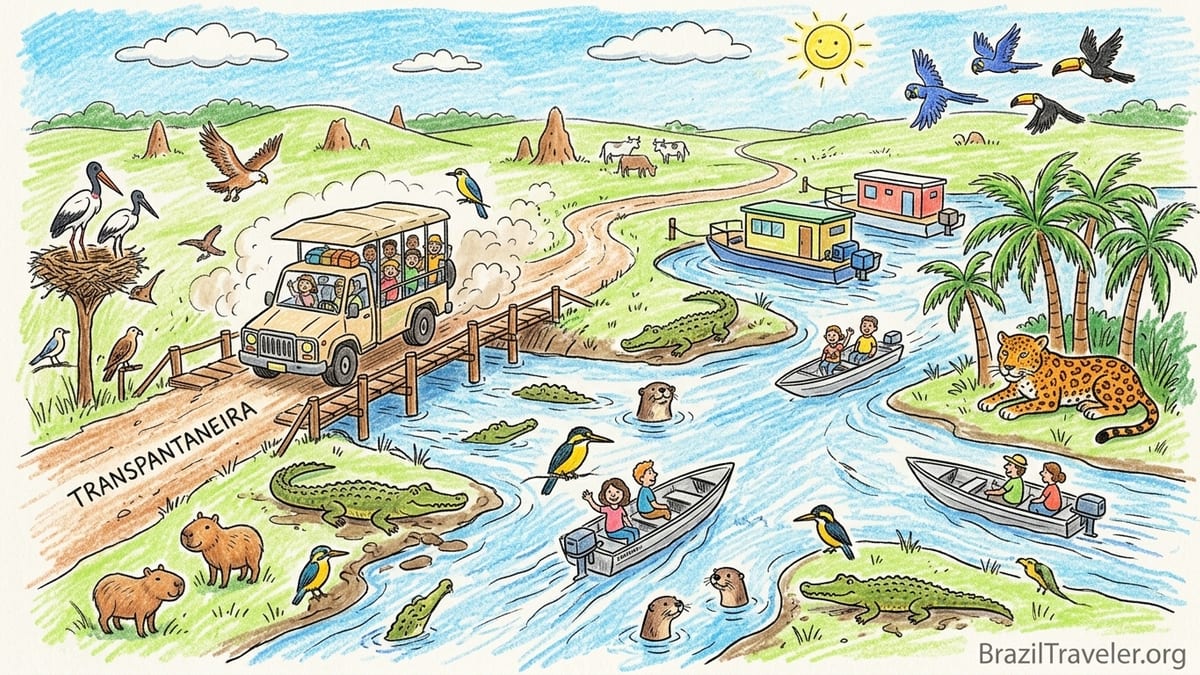
My first true sense of the Pantanal came on the long transfer from Cuiabá to Porto Jofre in northern Mato Grosso. After an hour of paved highway the road dissolved into the Transpantaneira, a 147 kilometer dirt track stitched with more than a hundred wooden bridges. In the dry season the surface is graded but still corrugated and dusty, and the drive in a 4x4 pick up or safari truck takes four to five hours with wildlife stops. I rode both in a closed air conditioned van and later in an open safari truck, trading comfort for better views of hawks, caimans and the occasional marsh deer.
Closer to Porto Jofre the landscape opened into classic Pantanal scenery: wide lagoons edged with reeds, half submerged termite mounds and cattle scattered on the horizon. Giant caimans lay on mud banks under jabiru stork nests, and capybaras splashed from the verges as we passed. The lodges near the riverfront cluster around the end of the Transpantaneira, which means hotel boats and flotel operators can collect guests by motorboat directly from small jetties. The last thirty minutes of my transfer to a floating lodge was by aluminum skiff, luggage wrapped in plastic against spray, dragonflies flicking across water already creased by hunting kingfishers.
In contrast, southern Pantanal pousadas near Miranda or Aquidauana are usually reached by shorter drives from Campo Grande on better roads, followed by a final stretch of farm track. For example, Pousada Aguapé sits about 195 kilometers from Campo Grande, with the last hour on red dirt through cattle pastures and gallery forest. Fazenda San Francisco is accessed off the BR-262 highway near Miranda and then via private ranch roads. The journeys are less rugged than the Transpantaneira but still feel like a transition from town to wetlands, with herons and caimans replacing billboards and gas stations.
Whichever region you choose, arrival is not a quick hop. For most visitors, reaching a Pantanal lodge eats a good part of the first day. Good operators factor this into their packages, starting activities with an afternoon safari or sunset boat ride on day one rather than promising a full schedule immediately on arrival.
Living on the Water: Hotel Boats and Flotels in Northern Pantanal
My first nights in jaguar country were spent on a hotel boat moored near the confluence of two rivers close to Porto Jofre. This was not a luxury cruise ship but a stationary flotel with simple, air conditioned cabins on the upper deck and a dining room and lounge below. Reaching it meant that last motorboat transfer from the Transpantaneira, which already felt like a mini safari; along the way we passed families of capybaras grazing on the riverbank and hundreds of caimans with only their eyes and nostrils above water.
Cabins on the flotel were compact, more like ship cabins than hotel rooms. Mine had two single beds, a small private bathroom with hot shower and a window just above water level. The key comfort feature, given the daytime temperatures above 30 degrees Celsius during the dry season, was reliable air conditioning that ran through the night. The hum of the generator was constant but soon faded into the background. Mosquito protection came from both the closed, cooled environment and mesh on the small window; I still used repellent at dusk and slept under a light sheet, but I did not find mosquitoes overwhelming on the water compared with some swampy forest edges inland.
Food on the boat was hearty and unpretentious: buffets of rice, beans, grilled chicken, freshwater fish like pintado, salads and a few simple desserts. Breakfast before the morning boat safaris included strong coffee, fruit, bread, scrambled eggs and tapioca pancakes. Bottled drinking water, coffee and tea were available all day. Electricity was from generators, with a brief period in mid afternoon when power was reduced for maintenance. Wi-Fi existed technically, via a river antenna and satellite backup, but signal strength varied by the hour; sending photos worked, video calls did not. For most guests this was an advantage, forcing attention back to the river that surrounded us.
From this base, wildlife excursions were almost entirely by speedboat. We left the dock around 6:15 in the morning, often in a cool mist, and returned by late morning before the heat became punishing. A second outing left after lunch and stretched until sunset. My boat carried six guests plus a pilot and a naturalist guide, which allowed everyone a clear view. Over three days I saw jaguars on the riverbank on multiple outings, including one large male patrolling a beach and a female resting in dense vines. We also watched family groups of giant otters fishing noisily, hyacinth macaws flying between palm islands, and, on one late afternoon, a tapir swimming across a side channel with just its head and shoulders above water.
On Land With the Wildlife: Porto Jofre Lodges and Ranch Pousadas
After the flotel I moved to a land based lodge near Porto Jofre to compare the experience. The lodge sat a short walk from the river and offered both boat safaris for jaguars and land safaris on the first section of the Transpantaneira. Rooms here felt more like a rural hotel than a ship cabin. My double room had tiled floors, a firm bed with simple linen, a fridge, an air conditioning unit mounted high on the wall and screened windows. Mosquito screens were intact and reasonably tight fitting, which mattered because mosquitoes and tiny sand flies were more noticeable in the garden than on the river. The bathroom had a strong hot shower and good water pressure, though plumbing noises carried between rooms at night.
Electricity was available 24 hours and strong enough to charge camera batteries, but the lodge advised guests to avoid using many high draw devices at once so as not to overload the system. Wi-Fi worked only in the restaurant and reception area and became congested when several groups tried to upload photos after dinner. During my stay there were several short dropouts, which staff attributed to regional providers rather than the lodge itself. For anyone needing to work remotely, this would not be a reliable base, but for standard travel planning and messaging it was sufficient.
From this lodge, my days followed the classic Pantanal rhythm. Wake up calls came around 5:15, with coffee and biscuits ready in the dining room before departure. Morning activities rotated between river boat trips, open vehicle safaris along the dirt road and short walks in forest patches for birding. In the late afternoon I joined one night drive that returned after 21:00. The open safari vehicle was a converted truck with bench seating and a canvas roof; it rode stiffly on the rustic bridges but offered excellent views of crab eating foxes, deer and a huge variety of birds. One of the most memorable sightings came not on the river but at dusk on the road: a giant anteater emerging from a termite mound, its long snout sweeping the soil while seriemas called in the distance.
The other kind of land based stay I experienced was a traditional Pantanal fazenda that now hosts guests in a small pousada wing. These ranch lodges, more common in the southern Pantanal but present in the north as well, mix cattle work with tourism. Rooms are usually simpler than in jaguar focused lodges, sometimes with fans rather than air conditioning, and sometimes with shared verandas where guests sit in the evenings watching toucans and aracaris in the farmyard trees. I spent a night at such a ranch south of Poconé, where ceiling fans and good mosquito nets were adequate during a shoulder season visit. The reward was the feeling of stepping into another pace of life, with horses saddled for morning rides across flooded fields and cowboys returning at dusk past the guest area.
Southern Pantanal Pousadas: Horses, Night Safaris and Ranch Life
While my own nights were concentrated in the north around Porto Jofre, I inspected and later researched extensively two of the most respected southern Pantanal properties: Pousada Aguapé near Aquidauana and Fazenda San Francisco near Miranda. Both combine working cattle operations with wildlife tourism and are often recommended in official tourism material as immersive bases for safaris, boat trips and horseback riding.
Pousada Aguapé is operated on family land that has been in the same hands for more than 150 years, set amid a mosaic of baías, small channels, gallery forest and cattle pasture along the Aquidauana River. Guest rooms are arranged around shaded courtyards with a swimming pool and hammocks. Current descriptions emphasize comfortable air conditioned rooms with private bathrooms, screened windows and verandas. Most stays are sold as full board packages including three meals and two activities per day: combinations of 4x4 safaris, horseback rides, boat trips, canoe outings and night drives. The lodge reports more than 300 bird species recorded in the area and regular sightings of capybaras, caimans, marsh deer and, on night safaris, crab eating foxes and ocelots.
Fazenda San Francisco, near the Miranda River, offers a slightly different emphasis with its long running conservation work on jaguars through the Projeto Gadonça research program. Here, irrigated rice fields sit beside wetlands and forest islands, creating habitat for a dense bird population and occasional big cats. Package structures typically range from one to four nights, with set combinations of day and night photographic safaris in open vehicles, boat trips on the river, piranha fishing, suspended walkways and horseback rides. Rooms vary from simpler ranch style units with air conditioning and private bathrooms to slightly larger family rooms. The atmosphere is more active and programmatic than at some smaller pousadas, with clear schedules posted for each group.
Southern Pantanal lodges share several practical traits that differ from the north. Many are accessible year round, although heavy rains from December to March can make access roads muddy and slow. Activities skew toward mixed habitat exploration rather than targeting one flagship species. Guests may see giant anteaters crossing open fields, rheas among cattle, and large groups of hyacinth macaws roosting in palm trees. Jaguars are present but far less predictably encountered than along the main rivers at Porto Jofre. Horse riding is also a major feature in the south. Guides saddle calm ranch horses for two to three hour rides through shallow wetlands and fields, which for many guests becomes as memorable as any boat trip.
In both regions, packages normally include all meals and activities but not alcoholic drinks. In 2026, mid range pousada packages in the southern Pantanal commonly price in the region of several hundred US dollars per person per night, including transfers from Campo Grande on fixed schedules. Exact figures vary by season and room category, and potential guests should request up to date quotes directly from the lodges or specialist operators rather than relying on older online references.
Comfort, Mosquitoes and Heat: What Rooms Really Feel Like
Across the Pantanal, room comfort has improved noticeably over the last decade, but expectations still need to match location. In the north, lodges and flotels that focus on jaguar tourism around Porto Jofre now almost always offer air conditioning, private hot showers and some form of internet connection. During my stays I found mattresses firm but comfortable, water pressure better than I expected in such remote settings and air conditioning strong enough to cool rooms even in late afternoon. That said, power cuts, though rare, did occur for short periods, during which ceiling fans and open windows became essential.
In more rustic ranch pousadas, particularly those on working cattle farms, simple is the norm. Fans may replace air conditioning in some rooms. At one ranch where I stayed, my room had a ceiling fan and a large screened window, plus a mosquito net draped from a central hook. The netting was intact and generously sized, which made a big difference on a humid October night when insects were abundant. Exposed wiring in bathrooms, improvised repairs to older air conditioning units and occasional weak plumbing are not unheard of in older properties, and travelers should arrive with some tolerance for these quirks.
Mosquito presence varies strongly by season and by micro habitat. On open river channels in the middle of the dry season I encountered very few biting insects, even at sunset. In contrast, near still backwaters and in shady forest around ranches, mosquitoes and no see ums were active at dawn and dusk. Lodges usually provide mesh on windows and sometimes burn coils under dining room decks, but personal protection is still essential. I used long sleeves, light trousers and repellent daily, and I recommend guests bring their preferred brand as choices in Cuiabá or Campo Grande shops are limited.
Most lodges now provide 24 hour electricity from a mix of on grid connections and generators. Guests should expect occasional hum from machinery and possibly diesel smells downwind of generator sheds. Water in bathrooms is usually safe for washing but not for drinking, so lodges provide filtered or bottled water stations. Some eco focused operators have eliminated single use plastic bottles by offering refill points and asking guests to bring reusable bottles from home.
Guides, Vehicles and What You Actually See
Guide quality and group size are as important as lodge comfort in shaping a Pantanal stay. On the flotel, my boat was led by a local pilot who had grown up fishing these rivers and a bilingual naturalist trained in Cuiabá. The guide to guest ratio on my departures was one guide to six guests, which allowed time to position the boat for photographers and explain animal behavior. In Porto Jofre, there is a robust informal network of radio calls among boats. When one spots a jaguar, others converge. This increases sighting chances but can lead to crowded scenes, with a dozen or more boats idling near a single cat. On my most intense encounter I counted over twenty vessels around a beach where a male jaguar slept, and the feeling was more like a floating grandstand than a solitary wilderness experience.
At quieter times, especially in shoulder months or on longer excursions up side channels, sightings felt more intimate. On one morning we followed fresh tracks along a slender creek and eventually saw a female jaguar step lightly across a fallen log before vanishing into vegetation. Only two other boats were present, and our guide cut the engine so we drifted in silence. On the same outing we watched a family of giant otters hunt, passing fish from adult to cubs and yelping continuously. Caimans were constant companions, sometimes with their jaws open to regulate temperature, and capybaras grazed on almost every sandbank, occasionally sliding into the water with a synchronized splash.
On land based safaris, open vehicles and tractors with adapted seating are standard. In southern Pantanal fazendas, a daylight drive may reveal rheas striding through pastures, crab eating foxes trotting along tracks and giant anteaters or armadillos near termite mounds. On one night drive at a northern ranch I saw a pair of ocelots briefly hunting near a pond, illuminated only by a filtered spotlight carefully kept away from their eyes. Birdlife is spectacular in both regions, from blue and yellow macaws and toucans to large flocks of ibises and spoonbills feeding in shallow water.
Horse riding excursions deserve special mention. On the ranch where I rode, horses were calm and used to inexperienced riders. Rides followed shallow flooded fields, with water up to the stirrups, and crossed small wooden bridges. From the saddle I saw a giant anteater at relatively close range and watched a line of caimans in a distant drainage channel. Helmets were available on request but not always insisted upon, so safety minded travelers should ask specifically and check fit before setting out.
Packages, Seasons, Prices and Conservation
Most Pantanal lodges and hotel boats sell their stays as packages rather than simple bed and breakfast nights. A typical northern Pantanal jaguar focused package might include three nights at a Porto Jofre lodge or flotel with three meals a day, two daily boat safaris, park fees and shared transfers from Cuiabá, with prices often running to several hundred US dollars per person per night depending on the operator, month and room category. Some higher end offerings that combine multiple lodges and private guiding can approach or exceed low four figure sums per person for a four night stay. Potential visitors in 2026 should request detailed, updated price lists because fuel costs, conservation fees and currency shifts have pushed rates up in recent seasons.
In the southern Pantanal, pousadas such as Pousada Aguapé and Fazenda San Francisco structure packages around two to four nights with full board and two activities per day. Transfers from Campo Grande or Bonito can be included or quoted separately. Rates again fall in the mid to upper range of Brazilian rural tourism, reflecting the inclusion of guided safaris, boat trips and horseback riding. Budget conscious travelers can sometimes reduce costs by choosing simpler room categories, traveling in the green season or arranging their own rental car for access when roads are dry, but this requires both Portuguese and a tolerance for self navigation on unpaved roads.
Seasonality is crucial. The classic dry season from roughly July to October brings lower water levels, concentrated wildlife and the highest jaguar sighting probabilities along the rivers. It is also the most expensive and crowded time, with boats sometimes queuing for cats. Shoulder months like May, June and November can offer good experiences with fewer visitors, though afternoon storms become more common later in the year. The wettest months from December to March transform much of the landscape into a shallow inland sea. Some lodges close or reduce operations in this period, while others remain open for birdwatching and fishing. Road access can be slow or temporarily cut, so flexible schedules and patience are essential.
Conservation practices vary by lodge. Some ranches participate in formal research projects on jaguars and giant anteaters, fitting animals with GPS collars and monitoring movements while compensating ranchers for livestock losses. Others focus on habitat preservation through cattle management that leaves key wetlands intact and by maintaining nest trees for macaws and other cavity nesters. Many lodges now promote low waste policies, such as minimizing plastic packaging and using solar heating for water where practical. From a traveler perspective, choosing operators that actively support conservation and employ local staff is one of the most direct ways to help sustain both wildlife and communities in the Pantanal.
Northern vs Southern Pantanal: How Location Shapes Your Stay
Having slept on a hotel boat and in land lodges in the north, and having walked through and researched several southern pousadas, I would summarize the experiences as complementary rather than competing. The northern Pantanal around Porto Jofre is fundamentally a river based jaguar destination. Your days revolve around boat departures, river channels and radio calls as guides search for big cats along the banks. The density of jaguar sightings in the right season is among the highest anywhere in the species’ range, and it is here that I personally watched multiple individual cats over successive days, as well as numerous giant otter families and constant caimans and capybaras.
However, this focus comes with trade offs. Time on land is relatively limited beyond the drives along the Transpantaneira, and the atmosphere can feel intensely geared toward photographers and big sightings. You spend many hours seated in motorboats under strong sun, with relatively little walking. Nights are often quiet at the lodges once dinner is over, and aside from occasional short walks or night drives there is less variety of activity compared with some southern ranch stays.
The southern Pantanal, by contrast, offers a broader mix of habitats and activities centered on ranch life. Visitors ride horses across wet meadows, join 4x4 drives through forest patches and rice fields, paddle canoes on small lakes and watch cowboys at work with cattle. Wildlife is abundant but spread out: countless birds, marsh deer, foxes, anteaters and, with some luck, maned wolves or ocelots on night drives. Jaguars are more elusive and should be considered a bonus rather than a guarantee. For families or travelers who value varied experiences over a single target species, the south can feel more relaxed and diverse.
Logistics also differ. Northern trips usually begin and end in Cuiabá, involving several hours on the Transpantaneira and often a combination of lodges that move guests progressively deeper toward the rivers. Southern itineraries connect more naturally with Bonito, Campo Grande and sometimes the Paraguay River, and can be chained with snorkeling, caves and waterfalls. In both cases, lodge location determines how long each daily excursion takes; a flotel moored inside a key jaguar hunting area means shorter boat rides to prime zones, while a pousada set near varied habitats may require longer vehicle drives but offer richer wildlife right around the buildings.
The Takeaway
Staying close to wildlife in the Pantanal is as much about managing expectations as it is about choosing the right lodge. You will wake before dawn, share dusty or bumpy transfers, and sometimes sweat through power cuts. Mosquitoes and heat are realities, as are generator noise and patchy Wi-Fi. At the same time, the rewards are immense: watching a jaguar pad along a riverbank, giant otters porpoising in muddy water, or a giant anteater crossing an open field while hyacinth macaws wheel overhead. These are not distant specks on a far ridge but often close, prolonged encounters from boats and open vehicles.
From my own nights on a hotel boat in northern Mato Grosso and at land lodges near Porto Jofre, I can say that the combination of solid basic comfort and extraordinary access to wildlife is rare. When I add the grounded, working ranch feel of southern Pantanal pousadas I inspected and researched, the picture rounds out into an ecosystem where tourism, cattle and conservation are in delicate negotiation. Choosing between north and south is less about right and wrong and more about whether you want your days shaped by boat engines on big rivers or horse hooves on flooded pastures.
For would be visitors, the most useful steps are to read recent, detailed trip reports, ask lodges directly about guide ratios, vehicle types and what is realistically seen in the month you plan to travel, and to budget for a properly immersive stay rather than a rushed overnight. The Pantanal rewards those who give it time. Settle into the rhythm of early alarms and long afternoons, listen to the frogs and night jars outside your room, and accept that dust on your clothes and a faint smell of river mud on your shoes are part of the experience. In return, you will gain not only photographs of iconic animals but a felt sense of one of the richest wetlands on the planet.
FAQ
Q1. Is it better to stay on a hotel boat or a land lodge in the Pantanal?
Both have advantages. Hotel boats in the north keep you close to prime jaguar channels, reducing boat commute times, while land lodges offer more space, gardens to walk in and easier access to land based safaris. If jaguars are your main goal and you are visiting in the dry season, a flotel or riverside lodge near Porto Jofre is very effective. For a broader mix of activities, including horseback riding and ranch life, a land based pousada, especially in the southern Pantanal, is often the better choice.
Q2. How many days should I spend at a Pantanal lodge?
A practical minimum is three nights, which gives you four to six full safari outings. For focused jaguar trips, many travelers choose four or five nights split between a Transpantaneira lodge and a riverside flotel. In the south, where activities are more varied and wildlife is less concentrated, four nights at a single ranch pousada such as those near Miranda or Aquidauana allows time for river trips, horse riding, 4x4 safaris and some unstructured relaxation.
Q3. How bad are mosquitoes and other insects?
Insects are part of the experience but not usually overwhelming if you prepare. On open rivers in the heart of the dry season I encountered relatively few mosquitoes, while forested and swampy areas around ranches had more activity at dawn and dusk, including tiny biting midges. Long sleeves, trousers, good repellent and intact window screens or nets are normally enough. If you are very sensitive to bites, consider choosing a lodge with air conditioning and sealed rooms rather than relying on fans and open windows.
Q4. What kind of wildlife can I realistically expect to see?
In northern river based lodges during the dry season, repeat jaguar sightings, giant otters, caimans, capybaras, many waterbirds and macaws are very likely. On land safaris you may see giant anteaters, deer, foxes and numerous birds. In the southern Pantanal, giant anteaters, marsh deer, rheas, caimans and a wide range of birds are common, with maned wolves and ocelots occasionally observed on night drives. Jaguars are present in both regions but are far more predictably encountered from boats near Porto Jofre than on southern ranch properties.
Q5. Are Pantanal lodge packages all inclusive?
Most Pantanal stays are sold as full board packages that include accommodation, three daily meals and a set number of guided activities such as boat trips, 4x4 safaris and horseback rides. Shared transfers from gateway cities like Cuiabá or Campo Grande may be included or offered at extra cost, depending on the lodge and package. Park entrance fees and basic non alcoholic drinks are often covered, while alcoholic beverages, premium soft drinks and optional private safaris are usually charged separately.
Q6. When is the best time of year to visit the Pantanal?
The prime wildlife viewing season runs roughly from July to October, when water levels are lower, animals concentrate along rivers and roads are usually passable. This is also the period with the highest prices and most visitors. May, June and November can offer very good experiences with fewer boats and vehicles, though rain and heat increase later in the year. The wettest months from December to March bring lush landscapes and excellent birding but more challenging road conditions and, for jaguar seekers, less predictable sightings.
Q7. Do Pantanal lodges have reliable electricity and Wi-Fi?
Most established lodges and flotels now offer 24 hour electricity from generators or local grids, sufficient for lighting, air conditioning and charging electronics. Short power interruptions are still possible, especially in storms. Wi-Fi is common in communal areas, but speeds are modest and connections can fail when many guests log on at once or during regional outages. It is generally fine for messaging and light browsing but not for heavy remote work or large file transfers. Treat connectivity as a bonus rather than a guarantee.
Q8. How physically demanding are the activities?
For most reasonably fit travelers, Pantanal activities are not especially strenuous. Boat safaris involve sitting for several hours, occasionally in strong sun, while land safaris use vehicles with low steps. Short walks on flat trails may be offered for birding. Horseback rides can be tailored to beginners, usually at a walking pace across open fields or shallow wetlands. The main challenges are early starts, heat, and sometimes bumpy transfers on dirt roads and wooden bridges. Those with back problems or mobility issues should discuss vehicle types and step heights with operators in advance.
Q9. Can I visit the Pantanal independently or do I need a tour operator?
Independent travel is possible but logistically complex. Public transport into core wildlife areas is limited, and many lodges are only reachable by prearranged 4x4 or boat transfers. Few properties accept walk in guests. In the north, most visitors book packages through lodges or specialist agencies that include transfers along the Transpantaneira and boat safaris. In the south, self drive with a rental car can work in the dry season to reach some ranch pousadas, but reservations and clear arrival instructions are still essential. For most travelers, a package arranged directly with a lodge or reputable operator is the smoothest option.
Q10. How can I choose a lodge that supports conservation and local communities?
Look for lodges that highlight concrete conservation actions, such as participation in jaguar or anteater research projects, habitat restoration or nest protection for macaws, and that employ and train staff from nearby towns and ranches. Ask specific questions about group sizes on safaris, adherence to distance guidelines around wildlife and how the lodge handles waste and water use. Reading recent trip reports and independent reviews can reveal whether practices match promises. By directing your booking to operators with clear conservation commitments, you help ensure that your stay contributes positively to the Pantanal’s long term health.