


I arrived in Goiás expecting a classic water-park getaway. Instead, several days split between Rio Quente and Caldas Novas turned into a lesson in how thermal water shapes an entire destination. Both towns are fed by the same geothermal aquifer, yet the experience of sleeping steps from the Rio Quente springs inside an integrated resort feels very different from staying in Caldas Novas, where hot-water pools are scattered among city blocks, independent restaurants and late-night clubs. What follows is not a catalog of every slide and every hotel, but what it actually felt like to move between rooms, pools and parks in two of Brazil’s most famous hot-spring hubs in 2026.
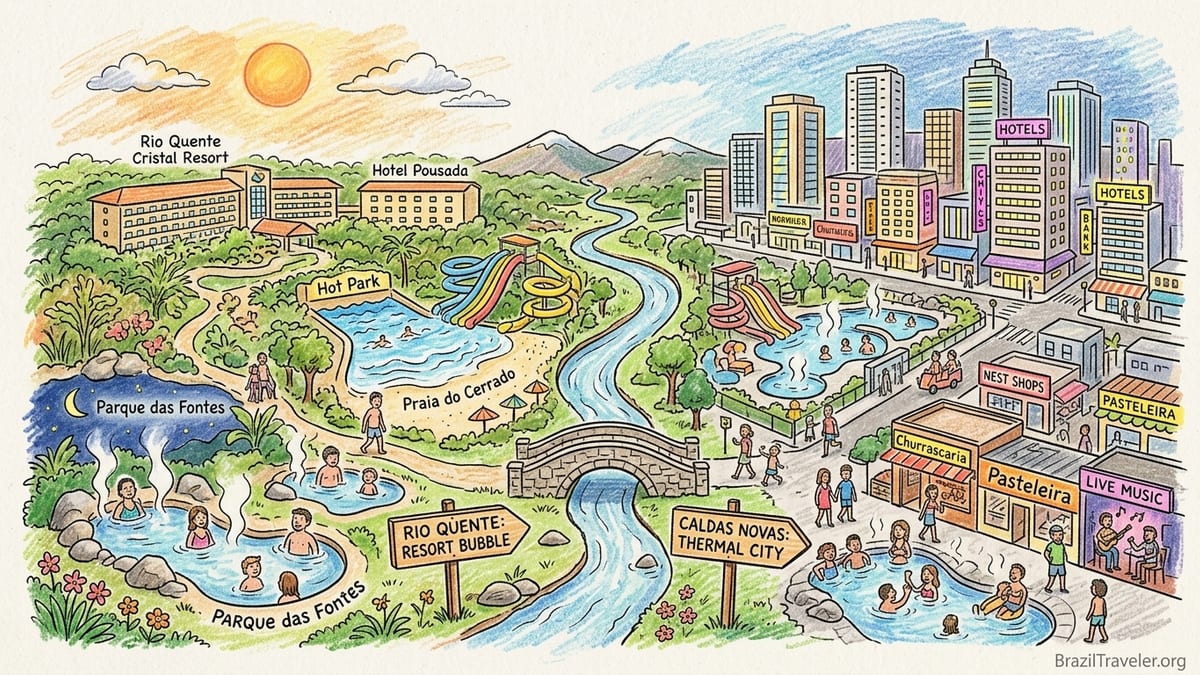
Rio Quente: Living Inside the Thermal-Water Bubble
Rio Quente today is essentially a purpose-built resort town, and most visitors never step far beyond the gates of the complex run under the Aviva brand. I based myself at the Rio Quente Cristal Resort, one of the flagship properties with direct access to the Hot Park water park and the thermal Parque das Fontes area reserved for resort guests. The resort sits a short internal shuttle ride from the main entrance, but the daily rhythm is defined less by buses and more by the flow between your room and the hot pools that run almost 24 hours a day.
The standard apartment where I stayed was modern and bright, with cool tiled floors, a balcony facing the pool area and a bathroom designed for frequent swims. The drying rack on the balcony and powerful showerhead were not decoration. I used them two or three times a day after moving between chlorinated slides at Hot Park and the softer, mineral-smelling waters at Parque das Fontes. Nighttime temperatures in the room stayed comfortable with quiet air-conditioning, important after long hours in hot water.
What defined Rio Quente for me was the walk from the Cristal pool deck down into Parque das Fontes. The water here rises naturally warm from underground, generally in the mid 30s Celsius, warm enough that you feel enveloped but not exhausted. In the early evening I would move between shallow, almost-bathing pools and deeper natural-looking basins. Children tended to stay in the shallower upper pools and at the edges where the current was gentler, while adults gathered closer to the waterfall sections and the hotter spots near the spring outlets.
Because the complex is designed as a bubble, almost everything I did in Rio Quente was on foot. From my room at Cristal to the Parque das Fontes entrance was roughly a ten-minute walk at a slow pace, through landscaped paths that cross other hotels such as Hotel Pousada and Hotel Turismo. To reach the main entrance of Hot Park, I needed another five to eight minutes, depending on crowd levels on the internal paths during school holidays. That walking became part of the pleasure, cooling down in the night air between hot immersions.
Inside Hot Park and Parque das Fontes: How We Actually Used the Pools
Hot Park is marketed as a day-long destination, and it can be, but my days there as a resort guest followed a pattern. I rarely arrived at opening time. Instead, I entered after breakfast when the sun had already warmed the air. The first hours were always devoted to slides and the wave pool, in water that felt closer to a regular heated resort pool than to a genuine hot spring. On a late September weekday in 2026, entry for day visitors purchased through Brazilian tour operators could run from a bit under two hundred to around three hundred reais per adult, depending on promotions and whether food vouchers were included. As a guest on a resort package, I had unlimited entry folded into my rate, which changed how I approached the park.
I spent more time than expected at Praia do Cerrado, the large artificial beach inside Hot Park. Here, the water is warm but not overwhelmingly hot, and the wide shallows made it a natural base for families. I watched parents set up camp on loungers while children played in the gentle surf, returning occasionally for drinks from the nearby kiosks. For my own routine, I used Praia do Cerrado as a transition space, cooling off between more intense thermal dips at Parque das Fontes later in the day.
Parque das Fontes was where the real hot-spring experience lived. The pools here run close to body temperature and sometimes a few degrees warmer. Late at night, with steam rising into the dark sky and the cerrado vegetation as a backdrop, you can sit almost motionless with the sound of flowing water drowning out the music from the main resort bars. During my stay, I noticed that many families with small children did their longest sessions here just after sunset, when the daytime heat had dropped but it was still early enough for younger kids to stay awake. Teenagers and adults came later, often drifting from pool to pool until close to midnight.
I also learned the value of alternating hot soaks with short walks. A typical evening saw me spend fifteen to twenty minutes in one of the hotter basins, step out to sit on a cooler stone bench or walk a circuit of the paths, then slide back into another pool. This pattern seemed common among experienced Brazilian visitors, many of whom come almost every year, booking similar meal plans and room types through the same agencies. Overheating is a real risk if you treat the hot springs as a static bath rather than a sequence of shorter immersions broken by air and hydration.
Rooms, Packages and Meal Plans in Rio Quente
By September 2026, the Rio Quente complex was selling a mix of breakfast-only and half-board packages across its main hotels, including Cristal, Pousada, Turismo, Luupi and Giardino. My stay was on a half-board plan that included breakfast and dinner in the main buffet restaurant, with soft drinks at meals and extra charges for other beverages. Published package examples marketed in Brazil around the same period showed three-night stays for a couple with Hot Park access starting in the neighborhood of several thousand reais, scaling up sharply during school vacations and long weekends.
In my case, the half-board structure shaped the day. Breakfast on site was the centerpiece of the morning: long buffets with pão de queijo, tropical fruit, cakes, eggs and made-to-order tapioca. Because lunch was not included, I tended to grab something quick and relatively simple inside Hot Park, like a prato feito or a snack combo that could easily reach eighty to one hundred reais for two people with drinks. Many Brazilian families I spoke to purchased meal vouchers or prepaid packages for lunches in the park to better control that cost, something worth investigating at the time of booking because promotions change frequently.
The room itself at Cristal was designed to absorb that rhythm of eat, swim, rest, repeat. Closet space left room for drying swimwear in addition to hanging regular clothes, power outlets were plentiful for charging phones and action cameras, and the mini-fridge was large enough to hold several bottles of water and some fruit from breakfast. I saw very little of the desk; the balcony and the pools did all the work of relaxation. Noise at night was manageable on my mid-level floor; lower floors closer to the main pool bar reported more ambient sound on busy weekends.
From a walking perspective, choosing Cristal meant more time inside the core of the complex and less on resort shuttles. Families staying at Giardino, which is outside the main gate, often relied on the included transport to reach Parque das Fontes and Hot Park. That adds a layer of logistics for naps and diaper changes. When I asked parents at the Giardino pool what they would do differently, several said they would pay more to stay inside the main area next time to reduce the number of times they had to fold strollers and juggle floaties on the shuttle.
Crowds, Kids and Evenings in Rio Quente
Rio Quente is busiest when Brazilian schools are on break and during national holidays. On a late September weekday, crowds inside Hot Park were manageable. Lines for major slides ranged from ten to thirty minutes, while queues for food spiked around one in the afternoon. At Parque das Fontes in the evening, pools felt comfortably populated without becoming chaotic. I found it easy to claim a corner even at peak times, provided I arrived before nine at night.
Children’s facilities are built into almost every corner of the complex. At Hot Park, younger kids gravitated toward shallow play areas and smaller slides, often spending entire afternoons within a single zone of the park rather than attempting every attraction. At the Cristal pool, the shallow sections with small fountains and the nearby games room absorbed younger guests when parents needed a break from the thermal waters. I rarely saw families using some of the more extreme slides or activities like zip lines; those tended to draw older teenagers and adults traveling in groups of friends.
Evenings in Rio Quente strike a particular balance between relaxed and busy. Live music around the Hotel Pousada plaza drew clusters of people after dinner, and some families stayed out for the shows before heading back to their rooms. For me, the most atmospheric nights were the quietest. After nine-thirty, many younger children were in bed, and a slow procession of adults in swimsuits and hotel robes headed back to Parque das Fontes for one last soak. The combination of music drifting faintly from the bars and the sound of water in the dark made it feel more like a retreat than a theme park.
The overall impression after several nights was of a place where you can surrender to the internal schedule. The price you pay is relative isolation. Apart from a few small restaurants and stores outside the complex entrance, most guests remain fully within the resort grounds for days, seeing the same buffet options and entertainment rotation. If you want quick access to independent bars or late-night clubs, Rio Quente itself is not the right choice; you come here to stay inside the bubble and follow the water.
Caldas Novas: Thermal Water in an Urban Setting
Moving from Rio Quente to Caldas Novas is like switching from a cruise ship to a small Brazilian city that happens to be obsessed with hot water. The drive between the two takes around thirty minutes, and the landscape is defined by high-rise condo towers, mid-range hotels and water parks that market themselves as mini-resorts. Instead of one integrated complex, you find dozens of properties competing for attention with neon signs and images of steaming pools.
My base in Caldas Novas was a city hotel with its own thermal pools and access deals with a larger water park a short drive away. The room felt more like a typical Brazilian mid-range property: tile floors, simpler furnishings and a compact bathroom, but still with the small details that matter in a thermal town, such as hooks for multiple wet swimsuits and strong water pressure. Outside my window, instead of cerrado vegetation, I saw other buildings and a busy avenue lined with snack bars and pastelarias.
The greatest difference compared to Rio Quente was the proximity to independent services. Within a ten-minute walk from my hotel I could eat at a traditional churrascaria, grab a burger at a chain restaurant, buy snacks from a corner market and hear live sertanejo in a club that filled up close to midnight. Prices for a decent dinner for two without drinks in September 2026 hovered around the hundred-reais mark in several of the places I tried, climbing higher in steakhouses with rodízio service.
Caldas Novas has its own concentration of resorts and water parks, but even the larger ones feel more permeable than Rio Quente. You can leave the park in the afternoon, walk a few blocks to have coffee or ice cream in town, and return later. That makes the experience more flexible and often cheaper, because you are not locked into buying every snack and drink at resort prices.
How We Actually Used Caldas Novas Pools and Water Parks
The hot-water experience in Caldas Novas is more fragmented but no less intense. My hotel had several thermal pools of different depths and apparent temperatures, and most guests seemed to use them in short bursts between other city activities. In the early morning, before breakfast, older couples soaked quietly in the calmest basins. In the late afternoon, families returned from external parks and treated the hotel pools as an extended warm-up or cool-down before going out for dinner.
At one of the larger urban water parks I visited, the pattern resembled a blend of Rio Quente and a mainstream Brazilian beach club. There were hot pools, of course, but also cooler slides and lazy-river rides that attracted teens. I watched parents set up at a table under a sunshade with a bucket of beer while children cycled between shallow thermal pools and slides, checking in regularly. Compared to Hot Park, I saw more people using the park as a social space with music and food rather than as an attraction to systematically conquer every ride.
The temperature range in Caldas Novas pools felt similar to Rio Quente, with many basins in the warm-bath zone and some hotter pockets closer to the sources. However, because parks are not all owned by a single operator, standards vary. In one smaller park attached to a condo complex, the hottest pool was almost too warm to linger in for more than ten minutes at a time, which regulars treated as part of the appeal. They alternated it with dips in a cooler adjacent pool, much as visitors to Rio Quente alternate between Parque das Fontes and Praia do Cerrado.
One practical difference is that day-use entry to Caldas Novas water parks and clubs often comes with more nuanced pricing. Residents and guests of partner hotels may pay significantly less than outside visitors, and packages with food included are common, especially on weekends. For travelers, that means you can design your days more modularly, perhaps spending a morning in a quieter condo-style pool, an afternoon in a larger park, and the evening sampling restaurants in town without feeling you are wasting a prepaid resort day.
Breakfasts, Restaurants and Nightlife in Caldas Novas
Breakfast at my hotel in Caldas Novas followed the Brazilian formula but at a smaller scale than in Rio Quente. There were fresh fruits, breads, cakes and a few hot dishes, but the buffet line was shorter and the dining room more functional than festive. That suited the more urban feel of the stay; many guests ate quickly and then left for parks or errands rather than lingering. Because most local rates included only breakfast, I had total freedom to choose lunch and dinner around town.
Over several days I tried a mix of restaurants: a family-run goiano spot serving pequi rice and grilled meats, a popular self-service buffet where you pay by weight, and a more polished steakhouse catering to tourists. Prices varied, but it was always possible to eat well without resort-style markups. Late at night, the area around the main avenue turned into a small entertainment strip, with bars offering live music, caipirinhas and sometimes cover charges that rose on weekends.
This environment rewarded walking. On my longest evening, my smartwatch recorded almost eight kilometers as I moved between hotel, dinner, a bar with live samba and a final soak back at the hotel pools. The sidewalks were busy but manageable, and I never once needed a car for nighttime activities. In contrast, evenings in Rio Quente required much less walking distance but also gave fewer options beyond the programming curated by the resort.
For solo travelers and groups of adults who enjoy variety, Caldas Novas felt more stimulating. For families with young children, the urban setting had pluses and minuses. It was easier to find kid-friendly restaurants at reasonable prices, but it also meant more decisions and more transitions, especially if little ones were exhausted from a full day at a water park.
Integrated Resort Bubble or Urban Hot-Spring City: Which Works Better?
After dividing my time between the two hubs, I realized that the choice between Rio Quente and Caldas Novas is not about which has better water. Both draw from the same geothermal system and offer plenty of ways to soak. Instead, the decision comes down to how much you value integration and simplicity over freedom and variety.
In Rio Quente, my days were almost entirely contained within a few square kilometers. I woke up, walked to breakfast, then strolled to Hot Park or Parque das Fontes without ever thinking about transportation or meal logistics beyond my half-board plan. The children I observed tended to use the same pools and slides repeatedly, forming a kind of temporary neighborhood with other families they recognized each day. Adults rarely needed to carry wallets inside the complex, using wristbands or room charges for most purchases. For me, the integrated setup was ideal for a trip focused purely on rest and water, with minimal decision fatigue.
In Caldas Novas, I preferred the sense of being in a real town. I could try a different restaurant every night, choose between several water parks and hotel pools, and change my plans easily if the weather shifted or I wanted a quieter day. Friends traveling with older teens appreciated the nightlife and independent clubs, which did not exist in the same way inside Rio Quente. At the same time, the freedom came with more planning, more walking and more temptation to overschedule.
If pressed to choose one style for a full week, I would lean toward starting inside the Rio Quente bubble and then finishing with two or three nights in Caldas Novas. The first part of the trip would be about surrendering to the hot springs in their most curated form. The second would reintroduce the pleasures of urban Brazil, where thermal water is one element among many in a more complex tapestry of food, music and daily life.
The Takeaway
Caldas Novas and Rio Quente share a geothermal heart, but they offer very different ways of living with hot water. In Rio Quente, the integrated resort environment wraps your entire day around access to Hot Park, Parque das Fontes and a handful of hotels, with meal plans and packages that reduce friction but also limit spontaneity. I found the late-night sessions in Parque das Fontes, walking back to my room in a robe under the cerrado sky, to be some of the most memorable hot-spring experiences anywhere in Brazil.
In Caldas Novas, the thermal pools are woven into an urban fabric where independent restaurants, bars and clubs compete as strongly as water parks for your time and money. Staying there meant making more choices and walking more, but it also gave me a richer sense of place beyond the resort walls. I could talk politics with a taxi driver in the morning, eat pequi rice in a family-run restaurant at lunch, and end the day watching steam rise from a hotel pool framed by city lights.
For families with young children or travelers who want a simple, controlled environment, Rio Quente still stands out as the stronger all-in-one resort experience, especially with the current structure of six integrated hotels and bundled Hot Park access. For repeat visitors, mixed groups or those who see hot springs as one part of a broader Brazilian journey, Caldas Novas offers a more flexible and often more affordable base. The best trips, I suspect, will continue to connect both: a few days inside the resort bubble to reset body and mind, followed by time in the city where the same hot water flows, but life moves at a more human, unpredictable pace.
FAQ
Q1. Is Hot Park access always included when staying at Rio Quente Resorts?
For guests at the main Rio Quente hotels marketed as part of the resort complex, Hot Park access is typically included in package rates, often alongside entry to the Parque das Fontes thermal area. However, inclusion can vary by hotel, promotion and travel dates, so it is important to confirm at booking whether your specific package covers unlimited park entry or has restrictions.
Q2. How hot are the thermal pools in Rio Quente and Caldas Novas?
Most thermal pools in both Rio Quente and Caldas Novas sit in a warm bath range, often in the mid 30s Celsius, with some pockets that feel a few degrees hotter near the sources. The sensation is of enveloping warmth rather than scalding heat, but in smaller or older pools the water can feel very hot, so it is wise to ease in gradually and limit continuous time in the hottest basins.
Q3. Which destination is better for families with young children?
For families with young children, Rio Quente’s integrated resorts tend to be easier. Walking distances are manageable, access to Hot Park and the Parque das Fontes is straightforward, and many needs can be met without leaving the complex. Caldas Novas can still work well for families, but it involves more transitions between hotel, parks and restaurants in the city, which some parents find tiring with strollers and naps.
Q4. Can I find good nightlife near the hot springs?
Yes. Caldas Novas in particular offers a variety of nightlife options, from bars with live sertanejo or samba to clubs that stay open into the early hours, all within walking or a short taxi ride of many hotels. Inside Rio Quente, nighttime entertainment focuses more on live music, themed shows and bar service within the resort, which is lively but less diverse than what you find in the city.
Q5. How much should I budget per day for food and extras?
Inside Rio Quente on a half-board plan, you might spend from around one hundred to a couple of hundred reais per person per day on lunches, snacks and drinks, depending on your consumption. In Caldas Novas, eating in town can be more economical, with simple restaurant meals often costing less than inside resort parks, but days at larger water parks will still add to the total through entry fees and on-site purchases.
Q6. Do I need a car to enjoy Caldas Novas and Rio Quente?
You do not strictly need a car, but it can be convenient. In Rio Quente, most movement is on foot or with internal shuttles, so a vehicle is largely unnecessary once you arrive. In Caldas Novas, having a car or relying on taxis or rideshare services makes it easier to move between different water parks and restaurants spread across town, especially for those traveling with children or large groups.
Q7. Are there quieter times to visit to avoid crowds?
Yes. Outside Brazilian school holidays and major national holidays, weekdays in both Rio Quente and Caldas Novas are generally quieter, with shorter lines for slides and more space in pools. Late September and much of the shoulder seasons often see lower occupancy than peak vacation months, although specific crowd levels still depend on regional holidays and promotional events.
Q8. What should I pack for a hot-spring stay in Goiás?
Bring multiple swimsuits, quick-drying clothing, a light robe or cover-up for walking between pools, and sandals that can handle wet surfaces. A small waterproof bag for phones and room keys is also useful, as are refillable water bottles and a hat for sun protection in outdoor parks. Formal clothing is rarely necessary, even in the nicer resort restaurants.
Q9. Is the water safe for people with sensitive skin or health issues?
The thermal waters in Rio Quente and Caldas Novas are generally considered safe for healthy adults and children, and many visitors with minor aches or joint discomfort report relief after repeated soaks. However, people with cardiovascular conditions, pregnancy, very young infants or specific skin issues should consult a doctor before extended exposure to hot water and should limit time in the warmest pools.
Q10. If I have time for only one destination, should I choose Rio Quente or Caldas Novas?
If your priority is a seamless, water-focused resort experience with minimal planning, Rio Quente is usually the stronger single choice. If you prefer varied restaurants, more nightlife and the feeling of being in a real Brazilian city with hot springs as one attraction among many, Caldas Novas may suit you better. Your decision should reflect whether you value an integrated bubble or a more flexible urban base.