


I used to think of “the Amazon” as a single green blur on the map. It was only when I started crossing North Brazil by slow boat, regional flight and long-distance bus that I realized how many Amazons there are. Over several trips between 2019 and 2026, I kept gravitating back to this vast northern arc of Brazil, chasing river beaches, forest trails, plateaus of orange sand and the eerie silhouette of Mount Roraima on the horizon. Some places dazzled, some disappointed, but all of them stayed with me. This guide brings together the destinations that earned a second visit, updated with the logistics, safety notes and seasonal quirks you need for a 2026 trip.
How I Chose and Connected These Northern Routes
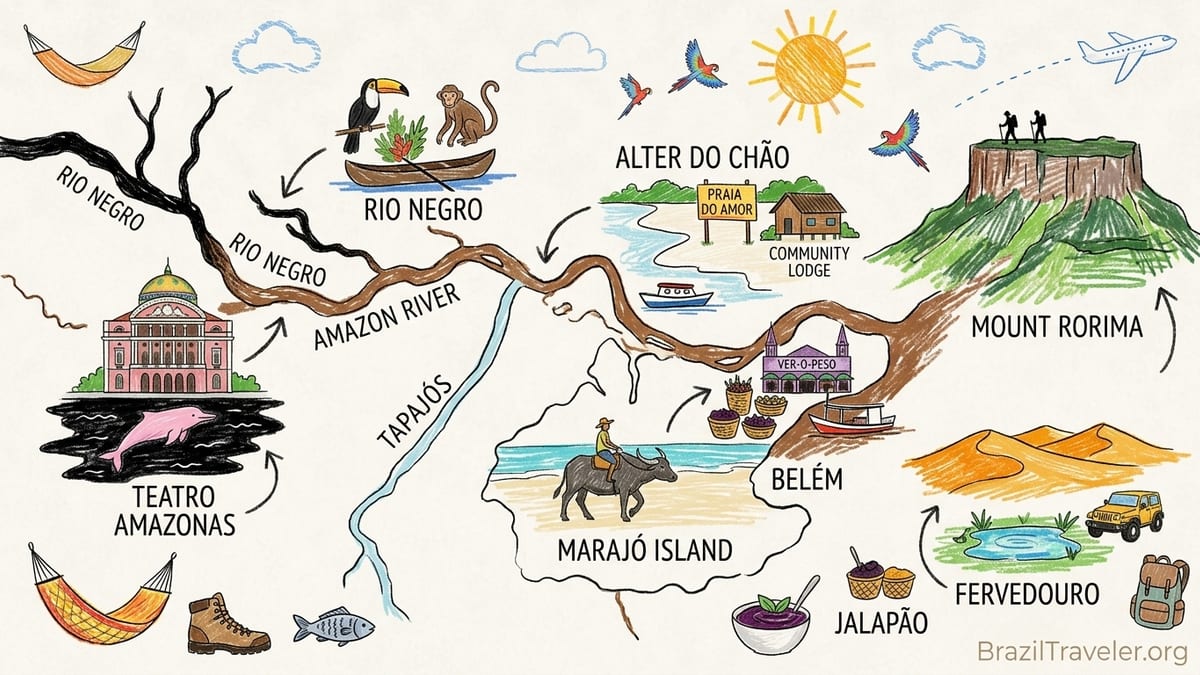
Every destination in this guide is somewhere I actually slept, sweated and, at times, got stuck when a river boat was late or a dirt road turned to mud. I began in Manaus because it remains the easiest deep-Amazon gateway from abroad, with daily flights from São Paulo and Rio and frequent connections to Belém and Boa Vista. From there, I followed the water: Rio Negro and Amazon tributaries around Manaus, the Tapajós around Santarém and Alter do Chão, then the big estuary around Belém and Marajó Island. On a later trip I pushed inland to the jalapão region in Tocantins for its canyons and fervedouros, and north from Boa Vista to the borderlands of Mount Roraima.
My route choices were influenced by what travelers are searching for in 2026: Manaus still dominates Amazon river cruise itineraries, Rio Negro lodges market wildlife and community visits, while Alter do Chão and Marajó Island are rising names among Brazilians looking for freshwater or tidal beaches. Tourism boards now emphasize that the Amazon is not just about boat safaris. Official 2026 materials highlight hiking, waterfalls, technical mountaineering on tepuis such as Roraima and community-based tourism on rivers like the Arapiuns near Santarém. I have tried to mirror that breadth here, focusing on places where you can hear howler monkeys at dawn one week and be waist-deep in a Jalapão river spring the next.
This is not an exhaustive list of everywhere you could go in North Brazil. Instead, it is a practical selection of where I would send a friend with two to four weeks, paying attention to your likely priorities: wildlife, beaches, food, adventure or a slower rhythm. Along the way I will mention lesser-visited states such as Acre, Amapá and Rondônia where it genuinely makes sense to detour, but I will not pretend to have crossed every road there. Northern Brazil is humbling that way. You learn to accept that most of the map will remain mysterious, and make peace with the few extraordinary slices you get to know well.
Because details change fast in the Amazon, all the logistics and prices I mention are checked against current 2026 sources at the time of writing. I avoid hard numbers if I cannot verify them, but when I say that a shared taxi from Santarém airport to Alter do Chão cost me roughly the same as a casual dinner, or that a three-day Rio Negro lodge package now often starts in the mid hundreds of US dollars per person, that reflects a combination of my own receipts and recent operator price lists. Treat these as planning benchmarks rather than guarantees, and always confirm with your host before you set off.
Manaus and the Rio Negro: My Base Camp for the Amazon
On my first arrival in Manaus I landed just before sunset, the airplane windows fogging slightly as we dropped over a brown-green quilt of forest and water. I took an official airport taxi into the city, a drive of roughly 30 to 40 minutes depending on traffic, and based myself near the Teatro Amazonas in the Centro district. I have stayed at both mid-range business hotels and a restored historic guesthouse here. The area is not the quietest, but you can walk to the opera house, the Mercado Adolpho Lisboa and the port, which makes early boat departures easier.
A normal day in Manaus for me starts very urban. I like breakfast at a simple lanchonete near the mercado: strong coffee, fresh pão francês and a cup of cupuaçu juice. Then I walk down to the riverfront where long-distance boats creak at their moorings and vendors sell hammocks, life vests and Styrofoam coolers to passengers heading upriver. This is where the city reminds you it is an Amazonian hub first and a tourist destination second. For wildlife or quieter river time you have to leave town, usually by joining a guided tour or heading to a jungle lodge. In recent years I have used small local outfits as well as larger operations that run three to six day Rio Negro itineraries including canoe excursions, night spotting for caimans and visits to indigenous or riverine communities.
The Rio Negro is what keeps drawing me back. Compared with the main Amazon, its dark, acidic water tends to have fewer mosquitoes when you are actually on the river, and the scenery of flooded forest and narrow igarapés feels more intimate. On one four-day lodge stay, accessed by a two to three hour speedboat ride upriver arranged through the operator, our days fell into a gentle rhythm. We would leave at dawn with a local guide, listening for howler monkeys and bird calls, then return for a hearty lunch of grilled tambaqui or pirarucu with farinha and a simple salad. Afternoons meant swimming in the warm dark water or paddling a canoe under trees laced with bromeliads, followed by a night excursion looking for caimans and bioluminescent insects. The evenings were surprisingly cool, and a simple fan and mosquito net were all I needed.
In 2026 there is a wide spectrum of Manaus-based Amazon experiences, from backpacker-friendly jungle camps to fully catered river cruises that run four to seven nights and include air-conditioned cabins, observation decks and onboard naturalists. I once joined a smaller-boat cruise that spent three nights largely on the Rio Negro, with scheduled pink river dolphin watching, piranha fishing, a visit to the Meeting of the Waters and time in a community that manages a segment of protected forest. It cost roughly the price of a week in a good Brazilian city hotel, but included meals, excursions and guides, so for wildlife-focused travelers with limited time, I still consider it good value.
If your priorities are wildlife and a sense of the forest, I suggest four to six days total around Manaus, with at least three nights actually spent on the river or at a lodge. If you care more about culture and food, you can spend two days in the city itself, visiting the opera house, trying tacacá from a street vendor and exploring markets, then combine Manaus with Santarém or Belém where the urban Amazon feels more accessible. Crowd levels spike in Manaus when large ships dock and during festival periods, but once you are on the Rio Negro, even in peak months, it is easy to find quiet coves where the only other sound is a kingfisher hitting the water.
Belém and Marajó Island: Estuary Light and River Tides
Belém is where I first felt the Amazon breathe with the ocean. Flying in from Manaus, the approach takes you over a maze of islands and channels before the plane drops into the humid coastal air. I usually stay in the Nazaré or Batista Campos neighborhoods, which sit a short taxi ride from the Ver-o-Peso market and the riverfront. One of my favorite routines here is a late afternoon wander through the market area, watching crates of açaí berries being unloaded from small boats, followed by an early dinner of grilled fish with a bowl of tacacá or maniçoba in a simple restaurant nearby.
Belém is less about dense forest and more about estuary culture. A typical day for me involves a morning visit to the Ver-o-Peso area, a stop at the old fort and riverside squares, then a long lunch at a place that takes its açaí seriously, served unsweetened and thick alongside fried fish or shrimp. On another day I might join a river tour to the nearby islands, which gives a hint of the mangrove and floodplain landscapes that lie beyond the city. The heat can be intense, especially from midday to mid-afternoon, so I often retreat to a shaded café or my hotel pool in the hottest hours before venturing out again in the evening.
Marajó Island, across the estuary, was a very different memory. I took a morning passenger boat from Belém, a several-hour journey that begins in city chaos and ends in a slow approach to Soure, where wide dirt streets and grazing water buffalo set the tone. I based myself in a simple pousada on the edge of town with hammocks strung out front. Days on Marajó fell into a beach and farm rhythm. One day we rode bicycles and then horses across ranch land that ended in broad ocean-facing beaches, with almost no one else in sight. Another day, we went out in the late afternoon to watch the tide race into the channels, birds picking at exposed mudflats before they vanished under fast-rising water.
Food on Marajó was rustic and memorable. I still think about the buffalo mozzarella and butter served at breakfast, thick slices of fried fish for lunch and the cold açaí that tasted slightly saltier than what I had in Belém, reflecting the estuarine waters where the berries grow. Crowd levels were minimal when I visited outside Brazilian school holidays, but local tourism offices in 2026 note more domestic visitors during July and around New Year, when lodging in Soure and Salvaterra can fill up. I would allocate three to four days here if you love empty beaches, local dairy products and a sense of wide sky, or limit it to an overnight if you mainly want to sample the estuary environment before heading deeper into the forest.
Traveling between Belém and other northern hubs is straightforward by air, with flights linking it to Manaus, Santarém and Macapá in Amapá. If you are tempted by Amapá, consider a short detour to its capital, Macapá, which famously straddles the Equator. From there, river and road routes lead into lesser-known Amazonian reserves, but infrastructure and tourism services are thinner than around Belém or Santarém. For most first-time visitors to North Brazil, I recommend treating Belém and Marajó as your Amazon coast chapter, contrasting nicely with the blackwater and white-sand scenes further west.
Santarém and Alter do Chão: River Beaches That Do Not Feel Real
If Manaus is my Amazon base camp and Belém my estuary window, Santarém and Alter do Chão are where I go when I need to remember that river water can be clear. I arrived first by boat from Manaus, a hammock on a big regional vessel for a journey that took roughly a day and a half, then later by direct flight. The city of Santarém sits where the green-blue Tapajós meets the brown Amazon, an encounter of colors that you can see from the waterfront mirante. I usually stay one night in Santarém itself, in a simple hotel near the river, then transfer to Alter do Chão the next morning.
Alter do Chão lies about 35 to 40 kilometers from Santarém, reachable in under an hour by car along the PA-457. You can arrange a pickup with your pousada, take a taxi from the airport or use a shared transfer. There has been discussion of bus connections, but in practice, as of 2026, most travelers I meet either book a transfer or share a ride. I like to arrive in the late afternoon, when the little central square comes alive with kids on bicycles and vendors setting out coolers of cold drinks. My stays have usually been in small pousadas within walking distance of the main beach, sometimes in simple rooms with ceiling fans, sometimes in more design-forward guesthouses with shaded courtyards and plunge pools.
What a normal day looks like in Alter do Chão depends heavily on river levels. From roughly August to January, when the Tapajós is low, sandbars appear and the Praia do Amor and Ilha do Amor live up to their reputation as some of the most beautiful freshwater beaches in Brazil. On one September trip I spent mornings crossing the narrow channel by small catraia boat steered by local boatmen, laying a sarong on the white sand and swimming in water so clear it felt like being in the Caribbean, only framed by forest instead of palm-tree resorts. By midday the heat drives most people back under the shade of beach tents, where I lunched on grilled peixe acompanhado with farinha and a cold beer, watching families play in the shallows.
In the high water months, roughly February to June, the beaches shrink or vanish, but the forest floods. On a May visit I swapped beach days for canoe explorations into the igapó, gliding between tree trunks where months earlier I had walked on dry ground. A small lodge on the Arapiuns River, which I reached by a two to three hour boat ride from Santarém’s river terminal, offered community-based tourism experiences, including overnight stays in riverside communities and visits to craft cooperatives. We woke to the sound of parrots, cooled off with river swims and ate meals of locally caught fish, rice and cassava prepared by women from the community. It felt slower and more intimate than the more commercial lodges around Manaus.
Santarém itself is worth at least a day. From the city you can visit nearby urban beaches like Maracanã and take boat trips across to more remote stretches of sand such as Ponta de Pedras, where rocky outcrops and close forest give a more wild feel. The municipal tourism office has been actively promoting these areas and investing in signage and basic infrastructure in recent years, and local news in 2026 notes a noticeable increase in visitors during school holidays, especially in July. Personally, I prefer the shoulder months, when there are enough people to give the town energy but not so many that the small restaurants overflow.
I would gladly dedicate five to seven days to the Santarém and Alter do Chão region if you have time, especially if beaches and relaxed river days are a priority. For wildlife observation, you see fewer big mammals than around some Manaus lodges, but birdlife is excellent and the landscapes are unforgettable. For food-focused travelers, the mix of Amazonian fish, fruits and community-run eateries is a major draw, and the growing number of small, well-designed pousadas makes it increasingly comfortable without losing its edges.
Jalapão: Orange Sand, Cool Springs and the Long Road In
Jalapão is where the Amazon region feels least like the stereotype of endless forest. Reached primarily from Palmas in the state of Tocantins, this area is characterized by plateaus, canyons, waterfalls and the famous fervedouros, natural springs with such strong upwelling that you cannot sink. I flew into Palmas on a domestic connection and then joined a guided 4x4 tour, which remains the most practical way to access the dirt roads and scattered attractions. Self-driving is possible but can be challenging in rainy conditions and requires careful planning for fuel, navigation and river crossings.
My days in Jalapão followed the sun. We would leave our simple pousada or campsite early, often before 6 am, to reach a fervedouro before other groups. Floating in those springs is one of my clearest sensory memories in North Brazil. The water is cool and perfectly clear, the sandy bottom bubbling under your feet, while the surrounding vegetation shuts out the rest of the world. Later in the day we would hike to viewpoints over orange sand dunes, visit waterfalls where you can swim in refreshing pools and sometimes end with sunset on a plateau, watching the sky soften over an almost savanna-like landscape.
Infrastructure in Jalapão has grown in the past few years, with more organized tours offering two to five day circuits that include lodging, meals and guiding. Prices vary by comfort level, but full packages can cost several hundred US dollars or more, especially if they include private vehicles and more comfortable pousadas. Park authorities have also been working with local communities to manage visitor numbers and environmental impact, particularly at popular fervedouros. On one visit, our guide booked time slots in advance and there were clear rules against using sunscreen or insect repellent in the springs to protect water quality.
Crowd levels depend heavily on Brazilian holiday periods. I once visited during a long weekend and saw convoys of 4x4s at the dune parking lots, which made sunset less magical. On a midweek trip in a shoulder month, we shared some springs and waterfalls with only one or two other small groups. For adventure travelers, I suggest three to four days in Jalapão, enough to sample a mix of springs, dunes and waterfalls without rushing. It pairs well with Amazonian river destinations because it shows a completely different side of North Brazil: dry, wide open, but still threaded with rivers and community-run stays.
If you are considering more offbeat corners, the Jalapão experience is a good benchmark before you look at states like Rondônia or Acre. Those states offer their own mix of rivers, rubber-era history and forest reserves, but on my visits there I found tourism services less structured, meaning more planning for transport and a stronger command of Portuguese are helpful. Jalapão, by contrast, strikes a middle ground: wild enough to feel adventurous, but with enough tour operators and pousadas to keep logistics manageable.
Boa Vista and Mount Roraima: Journey to the Tepui
Boa Vista, the capital of Roraima, has a calm, slightly frontier feel that I grew to appreciate over multiple passes through the city. I flew in from Manaus, a short hop that often runs several times a week, and stayed in modest business hotels near the central Praça das Águas or along the riverfront. A normal day here might involve a riverside walk, a stop at a local restaurant for carne de sol with rice and beans, and some practical errands like meeting a trekking agency or stocking up on snacks for the journey ahead. The city is also where you feel the presence of border dynamics, with a visible Venezuelan community and a sense of being on the edge of several worlds.
Mount Roraima, which sits at the tripoint of Brazil, Venezuela and Guyana, is the main draw for many visitors who reach Boa Vista. The classic multi-day trek to the top usually begins on the Venezuelan side, with access typically via Santa Elena de Uairén, reached by road from Boa Vista through the border crossing. When I prepared for my own trek, much of the planning revolved around choosing a reputable operator that could handle permits, porters, food and tents, along with current assessments of security and border conditions. As 2026 reports continue to note, conditions in this region can change, so it is vital to check the latest advice from local agencies and avoid attempting to organize cross-border travel independently without up-to-date information.
The journey itself, from Boa Vista by road to the trailhead, is an experience before the hike even begins. On my trip we left before dawn in a shared vehicle, crossed into Venezuela after the border formalities, and watched the landscape slowly rise, the tabletop silhouette of Roraima eventually appearing on the horizon. The trek took several days, with long hiking hours, nights in tents and weather that swung from strong sun to sudden rain and chilling wind on the summit. Standing on the top of the tepui, walking among strange rock formations and endemic plants, felt like stepping onto another planet. The altitude is not extreme compared with Andean peaks, but the cumulative effort and isolation mean this is better suited to travelers with solid fitness and a taste for rough conditions.
Crowd levels on the Roraima trek fluctuate. There are often other groups camping at the same established sites, but it rarely feels crowded once you spread out across the summit. In Boa Vista itself, you will see more trekkers in the main trekking seasons, often corresponding to drier months, but the city never feels overrun. If your main goal is to climb Roraima, I recommend allowing at least nine to ten days in total. That allows one or two buffer days in Boa Vista for weather or paperwork, the multi-day trek itself and recovery time afterward. For those not keen on a demanding hike or on current cross-border complexities, Roraima state still offers experiences such as visits to indigenous communities and river trips, but these require local contacts and, in my case, more Portuguese than I had on my first visit.
Boa Vista and Roraima are the northern extreme of this itinerary, both geographically and in terms of commitment. The rewards are huge if you value remote landscapes and serious hiking, but for many travelers, especially on a first Amazon trip, I would prioritize Manaus, Santarém or Belém before thinking about the tepuis. If you do decide to go, build flexibility into your schedule and budget to account for changing conditions, and insist on operators who center safety and local community partnerships in how they run their trips.
Where Acre, Amapá and Rondônia Fit In
Across my trips I have spent briefer periods in Acre, Amapá and Rondônia than in the other states featured here, but they deserve mention because they shape the wider story of North Brazil and offer specific niches for travelers who have more time or very particular interests. I reached Rio Branco, the capital of Acre, on a domestic flight and found a compact, friendly city with clear echoes of the rubber era in its museums and riverside architecture. Beyond the capital, Acre is known for forest reserves and community-led tourism projects that focus on traditional rubber tapping, forest walks and cultural exchange. On my visit to one such community, reached after several hours on a bumpy road and then a short river trip, days were structured around the rhythms of the forest, with early morning walks, workshops on latex extraction and shared meals of local fish and manioc-based dishes.
Amapá entered my itinerary primarily through Macapá, a city that famously straddles the Equator. Landing there from Belém or Santarém, you immediately sense a smaller scale and a slower rhythm. I spent a couple of days exploring the riverfront fortress, the monument that marks the Equator line and local markets. For nature experiences, Amapá offers access to reserves and rivers with far fewer visitors than the classic Amazon circuits, but on my visits I found that reaching these areas required more local contacts and advance planning. If you are comfortable with that and speak some Portuguese, Amapá can feel like the Amazon in slow motion, with genuine community-based stays and little pressure from mass tourism.
Rondônia, with its capital Porto Velho, reminded me how quickly Amazonian landscapes can change under human pressure. Flying in from Manaus, I saw more pasture and roads, but also pockets of forest and river scenery. I used Porto Velho chiefly as a transit and rest stop, spending a day walking along the Madeira riverfront, eating regional fish dishes and visiting modest local museums. There are boat trips on the Madeira and possibilities to connect with remaining extractive reserve communities, but again, services are less polished than in Manaus or Santarém. For most travelers, I would only suggest adding Rondônia if you have a strong interest in the region’s history of rubber, migration and deforestation, and if you are prepared for more improvised logistics.
In practical terms, these three states are easier to integrate as extensions rather than core pillars, unless you already know you want to focus on a specific project or community. For example, you might add a three-day community stay in Acre to a longer Amazon itinerary, or spend two days in Macapá between Belém and Santarém flights. If you do so, remember that official tourism information can lag behind on websites, so use multiple sources and recent traveler reports when confirming transport schedules, guides and safety conditions.
The Takeaway
When I look back over my notebooks from North Brazil, certain patterns emerge. Manaus and the Rio Negro are where I learned to listen to the forest at night, to the soft slap of water on a canoe and the faraway roar of howler monkeys before sunrise. Belém and Marajó taught me how much of Amazonian life takes place at the edge between river and sea, in markets stacked with açaí baskets and in estuary light that makes everything feel like late afternoon. Santarém and Alter do Chão reminded me that some of the most striking Amazon moments involve simply sitting on a sandbar with your feet in clear water, watching river traffic glide by. Jalapão added dry heat, starry skies and the strange buoyancy of fervedouros to the mix, while Boa Vista and Roraima stretched my sense of distance and effort, turning the map into something felt in my legs as well as seen on a screen.
If you are planning your own trip in 2026 or beyond, the key is to match destinations to your priorities and available time. For wildlife and classic rainforest immersion, I would start with Manaus and a Rio Negro lodge or cruise. For beaches and lazy swims, aim for Santarém and Alter do Chão in the low water season, or combine Marajó and Alter for a mix of tidal and river beaches. For food and culture, give Belém at least three days and add Manaus and Santarém city time. For adventure and hiking, look to Jalapão and, if conditions are right and you are prepared, Mount Roraima. For slower, more community-based tourism, weave in stays on rivers like the Arapiuns or in Acre and Amapá projects where daily life still follows the river and the forest more than the tourism calendar.
Logistically, North Brazil in 2026 is more connected than when I first came, with more frequent regional flights and a more mature ecosystem of certified guides and lodges. At the same time, the basics still apply. River levels define your experience, so always check whether you are traveling in the flooded or dry season for each region. Build buffers into your itinerary, especially where river or border travel is involved. Accept that internet connections will be patchy once you leave the cities, and embrace the slower rhythm that follows. The Amazon rewards patience and curiosity more than tight scheduling.
Most of all, remember that your presence has an impact. Choose operators that work with local communities, ask where your money goes and be a respectful guest in places where people are living first and hosting visitors second. The extraordinary range of Amazon experiences available today, from pink-dolphin river cruises to mountaintop treks and community forest walks, will only remain possible if the communities who live with the forest every day see tourism as a fair and sustainable partnership. As a traveler, that is one of the most meaningful choices you can make, long after the river sand has finally washed out of your shoes.
FAQ
Q1. How many days should I spend in Manaus and the Rio Negro region?
For a first visit focused on wildlife and river experiences, plan four to six days around Manaus, including at least three nights on a lodge stay or river cruise and one or two nights in the city for markets and the opera house.
Q2. When is the best time to visit Alter do Chão for beaches?
The best months for broad white-sand river beaches around Alter do Chão and Santarém are usually from August to January, when river levels are lower and sandbars emerge, though exact timing can vary each year.
Q3. Is Marajó Island better as a day trip or overnight stay from Belém?
Travel time by boat from Belém makes Marajó much more rewarding as an overnight or multi-day trip. I suggest at least two nights in Soure or Salvaterra to enjoy beaches, ranch visits and local buffalo-based cuisine without rushing.
Q4. Do I need a guided tour to visit Jalapão?
Because roads are largely unpaved, distances between attractions are long and conditions change with rain, most visitors are better off joining a guided 4x4 tour that includes driver, vehicle, lodging and meals, unless they have strong off-road and Portuguese skills.
Q5. How difficult is the Mount Roraima trek from Boa Vista?
The Mount Roraima trek is a demanding multi-day hike with long walking days, significant elevation gain, basic camping conditions and quickly changing weather, so it is best suited to travelers with good fitness and prior trekking experience who book through reputable operators.
Q6. Can I combine Manaus, Santarém and Belém in one trip?
Yes, regional flights link these cities and many travelers combine them. With about two and a half to three weeks you could spend time in all three, adding a Rio Negro lodge, Alter do Chão and Marajó for a varied Amazon itinerary.
Q7. Is North Brazil safe for independent travelers?
Major cities like Manaus, Belém and Santarém see the usual urban safety concerns, so take standard precautions and use registered taxis. In remote areas, using established guides and lodges, following local advice and checking current conditions greatly improves safety.
Q8. What kind of budget should I expect for Amazon experiences?
Costs vary widely, but in 2026 mid-range jungle lodge packages or small-boat cruises around Manaus and Santarém often run from the mid hundreds of US dollars per person for three to four days, including meals and excursions, with cheaper and more expensive options available.
Q9. Do I need to speak Portuguese to travel in these regions?
Portuguese is extremely useful, especially outside major cities. In Manaus, Belém, Santarém, Jalapão and Roraima, some tour operators and hotels work in English or Spanish, but a phrasebook and translation app make independent travel and community stays much easier.
Q10. How should I choose between Acre, Amapá and Rondônia for an extension?
If you want rubber-era history and forest communities, consider Acre. For a quieter Amazonian capital straddling the Equator and access to less-visited reserves, choose Amapá. For those interested in the Madeira River and development history, Rondônia can be an option, but services are more limited.