

I did not fall for Central-West Brazil all at once. It happened in stages, on overnight buses and dusty highways between Brasília, the wild plateaus of Goiás, the translucent rivers of Bonito and the flooded grasslands of the Pantanal. Each stop answered a different travel craving: architecture and politics, waterfalls and hiking, fish-packed rivers to snorkel, hot-spring pools to float in at night. This guide is built from the places I actually visited and revisited, updated with current park rules, access and prices so you can pick the right mix for your own trip today.
How I Chose My Central-West Route
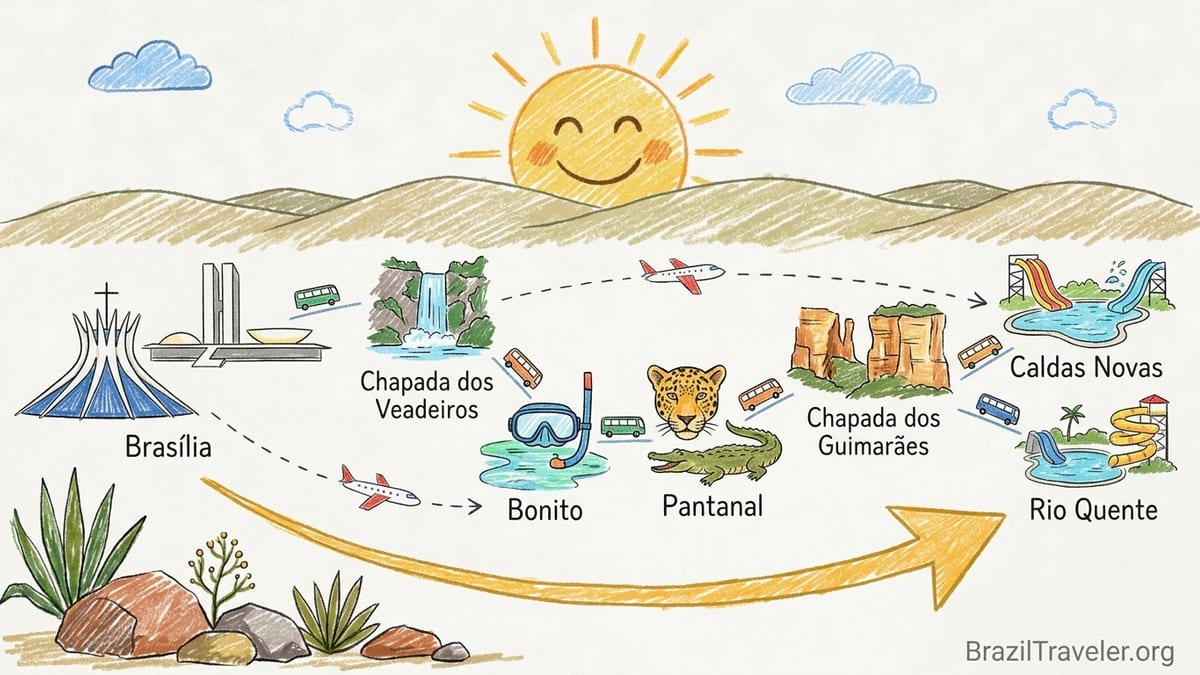
My first Central-West loop started with a cheap flight into Brasília, then ran in a rough circle: Brasília to Alto Paraíso for Chapada dos Veadeiros, back through Brasília, then south by bus and plane to Campo Grande and Bonito, further into the southern Pantanal, and finally up to Cuiabá for Chapada dos Guimarães before cutting across Goiás to Caldas Novas and Rio Quente. I have since repeated pieces of that route, which helped me see what deserves more days and what can be a quick taste.
Today, I would tell a first-time visitor with two weeks to choose three or four centers: Brasília for architecture and an introduction to the Cerrado, Chapada dos Veadeiros for hiking and waterfalls, Bonito for rivers and caves, and the Pantanal for concentrated wildlife. Chapada dos Guimarães is worth adding if you are already flying through Cuiabá, and Caldas Novas or Rio Quente works best for families who want waterparks and hot springs more than trails and jaguars.
Search demand mirrors that logic. When you look at what travelers are actually asking about now, Brasília, Chapada dos Veadeiros, Bonito and the Pantanal dominate: opening hours for the national park, 2025 snorkel prices on the Rio da Prata near Bonito, dry-season timing for jaguar safaris from Porto Jofre, and rules for access to the Hot Park complex in Rio Quente. Those are the places I focus on here, using my own stays as the backbone but adjusting the practical advice to match how these spots work in 2025 and 2026.
To keep it useful, I will explain how I arrived in each destination, where I stayed, what a normal day looked like, how crowded it felt, and what shaped my opinion. For each, I will also be explicit about how many days I would allocate now and who it suits best: architecture fans, families, hikers, wildlife watchers, waterfall hunters, swimmers or people mainly seeking to relax.
Brasília: Modernist City in an Endless Sky
Brasília is where my Central-West trips tend to start and end. The city’s Plano Piloto, a cross-shaped plan laid out by Lúcio Costa, is still one of the world’s most complete modernist ensembles and a UNESCO World Heritage site. Along the east west Eixo Monumental, you walk or drive past the TV Tower, the white curves of Oscar Niemeyer’s National Museum and National Library complex, the Cathedral of Brasília, the Esplanada dos Ministérios, and finally the Praça dos Três Poderes where the National Congress, Presidential Palace and Supreme Federal Court face each other across a monumental plaza.
I usually arrive at Brasília’s airport in the evening and take an app-based taxi to a simple hotel in Asa Norte or Asa Sul, the residential wings flanking the Eixo Monumental. On one stay, I based myself near the 210 Norte area, in a midrange hotel with air conditioning, Wi-Fi and a basic breakfast buffet of pão de queijo, fruit and coffee. That location allowed me to reach the central bus station and the Esplanade in a short ride while still feeling like I was in a lived-in neighborhood, with local restaurants serving self-service lunch buffets where you pay by weight.
A normal sightseeing day in Brasília for me starts at the TV Tower, both to get oriented and to watch the city’s planned geometry from above. From there I walk the grassy axis toward the Cultural Complex with the National Museum and National Library, then continue on to the Cathedral and the Esplanade. Many official buildings offer guided or self-guided visits on weekdays, though security procedures can change, so it is worth checking same-week information from local tourism offices or recent reports in Brazilian media. By late afternoon the light softens and the white concrete of Niemeyer’s buildings glows against the huge sky, which is when I like to circle the Praça dos Três Poderes and the Itamaraty Palace.
Brasília’s climate is high and dry for most of the year. During the dry season, from roughly May to September, the humidity drops and the sky stays an almost uninterrupted blue. In the build-up to the rainy season, usually October and November, dramatic thunderstorms roll in late in the day. Crowds cluster around national holidays and political events, but on regular weekdays the Eixo Monumental can feel surprisingly quiet for the symbolic center of a large country. Because of the distances, public buses are functional but not always intuitive for short stays, so I now rely mostly on ride-hailing apps to hop between sights and to reach outlying viewpoints along Lake Paranoá in the evening.
If I were planning now, I would allocate two to three full days for Brasília, enough to cover the Plano Piloto, visit a couple of interior spaces such as the Cathedral or Congress when access is allowed, and take a sunset walk along the shore of Lake Paranoá or the Pontão do Lago Sul area for dinner. It is not a waterfall or wildlife destination, but it is essential for architecture lovers, anyone curious about Brazilian politics and urban planning, and travelers who like to start a trip with good infrastructure before heading into more remote landscapes.
Chapada dos Veadeiros: Long Trails and Cold Waterfalls
From Brasília, my favorite escape is north to Chapada dos Veadeiros in Goiás, a high plateau of canyons and waterfalls about four to five hours away by road. I usually travel by bus or shared transfer to Alto Paraíso de Goiás and then continue by local van or hitchhiking to the village of São Jorge, right by one of the main entrances to Chapada dos Veadeiros National Park. São Jorge is tiny and dusty but has a relaxed, backpacker-friendly feel, with simple pousadas, vegetarian restaurants and a few bars that fill up on weekends.
On my last visit, I stayed in a pousada a short walk from the São Jorge park gate, in a simple chalet with a fan instead of air conditioning. The advantage was waking up, having a quick breakfast of scrambled eggs, fruit and strong coffee, then walking straight to the entrance to register for the trail that day. According to the official park information updated through 2023, Chapada dos Veadeiros National Park opens daily from 8 am to 6 pm, including on public holidays, with last entry in the early afternoon depending on the trail. Tickets are now purchased through an online system or at authorized points, and you must carry ID; there are discounts for Brazilian students and older visitors, but the rules state that if you cannot show proof at the entrance you can be denied the discounted rate.
A normal day in São Jorge starts early to beat the sun. The classic long trail is the Canyon II and Cariocas circuit, which takes the better part of a day and includes river crossings, ladders and steep sections. I remember drinking almost all my water by early afternoon and being grateful for the cold pools where you can swim. Another day I focused on shorter hikes to the Saltos do Rio Preto overlook and nearby falls, returning to São Jorge mid-afternoon for a late lunch and a nap in a hammock. In recent years the park has formalized many safety measures, including a Visitation Operational Protocol that asks visitors to confirm they are physically and mentally fit for the trails, and to respect closing times so rangers are not forced into night rescues.
The climate here is a typical Cerrado pattern. The dry season between May and September brings cooler nights and clearer skies, ideal for hiking, but the rivers can feel icy. The rainy season from roughly October to April transforms the vegetation into a bright green but can make trails slippery and sometimes leads to temporary closures of certain routes after heavy storms or for risk of flash floods. São Jorge gets busy on Brazilian holidays and school vacations, when pousadas fill and restaurants may require a wait. On midweek days in the shoulder season, I have had trails almost to myself apart from small guided groups.
I would now plan at least three full days for Chapada dos Veadeiros, with four or five if you also want to explore attractions outside the national park, like the Cataratas dos Couros or private reserves that offer access to waterfalls for a day fee. This is the top choice in the region for hikers and waterfall lovers, for travelers who want to swim in natural pools and photograph stark rock formations, and for those who like small village evenings more than resort complexes.
Bonito: Floating Through Aquarium Rivers
Bonito, in the state of Mato Grosso do Sul, is where I first understood why Central-West Brazil has become a major freshwater destination. To get there, I usually fly into Campo Grande, stay a night near the bus station, then take a long-distance bus or pre-booked transfer for the roughly four-hour trip to Bonito town. The roads are paved but can be bumpy, and on my first visit the bus stopped at roadside stalls where I bought empanadas and cold soft drinks to break up the journey.
In Bonito itself, I base in a simple pousada near the main street Rua Cel. Pilad Rebuá, which keeps everything walkable: restaurants, small supermarkets, and the tourism agencies that bundle and sell the region’s tightly regulated tours. Bonito’s entire tourism model is quota-based; each attraction has a daily visitor limit and you must book through an authorized agency that issues vouchers for specific time slots. Agencies now publish 2025 price tables, and one widely used tariff list shows, for example, flotation tours on the Rio da Prata priced around the mid hundreds of Brazilian reais in 2025, depending on season and category, with gear and guide included but not transport.
A normal day here starts not in town but on one of the rivers. The most memorable experience for me was a flotation tour on the Rio da Prata. After a 40 minute drive in a shared van, we suited up in wetsuits, snorkels and vests, did a quick practice in a quiet pool, then spent more than an hour drifting down impossibly clear water over sand, fallen logs and dense schools of fish. The rules are strict: no sunscreen in the water, no touching the riverbed or fish, and groups move under a guide’s control so that the environment stays pristine. On another day I visited a cave with a deep blue lake, with a mandatory helmet, set visiting hours and a steep staircase down to the water’s edge under a guide’s supervision.
Bonito town itself is low-rise and laid-back. In the evening, after returning from a tour, I usually walk to a churrascaria or a regional restaurant that serves freshwater fish from local rivers, like pacu and pintado, grilled or in stews. There are simple bars for a beer and some snack food, and souvenir shops that sell river-themed crafts. The climate is warm to hot for much of the year, with more rain in the summer months, roughly November to March. Heavy rains can raise river levels and temporarily affect visibility, so agencies sometimes adjust or reschedule tours based on conditions.
Bonito rewards time because most tours take a half or full day and are not close together. With updated price structures for 2025 that reflect the cost of conservation, I would budget at least three to four full days and a reasonable activity budget to make the journey worthwhile. It is ideal for people who want to swim and snorkel in natural settings, families with older kids who can manage basic walking and follow rules, and travelers who enjoy organized nature experiences more than independent hiking.
The Pantanal: Wetland Safaris and Long Evenings
If Bonito is about rivers you float in, the Pantanal is about rivers you ride along searching for eyes in the reeds. This immense wetland spreads across Brazil, Bolivia and Paraguay, but travelers usually focus on the Brazilian side. My trips have been via both Campo Grande, gateway to the southern Pantanal, and Cuiabá for the northern Pantanal and the famous Transpantaneira road that ends in Porto Jofre on the Cuiabá River.
On one of my most memorable visits, I flew into Cuiabá, overnighted in a basic hotel near the airport, then joined a pre-arranged transfer along the Transpantaneira. The paved road gives way to packed earth and then to a string of wooden bridges. We stopped often for photos of caimans, capybaras and jabiru storks. I based myself in a simple fazenda-style lodge partway down the Transpantaneira, with screened rooms, ceiling fans and communal meals, then spent two nights further downriver in a floating lodge near Porto Jofre aimed at jaguar watching.
A typical Pantanal day starts before dawn with strong coffee and maybe some fruit, then a morning boat ride or open-vehicle safari while the animals are more active. Midday is usually too hot, so time is spent in hammocks, reviewing photos or watching macaws and toucans from the lodge grounds. In the late afternoon, there is a second outing, sometimes by boat on the rivers, sometimes on foot or by vehicle across the floodplains. The dry season, usually June through October, is now widely recommended as the best time to visit because the lower water levels and sparse vegetation concentrate wildlife along remaining water sources. Operators that specialize in Pantanal trips highlight this period and suggest a practical minimum of four to five nights split between different areas to maximize diversity and jaguar chances.
The Pantanal is more regulated than it looks from a map. Boats now follow specific practices when watching jaguars, generally keeping a safe distance, limiting numbers and using radio contact between guides to avoid crowding a single animal. Park authorities and local associations update these guidelines periodically, and reputable lodges brief guests before the first outing. During the wet season, roughly November to March, sections of the Transpantaneira can flood, some bridges may need repair, and certain lodges become accessible only by boat or plane, so itineraries are built differently at that time of year.
This is not a budget destination once you factor in transfers, full-board lodging and guided excursions, but I have always felt the concentration of wildlife justified the cost. For planners now, I would allocate at least four full days in the Pantanal, and up to a week if wildlife is the main purpose of the trip. It suits photographers, birders, and anyone who wants to see capybaras, caimans, giant otters and, with luck, jaguars in relatively open landscapes. It is not ideal for very young children, as long boat rides and heat can be taxing, but older kids with an interest in animals often love it.
Chapada dos Guimarães: Canyon Edge Above Cuiabá
Chapada dos Guimarães, in Mato Grosso state, feels like a quieter cousin to Chapada dos Veadeiros. I came here after a Pantanal stay, catching a transfer from my lodge back to Cuiabá then heading about an hour and a half northeast by road into the higher plateau. The town of Chapada dos Guimarães itself sits on a ridge with cooler air than the lowlands and serves as the base for visiting the national park and surrounding private reserves.
I stayed in a small guesthouse a short walk uphill from the main square, with basic rooms, hot showers and a breakfast of bread, fruit and cake. In the evening, I could walk to restaurants serving regional dishes and to a small market for snacks. The national park had gone through periods of partial closure and reopening in past years, particularly around the main waterfall viewpoint at Véu de Noiva and some trails, but by the time of my visit guided tours to key sites had resumed with set opening hours and required registration. Local agencies in town had the most up-to-date information about which routes were open on a given week.
My typical day here started with an early pickup for a half-day circuit linking panoramic viewpoints along the canyon edge, where you look out over a patchwork of forest and farmland, and then stopping at a series of smaller waterfalls where you can swim. Trails were shorter and gentler than the big loops in Chapada dos Veadeiros but still required sturdy shoes and sun protection. In the afternoon, I often returned to town for a slow lunch, then walked to the local church square to watch the light change over the valley, or joined a sunset trip to nearby lookouts where sandstone cliffs glow orange.
The climate is hot in the middle of the day, especially in the dry season, but evenings can be pleasant thanks to the elevation. Crowds increase on weekends and holidays when day-trippers arrive from Cuiabá. Because some sections of the park remain sensitive to erosion and fire risk, authorities may adjust access rules seasonally. When I compare it with Chapada dos Veadeiros, I see Chapada dos Guimarães as a good add-on if you are already visiting the Pantanal via Cuiabá, rather than a standalone destination from far away. I would allocate two full days here today, aiming it at travelers who want moderate hiking and pretty viewpoints more than remote long-distance treks.
For families, the relative shortness of many walks, combined with the possibility of easy waterfall swims, can make it more approachable than all-day hikes in Chapada dos Veadeiros. For landscape photographers, the canyon rim views at sunrise and sunset are the main draw.
Caldas Novas and Rio Quente: Hot Springs and Water Parks
When all the hiking, snorkelling and safaris begin to blur together, Caldas Novas and nearby Rio Quente in Goiás offer a completely different side of Central-West Brazil: a concentration of thermal pools and water parks built around naturally hot waters. I arrived here once on an overnight bus from Brasília, stepping into a town dominated by high-rise hotel blocks and resort signs advertising thermal pools at temperatures well into the thirties Celsius.
On that trip, I stayed in a midrange hotel in Caldas Novas with access to a set of thermal pools on site, open into the evening. My days quickly fell into a pattern. After breakfast, if I wanted something quieter, I walked or took a short ride to a day-use park such as one of the complexes with multiple thermal pools, slides and artificial beach areas. Another day I booked a transfer to Rio Quente, about 25 minutes away, to spend the day at the Hot Park water park, which is repeatedly highlighted as one of Brazil’s best-known thermal attractions, with over twenty rides, river circuits and the large wave pool area called Praia do Cerrado.
Operators that manage the Rio Quente Resorts complex note that access rules are now clearly defined. The Parque das Fontes, a cluster of natural thermal springs and pools, is reserved for guests of the Rio Quente hotels or holders of a specific resort pass purchased in advance. Day visitors can buy tickets to the Hot Park itself, which operates with fixed opening hours and its own regulations about what can be brought in. The resort’s published rules state that guests cannot bring in outside food or drinks into the complex, following a legal agreement with local authorities. Another section notes that access to the Hot Park is tied to each guest’s hotel check-in and check-out times, with possible extra charges for use outside that window.
The water-park environment is very different from the small-village feel of São Jorge or the quiet of a Pantanal lodge. There are lined-up chairs, music around some pools, food stands selling fast food and cold drinks, and children running between slides. On Brazilian school holidays, the area can be extremely busy and popular parks fill quickly. Outside of peak times, particularly on weekdays outside the main vacation months, it is easier to find quieter corners, especially in thermal pools geared toward relaxation rather than slides.
Caldas Novas and Rio Quente are ideal for families who want safe places for kids to swim and play, or for couples who like the idea of soaking in hot water after bus journeys. They are less compelling if your priority is untouched landscapes or wildlife, and they make the most sense geographically if you are moving between Goiás and Minas Gerais or circling back to Brasília. I would rarely allocate more than two or three days here unless the main purpose of the trip is water-park relaxation.
How Many Days and Who Each Place Suits
Looking back across my circuits and comparing them with current transport options and park rules, my recommended allocations for a first or second trip to Central-West Brazil would look like this. Brasília deserves two to three days as a cultural and architectural anchor, especially if you enjoy modernist design and want time to see the Eixo Monumental from different angles and visit interiors like the Cathedral or the National Museum. It is also a good place to adjust to the Cerrado climate and pick up supplies before traveling on.
Chapada dos Veadeiros warrants at least three to five days for hikers and waterfall swimmers, centered either in São Jorge for direct park access or split between São Jorge and Alto Paraíso to reach outlying attractions. Bonito needs three to four days to make the most of the pre-booked activity system, allowing for two full days of major tours like Rio da Prata flotation and a cave visit, plus a more relaxed day at a river beach or secondary excursion.
For the Pantanal, every operator I have traveled with or spoken to stresses that shorter than four nights feels rushed. With four to seven nights, split between a fazenda lodge and a river-based base like the Porto Jofre area, you can enjoy repeated dawn and dusk boat outings, vehicle safaris, and some walking without feeling that every wildlife sighting is high-stakes. Chapada dos Guimarães, accessed through Cuiabá, fits neatly as a two-day add-on before or after the Pantanal, particularly if you like canyon views and moderate walking. Caldas Novas and Rio Quente fit best as a two or three day relaxation segment for families or those who want hot-water downtime.
In broad strokes, Brasília is strongest for architecture, Chapada dos Veadeiros and Chapada dos Guimarães for hiking and landscapes, Bonito and the hot-spring complexes for swimming, and the Pantanal for wildlife. Families with young children often combine Brasília, Bonito and Caldas Novas or Rio Quente, using more controlled environments with clear safety rules, while experienced hikers and photographers tend to focus on Chapada dos Veadeiros and the Pantanal. Your own mix will depend on whether you imagine your trip mostly in walking shoes, wetsuits, safari boats or reclining in warm water after dark.
The Takeaway
Central-West Brazil is less about a single icon and more about a spectrum of experiences strung between Brasília’s geometric skyline and the flooded plains of the Pantanal. My own trips across these states have taught me that the magic lies in choosing a few contrasting bases and giving them enough time, not in trying to tick off every known attraction in a single loop.
Brasília keeps drawing me back because its Plano Piloto remains one of the clearest expressions of twentieth century planning on a national scale. Chapada dos Veadeiros, with its high trails and chilly waterfalls, is where I feel the Cerrado most intensely. Bonito is where I learned to float slowly enough for the river to reveal itself fish by fish, and the Pantanal is where late-afternoon light on a caiman-filled bank still comes back to me unprompted. Chapada dos Guimarães and the Caldas Novas and Rio Quente hot springs round out the region by adding different speeds and textures.
If you are planning now, start with what you want to feel most. If you want architecture and a sense of Brazilian institutions, invest in Brasília. If you want to hike, concentrate time in Chapada dos Veadeiros and, if your route allows, Chapada dos Guimarães. If your dream is clear rivers and colorful fish, reserve your budget for Bonito. If you want wildlife and long, quiet evenings on a lodge veranda, prioritize the Pantanal’s dry season and accept the higher cost as part of protecting such a rare ecosystem. And if what you crave is warmth, water and simple fun with kids, then the thermal pools of Caldas Novas and Rio Quente may deserve a place at the end of your route.
Central-West Brazil rewards those who are willing to travel between very different kinds of places on the same trip. The contrast between a morning inside the National Congress in Brasília and a late-afternoon boat patrol on a Pantanal river is exactly what has kept me returning. With current park rules, booking systems and access information in hand, you can build a journey that feels as personal and layered as the region itself.
FAQ
Q1. How many days do I need for a first trip to Central-West Brazil?
For a first trip focused on highlights, plan around 14 days. That allows two to three days in Brasília, three to five in Chapada dos Veadeiros, three to four in Bonito and four or more in the Pantanal, plus travel days between them.
Q2. When is the best time to visit the Pantanal for wildlife viewing?
The core dry season from about June to October is usually considered best for wildlife viewing. Lower water levels concentrate animals along remaining rivers and ponds, road access along routes like the Transpantaneira is more reliable, and specialized lodges near Porto Jofre report higher chances of jaguar sightings.
Q3. Do I need to book Bonito tours in advance?
Yes. Bonito uses a quota system where each attraction sells a limited number of spaces per day through authorized agencies. For popular activities like flotation on the Rio da Prata or visits to major caves, it is wise to reserve at least several weeks ahead in busy seasons, especially Brazilian school holidays.
Q4. Is Chapada dos Veadeiros suitable for inexperienced hikers?
Chapada dos Veadeiros has both demanding full-day trails and shorter, easier walks to waterfalls. Inexperienced hikers can enjoy the shorter routes if they respect park rules, carry water, start early and consider hiring local guides. Those with limited fitness should avoid the longest circuits and check updated recommendations with park staff or tour agencies.
Q5. Can I visit the Pantanal independently without a tour?
It is technically possible to drive into some Pantanal areas and stay in basic roadside lodgings, but most meaningful wildlife experiences rely on guided boat trips and safaris offered by lodges or local operators. For most travelers, booking a package that includes transfers, lodging and guided outings is the most practical and rewarding option.
Q6. Is Brasília worth visiting if I am not very interested in politics?
Yes. Even if politics does not interest you, Brasília offers striking modernist architecture, open plazas, lakefront areas around Lake Paranoá and a unique planned-city layout. Many visitors enjoy simply walking or driving the Eixo Monumental and visiting the Cathedral, National Museum and Itamaraty Palace for their design alone.
Q7. Are Caldas Novas and Rio Quente good for young children?
Caldas Novas and Rio Quente are among the most family-oriented destinations in Central-West Brazil. Thermal pools, shallow areas, gentle slides and dedicated kids’ zones in water parks like Hot Park make them popular for families with young children, though parents should still check height and age restrictions for specific attractions.
Q8. Do I need a car to explore Chapada dos Guimarães and Chapada dos Veadeiros?
A car offers flexibility, but it is not essential. In both regions, local agencies in towns like Chapada dos Guimarães, Alto Paraíso and São Jorge organize daily group tours with transport included to major viewpoints and waterfalls. Independent travelers without a car simply need to accept fixed schedules and shared outings.
Q9. How expensive are activities in Bonito compared to other regions?
Bonito is more expensive per activity than many Brazilian destinations because tours are guided, regulated and capped at low numbers to protect the environment. Recent official tariff tables show core flotation and cave tours costing several hundred reais per person, but these prices include gear, guides and controlled access to well-preserved sites.
Q10. Which destinations in Central-West Brazil are best for relaxation rather than adventure?
For relaxation, Caldas Novas and Rio Quente stand out thanks to their thermal pools and resort facilities. Bonito and Chapada dos Veadeiros can also be restful if you choose shorter outings and allow time for slow evenings, while Brasília offers comfortable city amenities and lakefront sunsets with relatively low physical effort.