


Central-West Brazil rewards anyone willing to cover distance: UNESCO modernism in Brasília, waterfalls in Chapada dos Veadeiros, hot springs around Caldas Novas and Rio Quente, the rivers of Bonito and the endless wetlands of the Pantanal. The catch is that a poor choice of base can turn your dream itinerary into long predawn drives, expensive transfers and evenings stranded far from a restaurant. On my last extended trip across the region, I learned that the right neighborhood or village mattered far more than whether my hotel had an infinity pool. This article is about those bases: where staying closer to nature justified losing city conveniences, and where it really did not.
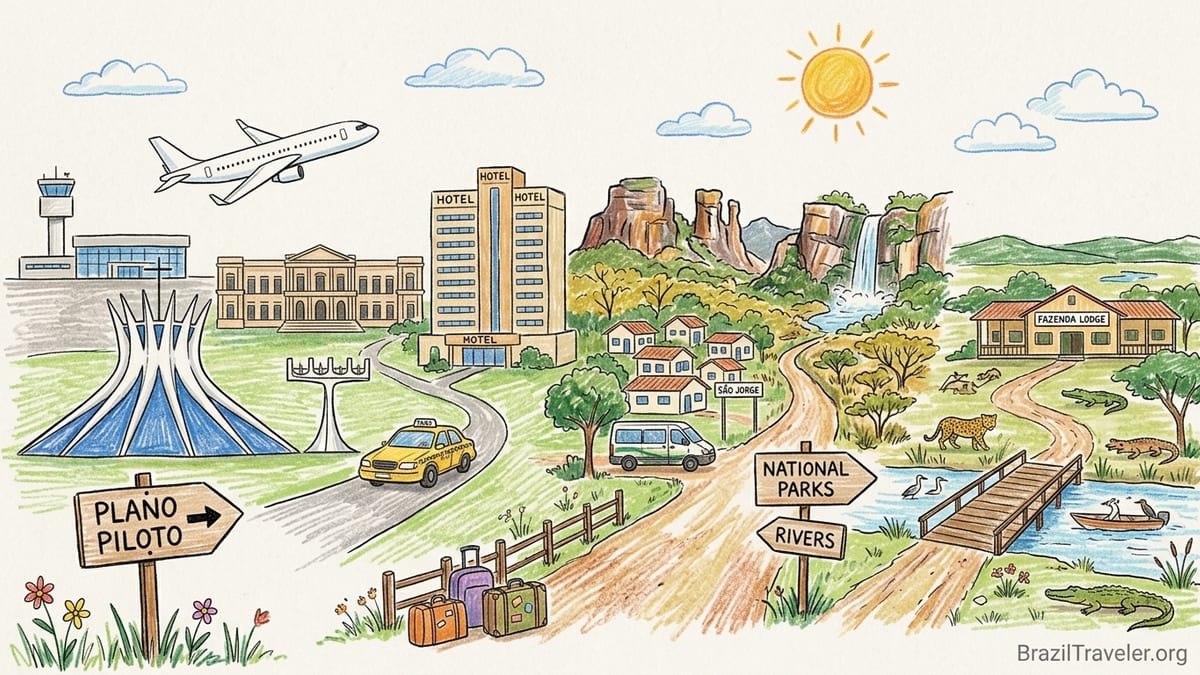
Brasília: Making the Plano Piloto Work for Sightseeing and Early Flights
Brasília is the main air gateway for Chapada dos Veadeiros and often a hub for Bonito and the Pantanal, so your choice of base on the Plano Piloto shapes more than a city break. I stayed in both the traditional North and South Hotel Sectors near the Eixo Monumental and in a residential quadra in Asa Norte. The hotel sectors put me about 15 to 20 minutes by car from Brasília International Airport, and airport taxis and app cars had no trouble finding the big hotel towers. This mattered for a 5:30 a.m. departure toward Alto Paraíso: the driver could pull straight into the hotel forecourt, and check out was a two-minute formality at any hour.
For sightseeing, staying within the Plano Piloto was essential. From the South Hotel Sector I could walk to the Conjunto Nacional mall in under ten minutes for a supermarket, food court and basic pharmacy purchases, then continue along the Eixo Monumental toward the National Museum and Cathedral. App cars across the Asas usually cost less than a modest restaurant meal, and traffic outside rush hour was light. When I experimented with an Airbnb farther out, in Águas Claras, I regretted it as soon as I had to cross half the Federal District for a sunrise tour at the Praça dos Três Poderes. Even with the metro, the extra 40 minutes of door-to-door time at dawn was not worth the lower nightly rate.
Restaurants and Wi-Fi quality were noticeably better inside the Plano Piloto. In Asa Norte, each superquadra had its own small cluster of bakeries, bars and casual spots, and I could eat well without using a car. Wi-Fi in the older residential block I rented was strong enough for video calls but had occasional evening slowdowns, while larger business hotels in the hotel sectors offered much more stable connections and backup options like co-working spaces in the lobby. For short stays tied to flights or tight overland transfers, I would choose a hotel in the North or South Hotel Sector over any outlying neighborhood, purely for transfer convenience, 24-hour reception and easy early checkouts.
The final lesson from Brasília was to avoid being overly clever about saving on accommodation by moving too far from the Plano Piloto. With toll-free highways leading toward Goiás and Mato Grosso, you gain nothing by sleeping in satellite cities before long bus or car departures. The 20-minute taxi from a central hotel to the interstate bus terminal or the airport is cheap insurance against traffic surprises, and you keep all the advantages of supermarket access, reliable ATMs and restaurant choice the night before you head into the interior.
Chapada dos Veadeiros: Alto Paraíso Versus São Jorge
Every traveler to Chapada dos Veadeiros faces the same first question: base in Alto Paraíso de Goiás or in the village of São Jorge at the entrance of the national park. I split my stay between the two and found that they solve different logistical problems. Alto Paraíso is a small town with paved streets, several well-stocked supermarkets, pharmacies and ATMs, and a greater variety of pousadas across price ranges. São Jorge is a compact village of dirt streets, a handful of mini-markets and a much more rustic vibe, but you can walk from most guesthouses to the park gate in around 15 minutes.
Arriving by car from Brasília, Alto Paraíso felt like the stress-free option. The main access from the BR-010 is paved, and the road between Brasília and Alto Paraíso is generally in good condition, though with occasional potholes and speed bumps when crossing small settlements. I reached Alto Paraíso in around three hours by rental car, parked inside my pousada’s courtyard without difficulty, and immediately had access to a large supermarket where I stocked up on snacks and drinking water for the week. Laundry services were available through my guesthouse and via a small self-service laundromat a few blocks away, which made a difference after days of dusty hikes.
The drawbacks of Alto Paraíso appeared when I focused my days on the national park itself. To reach the park gate from Alto Paraíso by car took roughly 35 to 40 minutes along the GO-239, which meant pre-dawn departures whenever I booked early guided hikes on popular trails. Returning tired after a full day on the Serra do Abismo or the Cânions trail, that extra drive felt longer than it did at sunrise, especially in the rainy season when fog patches reduced visibility. On one day, roadworks and muddy shoulders after heavy rain added almost 20 minutes to the return journey, and I wished I had kept my room in São Jorge instead.
In São Jorge I gave up on big supermarkets and embraced extremely simple logistics. The village has small mercadinhos with basic groceries, plus a few restaurants and bars on the main sandy street. I did not need a car within the village: from my pousada, I walked 10 minutes to the park entrance, and most tour agencies picked me up on foot for activities such as night sky observation or visits to nearby private waterfalls. Wi-Fi varied a lot between guesthouses; at my more rustic pousada it handled messaging and maps but struggled with large uploads. Power cuts were slightly more frequent here than in Alto Paraíso, and the unpaved village streets turned muddy in heavy rain, which made rolling suitcases a bad idea.
Looking back, I did not regret staying closer to nature in São Jorge for the days dedicated to the national park. Walking to the gate at sunrise and hearing parrots and seriemas in the still-cool cerrado was worth trading away city conveniences. However, I would avoid spending an entire Chapada week only in São Jorge. For trips to more distant attractions such as Cataratas dos Couros or multiple private waterfall complexes around Alto Paraíso, it was vastly simpler to start and end the day in town, with better restaurant choice in the evening and easier refueling and cash withdrawals. My ideal formula for Chapada dos Veadeiros became three or four nights in Alto Paraíso followed by two or three nights in São Jorge, using each base for what it does best.
Caldas Novas Versus Rio Quente: Balancing Hot Springs, Driving and Park Access
The hot spring region around Caldas Novas and Rio Quente in Goiás is one of Brazil’s most concentrated clusters of thermal resorts. On paper, the towns are only about half an hour apart by car, yet choosing one as a base changes the rhythm of your day. I tested Caldas Novas first, staying in a mid-range hotel in the central area within walking distance of small restaurants and a supermarket. Parking was free and gated, and I could arrive late from the road without worrying about spaces. From Goiânia, the main approach highway was mostly dual carriageway and in reasonable shape, though I encountered slow-moving farm trucks near harvest time.
In Caldas Novas, car dependence is moderate. Many hotels have their own thermal pools, and a cluster of water parks and club-style complexes sits a short drive outside the center. I drove 10 to 15 minutes to reach them, parked in large open-air lots and spent the day without needing to move the car. Returning in the evening, I appreciated having simple but varied restaurant choices close to my hotel, from buffet-by-weight eateries to churrasco places. Wi-Fi in the hotel handled streaming without difficulty, and laundry services were available through the hotel at per-kilo rates that felt reasonable for a resort town.
Rio Quente, on the other hand, is almost entirely oriented around the resort and its adjoining Hot Park. When I based myself there, I enjoyed the convenience of walking from my room to the thermal river pools and park gates without touching the car. Entry fees and breakfast were bundled into the accommodation, which simplified budgeting even if the nightly rate was higher than a basic hotel in Caldas Novas. For families or travelers who want to spend most of their time in the water, this removed the need for early transfers and parking lines at opening times.
The trade off in Rio Quente became clear after two days. Evening dining options outside the resort complex were limited, and the small village atmosphere meant fewer independent bars or cafes to explore on foot. Groceries were more expensive in the mini-markets close to the resort, and doing laundry was strictly through hotel services at resort prices. When I wanted a change of scene or needed something as simple as a wider choice of sunscreen brands, I had to drive back toward Caldas Novas. The road between the towns is paved and easy to navigate, but factoring in parking and slow traffic near holiday weekends made it feel like more effort than the distance suggested.
In this region, staying closer to nature in Rio Quente only justified the loss of city conveniences when I committed entire days to the thermal complex. If your goal is to visit a variety of water parks, try different hotel pools and have access to supermarkets and cheaper local restaurants, Caldas Novas works better as a base. However, for short stays focused on Hot Park and the thermal river, a car-free base inside Rio Quente’s resort area minimizes logistics and allows early park entries and returns to your room during the heat of the afternoon without a drive.
Bonito Town: One Base for Rivers, Caves and Early-Tour Logistics
In Mato Grosso do Sul, Bonito is the undisputed base for exploring crystalline rivers like Rio da Prata and Sucuri, caves such as Gruta do Lago Azul and a constellation of private fazendas with floating and snorkeling activities. Unlike Chapada dos Veadeiros, you are not choosing between several towns: the decision is whether to stay in or near the compact center of Bonito town, or in an outlying pousada closer to one particular attraction. I chose to sleep in town and was glad I did, given the way tours and transfers are structured.
Almost all authorized tours around Bonito require pre-booking through agencies, and they include precise pickup times, often between 6:30 and 8:00 in the morning. From my pousada a few blocks off the main Avenida Pilad Rebuá, agency vans picked me up at the door and dropped me back in the evening after full days on the rivers. I saw some travelers who had booked lodges farther along the rural roads waiting in the dark by the roadside for vans that could not turn into narrow driveways, which looked stressful in the rare cool drizzle. Staying in town ensured that all pickup logistics were simple and I did not need my own car at all once I arrived.
Driving in and out of Bonito on my first day made me appreciate that choice even more. The final stretch from Campo Grande is on paved roads, but there are long sections with heavy truck traffic and livestock crossings. Once in Bonito, however, the streets are flat and easily walkable. I could reach at least two decent supermarkets, several ATMs and a wide range of restaurants on foot from my hotel. Parking in the center was straightforward, with most pousadas offering free on-site spaces. Wi-Fi quality in my town accommodation was noticeably better than what overland travelers reported from some remote family farms that also take guests.
For laundry, Bonito town had small lavanderias that charged per kilo and returned clothes within 24 hours, which helped between river days. After sunset, I liked being able to walk out for açaí or pizza without worrying about driving on rural roads with cattle and capybaras near the shoulder. The only time I wished I were closer to an attraction was on consecutive days at distant sites like Rio da Prata and Buraco das Araras. Each round trip by tour van from town was over an hour each way. Even then, when I considered the limited dinner options and weaker connectivity at some countryside lodges, I still preferred the small-town base.
Among all the destinations on this itinerary, Bonito is where staying in the town center yields the clearest advantages. You have nearly all agencies, restaurants and shops within a few walkable blocks, and the tour system is designed around centralized pickups. Unless you plan a very specific retreat on a single property, I would avoid the temptation to stay far out of town for scenery alone. You can spend your daytime hours in pristine rivers and forests, then return to town for dependable infrastructure.
Pantanal: Southern Fazenda Lodges Versus Northern Gateways Around Cuiabá
The Pantanal sprawl across two states, and your experience changes sharply depending on whether you enter from the south, around Miranda and Aquidauana in Mato Grosso do Sul, or from the north, via Cuiabá and towns like Poconé in Mato Grosso. I experienced both the fazenda-style lodges of the southern Pantanal and the lodge-and-road combination along the northern Transpantaneira. In each case, choosing where to sleep meant trading city conveniences for immersion in the wetlands.
In the southern Pantanal, I based myself in a lodge on a working fazenda accessible by a combination of paved highway and dirt access road. Transfer from Campo Grande took several hours by van, including a supermarket stop in Miranda where guests could buy snacks and personal items before leaving paved roads behind. Once at the lodge, there were no nearby alternative restaurants or shops; all meals were included, and the day revolved around fixed-time activities: sunrise boat outings, horseback rides, birdwatching walks and night safaris. Wi-Fi, where available, covered only the main building and was slow but usable for messaging.
This was a case where staying closer to nature absolutely justified the loss of urban comfort. Early-morning wildlife drives and boat tours began so soon after sunrise that any attempt to sleep in a town like Miranda would have required waking up in the middle of the night and driving long distances in the dark on roads frequented by giant anteaters and cattle. By sleeping at the lodge, I simply walked from my room to the main building with a headlamp, had coffee and joined the small group. Parking was limited to a simple open area near the buildings, but once there I did not need my own car at all; lodge vehicles handled all internal transport.
In the northern Pantanal, Cuiabá served as the primary air gateway, with decent city infrastructure: proper supermarkets, varied restaurants and reliable laundry services. I spent a night near the airport and another in a central hotel before and after my time in the wetlands. App-based taxis from the airport to central hotels were quick, and several properties offered early breakfast from around 5:00 a.m., useful for early departure toward the Transpantaneira. Road quality between Cuiabá and Poconé was mostly paved and manageable, but once on the Transpantaneira itself, you face dirt tracks punctuated by dozens of wooden bridges, making driving slow.
Lodges along the Transpantaneira range from simple to comfortable, and many include full board and activities. As in the south, Wi-Fi is usually concentrated near the main building and may depend on satellite connections. I chose to stay at a lodge roughly midway along the road, which minimized driving time to key wildlife viewing areas. Sleeping in Cuiabá and attempting to join early-morning outings from there would have been impossible in practice, given the distance and road conditions. However, I made sure to time my returns so that I spent the final night back in the city, where I could do a full laundry, enjoy a restaurant dinner and reorganize gear before my flight.
The Pantanal is where the urban-to-nature trade off is most clear-cut. If your focus is fauna and photography, it makes sense to accept unstable Wi-Fi, limited or no mobile signal and a lack of supermarket access in exchange for being at the heart of the wetlands at dawn and dusk. Trying to keep one foot in a city like Cuiabá or Miranda dilutes the experience and wastes hours every day in transfers. On the other hand, using the city for the first and last night around your Pantanal stay is genuinely helpful, allowing you to buffer flight schedules and enjoy some normal conveniences before or after intense days in the field.
Cuiabá and Chapada dos Guimarães: City Services Versus Canyon Sunrises
Chapada dos Guimarães sits within reach of Cuiabá and offers a mix of canyons, waterfalls and viewpoints that are naturally visited at sunrise and sunset. Initially, I thought basing in Cuiabá, with its better restaurants and services, would be enough. After my first day that started in the city and ended at Mirante do Centro Geodésico near Chapada, I changed strategy. The drive from central Cuiabá to the town of Chapada dos Guimarães takes roughly an hour along a paved highway, and that does not include the additional time along scenic side roads to reach specific trails or waterfalls.
Early tour pick-ups from Cuiabá for Chapada required meeting guides before 5:00 or 5:30 a.m. to reach viewpoints in time for first light. Even in a private transfer, this meant a predawn dash through highway sections with limited lighting and some truck traffic. After one such morning, I shifted to staying in Chapada town itself. My pousada there offered simple but adequate rooms, gated parking and a small pool. Walking to dinner in the town center took less than 10 minutes, and I found basic supermarkets and bakeries for picnic supplies. Although the restaurant scene was smaller than Cuiabá’s, it was perfectly adequate for a few nights.
The benefits of sleeping in Chapada became clear when chasing short but intense weather windows, especially in the rainy season when afternoon storms could close canyon trails or reduce visibility. Being already in town allowed my guide to adjust meeting times by 30 minutes without turning the schedule upside down. Tour operators picked me up in front of the pousada in standard vehicles, and the distances to key sights like Véu de Noiva viewpoint felt reasonable rather than punishing. Wi-Fi at my Chapada accommodation was slightly weaker than in Cuiabá but good enough for research and photo backups overnight.
Returning to Cuiabá after my Chapada days was still worthwhile. I used one central hotel night at the end of the loop to do a thorough laundry, enjoy air conditioning in a larger room, and prepare for a next-morning flight to another region. In practical terms, Cuiabá worked best as an arrival and departure hub and as a place to rent and return cars, while Chapada dos Guimarães was the correct base for experiencing the landscapes themselves. My only regret on that stretch was not shifting to Chapada one night sooner; the extra hours of sleep and shorter pre-dawn transfers would have improved my energy for the longest hikes.
This pattern illustrates a repeated theme in Central-West Brazil. For attractions involving early starts and daylight-sensitive views, it is usually best to stay as close as reasonably possible to the trailheads, even at the cost of some urban habits. When distances are significant and roads, though paved, are not designed for high speeds, shaving 40 or 60 minutes off each morning transfer can transform an entire trip.
The Takeaway
Travel in Central-West Brazil rewards thoughtful base selection more than chasing particular hotel names. Brasília’s Plano Piloto, with its North and South Hotel Sectors and residential Asas, is worth using as a practical hub before and after journeys into Goiás and Mato Grosso, where airport and bus access, 24-hour reception and nearby services simplify early departures. In Chapada dos Veadeiros, splitting time between better-equipped Alto Paraíso and park-side São Jorge allows you to pair supermarket access and dining variety with the rare privilege of walking to trailheads at dawn.
Caldas Novas and Rio Quente present a gentler trade off between city-like conveniences and resort immersion. If you want variation and flexibility, Caldas Novas in town keeps you close to supermarkets and multiple parks. If your priorities are thermal water and park access with minimal transfers, a stay inside Rio Quente’s resort zone simplifies everything at the price of variety. Bonito, meanwhile, is structured around centralized tours that favor staying in town: agencies, restaurants and laundries are all concentrated, and pickup logistics are easier and safer from a walkable center.
The Pantanal and Chapada dos Guimarães demonstrate when it truly makes sense to give up urban comforts. Fazenda and Transpantaneira lodges place you in the wetlands at the exact times wildlife is active, and trying to commute from cities like Cuiabá or Miranda undermines the experience. Similarly, sleeping in Chapada town shortens the day, leaving more energy for canyons and waterfalls, while keeping just enough infrastructure in the form of small supermarkets and eateries.
Across all these destinations, I only really regretted staying far from the action when my choice forced long pre-dawn road segments or limited my ability to adapt to weather and last-minute tour changes. When I accepted rusticity in exchange for being on the doorstep of nature, the gains usually outweighed the losses. Approached this way, Central-West Brazil becomes less a series of exhausting transfers and more a chain of well-chosen bases, each tuned to what you want most from that stretch of the journey.
FAQ
Q1. Do I need a car for this Central-West Brazil itinerary?
Having a car is very helpful for Chapada dos Veadeiros, Caldas Novas and Chapada dos Guimarães, while in Bonito and the Pantanal you can rely more on organized transfers and tour pickups.
Q2. Is it better to stay in Alto Paraíso or São Jorge without a car?
Without a car, São Jorge works well for focusing on Chapada dos Veadeiros National Park, but Alto Paraíso offers better access to ATMs, supermarkets and more distant private waterfalls when you add transfers.
Q3. How early are tour pickups in Bonito and the Pantanal?
In Bonito, many tours start pickups around 6:30 to 8:00 in the morning, while in the Pantanal wildlife outings from lodges often begin close to sunrise, sometimes before breakfast.
Q4. Is road quality a concern when driving to these bases?
Main highways around Brasília, Goiânia, Campo Grande and Cuiabá are generally paved, but access roads to Chapada dos Veadeiros, Bonito, Chapada dos Guimarães and the Pantanal can include potholes, dirt sections and livestock crossings, so driving time is longer than distances suggest.
Q5. Are supermarkets and ATMs easy to find in these destinations?
Brasília, Alto Paraíso, Caldas Novas, Bonito, Cuiabá and Chapada dos Guimarães town all have supermarkets and ATMs, while São Jorge and Pantanal lodges have only small shops or on-site bars with limited choice.
Q6. How reliable is Wi-Fi in the more remote areas?
Wi-Fi in cities and larger towns is usually good, but in São Jorge and Pantanal lodges it is often limited to common areas and suitable mainly for messaging rather than heavy uploads or streaming.
Q7. When does staying inside a resort like Rio Quente make sense?
It makes sense when you want maximum time in thermal water and parks, value walking access over restaurant variety, and are willing to pay higher nightly rates for bundled entry and convenience.
Q8. Is it safe to drive before dawn to reach sunrise viewpoints?
Driving before dawn is common but requires caution because of poor lighting, occasional potholes and animals on the road, so basing closer to trailheads or using guided transfers is usually safer and less tiring.
Q9. Should I plan separate bases for Chapada dos Guimarães and the Pantanal?
Yes, Chapada dos Guimarães works best as a hilltop base for canyons and waterfalls, while Pantanal lodges, reached from Cuiabá or Campo Grande, should be treated as separate immersive bases with their own schedules.
Q10. How many nights should I spend in each of these bases?
A balanced plan might include two or three nights in Brasília, five to seven between Alto Paraíso and São Jorge, three around Caldas Novas or Rio Quente, four in Bonito, three in Chapada dos Guimarães and at least four in the Pantanal.