


I arrived in Campo Grande, the capital of Mato Grosso do Sul, with two very different trips ahead of me. First was Bonito, Brazil’s poster child for crystal-clear rivers and tightly organized eco‑tours. Then came the southern Pantanal, a vast wetland where days stretch into long boat rides and night safaris in search of caimans, capybaras and big cats. I have personally visited both Bonito and the southern Pantanal, so the sensory comparisons in this article come from direct experience, while current prices, logistics and booking details are based on updated research for the 2025–2026 seasons.
Getting There and Getting Around from Campo Grande
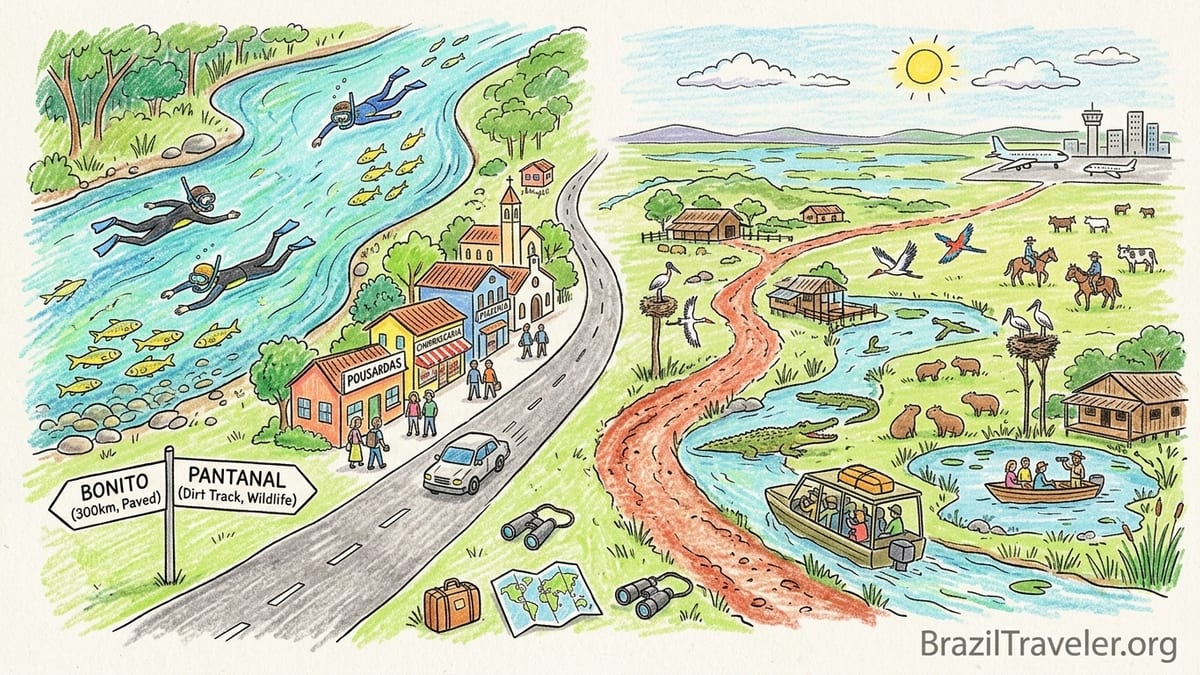
Both trips began the same way for me: stepping out of Campo Grande airport and into the heat. From there, Bonito and the southern Pantanal immediately diverge in feel. Bonito is a defined town with a clear end point. The road distance from Campo Grande to Bonito is around 300 kilometers, roughly four to five hours by paved highway in a private transfer or rental car. In practice, that meant a smooth drive, plenty of roadside gas stations and arriving right on Bonito’s main avenue with its cluster of tour agencies, restaurants and pousadas.
For the southern Pantanal, Campo Grande is more of a launch pad into a scattered landscape of fazendas and riverside lodges. Driving west, you follow BR‑262 to Pantanal gateway towns like Aquidauana and Miranda, roughly three hours and a bit more than four hours from Campo Grande respectively, before transferring to dirt tracks or lodge vehicles that push deeper into cattle ranches and floodplains. The last stretch to my lodge involved rumbling along red earth tracks, passing cowboys on horseback and capybaras grazing in roadside puddles. It felt like entering a different world, far removed from Bonito’s organized tourism grid.
In practical terms, travelers can efficiently combine both Bonito and the southern Pantanal through Campo Grande. One common loop is Campo Grande to Bonito, then back through the capital or directly across secondary roads towards Miranda or Aquidauana for a lodge stay, before returning to Campo Grande for onward flights. In my case, I started in Bonito, then returned via Campo Grande for a same-day transfer toward a Pantanal lodge. It made for a long day of driving but kept logistics straightforward.
Public transport is more workable to Bonito than to most Pantanal lodges. There are regular buses between Campo Grande and Bonito, which budget travelers combine with local shuttles. In contrast, Pantanal lodges generally require prearranged transfers from Campo Grande, Aquidauana or Miranda, sometimes bundled into packages. Independent travel to towns themselves is possible, but reaching the actual wildlife-rich wetlands usually means relying on lodge vehicles or boat transfers.
Where You Sleep: Town Pousadas vs Remote Lodges
My first night in Bonito was spent in a midrange pousada a short walk from the main street. The feel is very much a small Brazilian tourist town: tiled floors, air‑conditioned rooms, a breakfast room with fruit, cakes and pão de queijo, and staff who double as informal concierges for sorting out tours. Walking outside in the evening, I could pick between pizzerias, churrascarias and ice‑cream parlors, mingling with Brazilian families on vacation.
The southern Pantanal felt the opposite. Here, the “hotel” is usually a rural lodge or working fazenda adapted for tourism. My room in one such lodge held just a few other guests. From my porch I could see a lagoon with jabiru storks and caimans instead of a town square. Meals took place at shared tables, with set menus and simple, hearty dishes. At night the only lights were the stars and a few lamps around the main building. There was no wandering town to explore after dinner, only the sounds of frogs and distant cattle.
In Bonito, you book accommodation and activities separately. You might choose an affordable pousada slightly off the center or a boutique guesthouse with a pool. Either way, the feel is urban or semi‑urban, and you return to town every evening after your excursions. In the Pantanal, the lodge is your world. Packages usually include accommodation, all meals and a daily schedule of activities such as boat trips, vehicle safaris, horse rides and night outings. The separation from everyday life is part of the appeal, but it also means you need to be comfortable spending several days in one relatively isolated place.
If you like having restaurant choices, supermarkets and an evening promenade, Bonito’s town setting will suit you far better. If you prefer to step out of your room and immediately be surrounded by nature and wildlife, a remote Pantanal lodge offers that immersion in a way Bonito cannot.
How Booking and Costs Really Work
Bonito and the Pantanal differ sharply when it comes to how you pay for your experience. In Bonito, the cost structure is excursion‑based. You pay separately for each activity, usually at fixed official prices controlled by the municipality, and often book through local agencies. A classic flotation or snorkeling tour in Bonito’s clear rivers typically costs in the region of 290 to 350 Brazilian reais per person in 2025 for low season, with higher prices in peak periods. Entry to Gruta do Lago Azul, the famous Blue Lake Cave, generally falls around 120 to just under 200 reais per person depending on season. Each river, cave and attraction has its own ticket, and popular floats such as Rio da Prata or Rio Sucuri must be reserved in advance with set time slots.
Because of this, a day in Bonito can add up when you stack activities. On my own trip I might do a morning float and an afternoon visit to a cave or waterfall complex. With transportation, that meant two separate tickets plus transfers, pushing the daily spend well above accommodation alone. Agencies in Bonito provide updated tariff tables for 2025, and travelers should expect most marquee tours to sit in the mid‑hundreds of reais per person range, especially in high season holidays and Brazilian school vacations.
In the southern Pantanal, packages tend to roll everything together. A four‑day, three‑night stay at a comfortable lodge, including transfers from Campo Grande, full board and two activities per day, often runs to the low thousands of reais per person, or several hundred US dollars per night depending on lodge class and exchange rate. Some programs marketed to international visitors for 2025 quote per‑person prices for multi‑day stays that cover airport pickup, overland transfers to the lodge, accommodation, meals and guided outings. Once you arrive, you are not typically paying à la carte for each boat ride or horse trek, because they are part of the package.
That difference has a psychological impact. In Bonito, you feel the cost each time you add a river float or zipline. In the Pantanal, the upfront price can look steep, but once you are there daily spending may be limited to drinks, optional activities or tips. For budget travelers, Bonito offers more ways to control spending by choosing fewer or cheaper tours and cooking some meals, but the marquee experiences still have non‑negotiable fixed prices. In the Pantanal, independent bargain hunting is harder, but the per‑day value can be reasonable given that lodging, guided wildlife activities and food are bundled together.
Water vs Wildlife: What You Actually Do All Day
If I close my eyes and think of Bonito, the first image is always the same. I am lying face down in a river so clear that the pebbles look like they have been polished, drifting along with the current as schools of yellow piraputanga glide past my mask. Sunlight cuts through the water, picking out green riverweed and twisting roots. The guide in front of our small group wears a wetsuit and a snorkel too, occasionally pointing to a larger fish or gently tugging us back into the main current. This is Bonito at its best: soft‑adventure, controlled, incredibly scenic.
Most days in Bonito revolve around water. Flotation rivers like Rio Sucuri and Rio da Prata are the headline acts, but there are also boat rides with small rapids, waterfall circuits where you hike short trails and swim in natural pools, and sometimes adventure options like abseiling or ziplining inside sinkholes. Distances from town to the attractions vary from around 15 minutes to more than an hour and a half by road, but you always come back to your hotel in the evening. The rhythm is one or two half‑day tours per day, with the rest of the time spent strolling around town or resting by a guesthouse pool.
The Pantanal day rhythm is completely different. My most vivid memory is sitting in a small motorboat just before sunset, drifting slowly along a river while scanning the banks for movement. The guide would cut the engine, and we would sit in near silence, binoculars in hand, watching a capybara family slide into the water or a heron stalking fish. On another outing we crept along a dirt road at dawn in an open vehicle, eyes tracing every branch and termite mound in case a ocelot or, if we were lucky, a jaguar emerged. Sometimes the hours passed with no headline sighting, only the steady accumulation of caimans, giant otters, macaws and howler monkeys.
Where Bonito guarantees pretty scenery and contact with clear water, the Pantanal is about probability and patience. Some lodges tilt more aquatic, with daily boat trips and canoeing, while others focus on land safaris and horseback riding across pastures and wetlands. Weather and seasonal water levels shape the program. A “quiet” afternoon can still deliver a barrage of birds and reptiles, but there is no single postcard‑perfect activity that every visitor repeats in the same way as a Bonito float. The reward is that your days feel like a real wildlife quest, with unpredictable moments you cannot script.
Effort, Comfort, Heat and Mosquitoes
Neither destination is an extreme physical challenge for most reasonably fit travelers, but the type of effort is distinct. Bonito’s tours typically involve short walks on well‑marked trails, occasionally with steps down to river entry points or cave entrances. You float with life vests and wetsuits, carried by the current. The most demanding part for some visitors is managing the gear and repeatedly entering and exiting boats or rivers. During my floats, older travelers and children alike participated, and guides kept a close eye on anyone nervous in the water. It felt accessible and safe, with the main requirement being basic comfort in water and the ability to walk under the sun for a few minutes at a time.
The Pantanal shifts the challenge to long, hot hours outdoors. Sitting in an open vehicle or motorboat under the midday sun can be draining, even if you are not walking much. In the dry season, fine dust kicks up along roads. In the wet season, humidity climbs and sudden storms can drench you. I spent one afternoon alternately shielding my camera from rain and wiping sweat from my face as the guide steered through muddy tracks. None of it was technically hard, but it required tolerance for heat, dirt and a lack of climate‑controlled comfort during activities.
Mosquito experience varies strongly by season in both destinations. In Bonito, I noticed occasional mosquitoes around vegetation and at dusk, but they were rarely severe during river floats, perhaps due to flowing water and shorter exposure times. In the Pantanal, insect life felt far more present. At sunset around lagoons and on some night safaris, mosquitoes arrived in clouds around ankles and wrists, and I was grateful for long sleeves, repellent and sometimes even head nets. Lodges often provide mosquito screens and fans or air‑conditioning, but if you are particularly sensitive to bites, the Pantanal will likely test you more than Bonito.
Heat is a factor in both, especially from October to March. In Bonito you can retreat to shaded rivers and town cafés between tours. In the Pantanal, you may have a siesta break at the lodge but overall spend a larger portion of your waking time in open environments far from urban comforts. Travelers who dislike intense heat and insects may find Bonito easier to handle, while those ready to embrace some discomfort in exchange for wildlife encounters will accept what the Pantanal throws at them.
Food, Culture and Evenings
Bonito’s food scene reflects its role as a small tourism hub. My evenings often began with a walk down the central avenue past tour agencies, souvenir shops and restaurants advertising river fish, burgers and pizzas. It is easy to find a simple prato feito lunch plate or a sit‑down dinner with regional dishes like freshwater fish in sauce, accompanied by cold beer or caipirinhas. You choose where to eat and how much to spend. There are also supermarkets where you can stock up on snacks, water and fruit. The atmosphere after dark is relaxed, with families and couples out, but not loud or party‑oriented.
In the southern Pantanal, food is part of the lodge experience and usually included in the package. Breakfast might be a spread of coffee, fruit, eggs and local breads. Lunches and dinners tend to be buffet or plated meals with rice, beans, salads and meat, often beef or fish, and simple desserts. The recipes draw on rural Brazilian home cooking rather than restaurant experimentation. One evening I ate under a wide veranda while listening to frogs in a nearby pond, the air thick but cooled slightly by the night. There was no menu to choose from; you eat what the kitchen prepares, with some accommodation for dietary restrictions if arranged in advance.
Nights in Bonito can include small diversions such as visiting a snake education project, stopping at an ice‑cream shop or simply people‑watching in the center. In the Pantanal, evenings are quieter. After a night safari or boat ride, you may sit with other guests over a drink, compare sightings and then turn in early. There are no bars down the street, no music venues, and limited or no mobile signal depending on the lodge location. Travelers who enjoy a bit of nightlife or independent choice in dining will find more to engage with in Bonito. Those seeking digital detox, early bedtimes and the sounds of the countryside will appreciate the Pantanal routine.
Culturally, Bonito exposes you to a mix of Brazilian and international visitors, with a strong domestic family crowd. The Pantanal, particularly at wildlife‑focused lodges, tends to attract birders, photographers and nature enthusiasts from around the world, mingling with Brazilian guests who know the region well. Conversations at dinner tables often revolve around sightings, camera gear and animal behavior.
Photography, Families and How Much Time You Need
From a photography standpoint, Bonito and the Pantanal reward different skills. In Bonito, the star shots occur underwater. Getting clear pictures of fish and submerged roots requires a waterproof camera or housing and comfort operating it while floating. I remember trying to steady myself as the current pushed me along, angling the camera just as a large dourado flashed past. Above water, the landscapes are pretty but not dramatic; the magic happens below the surface. There are also postcard‑worthy moments at places like waterfalls, caves and lookout points, but fewer opportunities for big wildlife portraits.
The Pantanal is a wildlife photographer’s playground. Long telephoto lenses come into their own as you capture herons taking off, capybaras huddled beside caimans, and toucans on bare branches. On one morning drive, we spent twenty minutes watching a pair of hyacinth macaws delicately opening palm nuts, their cobalt feathers vivid against the pale sky. Good guides know how to position boats for backlighting at sunrise or approach roadside animals without causing them to scatter. Even casual photographers leave with memory cards full of birds and mammals. The trade‑off is that conditions can be harsh: dust, humidity and fast‑changing light challenge both equipment and skill.
For families, Bonito is generally more straightforward. Many activities welcome children with minimum age restrictions, such as flotation tours that accept kids from around 6 to 8 years old depending on operator, and calmer river or waterfall visits suitable for younger ones. Safety gear is standard. The town base allows one parent to stay back at the hotel with a tired child while another goes out on a tour with older siblings. Evening ice‑cream runs and short walks keep kids entertained without much planning.
The Pantanal can also be rewarding for families but requires more thought. Lodge days are longer and more structured, and young children may find multi‑hour boat rides or vehicle safaris tiring. Insects and heat can be hard on them too. That said, animal‑loving kids and teenagers often find the experience unforgettable, especially if they see charismatic species like giant otters or tapirs. Families might choose lodges with swimming pools or shorter activity options, and consider slightly cooler months to reduce discomfort.
As for trip length, I found three full days in Bonito to be the bare minimum to experience a couple of major river floats, one cave or waterfall complex and some relaxed town time. Four to five days allow you to pace tours and add an extra activity or rest day. In the southern Pantanal, a stay of three nights provides an introduction, but four to five nights at a lodge feel more satisfying, giving you multiple chances at good wildlife sightings in varying light and weather. For a combined trip, many travelers aim for roughly a week to ten days split between Bonito and the Pantanal, with transfers arranged via Campo Grande.
Who Will Love Each Destination, and Why They Work Better Together
After doing both back to back, I came away convinced that Bonito and the southern Pantanal are complementary more than they are competitors. Bonito speaks directly to travelers who prioritize clear, organized activities, soft‑adventure and visual beauty in a controlled setting. If you like the idea of guaranteed scenery, manageable half‑day excursions, comfortable town amenities and lots of water time, Bonito is an easy recommendation. It suits couples, families and first‑time Brazil visitors looking for nature without sacrificing comfort.
The Pantanal appeals to those who dream of being surrounded by fauna and are willing to trade some convenience for immersion. Birders, wildlife photographers and anyone excited by the possibility of seeing animals in their natural environment will likely feel at home on a Pantanal lodge deck at dawn with binoculars in hand. The days can be long and occasionally uneventful in terms of “headline” sightings, but the baseline level of wildlife is so high that even slow outings remain engaging. It is a destination for travelers who are patient, curious and comfortable with rustic or semi‑rustic conditions.
Crucially, the two experiences balance each other. After several hot, dusty days in the Pantanal, arriving in Bonito and slipping into a cool river feels almost luxurious. Conversely, after a few days of perfectly organized floats and neatly timed tours in Bonito, the wild uncertainty of the Pantanal reintroduces a sense of adventure. Logistically, connecting them via Campo Grande keeps backtracking minimal. From an emotional perspective, the combination takes you from underwater calm to wide‑sky wetlands, delivering a fuller picture of Brazil’s interior.
Planning both in a single trip requires watching the budget, since Bonito’s per‑activity prices can add up and Pantanal lodge stays are not cheap. Yet if you are already committing to reach Mato Grosso do Sul, it is worth considering at least a shorter taste of the other region. In my case, the memories that stand out most strongly are not either/or. They are the contrast between floating silently over Bonito’s pebbled riverbed in the morning and, a few days later, sitting in a boat in the Pantanal dusk, scanning the grass for the faint movement that might reveal a tapir’s shadow.
The Takeaway
If you have to choose only one, let your own travel personality guide you. Choose Bonito if you value clear water, easy logistics, family‑friendly soft adventure and evenings in a small, comfortable town. Choose the southern Pantanal if your heart beats faster at the thought of wild wetlands, early morning boat rides and the chance of seeing animals you have only encountered in documentaries.
From my own combined trip, though, the strongest recommendation is simple. If time and budget allow, do not force a choice. Use Campo Grande as a hinge, spend several days drifting along Bonito’s rivers, then head out toward Aquidauana or Miranda and trade the town lights for lodge decks and starlit wetlands. Together, Bonito and the Pantanal tell a richer story of inland Brazil than either can alone, balancing comfort with adventure and water clarity with wildlife abundance.
FAQ
Q1. Can I visit both Bonito and the Pantanal in one trip?
Yes. Many travelers connect both through Campo Grande, spending three to five days in Bonito for water activities and another three to five nights at a southern Pantanal lodge before flying out.
Q2. How far is Bonito from Campo Grande, and how do I get there?
Bonito is roughly 300 kilometers from Campo Grande by paved road. You can reach it in about four to five hours by rental car, prebooked transfer or intercity bus combined with local shuttles.
Q3. How far are the southern Pantanal lodges from Campo Grande?
Gateway towns like Aquidauana and Miranda sit about three to four and a half hours by road from Campo Grande. From there, lodge vehicles or boats usually take you the final stretch into the wetlands.
Q4. Which destination is cheaper, Bonito or the Pantanal?
Bonito lets you control costs by choosing how many excursions you book, but headline river floats and caves have fixed prices per person. Pantanal lodges look expensive upfront but bundle accommodation, meals and guided activities, often giving good value per day for intensive wildlife experiences.
Q5. Do I need to book tours in advance for Bonito?
Yes. Bonito uses a quota system for its main rivers and attractions. Advance reservations through agencies are strongly recommended, especially for popular floats, caves and peak seasons like Brazilian school holidays.
Q6. Is the Pantanal suitable for young children?
It can be, but families should consider heat, mosquitoes and the length of boat or vehicle outings. Lodges with pools and flexible activity schedules work better. Nature‑loving older children and teenagers usually enjoy it most.
Q7. When is the best time to visit Bonito for clear water?
Water clarity is generally good for much of the year, but months with less heavy rain tend to keep rivers clearer. Local agencies can advise for specific weeks, and travelers often favor drier months when runoff is lower.
Q8. When is the best time to visit the Pantanal for wildlife?
Many visitors aim for the drier months when receding water concentrates animals near remaining rivers and ponds, improving chances of sightings. Exact timing depends on your target species and lodge location.
Q9. How bad are mosquitoes in each destination?
In Bonito, mosquitoes are present but usually manageable with repellent, especially away from dusk and dense vegetation. In the Pantanal, insects can be intense in some seasons, particularly near water at sunrise and sunset, so long sleeves and strong repellent are essential.
Q10. Do I need to speak Portuguese to visit Bonito and the Pantanal?
Portuguese is very helpful, but not strictly required. In Bonito, agencies and some guides speak basic English or Spanish. In the Pantanal, wildlife‑oriented lodges that host international guests often provide English‑speaking guides, though general staff may speak mainly Portuguese.