

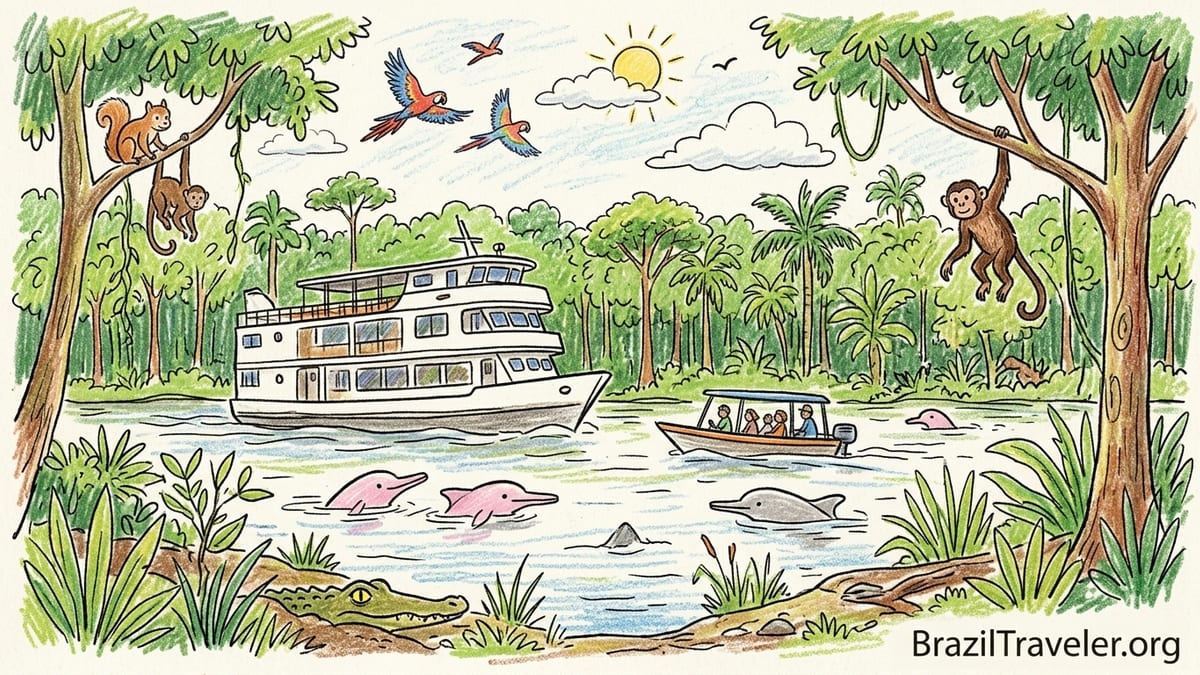
From glossy advertisements, an Amazon River wildlife cruise can look like a nonstop parade of pink dolphins leaping at sunset, macaws flying in formation and jaguars lounging on sandbanks. The reality, especially along an enormous working river system, is far more complicated, more subtle and, if you set your expectations well, more rewarding. To understand where the marketing ends and true expedition travel begins, I joined a multi day cruise in the Peruvian Amazon and kept a detailed log of every animal I actually saw.
The Cruise I Chose And What The Brochure Promised
I based this review on a 4 day / 3 night small ship itinerary in northern Peru, using a vessel comparable in size and style to boats operated by companies such as Delfin Amazon Cruises and Aqua Expeditions. These vessels typically carry around 30 to 40 passengers, sleep in air conditioned cabins and serve as a base for daily skiff outings into smaller tributaries, flooded forests and lakes rather than remaining in the main shipping channel. My departure point was Iquitos, the classic Amazon gateway city that is accessible only by air or river.
The operator’s brochure promised a wildlife focused expedition along sections of the Marañón and Ucayali Rivers, which together form the upper Amazon. The promotional images showed pink and gray river dolphins at arm’s length, multiple species of monkeys dangling over the skiffs, scarlet macaws exploding from clay banks and, in one especially dramatic shot, a jaguar staring directly into the camera from a river edge. The text mentioned Pacaya Samiria National Reserve, one of Peru’s largest protected areas, and highlighted “regular sightings” of river dolphins, caimans, sloths and “several monkey species.”
Before booking, I asked for specifics. The sample itinerary listed Iquitos as the embarkation point, three nights on board, and up to three excursions per day by motorized skiff or on foot. Maximum passenger capacity was just under 40, with one naturalist guide for every 8 to 10 guests. Guides were described as locally trained naturalists with at least five years of field experience and fluent English. The 2026 rack rate for a standard cabin in high water season on a comparable luxury expedition vessel is currently quoted at around 4,000 to 5,000 US dollars per person for three nights, including excursions and meals but excluding flights to Iquitos.
The wildlife “advertised” before booking fell into three tiers. First were the near certain species: pink and gray river dolphins, several kinds of herons and egrets, kingfishers, hawks, hoatzin, caimans and at least one monkey species. Second were “likely but not guaranteed” sightings such as three toed sloths, giant river otters and multiple monkey species. Third, almost as a throwaway, were “occasional” sightings of ocelot or jaguar, accompanied by that unforgettable big cat photo.
Itinerary, Boat And Onboard Life: How The Cruise Actually Ran
Our group of 32 passengers boarded in Iquitos and spent the first afternoon motoring several hours upstream on the main Amazon channel. The boat itself was three decks high with an open air observation lounge, dining room with river views and relatively stable, wide hull. Cabins had large windows rather than balconies, which matters if you plan to scan for wildlife in comfort during river transits.
Across four calendar days, the cruise scheduled a total of ten guided excursions: six by skiff, two forest walks, one village visit and one night boat outing. Due to a late arrival of cargo at Iquitos, our very first afternoon skiff ride was canceled, which meant we started wildlife viewing the following dawn instead. A midday thunderstorm later forced the guides to shorten one forest walk. In practice, we completed eight of the ten planned excursions in full, one in abbreviated form and lost one entirely.
The daily rhythm was demanding in a good way. Wake up calls came around 5:15 a.m., coffee and fruit at 5:30, and skiffs leaving soon after sunrise. Morning excursions lasted about three hours, when birds and monkeys are more active and temperatures remain reasonable. After brunch and a siesta, we headed out again mid afternoon for another two to three hours. Night outings departed after dinner to search for caimans, frogs and nocturnal birds along smaller creeks.
This structure matters when you evaluate value for money. On a three night, eight excursion program at roughly 4,500 dollars, you are effectively paying around 560 dollars per guided wildlife outing, not counting informal wildlife viewing from the main vessel. That ratio is not unusual for high end Amazon cruises, where the fare also covers crew, fuel, permits, gourmet food and comfortable accommodation. The question is whether those outings genuinely feel like field expeditions, or like short sightseeing rides tacked onto a floating boutique hotel.
Main River Versus Tributaries: Where The Wildlife Really Was
One of the key gaps between marketing and reality lies in where photographs are actually taken. Many brochure images imply that wildlife crowds the main Amazon channel, right beside large vessels. In practice, most of our meaningful encounters happened away from the highway of the river, in quiet blackwater creeks, oxbow lakes and narrow tributaries that larger ships cannot enter.
Ecologically, this makes sense. The central Amazon is a massive, sediment laden waterway used intensively for transport. Large barges, cargo boats, community ferries and long distance river buses churn up waves and carry engine noise for kilometers. Forest mammals and many birds prefer calmer edges, flooded forest interiors and smaller channels where they can forage, rest and avoid constant disturbance. Our naturalist pointed out that deep, fast flowing water near the main channel also offers fewer feeding niches for some fish species, which in turn shapes where predators, including dolphins and otters, concentrate.
On our first afternoon steaming from Iquitos, we saw only a handful of distant great egrets and neotropical cormorants perched on navigation markers. Two gray river dolphins surfaced briefly near a village, but always several hundred meters from the bow. Passengers who had arrived expecting a Serengeti style spectacle along the main river appeared deflated by sunset.
The mood shifted the next morning on a narrow side channel within the buffer zone of Pacaya Samiria. In a two hour skiff ride we logged multiple rufescent tiger herons, cocoi herons, great and snowy egrets, three species of kingfisher, black collared hawks and the unmistakable hoatzin clambering along low branches. Brown capuchin and squirrel monkeys crossed the canopy ahead of us, while pink river dolphins worked the confluence of a lagoon and creek. From that point on, expectations recalibrated. Wildlife was there, but usually where the big boat could not go.
What I Actually Saw: A Candid Wildlife Log
Because advertisements so often gloss over the unpredictability of nature, I kept a simple excursion by excursion log. I do not list species that other guests or the guide claimed but that I could not personally confirm with binoculars.
Across eight full excursions, I had confirmed sightings of pink river dolphins on six outings and gray river dolphins on four, usually at a distance of 30 to 100 meters. None of the encounters resembled brochure images of dolphins leaping close to the skiff; instead we watched their rounded backs and occasional fin tips break the surface in short feeding bursts. On one glassy calm morning a pair of pink dolphins lingered near our stationary skiff for about ten minutes, surfacing in a loose circle while the guide explained how seasonal flooding affects their distribution.
Birdlife was consistently rich. Over four days, with help from the guides and my own notes, I logged multiple heron species, three kingfisher species, horned screamers on distant sandbars, caracaras, black vultures almost everywhere, and colorful species such as parrots and macaws most often seen flying overhead rather than perched photogenically. The hoatzin, a quirky pheasant sized bird often highlighted in marketing for Pacaya Samiria, showed up reliably in flooded forest edges, though always at a modest distance.
Primates were less abundant than some passengers had hoped, but we still had productive encounters. We observed squirrel monkeys on three excursions, brown capuchin on two and a single brief sighting of howler monkeys deep in the canopy. Each sighting involved groups moving quickly, sometimes backlit against the sky, so good photography demanded fast lenses and more patience than typical brochure images suggest. We saw caimans during both the night boat ride and a dusk outing, mostly juveniles picked out by the red eye shine of the spotlight. One mid sized black caiman surfaced quietly within 15 meters of the skiff before slipping away.
Sloths, a star of Amazon marketing, proved genuinely elusive. After scanning hundreds of cecropia trees, we finally located one three toed sloth curled in a distant fork on the second full day and another gliding slowly down a trunk during a forest walk. Giant river otters and big cats remained completely absent. The guides were frank about this, explaining that even researchers can work months in prime habitat without seeing a jaguar. That message had more impact in person than any disclaimer in a brochure ever could.
Waiting, Misses And How Good Guiding Fills The Quiet
There were long stretches when seemingly nothing happened. On several mid morning and mid afternoon outings, especially when the sun climbed high, we motored for 20 or 30 minutes with hardly a bird in sight. Early in the trip some guests grew restless during these lulls, especially given the high fare and the sense of paying per hour for wildlife action.
Here the quality of guiding made a clear difference. Our lead naturalist, a Peruvian biologist with more than a decade of field experience, used quiet periods to explain seasonal flood dynamics, fish migrations and local conservation challenges. He pointed out subtle signs such as fruiting trees that attract primates, nest cavities excavated by woodpeckers and riverbank erosion near villages. When clouds rolled in and bird activity dropped, he discussed how communities in Pacaya Samiria manage fishing quotas and how climate patterns in recent years have altered flood timing.
Those explanations did not magically summon monkeys, but they changed how time felt. Instead of “waiting for something to show up,” the group began reading the landscape. On one slow stretch along a backwater lake, the guide had us sit with engines off while he softly imitated bird calls. For twenty minutes, nothing happened, then a pair of kingfishers approached, followed by a distant troop of squirrel monkeys crossing the trees behind them. The sighting felt earned, as if we had participated rather than simply consumed.
It is worth noting which excursions under delivered relative to expectations. The abbreviated forest walk after heavy rain produced little visible wildlife and a lot of mud, yet the guide used the time to highlight leafcutter ant trails, medicinal plants and camouflage strategies of insects. Passengers who came solely for charismatic mammals left that walk disappointed, but travelers curious about ecology still felt it added value. If your main goal is a long photo list, you might feel differently.
Gear, Boat Stability And The Reality Of Wildlife Photography
Advertising rarely shows you the unglamorous side of taking wildlife photos from a moving boat. Our skiffs were stable by Amazon standards, with padded seats and enough room for eight guests plus a guide and driver. Even so, low light at dawn and dusk, engine vibrations and constant movement made sharp images difficult, especially with long lenses.
Binoculars were essential. The cruise provided a limited number of shared pairs, but anyone serious about wildlife viewing should bring personal 8x or 10x binoculars. Many of our most rewarding moments, including watching a sloth change position or following a mixed flock of small birds through the canopy, happened too far away or too fast for casual naked eye viewing. Guests without binoculars often relied entirely on the guide to point and describe.
For photography, a camera with good performance at higher ISO settings and a relatively fast telephoto lens proved more useful than an enormous, heavy super telephoto. I used a 100 to 400 millimeter zoom and still found many situations challenging. On overcast mornings in flooded forest, shadows were deep and shutter speeds slow. A few guests tried to replicate brochure style images with phones alone and ended up with mostly silhouettes and distant dots.
Early morning and night excursions were the most productive for wildlife viewing, but also the most technically demanding for photographers. Spotlit night scenes, for example, are unforgiving. If your primary goal is professional level imagery comparable to marketing brochures, you may be better served by a specialist photographic charter with fewer guests per skiff, a looser schedule and guides accustomed to positioning boats for light as well as sightings.
Ethics, Animal Encounters And Why Jaguars Are Not Inclusions
Another area where advertisements gloss over nuance is how animals are encountered. Responsible Amazon cruise and lodge operators emphasize observation at a respectful distance, with no feeding, baiting or handling of wild animals. The cruise I joined aligned with this ethic. Guides kept skiffs at least several meters from river dolphins, never allowed guests to touch wildlife and declined suggestions to feed caimans or monkeys for better photos.
In contrast, there are still operations in parts of the Amazon Basin that offer staged encounters: feeding dolphins at fixed platforms so they approach swimmers, holding captive sloths for photos or spotlighting roosting birds at very close range night after night. These practices can stress animals, alter behavior and encourage human habituation that may make wildlife more vulnerable to hunting or harassment. When you evaluate a cruise, ask directly whether the company ever feeds wildlife, works with captive animals for photos or guarantees specific sightings.
The most misleading trope in Amazon marketing remains the casual inclusion of jaguar imagery, as if a big cat is simply part of the package. Scientific studies and long term fieldwork highlight just how elusive these predators are in dense rainforest habitats. Even in some of the best riverine jaguar areas of Brazil, dedicated wildlife operators frame jaguar viewing as a probability over several days, not a certainty. Along our Peruvian route, the guides were explicit that any big cat sighting would be extraordinary good fortune.
Framing jaguars or other apex predators as routine cruise inclusions sets travelers up for disappointment and can lead to pressure on guides to push boats too close to shy animals when they do appear. The most responsible expedition companies instead highlight the full spectrum of Amazon life, from insects and frogs to forest structure and human cultures, rather than a narrow checklist of trophy species.
Value, Cost Per Excursion And Would It Be Worth It With Fewer Sightings?
Breaking the fare down to a cost per guided excursion is a useful mental exercise. On our three night program, eight full outings plus one shortened walk came to roughly nine field activities. At around 4,500 dollars per person, that translates to approximately 500 dollars per guided excursion, not including incidental wildlife watching from the main vessel or self guided time photographing sunsets and river scenes.
Is that good value if wildlife turns out to be quieter than hoped? The answer depends on what you expect your money to buy. If you view the fare as a premium ticket to a wildlife performance, then any excursion without multiple charismatic mammals might feel like poor return. If you see it as paying for access to remote habitats, expert interpretation, safety, comfortable logistics and the chance to witness an enormous river system at work, the calculus shifts.
Comparing my actual experience with the package as advertised, I would say the cruise delivered strongly on comfort, guiding depth and variety of habitats visited, somewhat less strongly on density of large, photogenic animals and not at all on the implied possibility of big cats or giant otters. My satisfaction came less from ticking off species and more from understanding how water levels, human settlements and conservation policies shape what lives where.
Would I have felt the trip was worth it if our wildlife sightings had been limited to birds, a few distant dolphins and no monkeys or sloths at all? Honestly, at this price point, probably not. For that scenario, I would prefer a lower cost lodge based stay close to Iquitos or Manaus, where similar birding and river scenery are possible at a fraction of the cost. The premium fare of a dedicated expedition cruise only feels justified when guides can reliably access quieter tributaries and when at least some marquee mammals appear over several days, even if fleetingly.
Who This Kind Of Cruise Suits Best
The gap between marketing and reality narrows significantly when the right traveler books the right product. Birdwatchers who arrive with a field guide, patience and good binoculars are likely to feel richly rewarded even on slower days. Between herons, kingfishers, raptors, parrots and more specialized species like hoatzin and horned screamers, there was always something avian to scan for, even in heat and haze.
Dedicated wildlife photographers, on the other hand, should think carefully about group size, skiff capacity and schedule rigidity. A generalist luxury cruise with 30 to 40 passengers can certainly produce strong images, but you will share boat space with people whose priorities range from casual scenery to conversation. A specialist photographic charter with 8 to 12 guests, longer skiff sessions and guides trained to anticipate light conditions may justify its often higher price if your main objective is a professional portfolio.
Families with older children who are curious about nature, but not fixated on specific species, can do well on this style of cruise, especially when operators mix wildlife excursions with short village visits, piranha fishing or canopy walks where available. The early mornings and heat can be challenging for younger kids, and cabins on small vessels rarely offer expansive play space, so honest conversations about stamina and expectations are essential.
Casual nature lovers or travelers whose primary goal is to say they have “been on the Amazon” might find a smaller, simpler lodge or shorter river trip from Iquitos, Manaus or Puerto Maldonado more appropriate. These options often cost under 1,000 dollars for several days of activities and give a taste of jungle life without the premium price of a full expedition cruise. Travellers who care most about immersion in forest sounds, time in hammocks and occasional wildlife encounters may not require a high end boat at all.
The Takeaway
So, is an Amazon River wildlife cruise worth it? For some travelers, the answer is a resounding yes. If you value expert guiding, are realistic about what wild animals will and will not do on your schedule, and are more interested in ecosystems than guaranteed headline species, a multi day expedition cruise can be one of the most compelling ways to experience the world’s largest rainforest.
For others, particularly those guided mainly by brochure images of dolphins at arm’s length and jaguars on demand, the same trip could feel underwhelming and expensive. The main navigation channel of the Amazon is a powerful, busy waterway rather than an unbroken wildlife corridor. The real magic often lies in quieter tributaries and flooded forests that reward patience, early starts and a willingness to appreciate subtle signs of life as much as dramatic encounters.
Before you book, interrogate the marketing. Ask operators where their wildlife photos were taken, how often they enter protected areas like Pacaya Samiria or Anavilhanas, how many guests share a skiff, and whether they ever feed or handle animals. Request a sample daily schedule and count how many hours you actually spend in small boats or on trails. Then decide whether the cost per guided field hour feels right for your interests and budget.
If I were planning another Amazon journey tomorrow, I would still choose an expedition style cruise, but I would prioritize even smaller vessels, high guide to guest ratios and itineraries that focus on spending as much time as possible off the main river. I would board with a mental list of habitats, not species, I hoped to experience and treat every monkey, sloth or dolphin as a genuine privilege rather than an entitlement. With that mindset, the Amazon delivers its own, quieter kind of spectacle.
FAQ
Q1. Is an Amazon River wildlife cruise a good way to see lots of animals quickly?
In richer tributaries and reserves you may see varied wildlife over a few days, but sightings are never guaranteed and there are often long quiet periods.
Q2. How many days do I need on an Amazon wildlife cruise to feel it was worthwhile?
Three to four nights is usually the minimum to sample dawn, dusk and night excursions. Serious wildlife enthusiasts often prefer five to seven nights if budget allows.
Q3. Are pink river dolphins almost guaranteed on these cruises?
In many parts of the Peruvian and Brazilian Amazon, pink and gray river dolphins are seen frequently, but distances vary and close, photographic encounters are never assured.
Q4. Can I realistically expect to see a jaguar from a standard Amazon cruise?
No. Jaguars are very elusive in rainforest, and sightings from generalist cruises are rare strokes of luck, not normal inclusions, despite brochure photos.
Q5. What size boat is best for wildlife focused Amazon travel?
Smaller expedition vessels carrying 12 to 40 guests, with shallow draft and dedicated skiffs for side channel exploration, usually offer better wildlife access than large cruise ships.
Q6. Do responsible operators ever let guests hold sloths or feed dolphins?
Responsible operators avoid handling or feeding wild animals. If a tour advertises direct interaction with sloths, monkeys or dolphins, that is a red flag for wildlife welfare.
Q7. How important are binoculars and camera gear on an Amazon cruise?
Binoculars are essential for meaningful wildlife viewing. For photography, a camera with good low light performance and a telephoto lens is far more useful than a phone alone.
Q8. Are early morning and night excursions really worth the lost sleep?
Yes. Many birds and mammals are most active around dawn and dusk, while night outings reveal caimans, frogs and nocturnal species that are invisible at midday.
Q9. How can I tell if a cruise price is reasonable for what I get?
Divide the fare by the number of guided field excursions and consider what you are paying per outing, then weigh that against guide quality, habitat access and ship comfort.
Q10. Who is better off choosing a jungle lodge instead of a cruise?
Travelers on tighter budgets or those mainly seeking a sense of rainforest atmosphere, village visits and some wildlife, rather than extensive river exploration, often do better at a well run lodge.