


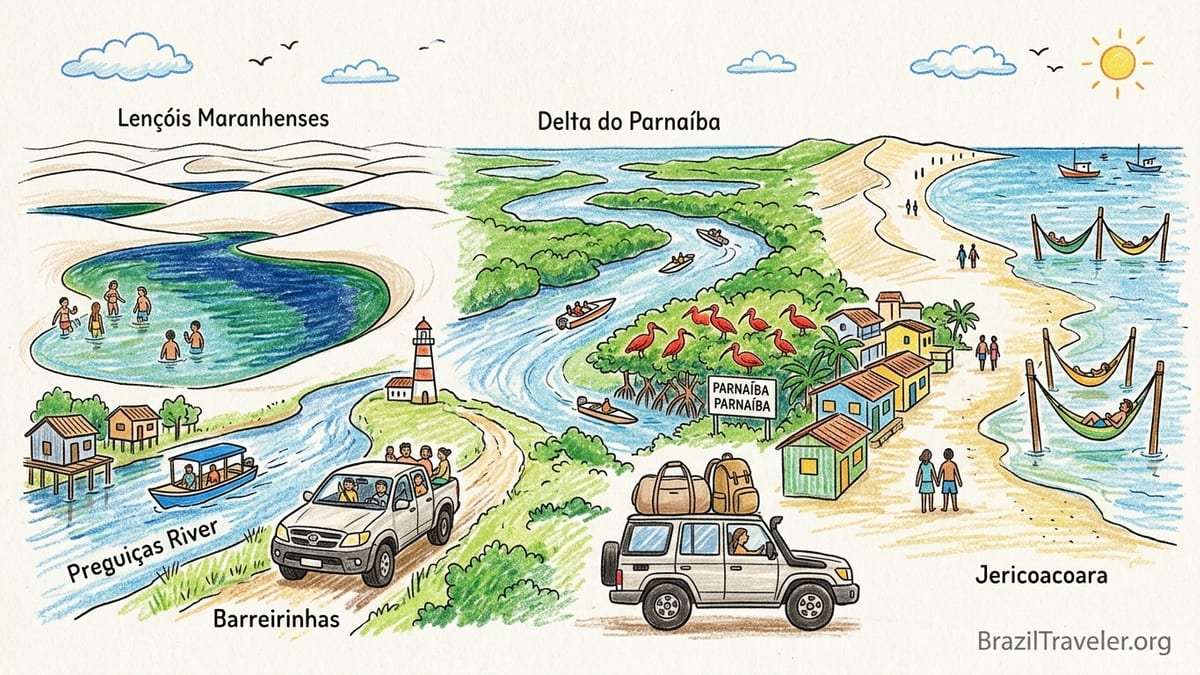
I had dreamed of the Rota das Emoções for years, tracing it with my finger on maps and agency PDFs before I ever set foot in Maranhão. In 2026 I finally committed, booking a seven-day package that stitched together São Luís, Lençóis Maranhenses, the Delta do Parnaíba and Jericoacoara into one continuous route. What follows is exactly how I traveled it, from my first airport transfer out of São Luís to my final sandy steps in Jericoacoara, with all the boats, 4x4s, fatigue, and small logistical victories in between.
Planning the Route and Choosing a Seven-Day Package
My starting point was not a romantic impulse buy, but a spreadsheet. I compared several 2025 and 2026 packages that covered the classic corridor between São Luís, Barreirinhas, Parnaíba and Jericoacoara, many of which now continue on to Fortaleza. One eco-focused operator advertised a seven-day and six-night “Rota das Emoções – Essencial” itinerary including overnights in São Luís, Barreirinhas, Parnaíba and Jericoacoara, plus the main tours in 4x4 and speedboat along the Preguiças River and the Delta, as well as a dune and lagoon tour in Jeri. Another regional agency showed a very similar 7-day product with departures scheduled for the second semester of 2026, priced around 4,990 reais per person in a double room, with shared transfers and mid-range pousadas.
These packages were my reference, but I ended up with a slightly customized version built on the same skeleton: arrival in São Luís, overland to Barreirinhas for Lençóis Maranhenses, onward to Parnaíba for the Delta, and finally on to Jericoacoara, ending my route in Fortaleza. I chose three nights in Barreirinhas, two nights in Parnaíba and three nights in Jericoacoara, spreading the trip across eight days instead of the tight seven. The idea was simple: I wanted the structure and logistics of a package, but with just enough slack to handle delays, bad weather or tired legs.
Prices in 2026 for the full route vary widely depending on hotel category and private versus shared services. I found shared 7-day programs in the 4,500 to 5,500 reais range out of São Luís with basic pousadas, while more boutique-oriented, small-group options climbed past 7,000 reais per person. The version I booked sat close to the middle: shared road and boat transfers, but with the option to pay extra for private legs if needed, and charming but simple pousadas everywhere. Air tickets into São Luís and out of Fortaleza were on my own, which kept the land package more transparent for comparison.
I also paid attention to timing. The lagoons of Lençóis Maranhenses are at their fullest roughly from June to early September, and by late September some of the smaller ones begin to dry. I booked for late July, aiming for deep blue and green lagoons without overlapping entirely with Brazilian school holidays, when the dune access roads, village restaurants and shared transfers can be very busy.
Day 1: Arrival in São Luís and Road to Barreirinhas
I landed in São Luís just before noon under a heavy, humid sky. At the arrivals hall I quickly spotted a driver holding a sign with my name and the agency logo. My main luggage was a 55-liter soft duffel plus a small backpack, which turned out to be a wise choice. Throughout the route, bags are loaded in and out of 4x4s, speedboats and vans, often on sandy or muddy ground, and soft luggage is much easier for the drivers to stack and strap than rigid suitcases.
The shared transfer from São Luís to Barreirinhas was scheduled for 14:00, which gave me a buffer for flight delays. Once the group was complete, we left in an air-conditioned minibus. The road is paved the whole way, roughly 250 kilometers, and agencies tend to estimate a 4 to 4.5 hour journey including a quick bathroom and snack stop at a roadside restaurant. In my case we left just after 14:15 and rolled into Barreirinhas around 18:30, the last stretch in dusk light under a warm, salty breeze from the Preguiças River.
In Barreirinhas the minibus made hotel-by-hotel stops. I was staying near the river at a pousada of similar standard to the three-star properties often listed in current packages. Check-in was quick and the receptionist handed me a small printed schedule for the next days, with pickup times for the lagoon circuit and the Preguiças River boat tour. I was surprised by how quickly the heat and travel caught up with me. Even in an air-conditioned vehicle, simply sitting for four hours after a flight left me heavy and slightly dehydrated. I drank nearly a liter of water that night and kept a dedicated “transfer day” bag with water, sunblock, a hat and snacks ready for the next morning.
That first evening I stayed close to the pousada, had grilled fish and rice at a simple riverside restaurant and was in bed by 22:00. In hindsight, starting the trip with an immediate transfer to Barreirinhas made sense; had I added a night in São Luís at the beginning, the overall route might have become too tight later on.
Exploring Lençóis Maranhenses from Barreirinhas
I spent three nights in Barreirinhas, and I am glad I did. Many packages compress the stay to two nights, fitting a Preguiças River tour and a single lagoon circuit. My agency had included two separate lagoon excursions: the classic “Lagoa Azul and Lagoa Bonita” circuit and an afternoon at other seasonal lagoons, plus the day-long Preguiças River speedboat tour to Caburé and nearby villages. All of these left directly from Barreirinhas and were organized in shared 4x4s and boats, the same format used in most current 7-day and 8-day products offered by regional operators.
The first lagoon circuit started around 14:00. A Toyota 4x4 pickup with benches in the back collected us at the pousada; our bags stayed in the room, as we were returning to the same hotel. The 4x4 crossed a sandy track and a small ferry over the river. Luggage handling here is light, but you do climb in and out of the truck bed on a narrow step, something to consider for anyone with reduced mobility. The ride to the park entrance took about 45 minutes, part dirt road, part deep sand, and was bumpy enough that I was grateful for the padded bench.
From the point where the driver stopped, we climbed on foot through loose sand to the top of the first dune. It was late July, early dry season, and the lagoons were still full, an intense blue against the white sand. Swimming in the lagoons after the dusty 4x4 ride felt like a reset switch. We visited several pools, swimming until nearly sunset, when the guide gathered everyone for the walk back. The descent was slow because some travelers were tired and the sand was still warm, but there was no rush; the vehicles waited below. We were back at the pousada by 19:30, enough time for a shower before dinner.
On the river day, pickup was just after 8:00. A short transfer took us to the floating piers, where our small duffel with cameras, dry bag and sunblock stayed near our feet. The speedboat had space for life jackets under each seat, and the guide asked us to keep bags toward the center to avoid splashes in wake zones. The Preguiças River exploration followed a pattern common in agency descriptions in 2026: stops at Vassouras with its “small Lençóis” dunes, Mandacaru with its lighthouse view and Atins or Caburé for lunch. The total time on the water was around four hours, broken up by walks on sand and boardwalks. It was a hot day, and by mid-afternoon even the breeze on the boat felt like air from a hair dryer. I reapplied sunblock repeatedly and was still a little pink by evening.
By the third night in Barreirinhas, accumulated heat and early starts were catching up with me. Three nights allowed one relatively relaxed morning with no scheduled activity, something I would strongly recommend. Two nights is enough to “tick the boxes,” but it leaves little margin for weather, tiredness or simply sitting with a caipirinha by the river to absorb where you are.
Crossing from Barreirinhas to Parnaíba and the Delta
On my fourth day the route turned west toward the Delta do Parnaíba. Most operators now connect Barreirinhas and Parnaíba with shared road transfers that can include a mix of paved highway and shorter sections over sand and dirt depending on the company. I had a shared transfer booked that left at 8:00 from my pousada. My main duffel and backpack were both coming along, so I made sure to pack anything I would need during the day (water, hat, snacks, a light long-sleeve shirt, power bank) in the smaller backpack, keeping it with me in the front of the van.
The journey is often advertised at around 4 to 5 hours, and my experience fit that range. We traveled first by van along paved roads, then switched to a 4x4 segment closer to the Piauí border where the paved surface gave way to more rural stretches. Agencies I researched later were charging roughly 450 reais per person in 2026 for this shared transfer, which aligns with what my combined package worked out to once I broke down the land costs. The ride was not as rough as the sand tracks inside Lençóis, but it was still tiring. The van’s air-conditioning did its best, yet the heat seeped in, and the mix of highway and dirt meant constant low-level vibration.
We reached Parnaíba around 13:00 and went straight to a small hotel in the historic center, near the Porto das Barcas area. Here, luggage handling was straightforward. The driver helped unload, but there was no need to drag bags over sand. My room was ready, and check-in included a briefing on the Delta tour for the next morning. I spent the afternoon walking slowly through the waterfront warehouses and having an early seafood dinner. Compared with Barreirinhas, Parnaíba felt less overtly touristy and more like a working town with a port, and I appreciated the quieter pace.
I stayed two nights in Parnaíba. In hindsight, this was the minimum amount of time I would recommend if the Delta is important to you. Some compressed itineraries only stop for a single night, tying arrival from Barreirinhas directly to an afternoon boat trip and then leaving the next morning. That is logistically possible, but it would have left me exhausted, and any delay in the road transfer could have jeopardized the boat excursion.
Boat Day in the Delta do Parnaíba
The Delta do Parnaíba section of the route is as much about the logistics as the landscape. My Delta tour started with a 7:30 pickup at the hotel. A van collected guests from several pousadas and drove us to the port area, where we boarded a regional schooner-style boat shared with other groups. More upscale packages sometimes use smaller speedboats, but my mixed group vessel was comfortable enough, with a shaded deck, plastic chairs and a simple bar for cold drinks.
Luggage for this day stayed at the hotel. That alone made the day feel lighter compared with the travel days. I brought only my backpack, dry bag, swimwear, hat and camera. The crew asked everyone to store backpacks under seats or toward the front to keep walkways clear. Once we left the port, the boat threaded its way through the river channels, passing sandbanks dotted with mangroves and, gradually, more remote islands.
The classic highlight is the “revoada dos guarás,” the evening return of scarlet ibis to their feeding areas. Most 2026 itineraries from reputable operators still time their Delta excursions to arrive near the mangrove islands in late afternoon, allowing guests to watch dozens or hundreds of bright red birds gathering in the trees. My boat followed that same plan. Before sunset we also stopped at a large dune field where we walked barefoot on warm but bearable sand, then slid down to the water’s edge. Returning up the dune was sweaty work and reminded me that the route rewards at least moderate fitness.
We returned to the port in Parnaíba just after dusk. By the time the van dropped me back at the hotel it was nearly 19:30. Heat fatigue hit again; even with the breeze on the river, a full day outside in the sun was draining. I ate at a restaurant a short walk from the hotel and made a point of drinking coconut water and juice instead of alcohol. The next day would be another transfer day, this time toward Jericoacoara, and I had learned by then that showing up already dehydrated was a mistake.
Looking back, the Delta section was one of my favorite parts of the trip, precisely because it is often rushed. Overnighting two nights in Parnaíba allowed me to experience not only the boat tour but also a calm evening in the historic center and a slow morning before the onward journey. On a strict seven-day schedule it would be tempting to cut the Delta short, but I would only do so if you are absolutely forced to choose between it and more time in Lençóis.
From Parnaíba to Jericoacoara: Road, Sand and the Final Stretch
The transfer from Parnaíba to Jericoacoara is where the romantic image of the Rota das Emoções meets the reality of road timetables and vehicle changes. There are two main ways to do it in 2026. Many agencies use a combined transfer that runs by road as far as Jijoca de Jericoacoara or another inland point, then switch to a 4x4 for the final sandy approach to Jeri. Other, more adventurous options include longer stretches along the beaches and dunes by 4x4, but these depend heavily on tides and are mostly arranged as private services at higher prices.
In my case, I had a shared transfer included in the package. We left Parnaíba at 7:30 in an air-conditioned van. My duffel and the other checked-style luggage were stacked in the back, covered with a tarp to protect from dust when the back door stayed open during short stops. The road to Jijoca was paved but narrow in parts. A direct shared service can take between 4 and 5 hours according to the operators I compared, and that was my experience, with a bathroom stop midway at a small roadside snack bar.
We reached the Jijoca area around noon, where the van pulled into a support point near one of the lagoon-side restaurants. Here, luggage handling became more hands-on. Each passenger collected their bag from the van and handed it to the 4x4 driver, who stacked everything on a rear rack and covered it with a canvas cover, tightening straps around the load. Daypacks and handbags stayed with us in the passenger area. This switch took about 20 minutes, long enough to use the bathrooms and stretch my legs before the final leg.
The ride from Jijoca to Jericoacoara village was the bumpiest of the trip. The 4x4 followed sandy tracks through low dunes and vegetation before crossing a broad stretch of firmer sand closer to the beach. It took roughly 45 minutes, occasionally slower when we fell in line behind other vehicles. The vehicle had air-conditioning in the cab, but the heat still built up, and I could feel sweat soaking into my shirt even while seated. This is the sort of leg where the romance of “remote Jeri in the dunes” coexists with practical discomfort. By the time we reached the village entrance and the driver began dropping travelers at their pousadas, everyone was a little wilted.
My pousada was close to the village center, along a sandy side street. There are no conventional roads in Jericoacoara, only sand, so the 4x4 stopped at the corner and I carried my duffel the last 50 meters. It was a reminder to keep luggage manageable; anything heavier would have been a slog under the midday sun. Check-in was efficient, and the staff were used to guests arriving covered in fine sand from the transfer. They immediately offered water and pointed me toward the shaded courtyard where I could sit until my room was finalized. I had arrived.
Life in Jericoacoara: Dunes, Lagoons and Slow Time
I spent three nights in Jericoacoara and could have stayed longer. Where Barreirinhas and Parnaíba felt like bases for day tours, Jeri felt like a destination in its own right. My package included a full-day buggy tour of the east side, visiting places such as Arvore da Preguiça, the blue and turquoise lagoons inland and some dune viewpoints. It also banked on the simple rituals that make Jeri special: walking to the top of the main dune for sunset, wandering the sandy streets at night and swinging in hammocks over shallow water.
The east side buggy tour left around 9:00 from my pousada. Once again, big bags stayed in the room; I carried only a backpack with water, camera and a towel. The buggy’s luggage space is small, so most people traveled with just daypacks. The driver warned us that there would be intense sun and reflection off the sand and water. Even with long sleeves and a hat, I felt the heat strongly by midday. We stopped at one of the popular lagoon complexes where you can pay for a shaded table, order lunch and use hammocks and floating platforms. These structures, often mentioned in current agency descriptions, are simple but effective: wooden decks, plastic chairs, net hammocks strung over shallow water and bars serving grilled fish, shrimp and ice-cold beer or juice.
The tour lasted until late afternoon, and by the time we returned my legs and face were deeply tanned. Heat fatigue was at its peak here. Unlike the largely seated experiences in the vans and boats, Jericoacoara asks you to walk more, climb dunes for sunset and stand in sand during photo stops. I adapted by taking a slow morning on my second full day, only going out after 16:00 to walk to the main dune and watch the sun sink into the ocean, a ritual that costs nothing but might be the best “tour” of the whole route.
My three nights in Jeri felt balanced. A shorter, two-night stay would have allowed one buggy tour and one sunset, but it would have left less time simply to be in the village, feel the rhythm and recover from the previous transfers. On the other hand, extending Jericoacoara to four or five nights without adding extra excursions, such as west-side tours to Tatajuba or kitesurfing sessions, might make the route feel weighted too heavily toward one end. For an eight-day São Luís-to-Fortaleza journey, three nights were just right.
Most 2026 packages now offer the option to continue from Jericoacoara to Fortaleza by road transfer in a shared 4x4–van combination similar to the Parnaíba leg. My route followed that pattern: a 4x4 picked me up at the pousada, drove me across the sand back to the Jijoca or Preá area, and then I transferred to a larger, air-conditioned vehicle for the paved drive to Fortaleza, where I spent my final night before flying out. As with the arrival, luggage was frequently loaded and unloaded, but the routine had become second nature by then.
What I Would Change: Pace, Nights and Missed Stops
Looking back at my actual trip and the current 7-day and 8-day itineraries available in 2026, there are a few specific things I would adjust if I were to repeat the Rota das Emoções. The main tension is between seeing everything and not turning the route into a forced march from one vehicle to another. My eight-day version with three nights in Barreirinhas, two in Parnaíba and three in Jericoacoara felt close to ideal, but even then I wished for one extra day at the very beginning or in the middle to break the cycle of early wake-ups.
The most obvious candidate for more time is Lençóis Maranhenses. I stayed only in Barreirinhas, which offers excellent access to the classic lagoon circuits and the Preguiças River, but I did not sleep in Atins or Santo Amaro. Some specialized itineraries in 2026, including those run by trekking-focused operators, already include nights in Atins and sometimes Santo Amaro, moving travelers between different gateways to the park. If I could add three more days, I would likely spend one extra in Barreirinhas for a slower day, one in Atins for a change of scenery and one in Santo Amaro for quieter, less crowded lagoons, accepting that this would stretch the whole route toward 10 or 11 days.
The area where I felt slightly rushed was Parnaíba and the Delta. Two nights allowed a high-quality Delta experience but left no room for a second excursion or a detour to neighboring beaches such as Barra Grande. On a strict seven-day São Luís-to-Fortaleza route, some travelers choose to skip the Delta entirely, traveling more or less directly between Lençóis and Jericoacoara by long 4x4 transfers. Having done the Delta, I would not recommend skipping it unless your time is extremely limited. Instead, I would suggest trimming perhaps one night from Jericoacoara if necessary, especially for travelers more drawn to nature and birdlife than to beach bars.
Another decision point is whether to begin with a night in São Luís. My package effectively used São Luís as a transit point, taking me straight to Barreirinhas after arrival. Some of the larger 2026 itineraries include at least one night in the historic center, which I skipped. If colonial architecture and city walks appeal to you, I would consider adding a full day in São Luís at the start, then keeping the rest of the route as I traveled it. The trade-off would be either a longer total trip or one fewer night in Jeri or Barreirinhas.
Overall, I do not regret following a structured package. The complexity of coordinating boats, 4x4s and tide-dependent segments along an underdeveloped coast is real. While there are independent travelers who piece together local buses, on-demand transfers and improvised stays, particularly between Parnaíba and Jijoca, I preferred the security of knowing that my seat in the van, boat or buggy was confirmed and that someone else was monitoring the schedule in relation to tides and road conditions.
The Takeaway
Traveling the Rota das Emoções from Lençóis Maranhenses to Jericoacoara is not a gentle resort holiday. It is a sequence of early alarms, long transfers, hot afternoons and repeated cycles of packing and unpacking. Yet each of those transitions delivers you to something remarkable: the mirror-like lagoons of Lençóis, the braided channels of the Delta, the soft evenings of Jericoacoara. In my trip, no single day was perfect, but the route as a whole felt like a coherent story threaded along the coast.
If you are considering a similar journey, I would encourage you to think in terms of nights and energy rather than just boxes to tick. Ask yourself how many dawn wake-ups you can enjoy before they become a chore, how much time you need in water or under shade to balance hours in a van seat. Look carefully at current 7-day and 8-day packages, especially how they distribute nights between São Luís, Barreirinhas, Parnaíba and Jericoacoara, and do not hesitate to stretch the route by one or two days if your budget allows. A modest increase in total cost and time can transform the experience from a rushed sequence into a trip where you actually feel the places you are passing through.
Finally, pack as if you will carry your luggage through sand more than once, because you will. Favor a soft, manageable bag, keep a small backpack ready with your daily essentials, and treat hydration and rest as non-negotiable parts of the itinerary. The Rota das Emoções rewards those who show up not just with a camera, but with enough energy left to climb one more dune for sunset, step into one more lagoon and let the wind and salt and light do their work.
FAQ
Q1. How many days do I really need for the Rota das Emoções between Lençóis Maranhenses and Jericoacoara?
Most structured packages in 2026 offer the full route between São Luís and Fortaleza in seven or eight days, with at least one night in São Luís, two in Barreirinhas, one or two in Parnaíba and two or three in Jericoacoara. I traveled it in eight days and felt that was the minimum for a comfortable pace. If you want to add nights in Atins or Santo Amaro within Lençóis, or spend more time in Jeri, consider 10 to 11 days.
Q2. How much does a complete 7-day package cost in 2026?
In my research I found specialized operators charging around 4,500 to 5,500 reais per person in a double room for a seven-day land package connecting São Luís, Barreirinhas, Parnaíba and Jericoacoara, usually ending in Fortaleza. These prices generally include accommodation with breakfast, shared transfers by van and 4x4, and key tours such as a Lençóis lagoon circuit, a Rio Preguiças boat outing and a Delta do Parnaíba excursion, but not flights.
Q3. How are the road and sand conditions between Barreirinhas, Parnaíba and Jericoacoara?
The main roads between São Luís, Barreirinhas and Parnaíba are paved but can be narrow or patched in places. The sandy access tracks inside Lençóis and the final stretch between Jijoca and Jericoacoara are on deep sand and require 4x4 vehicles with experienced drivers. Expect bumpy sections, especially in the dune areas, and allow for slightly longer travel times than the distance alone might suggest.
Q4. Is it better to book a package or arrange everything independently?
I chose a package because of the complexity of lining up boats, 4x4s and transfers that depend on tides and local conditions. Many reputable agencies now offer modular seven- and eight-day products that cover the classic corridor, and having those logistics pre-arranged allowed me to focus on the experience. Independent travel is possible, especially if you speak Portuguese and have flexible time, but it usually requires more planning and a higher tolerance for last-minute changes.
Q5. When is the best season to see the lagoons in Lençóis Maranhenses full?
The lagoons usually reach their highest levels between about June and early September, after the rainy season has filled the depressions between the dunes. I traveled in late July and found the lagoons in excellent condition, with enough water for swimming and bright blue and green colors. By late September and October some smaller lagoons may start to dry, although conditions vary from year to year.
Q6. How did you manage luggage with so many transfers and 4x4 segments?
I traveled with one medium soft duffel and a small backpack, and I was grateful not to have a hard suitcase. On road segments, the duffel was loaded into the rear of vans or strapped to racks on 4x4s, often covered by a tarp or canvas. For boat tours and day excursions, larger bags stayed at the hotel and I carried only the backpack with water, sun protection, a towel and electronics. Keeping luggage light and flexible made it easier to handle sandy streets and repeated loading and unloading.
Q7. Did you feel rushed at any point on the route?
Even with eight days I felt that Parnaíba and the Delta could have used one more day if I wanted to add extra excursions or explore nearby beaches. The seven-day packages I compared looked particularly tight, with limited downtime between early departures and full-day tours. The sections that felt most crowded timewise were the travel days that combined transfers and activities, such as arriving in Parnaíba from Barreirinhas and preparing early for the next morning’s Delta tour.
Q8. Is Jericoacoara worth the long transfer at the end?
For me, yes. Jericoacoara is more than just another beach town; it is a car-free village on sand, with daily dune sunsets and nearby lagoons that feel like natural swimming pools. The final 4x4 stretch from Jijoca into the village is hot and bumpy, but arriving and stepping onto sand streets with no asphalt feels like crossing a threshold. The three nights I spent there gave the route a soft landing after the more intense touring days in Lençóis and the Delta.
Q9. Can I skip the Delta do Parnaíba and travel directly between Lençóis and Jeri?
Some travelers do skip the Delta, arranging long 4x4 or combined van and 4x4 transfers directly between Barreirinhas and Jericoacoara or between São Luís and Jijoca. That can save a day or two, but it means missing the unique ecosystem and birdlife of the Delta. Having experienced it, I would only advise skipping the Delta if your time is extremely limited and your primary focus is on dunes and beach.
Q10. How physically demanding is the Rota das Emoções?
The route does not require technical hiking, but it is physically demanding in other ways. You will climb dunes in deep sand, often under strong sun, walk across uneven terrain during lagoon and Delta stops, and sit for several hours at a time in vans and 4x4s on hot days. Good sun protection, hydration, comfortable walking sandals or shoes and a willingness to rest when possible make the experience much more enjoyable.