


When I first planned to travel from Rio de Janeiro to Paraty, I underestimated how big a journey it would be. On the map it looks like a simple coastal hop. In reality it is a 230 to 250 kilometer transfer that can shape the start of your Paraty stay, especially if you are landing at RIOgaleão after a long international flight. Here is exactly how I made the trip, what went smoothly, what I would change next time, and how today’s transport options compare for different types of travelers.
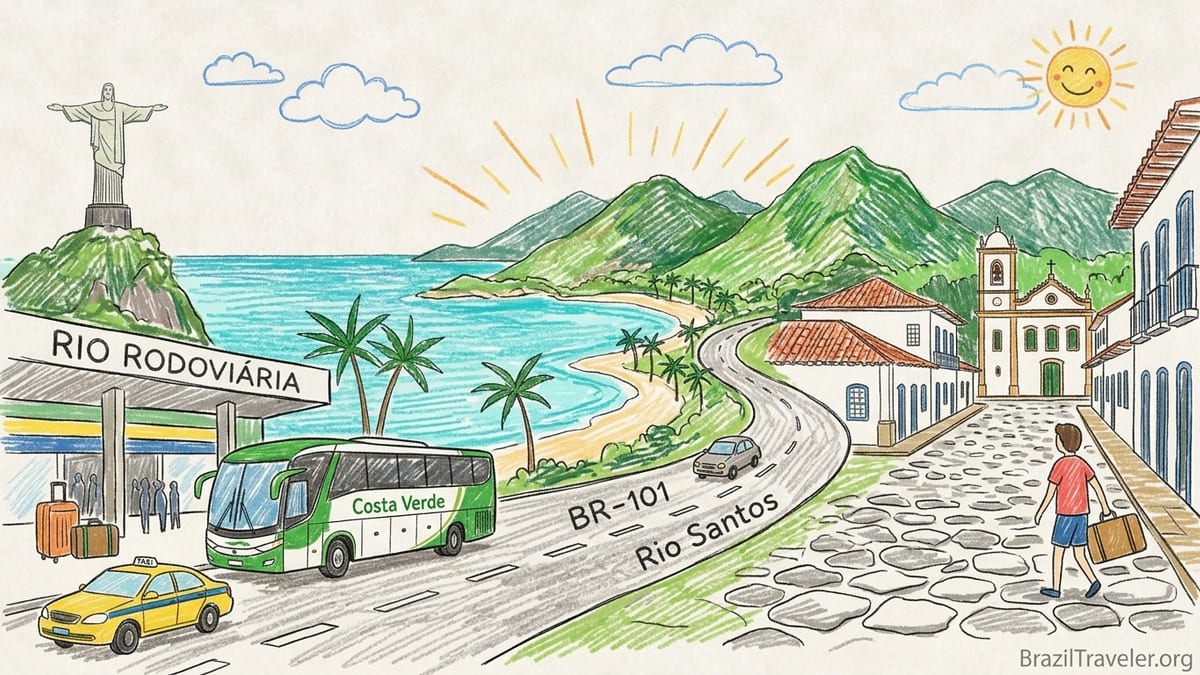
My Real Journey: From Copacabana to Paraty by Bus
I started my journey in Copacabana, staying two blocks behind Avenida Atlântica near Posto 4. I decided to use a scheduled intercity bus rather than a rental car or private transfer. That meant my first step was crossing the city to Rodoviária Novo Rio, the main long distance bus terminal on Avenida Francisco Bicalho, in the Santo Cristo area. I booked a mid-morning coach run by Costa Verde, the long established operator on the Rio to Paraty route, whose departures are still concentrated at Novo Rio.
I left my hotel at 7:45 a.m. with a medium suitcase of about 18 kilograms, a carry-on sized backpack and a small daypack. Yellow metered taxis were queueing on Rua Barata Ribeiro, but I booked a ride app to control the price and avoid the airport style surcharges. The ride from Copacabana to Novo Rio took about 25 minutes with light traffic through the Túnel Rebouças corridor and along Avenida Paulo de Frontin, and cost roughly what current app quotes still show for this route, which is in the range of 35 to 50 reais depending on time and demand. The driver dropped me at the Costa Verde bay on the upper level of the terminal, which meant I only had to navigate a short ramp with my luggage.
At the ticket counter Costa Verde staff weighed my suitcase briefly and tagged it for the hold. The process was straightforward, and at check-in they confirmed what current schedules also show: direct services from Novo Rio to Paraty generally take between 4 hours 30 minutes and 5 hours, depending on time of day and intermediate stops in places like Itaguaí or Angra dos Reis. Ticket prices on the day matched what booking sites still list for the route, roughly in the 120 to 160 reais range per person for a conventional or semi-reclining coach seat. I boarded a 9:00 a.m. departure and settled into a window seat on the right hand side for the sea views.
The bus left the platform almost exactly on time. Leaving central Rio, we took Avenida Brasil and then joined the BR-101 Rio Santos highway, the coastal road that snakes southwest past Mangaratiba and Angra dos Reis before reaching Paraty. Federal and state sources still describe Paraty as being around 240 kilometers from Rio de Janeiro along this route, with much of the way following the coast between beaches and Atlantic Forest hills. The coach was about two-thirds full, with a mix of Brazilian families and a handful of foreign travelers, all of us prepared for a long but scenic ride.
On the Road: Traffic, Comfort and Real Door to Door Timing
The first hour out of Rio was the least pleasant part of the journey. Although I traveled on a weekday outside major holidays, there was slow moving traffic leaving the metro area as trucks, local buses and commuters all funnelled onto BR-101. We crawled through several short bottlenecks near Itaguaí, adding perhaps 20 to 30 minutes beyond the theoretical schedule. Once we had passed the industrial belt, the pace picked up and the landscape changed quickly from concrete and warehouses to bays dotted with islands.
From Mangaratiba onwards the Rio Santos highway lived up to its reputation as one of Brazil’s most beautiful coastal drives. Between Mangaratiba and Angra dos Reis the road alternated between sea level stretches with glimpses of beach kiosks and elevated curves cut into the hillside. Later official descriptions of the highway emphasize how it passes a chain of resorts including Mangaratiba, Angra dos Reis and Paraty, with the pavement squeezed between steep green slopes and the Bay of Ilha Grande. That matched what I saw from my window: small fishing villages, marinas with speedboats, and the occasional glimpse of a hidden cove.
Comfort on board was adequate but not luxurious. My Costa Verde bus was a standard coach configuration with semi-reclining seats, air conditioning that veered from slightly too cold to slightly too warm, and a basic onboard toilet. There were no seat-back screens or power outlets on the bus I rode, although some updated fleets on this route now advertise USB ports. The driver announced a single longer rest stop at a highway service station outside Angra dos Reis. There I was able to buy a hot snack, bottled water and coffee, and use a cleaner bathroom than the onboard one. The 20 minute pause broke the trip into more manageable segments and allowed passengers to stretch their legs.
The approach to Paraty was slower than I expected. The final section of BR-101 is winding and in some stretches reduced to a single lane each way, which makes overtaking trucks difficult. Sources that describe the region as mountainous are not exaggerating: the road runs between Atlantic Forest covered slopes and mangrove fringes, and speed limits are more conservative than on inland motorways. We reached Paraty’s small bus station on the edge of the historic center at about 2:20 p.m., meaning my 9:00 a.m. departure translated into roughly 5 hours 20 minutes of travel, including the rest stop and traffic delays.
Arrival in Paraty: Cobbled Streets and the Last Few Hundred Meters
Paraty’s rodoviária is a modest terminal located a short walk from the colonial center. From there my journey was not quite finished. I had booked a guesthouse inside the historic center, near the Church of Santa Rita, which meant navigating streets famous for their uneven cobblestones. This is where transport logistics matter. Motor vehicles are restricted in much of the core, and even where they are allowed, cars and vans struggle on the large, rounded paving stones laid out in the Portuguese colonial era.
I chose to walk the final 800 meters rather than hire a local taxi, thinking it would be a gentle stroll. With a backpack the walk would have been delightful. With a rolling suitcase, it was a different story. The small plastic wheels bounced and snagged on the stones, and at one point I had to carry the suitcase in my arms for an entire block. By the time I reached the pousada, my arms and shoulders were tired and the suitcase showed visible scuffs. I checked in around 2:45 p.m., so the true door to door travel time from my Copacabana hotel to my Paraty guesthouse was close to 7 hours.
What did work well was the human scale of Paraty on arrival. Even as I wrestled with the suitcase, I could smell the sea and hear people talking in small bars and cafés. The setting between the bay and the mountains felt intimate compared with Rio. The pousada owner later confirmed what local guides and tourism documents still point out. Paraty is physically small, but it is wedged between the Serra da Bocaina slopes and the ocean, with road access concentrated along BR-101 and a single paved road linking down from the highlands. That geography makes arrival by road almost inevitable and helps explain why the Rio transfer feels like an integral chapter of any Paraty trip, not an afterthought.
If I had been arriving with children or larger bags, I would not have walked. Many pousadas in or near the historic center now coordinate pick-ups with small electric carts, or advise guests to stop a taxi just outside the cobbled zone. That is worth considering if you carry heavy luggage or arrive late at night when the streets are quieter and lighting is softer.
What I Would Change Next Time
Looking back, there are three main aspects of my journey I would handle differently. The first is the timing of my departure from Rio. Leaving Copacabana at 7:45 a.m. for a 9:00 a.m. bus meant traveling during the end of the morning rush, when traffic leaving the Zona Sul and crossing the central area can still be heavy. If I repeated the bus option, I would either choose a slightly later departure, around late morning, to miss the peak, or an earlier one with a longer buffer at the terminal. Novo Rio has basic cafés and waiting areas, but I would rather drink slow coffee at the rodoviária than anxiously watch the minutes tick down from a taxi stuck in a tunnel.
The second change would be luggage strategy. Knowing what I know now about Paraty’s cobblestones and restricted traffic, I would pack into a backpack or duffel bag that I can carry on my shoulders instead of a wheeled suitcase. Travel reports from recent years consistently mention the difficulty of rolling bags over the stones, and my own experience confirmed that. For travelers who need a suitcase, I would suggest a hard shell with large rubberized wheels and perhaps arranging a short taxi ride from the bus station to the closest accessible corner to your accommodation.
The final change would be my choice of transport overall. For a solo traveler on a moderate budget, the Costa Verde bus remains very good value. However, I underestimated how tiring a five-hour coach ride after several busy days in Rio can be. After researching today’s options, I would seriously consider a shared shuttle or private transfer next time, particularly if I were starting at RIOgaleão or Santos Dumont airport rather than an in-city hotel. The door to door convenience, especially when carrying luggage and traveling with others to share the cost, can justify the higher price.
The one element I would absolutely keep is the coastal route itself. Whether you are behind the wheel of a rental car, on a shuttle or on a bus, the stretch around Angra dos Reis and along the Bay of Ilha Grande is one of the most scenic bits of highway in Brazil. I would plan snacks, water and a fully charged camera or phone so that I could focus entirely on the view, rather than on navigating tickets or worrying about arrival logistics.
Today’s Main Transport Options from Rio to Paraty
Travelers in 2026 have four main practical ways to reach Paraty from Rio de Janeiro: scheduled bus, shared shuttle, private transfer and rental car. Each one uses roughly the same roads, but they feel very different in cost, comfort and control. All distances center on the fact that Paraty sits approximately 240 kilometers from Rio along the BR-101 Rio Santos corridor, with RIOgaleão airport frequently cited as the nearest large hub with regular jet services.
The scheduled bus remains the backbone of public transport on this route. Costa Verde is still the primary operator linking Rodoviária Novo Rio and Paraty with several departures per day, with journey times around 4 hours 30 minutes to 5 hours depending on intermediate stops. Fares as of late 2026 often sit around 130 to 170 reais per person for a standard or semi-leito seat, with some variation between weekdays and peak holiday periods. Tickets can be bought at the terminal ticket office or via Brazilian bus booking platforms, and luggage in the hold is included within generous weight limits typical of domestic coach travel.
Shared shuttles are a middle ground between the bus and a full private transfer. Several Rio based tourism and transfer companies now sell per seat transfers from RIOgaleão or Santos Dumont to Paraty, sometimes stopping at major Zona Sul hotels along the way. These services generally operate in 12 to 20 seat vans or minibuses and include hotel or pousada drop off in Paraty, which removes the stress of the final connection from the bus station. Current advertised prices often range from around 350 to 450 reais per person depending on company, currency fluctuations and whether the shuttle leaves from the airport or a city neighborhood.
Private transfers are the most comfortable but also the most expensive option. Executive transfer providers and some Paraty based agencies quote door to door rates from both RIOgaleão and Santos Dumont in the high hundreds of reais for a car or van that fits three to six passengers plus luggage. Some list sample journey times of about 2 hours 30 minutes to 3 hours in light traffic, acknowledging that peak holiday or weekend congestion can extend that. While these times are optimistic in real traffic, a private driver waiting at arrivals, helping with bags and taking you straight to your pousada in Paraty can transform the experience after a long overnight flight.
Lastly, there is the rental car option. Major car hire brands maintain desks at both main Rio airports and in some central districts. Driving yourself gives maximum flexibility to stop in places like Mangaratiba, Muriqui, Angra dos Reis or small beaches along the Costa Verde. However, the BR-101 segment has winding sections, mixed traffic, occasional potholes and the risk of heavy rain or landslides in the summer months. Parking in Paraty’s historic center is restricted and often charged, with many visitors leaving cars in private lots at the edge of town and exploring the core on foot or by boat.
Comparing Options for Different Types of Travelers
For travelers arriving on an international flight into RIOgaleão, the main question is whether to attempt the full airport to Paraty journey on the same day. The airport is about 240 to 250 kilometers from Paraty by road. After passing immigration, collecting bags and perhaps changing money, most long haul passengers are tired. In that context, a direct private transfer or prebooked shared shuttle from RIOgaleão to Paraty is fairest on your energy levels. You hand your luggage to a driver in the arrivals hall and next touch it again at your hotel reception in Paraty. This is especially attractive if you are carrying two large suitcases per person, sports equipment or musical instruments.
If budget is more constrained, one workable pattern is to spend the first night in Rio and travel to Paraty by Costa Verde bus the next day. This splits the travel, gives you a taste of the city and lets you adjust to the time zone before committing to a 4 to 5 hour road journey. For example, you might land at RIOgaleão in the evening, take a taxi or ride app to a hotel in Lapa, Santa Teresa or Copacabana, then head to Novo Rio the following morning for a late morning or midday bus to Paraty. This approach spreads costs and fatigue more evenly.
Families with children face a different set of priorities. With small kids, the ability to make unscheduled stops, manage bathroom breaks and control noise levels matters more than shaving a few reais off the fare. In that scenario, a private transfer or rental car stands out. A private transfer from Rio to Paraty in an air conditioned van allows car seats, frequent snack stops and a flexible timetable, without placing the driving burden on one parent in an unfamiliar road environment. For families comfortable driving in Brazil, renting a compact SUV at the airport and breaking the journey in Angra dos Reis, perhaps having lunch on the seafront before continuing, can turn the transfer into a mini road trip.
For solo travelers and couples traveling light, the bus is still very appealing. A single ticket costs a fraction of a private transfer, and the total door to door time via Novo Rio is not dramatically longer once you factor in check in at the airport and urban traffic. If you plan carefully so that your luggage is easy to maneuver over Paraty’s cobblestones, and you accept the lack of toilets and entertainment that come standard on European or North American intercity trains, the bus offers a grounded and economical way to see the Costa Verde at eye level.
Dealing with Luggage, Delays and the Historic Center
No matter which transport option you choose, three practical issues shape the comfort of your Rio to Paraty transfer: luggage, delays and the final approach into the historic center. Luggage is where many travelers, including me, miscalculate. Paraty’s charm lies in its colonial streets paved with large, rounded stones, some of which flood at high tide. Those same stones are arch-enemies of cheap suitcase wheels. If you know you will be staying within the historic grid, travel with a backpack, soft duffel or suitcases with large, durable wheels designed for rough ground.
On buses and shared shuttles, check how many big bags per person are included in the fare and whether there are weight limits. Long distance bus companies in Brazil usually allow one sizable bag in the hold and a smaller one inside the cabin, and shuttle companies often state capacity as a certain number of passengers with a limited number of large suitcases. Overpacking can become a real issue in high season, when vehicles run full and drivers may have to shuffle luggage at multiple hotel stops.
Delays are a reality on the Rio Santos highway, especially during summer weekends, Brazilian school holidays and the Christmas to New Year period. The road runs between the sea and the Serra do Mar mountain range, and in places there is little space to widen or create faster alternatives. Landslides and heavy rain can slow traffic or cause temporary closures. When planning, treat any advertised journey time as a best case and add a safety margin of at least an hour. If you have a flight out of Rio after your Paraty stay, travel back a day earlier or choose an early morning departure and stay near the airport one night rather than risking a same day connection.
The final approach into the historic center rewards a bit of advance coordination. Many pousadas on the edges of the cobbled grid have direct road access, while those deeper inside rely on guests walking in. It is worth emailing your accommodation to ask for the easiest place to be dropped and whether they can meet you or arrange a porter. Some transfer companies already coordinate directly with hotels, ensuring that vans drop guests at the nearest allowed street and that staff are ready to help with bags. This is particularly useful if you are arriving after dark or during a rainstorm, when judging puddle depth on the old stones becomes a minor art.
The Takeaway
What my own journey from Copacabana to Paraty taught me is that the transfer is a substantial and characterful part of any Paraty trip. It is not a short hop. Even in steady traffic you are looking at several hours by road from Rio’s beaches or airports to this small colonial town framed by the Atlantic Forest. Choosing the right combination of bus, shuttle, private car or rental vehicle can make the difference between arriving exhausted and arriving ready to drop your bags and wander the cobbles.
If I were repeating the trip alone and watching my budget, I would still choose the scheduled Costa Verde bus, but I would travel with a backpack, avoid rush hour in Rio, and organize a short taxi hop from Paraty’s bus station to the closest point to my accommodation. If I were landing after a long international flight, traveling with children, or carrying heavy or delicate luggage, I would invest in a shared shuttle or private transfer from RIOgaleão straight to my pousada door, accepting the higher fare as the price of starting my Paraty stay on a calmer note.
Paraty’s location, roughly 240 kilometers from Rio de Janeiro on the BR-101 corridor, will not change. Nor will its cobbled streets or the combination of sea and mountains that makes the Costa Verde so appealing. What you can change is how you connect the dots between city and coast. With a clear sense of your own priorities comfort, budget, independence and an honest look at how you cope with long road journeys you can choose the option that turns this necessary transfer into an enjoyable introduction to one of Brazil’s most atmospheric towns.
FAQ
Q1. How long does it really take to travel from Rio de Janeiro to Paraty?
The core road journey typically takes around 4 to 5 hours in a car or bus in good conditions, but once you add time to reach the terminal or airport, stops on the way and the last stretch into Paraty’s historic center, many travelers should plan for 6 to 7 hours door to door.
Q2. Is the Costa Verde bus from Rio to Paraty comfortable enough for a long ride?
Yes, the Costa Verde coaches are generally clean and air conditioned, with semi-reclining seats and an onboard toilet. They are not luxury buses, but for the price they offer a reasonable level of comfort, especially if you bring a neck pillow, water and light snacks.
Q3. What is the best option if I land at RIOgaleão on an overnight international flight?
If budget allows, a prebooked shared shuttle or private transfer from RIOgaleão directly to your hotel in Paraty is the least stressful choice after a long flight. It avoids navigating the city with luggage, changing terminals and dealing with ticket counters while jet lagged.
Q4. Is it safe and practical to drive a rental car from Rio to Paraty?
Many visitors do drive themselves along the BR-101 between Rio and Paraty, and the route is scenic. However, you need to be comfortable with winding coastal roads, mixed traffic and occasional heavy rain. Parking regulations in Paraty’s historic center are strict, so you may end up using paid lots on the edge of town.
Q5. How much does a private transfer from Rio to Paraty usually cost?
Prices vary by vehicle size and company, but private transfers for a small group from Rio’s airports to Paraty often start in the high hundreds of reais for the vehicle, not per person. The exact amount will depend on season, fuel costs and how many people share the ride.
Q6. What would you choose for a family with young children?
For families with young children, a private transfer or rented car is usually worth the extra cost. These options allow you to use child seats, stop when needed, control the temperature and noise, and manage nap times more easily than on a shared bus or shuttle.
Q7. Is the bus or shared shuttle better for travelers on a tight budget?
For strict budgets, the scheduled bus from Rodoviária Novo Rio to Paraty is generally the cheapest reliable option. A shared shuttle can be more expensive per seat but still cheaper than a private car, and it includes direct hotel drop off, which you should factor into your calculations.
Q8. How should I handle luggage if my accommodation is inside Paraty’s historic center?
If your hotel is within the cobbled core, try to travel with a backpack or duffel bag rather than a wheeled suitcase. If you must bring a suitcase, choose one with sturdy, large wheels and consider arranging a taxi or pousada pick-up to the nearest accessible corner to reduce the distance you need to roll or carry it.
Q9. Can I go from Rio to Paraty and back as a day trip?
Technically it is possible but it would be a very long day, with at least 8 to 10 hours spent on the road. Given the distance and the charm of both the town and nearby bay, most travelers find it more worthwhile to stay at least one or two nights in Paraty.
Q10. When is it most important to build extra time into my travel plans?
You should always allow extra time during Brazilian school holidays, long weekends and the summer rainy season, when the BR-101 can become congested or affected by weather. It is also wise to add a safety margin if you need to catch a flight in Rio after leaving Paraty, ideally traveling back the day before your departure.