


I crossed from São Sebastião to Ilhabela twice in early 2026, once queuing for the ferry with a rental car and once walking on as a pedestrian. The route is short, the crossing itself takes about 20 minutes, yet the experience can feel completely different depending on whether you bring a vehicle and when you travel. Here is exactly what it was like, along with the practical details you need to plan your own crossing today.
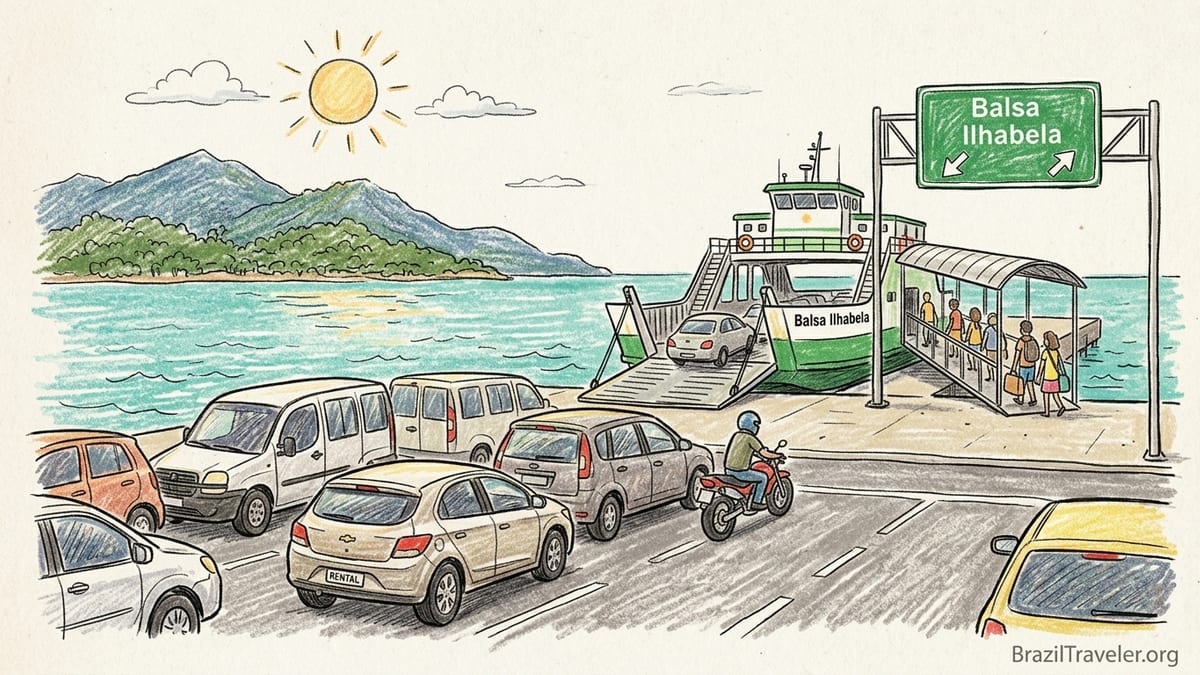
Arriving at the São Sebastião Ferry Terminal
My first crossing began on a Friday afternoon in February 2026, in a compact rental car rolling north along the Rio-Santos highway into São Sebastião. As I approached the city center, the road narrowed and traffic thickened around the port area. Signage for the Ilhabela ferry appears fairly early, with painted indications on the asphalt and overhead signs directing vehicles into the dedicated access lanes on the coastal side of the avenue.
The terminal itself feels more like a long funnel than a classic harbor. Cars, vans, and motorcycles are sorted into side-by-side lanes with simple metal barriers that guide you toward the boarding ramp. There is no big terminal building for drivers. Instead you watch the concrete pier and the green-and-white ferry moving back and forth across the narrow channel that separates São Sebastião from Ilhabela.
On that Friday, I reached the tail of the queue around 15:30. By then, weekend traffic from São Paulo was already feeding into town. It was not yet a holiday, but it was high summer on the north coast of São Paulo state. The line of vehicles stretched for several blocks along the water, dense but not yet chaotic. A roadside sign warned that waiting times could exceed one hour at peak periods, particularly on summer weekends and long holidays when Paulistanos swarm into Ilhabela for beach escapes.
Pedestrians and cyclists have a different reality. On my second crossing, a weekday morning in May 2026, I arrived by intercity bus from Caraguatatuba and simply asked to disembark near the “Balsa Ilhabela” stop. From there it was a short walk to the pedestrian entrance, which is set slightly aside from the car lanes. Foot passengers enter through a gate and follow a covered walkway parallel to the vehicle ramp. There was no queue at all, just a handful of locals heading home with shopping bags.
Crossing With a Car: Cost, Queue, and Boarding
The heart of the decision to bring a car is the balance between cost, waiting time, and freedom on the island. Official information at the time of my trip listed the crossing itself as averaging around 20 minutes, which matched my experience on both journeys. The part that varies dramatically is the time spent stationary in the queue on the São Sebastião side.
On that February Friday, I joined what looked like a moderate line of cars and motorcycles. It took about 10 minutes before a staff member walked down the lane selling tickets. Payment was straightforward. Drivers can pay in cash or by card, and the fare is charged per vehicle, not per passenger. Pedestrians and cyclists cross free. For cars, the posted price at the terminal was just under the figures travelers often mention in planning forums, which typically cite around 19 reais on weekdays and close to 28 or 29 reais on weekends and holidays for a standard car. There are separate, higher fares for larger vehicles and commercial trucks.
Ticket in hand, I settled in for what turned into a 1 hour 25 minute wait from joining the line to rolling onto the ferry ramp. This was not the worst-case scenario locals describe for long holiday weekends, when queues can reportedly snake back several kilometers and waiting times of three hours or more become a grim reality. Even so, nearly an hour and a half for a 20 minute crossing felt out of proportion. It was a warm, humid afternoon. People left their cars parked in neutral, walking up and down the lanes with phones and cold drinks. A few vendors wandered by selling water, soft drinks, and snacks at slightly inflated prices.
Boarding itself is efficient once your lane is called. The ferry crew guide each row of vehicles forward, alternating cars and motorcycles to maximize available space. I drove slowly up the metal ramp, the deck rattling under the tires, and found myself parked bumper to bumper between a family in a hatchback and a pickup truck loaded with surfboards. Engines off, handbrake up, doors opened, everyone emerged for the short ride across the channel. You can stay in your vehicle if you prefer, but most passengers go upstairs for the view and fresh air.
Crossing on Foot: A Very Different Experience
Several months later, when I returned to Ilhabela for a midweek visit, I decided to leave the car behind and experience the crossing as a foot passenger. This time, arriving around 10:00 on a Tuesday in May, the entire approach felt calmer. There were vehicles queued in the lanes, but nothing like the solid wall of tail lights from my earlier trip. The pedestrian entrance, by contrast, was quiet.
Foot passengers do not pay a fare, so there is no ticket counter to worry about and no need to arrive very early purely for payment. I walked straight through a simple turnstile with a security guard nearby keeping an eye on things. There was a digital display showing the estimated departure time of the next ferry and basic operating notes, but the rhythm is so frequent that I never bothered to time it exactly. The same ferries that carry vehicles also accept passengers on foot, so the crossing pattern is shared.
Waiting as a pedestrian was comfortable compared to the car queue. There is a sheltered waiting area with benches and a relatively clear view of the loading ramp. A small snack kiosk sold coffee, pão de queijo, water, and soft drinks at typical São Paulo coastal prices, more than in a supermarket but not outrageous. When boarding began, foot passengers were directed to a side ramp. We walked on after vehicles but before the ramp was finally raised. The whole process from arriving at the terminal to standing on the deck looking back at São Sebastião took less than 25 minutes.
For anyone who dislikes sitting in stationary traffic, the contrast is striking. Pedestrians and cyclists can bypass the worst of the congestion because their boarding is not limited by lane capacity or vehicle spacing. On my pedestrian crossing, I saw drivers who had obviously been waiting far longer watching us walk onto a ferry that their cars would not yet be able to board. It was a reminder that the channel, not the distance, defines the tempo of this trip.
What the Crossing Itself Is Really Like
Despite the reputation for epic queues, the ferry ride between São Sebastião and Ilhabela is short and scenic. On both of my crossings, once the ramp lifted and the engines engaged, the boat eased away from the pier and threaded its way into the channel in a smooth, almost leisurely fashion. The crossing time, around 20 minutes on average, felt accurate. It was long enough to leave the car, walk up to the passenger deck, and take in the view, but not so long that you needed to settle in for a full voyage.
The channel between the mainland and Ilhabela is busy with commercial and recreational traffic. Oil tankers and supply ships serve the offshore platforms, and smaller boats move along the coast. The ferry route is well defined, and the crew operate it so frequently that the routine feels practiced and safe. On my February afternoon crossing, the sun was still high and the sea was calm, with only a light chop. People crowded the railings with phones in hand, capturing the silhouette of Ilhabela’s mountains rising sharply from the water.
Weather, of course, influences comfort. During a previous winter visit to the north coast, before these 2026 crossings, I had seen ferries operating in drizzle and low clouds. Services can be slowed or temporarily suspended when strong winds or heavy rain make maneuvering difficult, but on typical days the motion is gentle. On my May morning foot crossing, there was a cool breeze on the upper deck but no significant swell. Families with small children stood on tiptoe to watch the wake, while commuters in work uniforms simply leaned against the railings, clearly used to this daily routine.
The atmosphere on board is informal. There is basic seating along the sides of the passenger deck, but many people prefer to stand near the bow or stern to enjoy the view or take photos. Announcements are made in Portuguese, mostly related to safety and disembarkation instructions. Even with limited language skills, it is hard to miss what is happening because the visual cues are clear. When Ilhabela’s pier comes into view and the crew begin lowering the ramp, everyone returns to their vehicles or lines up near the pedestrian exit in an orderly fashion.
Arrival on Ilhabela: With and Without a Vehicle
Arriving on Ilhabela with a car is both a relief and an immediate test of patience. On my Friday afternoon arrival, the ramp lowered and the deck erupted into the usual subtle competition of engines starting and drivers trying not to get boxed in. The crew guide vehicles off row by row, and within a few minutes you find yourself on the island’s main coastal road, facing another decision. Turn north toward Perequê, the commercial heart of the island and gateway to the northern beaches, or south toward the historic center and some quieter stretches of sand.
The first few kilometers after disembarkation can be slow, especially during peak arrival waves when multiple ferries have unloaded in quick succession. Traffic lights near the pier and along the coastal strip create short bottlenecks. That said, having my own car proved extremely useful once I cleared the immediate port area. Over the next two days, I used it to reach beaches like Julião, Curral, and Praia do Pinto, and to tackle the steep, winding roads up to guesthouses set in the hills. Public transport does exist, but frequencies can be irregular and many pousadas and rental houses sit up steep inclines far from any bus stop.
My car also made it easier to handle practical errands such as stopping at a supermarket in Perequê for groceries and water, visiting a pharmacy, and driving out at night to restaurants in the historic center and along the coast. For families, groups of friends, or anyone staying in more remote parts of the island, the convenience is significant. The trade-off, of course, is that you pay with your time in the outbound queue and sometimes again when leaving Ilhabela for the mainland.
Arriving on foot felt very different. After my May morning pedestrian crossing, I walked off the ferry directly onto the sidewalk near the main road. There were two immediate options. The first was a line of municipal buses waiting just beyond the exit, heading toward Perequê and the northern beaches. The second was a cluster of taxis and app-based ride-hailing drivers parked a short distance away. I opted for a local bus, paying a simple fixed fare in cash as I boarded.
The bus took about 10 minutes to reach Perequê, where many travelers choose to stay because of its central location and range of services. From there, it is possible to continue by bus or taxi to more distant beaches. If your accommodation is within walking distance of a bus stop and you do not plan to explore the island’s more remote corners, crossing on foot and relying on local transport can be entirely workable. It also means you avoid the worst vehicle queues at the ferry and the limited parking near some of the island’s smaller beaches and trailheads.
Holiday and Weekend Congestion: What I Actually Saw
Stories of five hour ferry waits circulate among residents of São Paulo like campfire tales, and while they may sound exaggerated, there is some truth behind them. During my February Friday afternoon crossing, I experienced only a mild version of this phenomenon. An hour and a half from joining the queue to boarding felt long but manageable. Mixed into the line were cars with surfboards, families clearly bound for rental houses, and small delivery trucks serving local businesses. Everyone accepted the delay as the price of reaching the island on a summer weekend.
The terminal staff seemed well adapted to the ebb and flow of traffic. They kept the lanes organized, sold tickets efficiently, and directed boarding without drama. What created frustration among drivers was not any lack of process inside the terminal, but the sheer volume of vehicles feeding into a limited number of ferry spaces. Even with multiple boats shuttling across the channel, each trip can carry only so many cars. When that capacity is exceeded for hours at a time, the backlog inevitably spills back into the city streets.
On my pedestrian crossing in May, I asked a local resident who commutes regularly what weekends and holidays are like in high summer. He described leaving São Paulo at 4:00 in the morning on New Year’s weekend to reach the terminal before 8:00, and still finding a substantial queue. Another time, arriving around midday on a holiday, he and his family waited nearly three hours on the São Sebastião side. By contrast, midweek mornings and off season periods, such as May and June excluding holidays, are often quiet. My own experience that Tuesday mirrored this. The car queues were modest, and on foot I barely paused at the entrance.
The clear lesson is that congestion depends heavily on timing. Late afternoon and evening on Fridays, Saturdays, and the start or end of long holiday periods are the worst windows for drivers. Early morning arrivals can be somewhat better, though not immune during major holidays. Travelers with flexible itineraries should consider planning crossings outside these peaks, or at least emotionally budget extra hours so that queue time does not feel like a ruined day.
Would Hora Marcada Have Helped?
In response to chronic congestion and the importance of the ferry link for residents, workers, and tourists, São Paulo state offers a reservation system known as Hora Marcada. It is designed to let drivers book a specific departure time in advance, reducing uncertainty and potentially cutting down on time spent in the general queue. Before traveling in 2026, I checked the latest information on how this system operates, as procedures and conditions can change.
In broad terms, Hora Marcada allows you to reserve a slot on certain departures in exchange for an additional fee on top of the normal vehicle fare. The number of reserved spots per sailing is limited, and not all departures offer this option. Reservations are made online through the state’s official transport channels, and you need to arrive at the terminal within the time window indicated in the booking conditions. Missing that window usually means forfeiting the reservation and joining the regular queue instead.
On my February Friday crossing, I had not booked Hora Marcada, partly to understand what an ordinary driver experiences. Looking back, would it have helped? Given that my wait was about 1 hour 25 minutes, a guaranteed boarding window could have reduced that significantly, particularly in a scenario with heavier-than-average traffic. The catch is that on truly gridlocked holiday weekends, even reserved lanes can be affected by overall congestion on access roads, and the availability of reservation slots may vanish quickly days or weeks in advance.
For my May midweek visit, there was no real need for a reservation, especially because I was traveling on foot in one direction. The normal rhythm of ferries and the low demand made crossing straightforward. That illustrates the main takeaway with Hora Marcada. It is most valuable for travelers with fixed schedules who must bring a car during peak periods, such as families heading to a reserved beach house for a holiday weekend. For more flexible trips or off-season visits, careful timing and a bit of patience can be enough without paying extra for priority.
Should You Bring a Car or Cross on Foot?
After crossing both with a vehicle and as a pedestrian, my answer is that the decision depends almost entirely on where you are staying on Ilhabela and what you want to do while there. If your accommodation is a pousada in Perequê or the historic center, within easy reach of bus stops, supermarkets, and restaurants, and if your plan focuses on a few nearby beaches and maybe a boat tour, then leaving the car in São Sebastião and walking onto the ferry can be a smart choice. You save on ferry fares, skip long vehicle queues, and avoid the stress of parking on busy weekends.
In that scenario, local buses and taxis do the heavy lifting. For example, staying near Perequê, you can catch a municipal bus up the coast toward beaches like Viana or south toward Julião, or grab a taxi for late-night returns from restaurants. Organized tours to the famous Castelhanos beach on the wild eastern side of Ilhabela typically depart from central points and include their own transport by 4x4, so you do not need your own car for that adventure either. The inconvenience of waiting for occasional buses is balanced by the freedom from driving in traffic.
However, if your lodging is perched on a steep hillside with a long, winding driveway, or if you are traveling with children, older relatives, surfboards, or a lot of luggage, a car becomes much more valuable. My February trip involved a pousada up a steep road above one of the southern beaches. Walking up that hill in the heat after a day on the sand would have been exhausting. Driving, even slowly, transformed the experience. Likewise, being able to explore less central beaches at odd hours without worrying about the last bus offered real flexibility.
From a purely logistical standpoint, the combination of ferry fare and potential waiting time is the main cost of bringing a car. Pedestrians and cyclists cross free, whereas standard cars pay a modest but noticeable amount more on weekends and holidays than on weekdays. Only you can decide whether one or two hours idling in a queue and the additional cost is acceptable in exchange for on-island mobility. After experiencing both sides, I would personally bring a car during shoulder seasons or quieter weekends and leave it behind when visiting in the absolute peak of summer or during major holidays.
The Takeaway
The São Sebastião to Ilhabela ferry is a short route that carries an outsized share of emotion because it represents the final hurdle between the mainland and one of São Paulo’s most beloved islands. In 2026, the core facts are clear. The crossing itself averages around 20 minutes, pedestrians and cyclists travel free of charge, and cars pay a modest fare that rises on weekends and holidays. What is less predictable is how long you will wait in the queue, a factor that depends heavily on season, day of the week, time of day, and whether you reserve a slot through Hora Marcada.
My February car crossing, with nearly an hour and a half in line on a Friday afternoon, highlighted the frustrations of peak travel. Yet that same car proved extremely useful once on Ilhabela, taking me to hilltop accommodations, distant beaches, supermarkets, and restaurants with ease. My May pedestrian crossing, in contrast, was quick and simple, with under half an hour from arriving at the terminal to walking off the ferry on the island. Relying on local buses and taxis worked well for a central stay focused on a few key areas.
If you are planning your own trip, start by looking honestly at your itinerary. A centrally located pousada, light luggage, and an off peak travel date all point toward crossing on foot and using local transport. A remote rental house, family group, or surf trip loaded with gear makes bringing a car more attractive, with Hora Marcada as a possible tool to soften the worst weekend queues. In either case, building some flexibility into your schedule will keep the ferry from dictating your mood.
Ilhabela rewards the effort. Whether you arrive at sunset after a long car queue or step off the ferry mid morning with only a backpack, the island’s mountains, Atlantic forest, and sheltered bays quickly make up for any time lost waiting on the mainland. Understanding how the ferry operates today, and choosing the crossing style that matches your plans, turns this necessary logistical step into just another part of the journey rather than an obstacle overshadowing it.
FAQ
Q1. How long does the São Sebastião to Ilhabela ferry crossing take?
The crossing itself averages around 20 minutes from departure to arrival, although total travel time can be much longer once you factor in vehicle queues and boarding.
Q2. Do pedestrians have to pay to use the ferry?
No. Pedestrians and cyclists currently cross free of charge. You simply enter through the pedestrian gate, wait in the covered area, and walk onto the ferry when boarding starts.
Q3. How much does it cost to take a car on the ferry?
Standard passenger cars pay a fare that is lower on weekdays and higher on weekends and holidays. Recent official information and traveler reports typically cite values around the high teens in reais on weekdays and just under 30 reais on weekends and holidays, with higher prices for larger vehicles.
Q4. How long are the queues for cars at peak times?
Queues vary widely. On a busy summer Friday afternoon I waited about 1 hour 25 minutes from joining the line to boarding. On major holidays, locals report waits of several hours, while midweek off season crossings may involve only a short delay.
Q5. Is it worth bringing a car to Ilhabela?
It depends on your plans. A car is very convenient if you are staying in a hillside pousada, traveling with family or heavy luggage, or exploring remote beaches. If you stay in central areas like Perequê and focus on nearby beaches and tours, crossing on foot and using buses or taxis can be easier.
Q6. What is Hora Marcada and should I use it?
Hora Marcada is a reservation system that lets you book a vehicle slot on certain departures for an extra fee. It can significantly reduce waiting time during peak periods if you must bring a car, but it requires booking in advance and arriving within a specific time window.
Q7. How often do the ferries run between São Sebastião and Ilhabela?
Exact schedules can change, but multiple ferries usually shuttle back and forth throughout the day, giving the route a frequent, almost continuous rhythm. At busy times, departures are often close together, while late at night there may be longer gaps.
Q8. What happens if the weather is bad?
Ferries normally run in light rain and moderate wind, but strong winds, heavy rain, or poor visibility can slow operations or cause temporary suspensions. In such cases, queues grow and waits lengthen, so checking conditions before you travel is wise.
Q9. Is it easy to get around Ilhabela without a car?
Yes, if you stay near the main road. Municipal buses connect the ferry area with Perequê, the historic center, and many beaches, and taxis or app-based rides are available. For remote lodgings or steep hillside properties, not having a car can be inconvenient.
Q10. When is the best time to cross to avoid long waits?
Midweek days outside major holidays are usually the calmest. Even on weekends, early morning crossings tend to have shorter queues than Friday evenings or Saturday afternoons. Planning your arrival and departure around these patterns can save significant time.