


Over the last few years I have done the full coastal shuffle between São Paulo and Rio: a rainy long weekend in Ubatuba, a festival-filled few days in Paraty and, more recently, a hot, mosquito-plagued but unforgettable escape to Ilhabela. I drove, ferried and walked my way through all three, sometimes solo, sometimes as a couple, and once with friends who insisted on cramming four surfboards into a tiny rental. What follows is a first-person comparison of how these trips actually felt, grounded in my own time on the ground and updated with current practical details from 2026 when my memory needed a reality check.
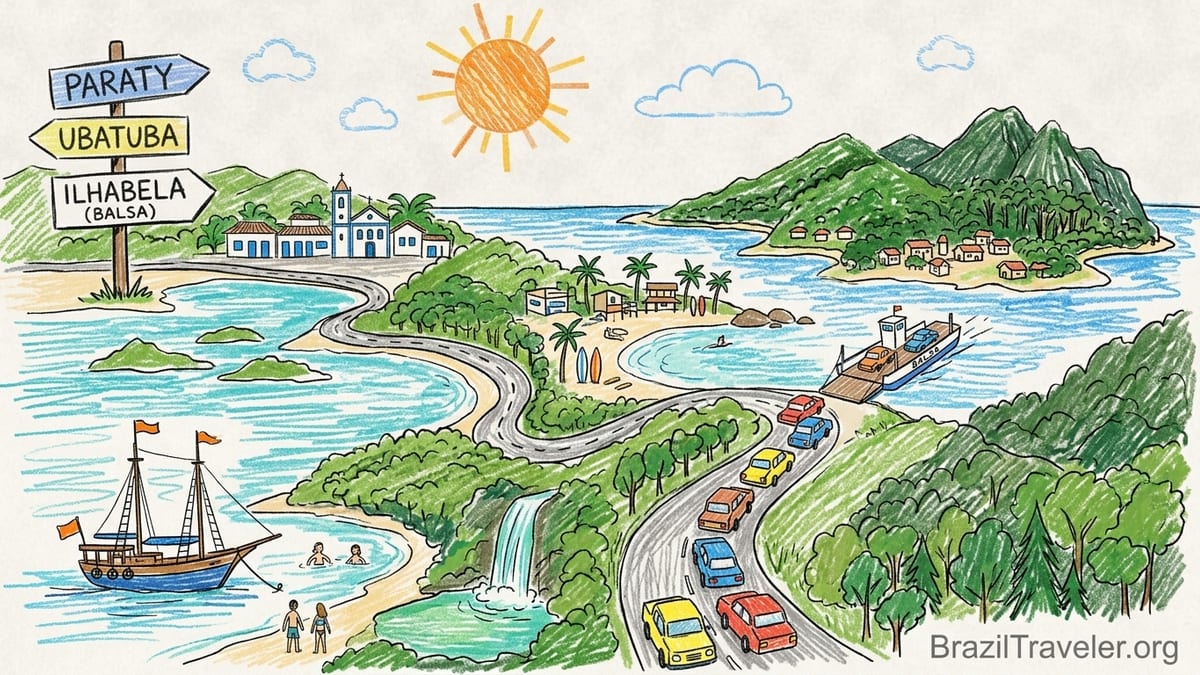
Getting There: Road Reality and Ferry Bottlenecks
All three destinations sit on the same broad coastal corridor between São Paulo and Rio, but the way you arrive shapes the entire mood of the trip. Paraty, in the state of Rio de Janeiro, sits roughly midway between the two big cities on the BR-101, the Rio–Santos coastal highway. Recent drives and current travel information put it at about four to five and a half hours by road from either Rio or São Paulo, depending on traffic and weather. The approach from Rio runs along the Costa Verde, with green mountains on one side and island-dotted bays on the other, a drive that already feels like part of the experience rather than mere logistics.
Ubatuba, in São Paulo state, is more obviously a road-trip town. From São Paulo, I have driven there in just under four hours on a quiet weekday using the combination of the inland highways and then SP-55 along the coast, and almost six hours on a February Saturday when every resident of the capital seemed to have the same beach idea. SP-55, which is part of the Rio–Santos route, threads through hillsides that squeeze into bays, so you are always slowing down for curves, trucks and small villages. The upside is that you can peel off toward different beaches directly from the highway, which is exactly what makes Ubatuba such a rewarding but car-dependent destination.
Ilhabela adds an extra step. The town is an island a short distance off the coast, and there are no bridges, so everyone and everything comes in by ferry from São Sebastião. I still remember rolling into São Sebastião late on a Friday afternoon, feeling victorious after clearing the highway, only to find a huge line of cars snaking toward the terminal. Current ferry information from São Paulo state confirms what I experienced in practice: crossings for vehicles run frequently but can back up badly in peak season and on holiday weekends, and you pay a fee per vehicle and sometimes additional charges depending on size categories. When I came back on a Tuesday morning, I essentially drove straight onto the boat, which shows how drastically wait times swing with the calendar.
If you do not want to drive at all, Paraty is the simplest choice. Regular intercity buses connect it with both São Paulo and Rio de Janeiro, with several departures a day operated by established companies. The trip is long but direct, and once you arrive you can walk the historic center and join boat tours without needing a car. Ubatuba and Ilhabela are much more awkward without your own wheels. There are buses from São Paulo to Ubatuba and then local buses along the coast, but timing beach-hopping days around irregular local services is frustrating. Ilhabela technically has local buses and even an Aquabus boat line running limited daytime hours, yet in real life almost everyone I met on the island had arrived by car and used it constantly to shuttle between beaches and trailheads.
First Impressions and Atmosphere on the Ground
My first evening in Paraty felt like stepping onto a film set. The historic center is closed to cars and paved with big, irregular cobblestones, so I left my car in a paid lot at the edge and walked in with my bag bumping against my hip. The whitewashed colonial houses, low and geometric, were trimmed with bright doors and window frames, and the small churches glowed in the soft light. The streets were just flooded enough from the high tide that reflections of the façades shimmered in the water, a quirk of urban design that locals know well. I wandered after dinner, picking my way between stones, the air full of music drifting from simple bars and more polished restaurants. It felt self-contained and theatrical, like a historical set piece wrapped in rainforest.
Ubatuba’s atmosphere could not be more different. Rather than a single postcard-perfect center, it is a long, spread-out municipality with more than one urban cluster and well over one hundred distinct beaches documented by local tourism authorities and recent guides. Driving in, you see surf shops, apartment blocks, supermarkets and mundane Brazilian life mixed in with vacation homes and pousadas. On my first trip I stayed near Praia Grande, a big city-style beach lined with kiosks. I woke to the sound of cars and bus brakes rather than church bells, and that energetic, everyday feel never really leaves you. Ubatuba “works” as a place to live, not just somewhere dressed up for visitors, which makes it less instantly charming but very comfortable for a week or more.
Ilhabela, at first glance, feels like a more polished version of a classic island escape. When you drive off the ferry, a simple waterfront road lined with palm trees and a scattering of bars and stores leads north and south. The main village, often just called “a Vila”, has historic buildings and a church square, but in scale and preservation it feels lighter than Paraty’s center. Where Ilhabela shines atmospherically is the way the Atlantic forest plunges right down the cliffs to the sea. Most of the interior is protected, and driving even a few minutes away from the village you get the sense of being hemmed in by thick, green walls. At night, the island can feel very dark and isolated, especially on the quieter southern stretches.
All three have their own social rhythms. Paraty has festivals, especially literary and cachaça-related events, that can fill every bar and pousada in town, making the streets buzz until late. Ubatuba tends to spread its nightlife along the main beaches and highway, more about clusters of live-music bars and simple seafood joints than one centralized scene. Ilhabela is somewhere in between, with the liveliest energy in the Vila on summer weekends, then isolated beach bars and hotel restaurants once you move away from the center.
Where I Slept: Pousadas, Hotels and Neighborhood Choices
In Paraty I have stayed both inside the historic center and in quieter neighborhoods just beyond it, and that choice radically changed the feel of my nights. Sleeping inside the center meant I could stroll back to my room after dinner in a few minutes, passing candlelit doorways and hearing snippets of live bossa nova from tiny bars. The flip side was the noise on festival weekends and the practical detail that you cannot park on those cobbled streets. I left my car in a paid lot at the edge of the zone, which charged a daily rate in line with other Brazilian touristic towns, and walked in with a small bag. Another stay in a pousada in the Jabaquara area gave me more breathing room, a small swimming pool and on-site parking, but required a longer walk or quick taxi ride after dinner in the center.
Ubatuba’s accommodations are spread like confetti along the coastal highway. The town offers everything from simple, family-run pousadas steps from local beaches to more structured hotels and rental apartments. I spent one stay at a pousada near Itamambuca, a beach loved by surfers, where mornings began with the smell of tapioca and fresh coffee in a garden full of surfboards. Another time I picked a spot near the more urban Praia Grande area to be closer to supermarkets and restaurants. Because the municipality is so elongated, you need to think carefully about what sort of days you want. If your idea is to beach-hop by car, staying somewhere central on the highway, with easy access to parking and fuel stations, matters more than charm.
On Ilhabela I chose a mid-range pousada uphill from the main village. That meant a view of the bay and a constant breeze, but also a daily reality of driving down steep, narrow streets every time we wanted dinner. The island caters particularly well to couples, with many pousadas leaning hard into romantic design: wooden decks, small pools, fairy lights and breakfast served at individual tables. There are also more remote pousadas near beaches only accessible by sections of dirt road; in those the setting is magical, but you need to accept that a quick run to the pharmacy or bakery is not part of the deal. Unlike Ubatuba, where renting an apartment near a supermarket can make a long stay feel effortless, Ilhabela always reminded me that I was on an island with limited infrastructure.
Price-wise, all three cover an overlapping mid-range. When I cross-checked current 2026 listings while writing this, I found simple double rooms in low season starting in a similar band in Paraty, Ubatuba and Ilhabela, with weekends and holiday periods increasing prices significantly. Paraty’s historic center and peak festival dates push it slightly higher at the top end. Ilhabela’s romantic pousadas and more boutique hotels can also command higher rates, while Ubatuba generally has the broadest range of budget-friendly stays if you are not fixated on a particular postcard beach.
Beaches, Boats, Trails and Waterfalls
Paraty’s beaches are more about the surrounding bay and islands than the strip of sand directly in town. The beach in front of the historic center is scenic but not a place I wanted to spend a full day. Instead, I joined one of the schooner-style boat trips that line up at the pier each morning. After paying in cash at a kiosk and stepping aboard with a mixed crowd of Brazilians and foreign visitors, we spent the day stopping at small island coves with clear water and floating restaurants that delivered fried fish and caipirinhas by wooden dinghy. On another visit I hired a smaller speedboat with friends for a more flexible route to quieter bays. Inland, the Paraty area hides waterfalls like Cachoeira do Tobogã, a natural rock slide where locals queue up to whoosh down the smooth stone into a pool. Reaching it required a short drive up a potholed road and a short walk through the forest, and in the rainy season the trail was muddy but manageable.
Ubatuba, by contrast, is all about sheer variety. Official tourism material and recent guides emphasize that the municipality counts well over one hundred beaches, and driving along SP-55 makes that believable. On one long, hot Sunday I used the car to string together four very different stops. We started at Itamambuca, watching surfers line up on strong Atlantic waves. A short drive later we were at a smaller, more sheltered cove where families sat under rented umbrellas while kids played in calm water. By late afternoon we were on a long, wilder stretch of sand accessible by a short section of dirt road, watching the sun drop behind the hills with almost no one around. Boat trips from Ubatuba are less central than in Paraty, but there are still small-boat excursions to offshore islands and snorkeling spots if you want them.
Ilhabela combines both elements. Some beaches sit directly on the road and are easy to reach, with parking lots, kiosks and stand-up paddle rentals. Others, especially on the far side of the island, require sections of unpaved road that can be slow going for small hire cars. On one of my most memorable days there we left early, bumped along a dirt road through dense forest and emerged at a wide bay where the sand blended almost seamlessly into greenery. After swimming, we followed a short trail along the edge of the forest to a waterfall with clear pools deep enough for a proper plunge. That experience is not unusual for Ilhabela. The island’s protected Atlantic forest and network of over three hundred waterfalls make it a playground for short hikes and full-day treks, including routes that climb high into the hills with demanding gradients.
For serious hiking, Ilhabela clearly comes out on top, with long trails that cross the island and guided routes advertised locally. Ubatuba offers a good middle ground, particularly in areas that blend beaches and sections of the Serra do Mar State Park along the hills. Paraty’s hiking is more scattered but, if you are willing to drive inland, you can connect with trails in the Bocaina region that lead to viewpoints and more remote waterfalls. In all three places, recent rainfall matters a lot: during one especially wet spell near Ubatuba, a waterfall trail I planned to do was closed due to mud and the risk of landslides, a reminder that this is serious rainforest rather than landscaped parkland.
Eating, Nightlife and Everyday Practicalities
Paraty surprised me with how seriously it takes food. Beyond the tourist menus near the main square, there is a growing scene of bistros, seafood restaurants and bars that ride on the town’s recognition as a gastronomic destination. One evening, after a plate of moqueca in a candlelit courtyard, I walked back along the stone streets around 11 p.m., passing a crowd spilled into a tiny bar listening to live samba while a line formed outside a gelato window. Despite the rustic paving and colonial façades, the overall feeling was quite cosmopolitan. Prices for mains and drinks felt in line with other popular Brazilian tourist spots, slightly higher than Ubatuba’s more down-to-earth venues but still reasonable when compared with large-city restaurants.
In Ubatuba, food is more functional but very satisfying. Beach kiosks serve fried fish, pastel and beer on plastic tables, and many blocks near Praia Grande and other central areas are packed with casual pizzerias, burger places and simple seafood restaurants. On one trip with friends, we ended up eating the same grilled fish dish in different variations three nights in a row because it was exactly what we wanted after long days in the sun. Drinking here happens more in dispersed bars and beach kiosks than in one historic district, and nights tend to end a bit earlier unless you deliberately seek out live music venues.
Ilhabela sits somewhere between those two. The Vila has a good handful of restaurants aimed squarely at visitors, mixing seafood, Italian and contemporary Brazilian menus. Sitting outside after dark one humid night, watching people drift between ice cream parlors and bars, I had the feeling of a small-scale resort town more than a preserved historical site. Once you leave the village, eating and drinking options narrow quickly to hotel restaurants and single beachside kiosks that may close early outside high season. One thing Ilhabela adds to the practical mix that the others do not is its infamous mosquitoes. Locals talk about biting insects as a defining feature, and in my experience they were not exaggerating. Walking a shaded waterfront path at dusk without repellent was an instant lesson; within minutes I was slapping my legs and heading for the nearest pharmacy.
Parking and traffic deserve special mention. Paraty’s car-free center forces you to adapt, but once you have arranged parking at the edge of town, you forget about driving until you want to visit a more distant beach or waterfall. Ubatuba, on busy holiday weekends, can feel like one long traffic jam along SP-55, with cars stacked at the entrances to the most popular beaches and improvised parking spilling onto verges and informal lots. In Ilhabela the road network is simpler but quickly clogged when the island is full, especially around ferry arrival times. I remember one Sunday when cars lined up at every beach lay-by as visitors tried to squeeze in a last swim before queuing for the ferry back to the mainland.
Costs, Independence and How Easy Each Trip Felt
On a practical budget level, none of the three destinations felt dramatically more expensive than the others on a normal summer weekend, although festival periods in Paraty and New Year or Carnival weeks on the São Paulo north coast push hotel rates much higher. Based on checking current 2026 prices while writing this and comparing them to what I paid in recent years, mid-range meals and daily expenses are broadly similar. The main cost differentiators end up being transport and how many boat trips or guided excursions you add.
In Paraty, you can keep things simple and fairly affordable by choosing a pousada within walking distance of the center, leaving your car in a long-term lot and joining group boat trips or shared transfers to nearby beaches and waterfalls. I never felt stuck without a car here, and for a short stay it is probably the easiest of the three to manage independently using only buses, taxis and your feet. Even returning to my accommodation after midnight on busy weekends felt safe and straightforward because the streets around the main squares stayed active.
Ubatuba is a different story. The town’s magic lies in moving between beaches that can sit many kilometers apart, and many of those require at least a short drive or ride from the main highway. You can technically rely on local buses or ride-hailing, but my attempts to plan a car-free stay always hit the same wall: long waits, limited routes and the frustration of being tied to one or two nearby beaches. Renting a car, ideally shared between two or more people to dilute costs, transformed Ubatuba from a slightly awkward base into an incredible playground. Fuel and parking charges added up, but I never felt they outweighed the freedom to explore.
On Ilhabela, the ferry adds a small but noticeable extra cost and time component. The vehicle fare for the short crossing is not high in absolute terms but becomes a line item, especially if you are comparing directly with driving to a mainland town like Ubatuba. Once on the island, I found that many of the best beaches and trailheads still required my own car or pre-arranged transfers via 4x4. There is a public Aquabus running on a set daytime schedule, and standard buses exist, but I rarely saw visitors relying on them for anything more than short hops. Independence here comes from either bringing your own vehicle across or committing to private transfers and tours, which can add up quickly for solo travelers or couples.
Who Each Destination Suits Best
After visiting all three, my personal choice for a first coastal trip from São Paulo or Rio would be Paraty. The combination of a walkable historic center, boat trips that leave from the town pier, decent restaurant and bar options and the ability to arrive without renting a car makes it an easy win for someone wanting a blend of culture and coastline. That said, it is not a universal winner. If your idea of the perfect holiday is waking up steps from a surf break or discovering a different beach every day, Ubatuba or Ilhabela will likely feel more satisfying.
For couples, Ilhabela edges ahead in my mind. My days there felt more inherently romantic: waking up in a room with a view over the bay, driving together along a forested road to a semi-hidden beach, rinsing off in a waterfall on the walk back to the car and then sharing dinner at a small restaurant in the village. Paraty can absolutely be a romantic destination too, especially if you enjoy wine bars, live music and colonial architecture, but the experience there is more about streets and squares than intimate natural corners. Ubatuba, with its busy roads and more ordinary everyday feel, is arguably better for active couples who are happiest spending long days in the water and are less attached to a picture-perfect town.
Families with children often ask me which of the three is easiest. If you want to avoid driving altogether and have young kids, Paraty is appealing because you can base yourselves in town, pick family-friendly boat tours and use short transfers to calmer nearby beaches. Ubatuba, with its spread-out geography, can be fantastic for families with a car and some experience of Brazilian roads, because you can cherry-pick gentle, protected beaches with shallow water one day and a livelier surf strand for teens the next. Ilhabela ups the adventure element for families that enjoy hiking and waterfall days, although the logistics of the ferry, the presence of biting insects and the more limited range of big supermarkets and services make it slightly more demanding with very young children.
For history and atmosphere, Paraty is in its own category. Walking those uneven stone streets at night, with the façades lit and the sound of footsteps echoing in lanes that have changed comparatively little in centuries, felt unlike anything in Ubatuba or Ilhabela. If your heart beats faster for heritage, churches and a narrative that ties into Brazil’s gold and coffee routes, this is where to spend the bulk of your time. For pure beach variety, the crown goes to Ubatuba, whose sprawling coastline can keep even a restless beach-hopper satisfied for a long stay. For hiking and waterfalls, Ilhabela’s dense Atlantic forest and steep interior offer the most dramatic routes, although both Ubatuba and Paraty’s hinterland can deliver rewarding day hikes too.
For a long weekend specifically, I would pair Paraty and one nearby beach or waterfall area rather than trying to squeeze in all three destinations. With three or four days, arriving by bus or car, you can walk the historic center, join at least one island-hopping boat trip, and still fit in a short inland excursion. Ubatuba and Ilhabela come into their own when you have more time. A five to seven day trip allows the slow rhythm of the ferry, multiple hikes and proper exploration of their many beaches to feel natural rather than rushed.
FAQ
Q1. Which is easiest to reach without renting a car, Paraty, Ubatuba or Ilhabela?
Paraty is the easiest to reach car-free, with regular intercity buses from both São Paulo and Rio and a compact, walkable historic center where you can join boat trips and local excursions without driving.
Q2. If I want to visit the most different beaches in one trip, which destination should I choose?
Ubatuba is the best choice for beach variety, with well over one hundred distinct beaches spread along its coastline, ranging from surfing hotspots to calm family coves, all accessible by car from the main coastal highway.
Q3. Is the Ilhabela ferry a big hassle for a short weekend trip?
The Ilhabela ferry itself is short and affordable, but at peak times cars can queue for a long time, which eats into a short weekend. If you only have two or three days, that extra step may feel like a downside compared with driving directly to Ubatuba or taking a bus to Paraty.
Q4. Which destination has the strongest historic atmosphere?
Paraty stands out for history, with a preserved colonial center of cobbled streets, churches and old houses that feels immersive when you walk it at night, something neither Ubatuba nor Ilhabela can really match.
Q5. Where would you recommend for couples looking for a romantic coastal break?
Ilhabela is my top pick for couples who enjoy nature, with romantic pousadas, forest-backed beaches and waterfall walks, while Paraty suits couples who value charming streets, live music and good restaurants.
Q6. Which town works best for families with small children?
For families without a car, Paraty is easiest thanks to its walkable center and family-friendly boat tours. With a car, Ubatuba offers the most flexibility to choose calm, shallow beaches and adjust plans around the weather.
Q7. I love hiking and waterfalls. Should I prioritize Ilhabela, Ubatuba or Paraty?
Ilhabela is the top choice if hiking is your main focus, with many trails and waterfalls in its protected forest interior. Ubatuba and Paraty also offer good day hikes, but on a smaller scale.
Q8. How do costs compare between Paraty, Ubatuba and Ilhabela?
Overall costs are similar for mid-range travelers, but Paraty’s historic center and festival dates, plus Ilhabela’s boutique pousadas and ferry fee, can make those two slightly pricier than Ubatuba at busy times.
Q9. Can I realistically visit all three in one week?
It is possible to visit all three in a week with a rental car, but you will spend a lot of time on the road and on the Ilhabela ferry. For a first trip, I suggest choosing two bases rather than three to keep the pace comfortable.
Q10. For a long weekend, which single destination would you personally choose?
For a three or four day long weekend, I would personally choose Paraty because it combines a distinctive historic atmosphere with easy access to boat trips and nearby nature, and it works well even without a car.