


I’ve visited both Rio de Janeiro and São Paulo, and the most honest way I can describe the difference is this: Rio immediately felt like a city you look at, while São Paulo felt like a city you live inside. That’s not a stereotype about beaches versus business. It’s what my days actually turned into after landing, checking into hotels, figuring out transit cards, walking blocks that suddenly got steeper than expected, and realizing that the “right” choice depends on what you want your trip to feel like at street level. In 2026, search results comparing Rio de Janeiro vs São Paulo are everywhere for a reason. Travelers really do choose between them, or try to squeeze both into one first trip. After spending time in each, I’d still hesitate to crown a universal winner. But I can tell you exactly where each city won me over, and where it asked for more patience.
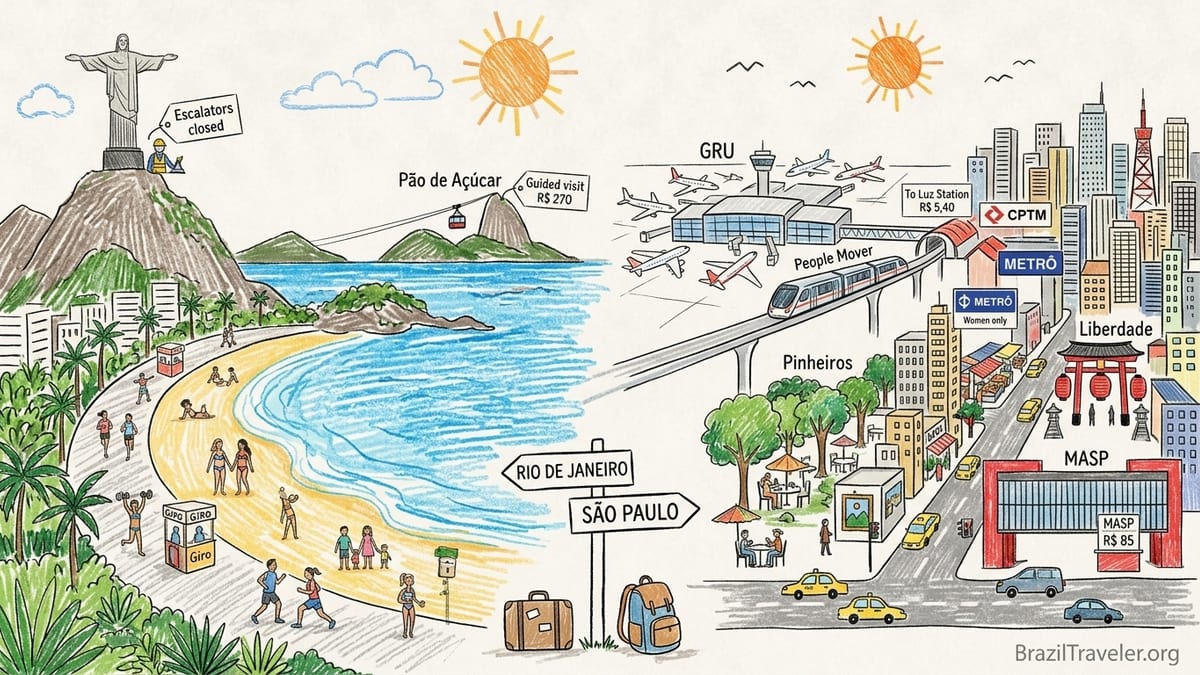
Arriving by air: first impressions from GIG and GRU
Rio’s Galeão (GIG) felt like landing into the edges of a landscape. Even before you get deep into the city, there’s water, low islands, and that unmistakable Rio light. The practical side kicks in fast, though: you still need a plan for getting from the airport to where you’re staying. On my first Rio arrival, the biggest “feel” difference was how quickly distance becomes a factor. You’re not just going downtown. You’re going to a specific zone that will define your trip, like Copacabana, Ipanema, Botafogo, Flamengo, or Centro, and the ride time can change your mood if you hit traffic at the wrong hour.
São Paulo’s Guarulhos (GRU) felt more like arriving into motion than arriving into scenery. It’s busy, sprawling, and very much an international hub atmosphere. What surprised me on my last arrival was how straightforward it was to aim for rail if you’re trying to keep costs down. GRU’s official guidance highlights the train connection from the airport to Engenheiro Goulart, linking into CPTM lines, and it points travelers toward the Airport Express style service as the most “tourist legible” option if you’re heading toward the central stations like Luz. The train itself felt like a practical win for São Paulo’s side of the comparison: the city is big, but it’s used to moving people.
There’s also a 2026 detail that made GRU feel more modern in practice than I expected: the GRU Airport People Mover opened to the public in February 2026, connecting the airport area to the rail station, though early operations have been described as lower frequency while the system fully ramps up. That kind of infrastructure update is exactly why this Rio vs São Paulo decision is not just a vibes debate in 2026. The “friction” of arrival, especially after a long flight, is part of the trip.
Where I stayed and how neighborhoods shaped the trip
In Rio, where you sleep is where you vacation. That was the strongest pattern across my stays. When I based myself near Ipanema, mornings naturally became walkable rituals: coffee, fruit, and a long look at the ocean before the day’s big sights. Copacabana felt more hectic at the edges and more “always on,” especially along Avenida Atlântica, but it also made it easier to step out and immediately feel like you were in Rio, even if you were only in town for a few nights. Botafogo, meanwhile, gave me a different Rio: less postcard, more everyday city, with quicker moves toward Flamengo, Centro, and the cable car area around Urca.
São Paulo was the opposite: where you sleep shapes how you work the city, but it doesn’t define your days as tightly because the city’s appeal is distributed. I’ve stayed in areas that made my days feel completely different. Pinheiros felt like the easiest “first-time” neighborhood for me to settle into: cafés, restaurants, shops, and a sense that you can walk for a while without constantly negotiating the street. Jardins gave me that polished, hotel-friendly base when I wanted a smoother business-style stay. And when I spent time eating in Liberdade, the neighborhood itself felt like a destination rather than a detour, with busy sidewalks, bakeries, and the kind of casual meals you end up talking about later.
If you’re choosing one city and you want the trip to feel effortless from the second you check in, Rio rewards you more quickly if you pick the right beach-zone base. If you want a city that can absorb multiple versions of your trip, São Paulo’s neighborhoods behave like different cities stitched together, and that’s part of its appeal.
Getting around: metro cards, ride-hails, and what walking actually felt like
Rio taught me to plan my “movement days.” When I tried to stack too many major sights, the city pushed back with distance, elevation, and traffic. The metro is a real help if you’re moving between key areas, and MetrôRio’s fare and card system is a practical detail you’ll probably deal with early. The Giro card is sold at stations and is designed to save time for repeat riders, and MetrôRio’s own customer guidance emphasizes reloading at ticket offices or machines. What caught my attention in 2026 is that MetrôRio’s official FAQ notes that, in compliance with a state law dated March 23, 2026, women-only cars are now available every day during the entire operation. That’s not a “tourist tip” so much as a real-world operational detail that shapes how the system feels at rush hour.
São Paulo’s public transport felt more built for scale, especially if you commit to it. The CPTM airport rail link is notably affordable by official listing, with the Airport-Guarulhos service described as costing R$ 5,40 and connecting through major stations with broad integration options. Once you’re in the city, the metro and trains let you cross long distances without the “this might take my whole afternoon” feeling I got more often in Rio. São Paulo still has serious traffic, but it also has more ways to avoid being trapped in it if you plan well.
Walking felt emotionally different in each city. In Rio, I walked in bursts: beach promenades, scenic stretches, short neighborhood hops, and then a ride-hail for the bigger jump. In São Paulo, I often walked because the street-level rewards were there: a bakery, a bookstore, a café, a bar you didn’t plan on. The tradeoff is that São Paulo’s scale can make you underestimate distances. More than once, I thought something was “just a few blocks,” then realized those blocks were longer, busier, and more exhausting than expected.
A morning in Ipanema vs an afternoon in Liberdade: the trips in miniature
If you want one specific moment that captures Rio for me, it was a morning around Ipanema that began without an agenda. I walked toward the beach early enough that the city felt like it was still warming up. People were setting up chairs, runners were already out, and the ocean was doing most of the talking. Rio’s best moments can be like that: not an attraction, not a ticket, just a few hours where the city’s natural setting makes your day feel more spacious. It’s also where Rio feels honest. You see how locals use the beach as a daily living room, not just a visitor backdrop.
In São Paulo, my equivalent “this is the city” moment happened in Liberdade, where the neighborhood energy pulled me into an unplanned meal. São Paulo’s magic is often indoors or at street level: a casual counter spot, a bustling bakery, a market aisle, a tiny restaurant where you’re not sure what to order until you point at what looks good. That’s where São Paulo started to feel less intimidating and more personal. Instead of trying to see the whole city, I let a neighborhood hold my attention for half a day and it paid me back.
Those two moments explain why the Rio vs São Paulo question is so real. If your dream trip is built around a few perfect daylight hours and scenery you can’t replicate elsewhere, Rio delivers quickly. If your dream trip is built around neighborhoods, eating well repeatedly, and feeling like the city keeps offering options, São Paulo is the one that grows on you.
Beaches, outdoor time, and the logistics of Rio’s biggest sights
For beaches and scenery, I would personally choose Rio every time, with no hesitation. Copacabana and Ipanema aren’t just famous. They are functional, daily spaces that make it easy to fit beauty into the routine of a trip. Even if you do nothing “big” in Rio on a given day, you can still have a world-class morning. That’s a rare kind of travel value.
Rio’s outdoor “icon” sights also come with real logistics you should plan around. Christ the Redeemer, for example, now comes with a notable operational detail in 2026: the Corcovado Train’s official site states that escalators at Christ the Redeemer went out of service starting August 3, 2026, with works expected to run until the end of May 2027. That kind of information matters for accessibility planning and for anyone traveling with older relatives or anyone who wants to minimize stairs. It also matters for expectations: your experience at the top might include more walking and slower movement than you imagined from photos.
Then there’s Sugarloaf (Pão de Açúcar), which is often the easiest “this is why I came” Rio attraction to recommend because the payoff is immediate. Prices can change, and ticket types can vary, but the operator’s own support pages in 2026 show premium experiences like a guided visit bundled with the cable car priced at R$ 270. Even if you don’t choose a guided option, that reference point is useful for budgeting a Rio day where one major scenic attraction might cost about what a nice dinner would in other cities.
Food, museums, and nightlife: where each city clearly pulled ahead
For food, I’d personally choose São Paulo. It wasn’t just one great meal. It was the repeatability. I could eat well multiple times a day without feeling like I was chasing a “scene.” Pinheiros became my default answer when friends asked where the city felt easiest to explore. It’s the kind of area where you can have a coffee, wander into a lunch place, and end the night at a bar without needing to cross half the city. Liberdade, meanwhile, felt like a must for a first-time visitor who cares about food and neighborhood atmosphere, especially if you want the day to feel busy, bright, and specific to São Paulo.
For art and museums, São Paulo also edged ahead for me, mostly because of density and choice. MASP is the headline, and its official visitor information lists a full-price ticket at R$ 85. That’s a concrete number that helps you compare museum days across the two cities, especially if you’re trying to plan a short trip with a “one major museum” budget. The museum also runs a café in partnership with A Baianeira, and in practice that matters because it turns a museum visit into a longer, more comfortable block of your day rather than a quick in-and-out.
Rio, however, had a different museum advantage: settings that feel uniquely Rio. The Museu do Amanhã in Praça Mauá made my “culture day” feel tied to the city’s waterfront identity. Its official ticket page lists R$ 40 for a full-price ticket, and it also notes a promotional entry day on the 10th of each month at R$ 10, tied to its anniversary programming. That kind of local-facing promotion is helpful if you’re traveling on a budget and can align your itinerary. It also shows how Rio’s cultural experiences can be surprisingly affordable compared with its famous scenic attractions.
Nightlife is where I refuse to declare a universal winner because I liked them for different reasons. Rio nights felt more tied to location. Even a simple plan, dinner near your neighborhood and then a bar nearby, feels like “going out in Rio” because the city’s identity is so strong. São Paulo nightlife felt more like a menu. The city is massive, and you can choose your night based on your mood: low-key cocktails, a busy restaurant night, or something that runs late and feels more like a global city. If you’re traveling specifically to eat and then keep the night going in a neighborhood with multiple options, São Paulo made that easier for me.
Costs, comfort, and how many days felt right in each city
On costs, my honest takeaway is that both cities can surprise you, just in different categories. In Rio, the biggest “spend spikes” for me were the iconic scenic attractions and the convenience rides when I didn’t want to lose time to traffic or complicated transfers. If you’re doing Christ the Redeemer, Sugarloaf, and a couple of paid experiences, Rio can start to look less like a bargain and more like a destination where you need to choose priorities. The upside is that some cultural attractions remain approachable, and beach time is free, which is a real kind of value that changes the overall math of a trip.
São Paulo, on the other hand, can feel expensive in the everyday way: you’re more likely to pay repeatedly for small comforts because you’re using the city differently. You might spend more on taxis or ride-hails if you keep hopping between neighborhoods, and you might pay more often for cafés, lunches, and dinners because the city keeps giving you reasons to stop. Public transport can help keep it manageable, and the GRU rail fare listed at R$ 5,40 is a good example of where São Paulo can be remarkably cost-efficient if you lean into the system.
As for how many days felt right, Rio felt best to me with about four to six days if it’s your main destination. That was enough time to balance beach mornings, one or two major scenic attractions, a culture day, and at least one “slow day” where the city doesn’t feel like a checklist. São Paulo felt best with three to five days if you love food and museums, because the city’s reward is cumulative. The longer you stay, the more it becomes about neighborhoods and repeated pleasures rather than one defining landmark.
The way I’d frame it for a first-time Brazil traveler is simple: if you only have a long weekend, choose based on what you want your mornings to feel like. If you want ocean air and scenery built into the day, pick Rio. If you want to wake up and choose between museums, neighborhoods, and meals that can define the day on their own, pick São Paulo.
The Takeaway
If I were choosing purely for beaches and scenery, I’d choose Rio de Janeiro. It’s the rare city where a “nothing planned” morning can still feel like the highlight of your trip, and the big sights deliver on the postcard promise, even if they require more logistical planning than first-timers expect.
If I were choosing for food, museums, and the feeling of being in a modern megacity with endless options, I’d choose São Paulo. It’s not a city that flatters you instantly, but once you learn how to spend a day in one neighborhood, it becomes easy to fall into a rhythm that feels both local and world-class.
For business travel, I’d personally lean São Paulo because the city’s infrastructure and neighborhood variety made it simpler to build a schedule around meetings, museums, and dinners without relying on scenic weather. For a short first trip that’s meant to feel unmistakably Brazil in a globally recognizable way, I’d lean Rio, especially if you’re the kind of traveler who wants at least one morning that feels like a movie.
And if you can do both, the best way to avoid turning it into a stressful comparison is to let each city be itself: give Rio enough time for the beach to slow you down, and give São Paulo enough time for a neighborhood to win you over.
FAQ
Q1. Which city should I choose for a first-time, short Brazil trip?
Rio de Janeiro is usually easier for a short first trip because the beach neighborhoods and major sights deliver quickly without needing deep planning.
Q2. Which felt better for beaches and scenery?
Rio de Janeiro, by a wide margin. Morning time around Ipanema or Copacabana can be a trip highlight without spending money.
Q3. Which city is better for food-focused travelers?
São Paulo. Neighborhoods like Pinheiros and Liberdade make it easy to build entire days around eating well and exploring locally.
Q4. Which city has stronger museums and art density?
São Paulo felt stronger overall for museum variety and concentration, with major anchors like MASP.
Q5. Is Rio’s metro practical for visitors?
Yes, especially for key zones. MetrôRio sells and supports the Giro card at stations, and it can save time if you take multiple rides.
Q6. Can I get from São Paulo GRU airport to the city by train?
Yes. Official airport and CPTM information describes rail connections from GRU with low-cost fares and links into central stations via transfers.
Q7. Are there any 2026 changes travelers should know for Rio transit?
MetrôRio’s official FAQ notes women-only cars are available every day during the entire operation, reflecting a 2026 compliance update.
Q8. Are there any 2026 updates for visiting Christ the Redeemer?
The Corcovado Train’s official site states escalator replacement works began August 3, 2026, with completion expected by the end of May 2027, which can affect accessibility and timing.
Q9. How many days felt “right” for each city?
Rio felt best with roughly four to six days; São Paulo felt best with roughly three to five days, especially if you prioritize museums and food neighborhoods.
Q10. Which city would you pick for nightlife?
It depends on your style. Rio nights felt more tied to place and atmosphere, while São Paulo offered more variety across neighborhoods and late-night options.