


Family resorts in Brazil can look identical on booking sites: pools, beach, kids club, buffet, “all inclusive.” What actually decides whether a trip feels restorative or exhausting is far more practical: how quickly you can get back to the room when a toddler melts down, whether there’s shade where kids actually play, if the beach is swimmable on a normal day, and whether the kids club truly takes your child at their age without you hovering nearby. For this September 2026 update, we researched the family-resort market around Porto de Galinhas (Pernambuco), Maragogi and Japaratinga (Alagoas), Bahia’s north coast, and Natal and Via Costeira (Rio Grande do Norte), emphasizing what makes day-to-day travel with children easier rather than repeating amenity lists.
What made the biggest difference (and what didn’t)
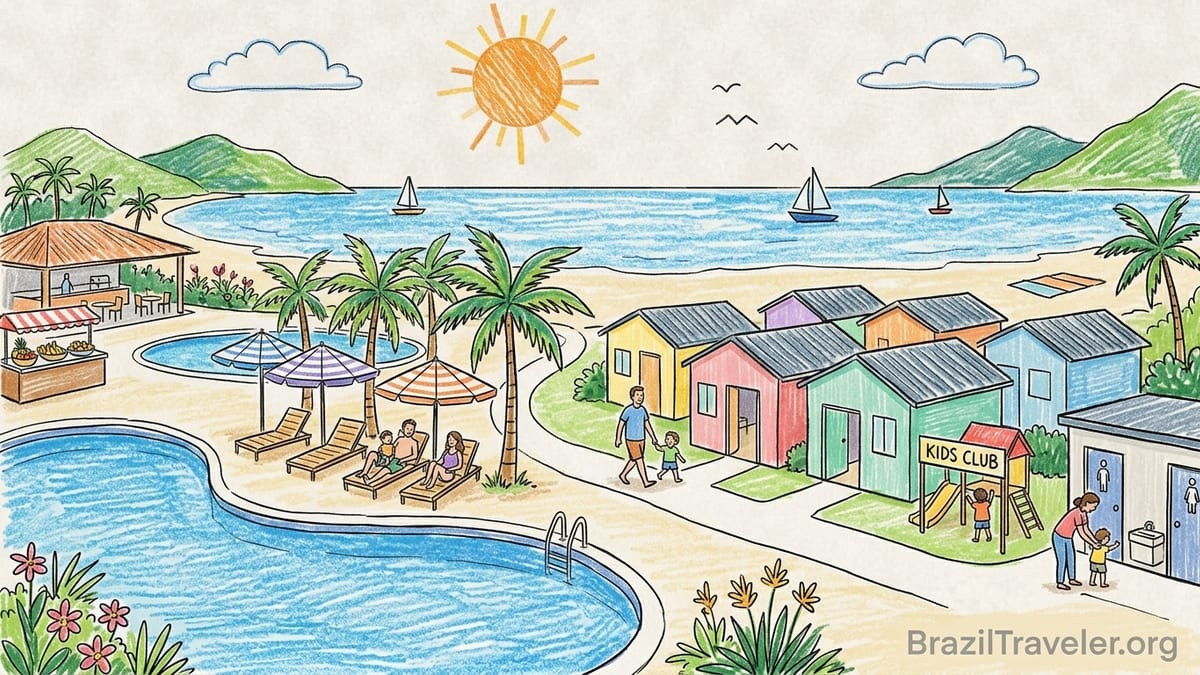
The biggest quality-of-life upgrade across Brazil’s beach resorts wasn’t “more activities.” It was proximity and pacing. The resorts that felt easiest with kids were the ones where you could do a full morning loop without a long trek: breakfast to pool to shade to restroom to room, all within a few minutes. When the room was a quick return point, parents used it as intended: naps, reset time, changing a wet child, or escaping late-afternoon sun. When the room was far, we saw families push through meltdowns because it felt like too much work to go back.
Shade was the other quiet deal-breaker. Many properties have huge pool complexes, but the usable area for little kids is the shaded, shallow, low-noise section where you can sit with snacks and still see everyone. A kids pool with spray features looks spectacular in photos; in reality, if there are only a few umbrellas and the sun hits hard from late morning onward, families drift away or spend the day negotiating who stands in the shade.
What looked important during booking but often mattered less in practice: the number of restaurants and “gourmet” positioning. With children, the actual wins were predictable food at predictable hours, a breakfast that starts early enough for jet-lag kids, and a buffet that always has safe picks (plain rice, beans, pasta, fruit, eggs, grilled chicken, soup). The most “luxury” meal can become irrelevant if the wait is long or the dress code is fussy at the exact time your child is ready for bed.
Finally, kids-club rules are not a small-print detail. In Brazil’s resort market, supervision policies and minimum ages vary, and they can change the entire trip. Several properties allow kids to enter a kids space, but require a responsible adult below a certain age, which means it’s playtime, not childcare. If you’re booking specifically for supervised time, the minimum age and the “stay-alone” rule are as important as the flight time.