


Brazil is the kind of country that punishes overland optimism. Distances look manageable on a map until you realize that a “quick hop” can mean two days on a bus or a full day lost to highway logistics. On my last run of domestic flights, I stitched together Rio, São Paulo, Foz do Iguaçu, Salvador, Manaus, and Cuiabá using the routes I actually flew and the airports I actually walked through, with one goal: move between regions without donating entire days to transit. Domestic aviation is doing heavy lifting right now, too. Brazil’s government reports 68 million domestic passengers from January through August 2026, which helps explain why the main corridors feel like commuter rail in the sky.
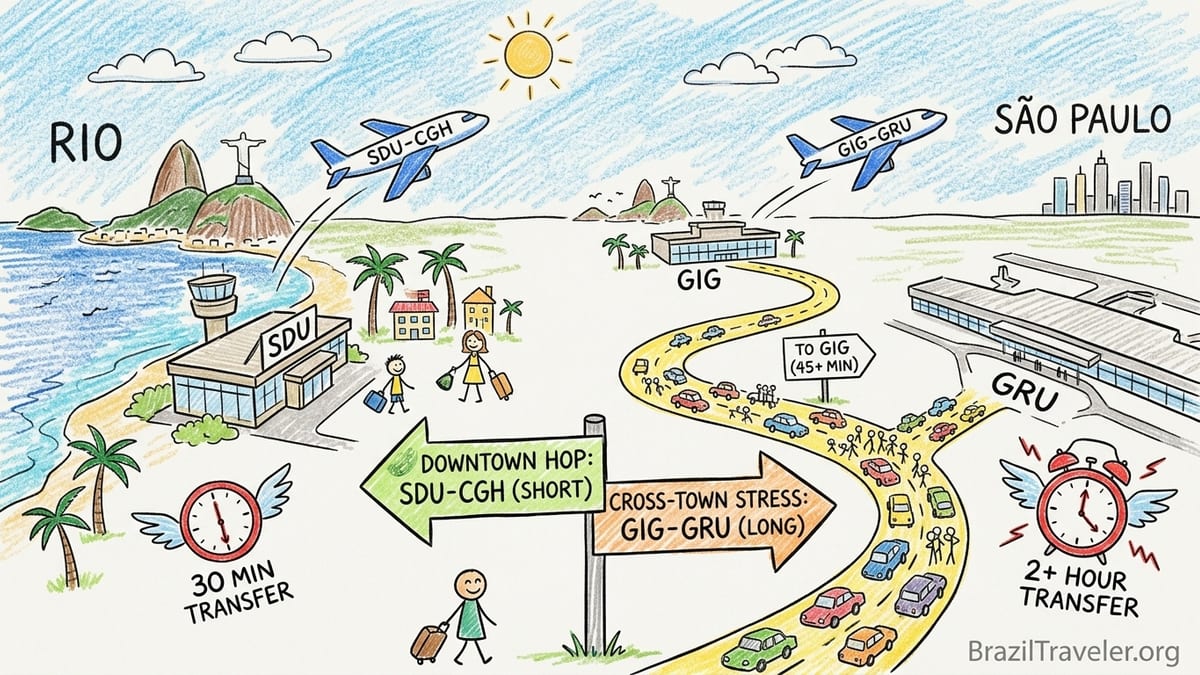
Before You Book: Brazil’s Airport Geography Can Make or Break Your Day
The biggest “domestic Brazil” mistake is assuming the city name in your ticket equals the city you’ll depart from. Rio and São Paulo both have multiple airports, and picking the wrong one can turn an easy morning flight into a stressful, expensive cross-town transfer. Rio’s Santos Dumont (SDU) sits essentially downtown, while Galeão (GIG) is much farther out. São Paulo’s Congonhas (CGH) is the close-in domestic workhorse, while Guarulhos (GRU) is the big international hub about 25 km from the center. That distance is not abstract when you’re trying to make a tight connection during rush hour.
On my own trip, the “airport choice” decision mattered most on the Rio to São Paulo corridor. When I flew SDU to CGH, I could treat it like a short commuter hop. When I priced out options involving GIG or GRU, the flight time barely changed, but my door-to-door time and ground costs jumped. That ground-time penalty is why I now start every search by filtering for SDU and CGH first and only widening to GIG and GRU when price or schedule forces it.
It also matters for connections. A same-city connection can still be an airport transfer, and in Brazil that is often a hard no unless you have a huge time buffer. If your itinerary requires switching between GRU and CGH in São Paulo, or between SDU and GIG in Rio, treat it like changing cities. Build in hours, not minutes, and assume traffic will be unkind.
My “Ponte Aérea” Reality: Rio (SDU) to São Paulo (CGH)
The Rio to São Paulo shuttle corridor is famous for frequency. I flew it the most “classic” way: Santos Dumont (SDU) to Congonhas (CGH), the combination that minimizes ground transfers on both ends. SDU is roughly 2 km from downtown Rio, which meant my ride from Zona Sul felt like a city errand rather than an airport expedition. The terminal is compact, security is usually fast when you arrive with time, and it’s the closest thing Brazil has to a true downtown airport experience.
Check-in was straightforward because I used mobile boarding passes, but the practical detail is baggage. Brazil’s rules guarantee a minimum 10 kg cabin allowance, yet airlines now structure fares so the cheapest tickets can be restrictive in practice. The safest baseline for planning is: know your fare family and assume checked baggage is extra unless your ticket explicitly includes it. On GOL, for example, published fees for a first checked bag on domestic flights can be as low as R$ 50 via digital channels for certain fares, and R$ 100 at the counter, with the price depending on fare type and where you pay. Those numbers matter because they can swing your “cheap” fare into “not cheap” very quickly if you show up with a big suitcase.
Aircraft on this route are typically narrow-body jets, and that creates an operational pattern I learned to respect: gate-checking carry-ons when overhead bins fill. My mistake the first time was boarding late with a roller carry-on and assuming it would be fine. I was offered a free gate-check, which sounds generous until you remember you’re landing at a busy airport and now you’re waiting at the belt. These days, if I’m flying this corridor and I want to walk off and go, I pack so my main bag can fit overhead and I board earlier when possible.
Door-to-door, SDU to CGH is the rare Brazil domestic trip that can genuinely be done without losing a day. The flight itself is short, but what saved me was the airport pairing: short ride to SDU, short ride from CGH. If I had accidentally booked SDU to GRU, or GIG to CGH, the flight time would look similar while ground time would quietly eat the advantage.
Rio or São Paulo to Foz do Iguaçu: The Route That Rewards Planning
I flew into Foz do Iguaçu via its main airport, IGU (Foz do Iguaçu/Cataratas International). What I didn’t appreciate until I arrived is how “tight” the local geography is in the best way: IGU is less than 20 minutes from downtown Foz, and also convenient for the national park area. That means you can land and still have a functional half-day, especially if your flight arrives before mid-afternoon.
The most practical pitfall in this region is not inside Brazil, but next door: Iguazú has airports in two countries. If you’re staying on the Brazilian side, IGU is the clean option. If you accidentally book into Puerto Iguazú in Argentina, you may add a border crossing and a transfer that can stretch from 45 to 90 minutes or more depending on traffic and controls. I met travelers who did this unintentionally because they searched “Iguazu” without looking closely at the country code and then wondered why their arrival day evaporated.
At IGU, the airport experience is simple, but the “real cost” comes from timing and transfers. A rideshare or taxi to the hotel zone is usually quick, yet if you land during peak arrival banks you can wait longer than expected for a car. I now budget a little extra time and I avoid scheduling “must-do” park visits for the same afternoon unless the flight is early and I’m traveling with carry-on only.
On the aircraft side, this was also where I saw more aggressive cabin baggage management. Smaller overhead space and full flights push airlines toward gate-checking. If your itinerary includes a connection after Foz, do not assume a gate-checked bag will reappear quickly. Plan connections with enough slack that a delayed bag delivery does not cascade into a missed onward flight.
Salvador Connections: Where Tight Layovers Became My Self-Inflicted Problem
Salvador (SSA) was my connection point to keep the routing efficient, and it’s where I made the mistake I now warn people about: booking a connection that looked fine on paper but was fragile in real life. The problem was not just the flight schedule, but the combination of a minor departure delay and the time needed to move through the terminal and recompose at the gate. Domestic terminals can feel fast until they suddenly aren’t, especially when multiple flights unload at once.
My tight connection became stressful the moment the inbound flight pushed back late. Even a 20 to 30 minute delay can turn a “comfortable” connection into a sprint if gates are far apart or if boarding closes earlier than you expect. This is the scenario where Brazil’s domestic volume shows up in your day: flights are full, boarding takes time, and airlines are less forgiving about holding doors because the network is tightly scheduled.
If I were booking the same routing again, I would buy myself more time at SSA, especially if I had checked baggage. Even when your bags are tagged through, you’re still at the mercy of operational decisions. If a short connection forces the airline to offload bags, you can arrive without your luggage and lose time filing reports. My current rule is simple: I treat anything under 90 minutes as “tight” for a domestic-to-domestic connection in a busy hub unless I’m traveling with one small bag and a personal item only.
On baggage allowances, I now verify the exact fare inclusions before purchase. LATAM’s current domestic fare families in Brazil commonly include one personal item up to 10 kg and one small cabin bag up to 12 kg across Light, Standard, and Full, while checked baggage of 23 kg is included in Standard and Full but costs extra on Light. That fare detail is the difference between a smooth connection and an unexpected payment and bag-drop queue.
Flying To Manaus: The Flight Is Easy, The Timing Is What Costs You
Minaus (MAO) was my gateway into the Amazon region, and the lesson there was less about airport confusion and more about schedule shape. Flights to Manaus can be frequent from major hubs, but they often arrive late or depart early. That matters because the “real” cost of flying is not only your ticket, but the hotel night you might need on either side to make the schedule work without exhausting yourself.
On my Manaus leg, I planned for a buffer day rather than trying to land and immediately jump into a tour schedule. That decision saved the trip. In practice, even a small delay can push you into a late arrival, and once you factor in baggage claim, a ride into town, and check-in, you can lose the evening. For Manaus, I now prefer arrivals that still allow dinner-time check-in rather than midnight logistics.
This is also where baggage strategy mattered. If you’re flying into a hot, humid environment and you’re continuing onward by boat or lodge transfer, you want your essentials with you. I pack one change of clothes and key gear in my personal item so a delayed checked bag becomes inconvenient rather than trip-breaking. If you’re flying GOL on a fare that does not include checked baggage, remember that adding a first checked bag can be inexpensive if purchased through the airline’s digital channels, but significantly more if you wait until the counter. The rule is not “never check,” it’s “decide early and pay early.”
Operationally, Manaus felt like a place where weather and network ripple can show up. I did not experience a dramatic cancellation, but I did see how quickly boarding and gate information can shift. My best practical habit in MAO was staying close to my assigned gate area once the inbound aircraft was confirmed, rather than wandering far for food and returning to find a last-minute gate change.
Cuiabá For The Pantanal: The Flight Is Step One, The Transfer Is The Trip
Cuiabá (CGB) is the access point I used for the northern Pantanal, and it’s a classic Brazil case of “the flight is the short part.” The airport gets you to the region quickly, but the Pantanal experience begins when you leave the terminal and start moving by road. If your end goal is Porto Jofre, you’re looking at an overland route that includes a long dirt-road segment on the Transpantaneira, roughly 145 km of unpaved road with a huge number of bridges. That transfer can take hours and it is not the kind of drive you want to start late in the day.
My biggest planning improvement for Cuiabá is now timing: land early, transfer early, arrive before dark. I once underestimated how long it would take to get organized, meet a driver, and actually get rolling out of Cuiabá. The result was arriving later than I wanted, which meant less wildlife viewing and more white-knuckle “just get there” travel. If you’re joining a lodge transfer, confirm the pickup time in writing and be realistic about baggage claim and the walk to the meeting point.
In terms of “door-to-door” cost, Cuiabá is where you feel the difference between airfare and total transport budget. Even if your flight is reasonable, a 4x4 transfer or lodge transport can be a major add-on. If you’re trying to keep costs predictable, it can be smarter to book a package that bundles the transfer rather than assembling it last-minute when options are limited and prices are less flexible.
One more airport-choice lesson applies here too, but in a different form: Cuiabá is the correct aviation gateway for this part of the Pantanal, and trying to improvise the region by flying somewhere “near-ish” can lead to punishing drives. If the Pantanal is the point of your trip, align your flights with where your lodge or route actually starts, not just the closest dot on the map.
The Takeaway
After flying these domestic legs, the pattern is clear: in Brazil, the flight rarely steals your day, the wrong airport and the wrong connection do. SDU and CGH saved me hours on the Rio to São Paulo hop. IGU saved me border friction at the falls. Salvador taught me that tight connections are a gamble you usually lose when the network is busy. Manaus reminded me to price in the schedule shape, not just the ticket. Cuiabá proved that the “last mile” can be half your travel day, and you have to plan the transfer like it is a second flight.
If I could boil it down to what I would book differently: I would prioritize the closest airports even when the fare is a bit higher, I would stop trying to “win” with 45-minute connections, and I would lock baggage decisions before arriving at the airport. Brazil’s domestic network is strong and it can absolutely move you between regions efficiently, but it rewards travelers who treat ground transfers, baggage rules, and airport geography as part of the same itinerary.
FAQ
Q1. Which Rio airport should I use for domestic flights?
For convenience, Santos Dumont (SDU) is the downtown-friendly choice for many domestic routes, while Galeão (GIG) is farther out and more common for international flying.
Q2. Which São Paulo airport is best for quick domestic trips?
Congonhas (CGH) is the close-in airport that usually saves time on domestic travel; Guarulhos (GRU) is farther from central São Paulo and often adds ground-transfer time.
Q3. Is it risky to book a connection that requires changing airports in Rio or São Paulo?
Yes. Treat SDU to GIG or CGH to GRU as a major transfer and only book it with a large time buffer, because traffic and terminal procedures can easily break tight plans.
Q4. How much carry-on is guaranteed on domestic flights within Brazil?
Brazil’s rules provide a minimum allowance of 10 kg as cabin baggage, but airlines also apply fare-based rules that can restrict what you bring onboard, so verify your fare inclusions before you pay.
Q5. Does LATAM include a cabin bag on domestic Brazil tickets?
LATAM’s domestic fare families in Brazil commonly include a personal item and a small cabin bag up to 12 kg in Economy, while checked baggage is typically included only in higher fare families.
Q6. How do GOL’s domestic checked-bag fees work in practice?
GOL publishes different prices depending on fare type and whether you pay online or at the counter, so buying checked baggage through digital channels ahead of time can materially reduce the cost.
Q7. Which airport should I fly into for Iguazú Falls on the Brazilian side?
Use Foz do Iguaçu/Cataratas International Airport (IGU) if you’re staying on the Brazilian side, because arriving via the Argentina-side airport can add a border crossing and significant transfer time.
Q8. How much connection time should I plan at hubs like Salvador?
If you have checked baggage or you’re traveling at peak times, building in at least 90 minutes for a domestic-to-domestic connection reduces the risk that a small delay becomes a missed flight.
Q9. What’s the biggest mistake travelers make flying to Manaus?
Underestimating schedule impact. Flights often arrive late or depart early, and that can force extra hotel nights or lost evenings unless you plan your tour timing around the flight shape.
Q10. Is Cuiabá a good aviation gateway for the Pantanal?
Yes, but plan the overland transfer as a major part of the trip. The drive toward Porto Jofre includes a long unpaved section on the Transpantaneira and can take hours.