


On the map, Uakari Floating Lodge is little more than a dot in a maze of water and forest between Manaus and the Peruvian border. On the ground, or rather on the river, it feels like a small, purpose-built village afloat in the middle of one of the Amazon’s most important protected wetlands. Over four nights inside Mamirauá Sustainable Development Reserve, I learned that this community-run lodge is less a conventional hotel and more a living classroom about how people and wildlife can share a flooded forest.
Getting to Tefé and the Edge of Mamirauá
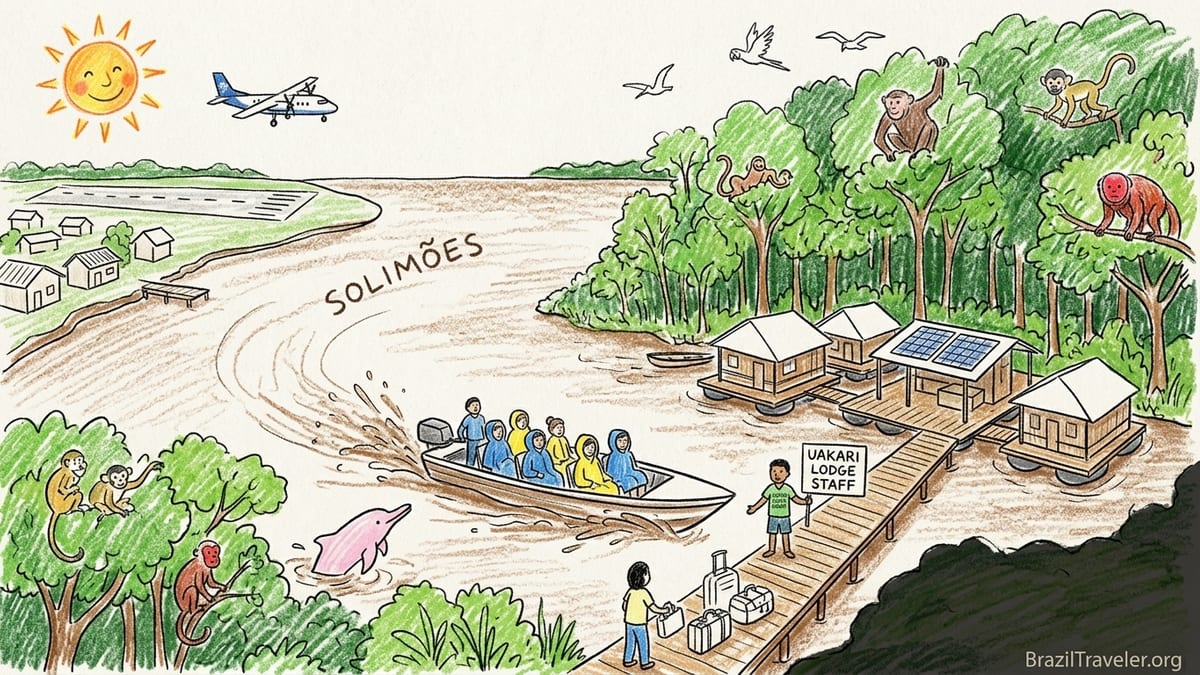
Reaching Uakari Floating Lodge begins with Tefé, a river town about 520 kilometers west of Manaus on the upper Solimões. From Manaus, the most practical route today is the daily or near-daily Azul Linhas Aéreas flight to Tefé, a journey of about 1 hour and 10 minutes in a narrow-body jet or turboprop, depending on the schedule. Fares on this route at the time of my trip started around 700 to 1,200 Brazilian reais one way if booked several weeks out, with prices fluctuating with holidays and demand. There are slow and fast river boats from Manaus as well, but those can take anywhere from 12 to more than 30 hours, which already hints at how remote Mamirauá really is.
Tefé itself is not a tourism hub in the way Manaus is. The compact airport handles only a handful of flights a day, and the runway is often bordered by rain-soaked grass and the occasional vulture. Uakari Lodge’s operation, however, is tightly coordinated with Azul’s arrivals and departures. The lodge explicitly structures its programs to start and end on the days of these flights, which means most guests plan their Amazon stay around the airline’s schedule rather than the other way around.
Once I collected my bag in Tefé, a member of the lodge’s community team was waiting just outside the baggage claim with a small hand-painted sign. We drove a short 10 to 15 minutes through town to the river port used by the lodge, passing basic houses on stilts, small supermarkets and satellite dishes that looked oddly modern against the muddy streets. This is where the abstraction of “community-based tourism” started to feel tangible: the driver, boat crew and the guide who greeted us introduced themselves as residents of riverside communities inside Mamirauá who rotate through lodge work on a schedule decided collectively.
Before boarding the transfer boat, the staff weighed larger bags, offered lightweight rain ponchos and checked names against the program list for three, four and five night stays. The four-night “Amazon Experience” program I joined is one of Uakari’s core products and is usually recommended by the lodge and partner operators because it fits two full days plus arrival and departure excursions. Shorter two or three night stays exist but the staff made it clear that these feel rushed given the distances involved.
Sailing into the Flooded Forest and Arriving Afloat
The boat transfer from Tefé to Uakari Floating Lodge takes around one and a half to two hours, depending on water level and river traffic. We began on the vast brown expanse of Lago Tefé before turning into narrower channels flanked by forest. On high-water dates, usually between about February and August in Mamirauá, the trees rise directly from the water, their trunks hidden below a surface that can rise roughly 10 meters between low and high season. In the drier months from September to January, more muddy banks and exposed roots emerge, and some of the smaller side channels used in flood season become firm forest trails instead.
Even if you have visited other parts of the Amazon, the sensation of cruising into Mamirauá Reserve feels different because of its legal status as Brazil’s first Sustainable Development Reserve and as part of the Central Amazon Conservation Complex World Heritage Site. The guide pointed out villages that only appear on the map in connection with the reserve’s management plans, then slowed when a pair of pink river dolphins surfaced near our bow. The dolphins are not baited or fed. The crew treated the sighting with the same understated enthusiasm they would later show for monkeys and rare birds: important, but not guaranteed.
Uakari Lodge came into view suddenly around a bend, a series of white-roofed structures floating on interconnected wooden platforms, moored close to the forest edge. There are five guest bungalows and a central floating building for the dining room, bar and small library, along with staff and operations pontoons. From a distance it resembles a tiny riverside village unmoored from land. Up close, the floating walkways undulate gently underfoot, a reminder that everything here adjusts constantly to the pulse of the Solimões.
Upon arrival, we stepped directly from the transfer boat onto the main deck. Check-in was informal but structured. A community guide gave a safety briefing that covered lifejackets, movement around the floating platforms, the strict no-swimming rule due to piranhas and caimans, and expectations around noise at night. Passports were registered, dietary requirements confirmed, and we were shown a map outlining which community sectors of Mamirauá see direct revenue from the lodge. Only then did we wheel our bags along the wooden causeway to our cabins, lulled by the constant sound of water lapping under the floorboards.
Sleeping on Water: Rooms, Comfort and the Reality of the Jungle
Each of the five guest bungalows is split into two en-suite rooms, so the lodge hosts around ten rooms in total, occasionally slightly more if family configurations require extra beds. My room was simple but consciously designed: polished wooden floor, twin or double beds under generous mosquito nets, screened windows on three sides, and a small balcony with a view straight into the flooded forest. There was no air-conditioning. Instead, overhead fans and the near-permanent cross-breeze generated by the surrounding lake provided ventilation. For travelers used to sealed hotel rooms, the combination of netted windows and constant airflow feels surprisingly comfortable at night, when temperatures usually drop into the low to mid-20s Celsius even in the humid months.
Mosquito protection is a constant conversation point in any Amazon lodge, and Uakari addresses it with overlapping layers rather than promises of a bug-free experience that would be unrealistic. The bed nets were intact and tucked under the mattress at turndown. All windows were fitted with fine mesh screens, and the staff sprayed drains and bathrooms daily. Guests are reminded to bring long sleeves and repellent for dusk and dawn. During my four nights in the high-water period, I found mosquitoes most noticeable at the boarding area around sunset and virtually absent inside the room once the net was down, but this is the kind of detail that will vary with rainfall and wind.
The private bathroom was functional, closer to an ecolodge than a city hotel. There was a standard flush toilet, a basin, and a shower with solar-heated water supplemented by a generator system on overcast days. Water pressure was moderate rather than powerful, but after three hours of paddling in a canoe or walking in 30-plus degree heat, the simple act of a warm shower felt indulgent. The lodge filters and treats its water and encourages guests to refill reusable bottles from a dispenser in the dining room, part of a stated effort to minimize single-use plastics.
Electricity at Uakari runs on a timed system to balance guest comfort with the lodge’s conservation commitments. During my stay, the power was on for most of the day and evening, typically from late morning until around 11 p.m., with a short off period in the early afternoon if demand was low. Room outlets handled charging for cameras, phones and a laptop without any issues, though high-draw devices like hairdryers are discouraged. At night, the ambient soundscape replaced most mechanical noise: frog choruses, distant howler monkeys, occasional splashes that might have been fish or caimans. The generators, housed on a separate platform, were audible as a low hum during peak hours but faded into the background compared with the calls of nocturnal wildlife.
Food, Daily Rhythm and Life Surrounded by the Reserve
Meals at Uakari Floating Lodge are included in all multi-night packages and follow a predictable but satisfying rhythm. Breakfast appeared around sunrise, with strong coffee, juices from fruits like cupuaçu and taperebá, fresh bread, eggs, local cheese, and occasionally tapioca pancakes. Lunch and dinner were buffet-style regional Brazilian fare: rice, beans, grilled or stewed fish from legally managed fisheries, chicken or beef, and several vegetable dishes and salads. Vegetarian options were present at every meal during my stay, and the kitchen was prepared to handle vegan and gluten-free requests that had been flagged in advance.
One detail that stood out was the lodge’s effort to source ingredients from within the reserve or nearby Tefé whenever possible. Staff explained that fish came from community-managed lakes governed by Mamirauá’s sustainable fishing agreements, and that fruits and some vegetables were bought directly from small producers linked to the reserve’s projects. This anchoring in the local economy is part of the lodge’s founding purpose: since Uakari opened in 1998, its revenues have funded community projects selected collectively, and management is shared between the Mamirauá Institute for Sustainable Development and eight riverside communities.
The daily schedule is adapted around the heat and the animals. Most days began with a knock on the cabin door around 5:30 a.m., coffee on the deck, and a morning excursion by motorized canoe or on foot. We would return mid-morning for breakfast, rest during the hottest hours, then head out again around 3 or 4 p.m. for a second outing that typically ended at sunset. Dinner was usually at 7:30 p.m., followed by a short talk or slideshow about ongoing research in the reserve, then lights-out for most guests by 10 p.m. Wi-Fi was limited to the main building and intentionally slow. Some nights it did not connect at all, which encouraged swapping sighting stories rather than scrolling through news feeds.
Being physically surrounded by the reserve is part of what sets this lodge apart from Amazon hotels closer to Manaus or along major highways. There are no nearby roads, villages, or competing lodges visible from the decks. At high water, the forest approaches right up to your balcony, and the only lights at night are from the lodge and occasional distant fishing boats. At low water, more of the muddy forest floor is exposed, but you are still inside a strictly regulated conservation area where hunting and logging are controlled and surveillance is supported by both community monitors and researchers. You feel like a guest not just of the lodge but of a landscape that is being actively studied and defended.
Excursions in a Flooded Forest: From Canoes to Community Visits
Over a four-night stay, Uakari’s standard program includes a varied set of excursions that shift with the seasons. During my visit in the flood period, many outings took place by small motorized canoe, often with an additional silent section paddled by hand. On the first afternoon, we cruised narrow igarapés, or flooded forest channels, with tree trunks and vines rising from several meters of water. Our naturalist guide, a local resident trained through the reserve’s auxiliary guide association, identified three species of monkeys within an hour: squirrel monkeys moving nervously through the canopy, the slower bare-eared squirrel monkeys in a mixed troop, and a group of noisy howler monkeys whose roars felt disproportionate to their stocky bodies.
The lodge is named after the red-faced uakari monkey, a species strongly associated with Mamirauá. Guides are careful to frame sightings honestly. They explained that while the reserve is a stronghold for the species, water levels, fruiting patterns and even recent storms can affect how often guests see them. During my own stay we did not see uakaris, and the staff presented this not as a failure but as a normal reality of wildlife viewing in a true forest, contrasting it with heavily baited or semi-captive experiences elsewhere in the Amazon. Instead, our most memorable primate encounter came from watching a troop of capuchin monkeys cracking open snails above a side channel, dropping shell fragments into the water where fish quickly darted in.
Birdlife is abundant enough that even casual birders will go home with a mental checklist more than a written one. In just four days I noted macaws flying in pairs above the canopy, noisy flocks of oropendolas weaving hanging nests from branch tips, and a sunbittern that the guide was particularly proud of spotting along a shaded backwater. A highlight for many guests was a morning spent watching pink and grey river dolphins where a side channel joined the Solimões. The boat engine was cut, and we simply drifted as dolphins surfaced in irregular patterns around us, their pink coloring especially visible on overcast days.
Community visits form a structured part of Uakari’s longer programs. On our third day, we traveled about 40 minutes by boat to a riverside village that participates in the lodge’s management. We walked along wooden walkways that had been built higher after an extreme drought more than a decade earlier, a reminder of how quickly water extremes can force adaptation. Residents showed us their school, small manioc gardens on higher ground, and fish-drying racks. In a shaded meeting area, one of the elders described how tourism income had funded solar panels for several homes and helped support transportation for medical visits to Tefé. It was not a staged folkloric show but a conversation, translated by the guide, that also touched on challenges such as balancing fishing needs with conservation rules.
Nocturnal Forest, Research Talks and Learning in Place
Nights at Uakari Lodge are not only for sleep. Several times during a four-night stay, the program includes a nocturnal outing by canoe to look for caimans, owls and other night-active wildlife. On our second evening, after dinner, we donned lifejackets and set out with headlamps cutting narrow beams into the dark. Within minutes, the guide pointed to twin red pinpricks reflecting our light: the eyeshine of a spectacled caiman resting at the water’s edge. As we approached slowly, he explained the species’ role as both predator and, historically, hunted animal, and how hunting regulations in Mamirauá had helped populations recover from earlier overexploitation.
Beyond the thrill of eyes in the dark, these night trips revealed smaller but equally fascinating species. We saw fishing bats skimming the water’s surface, tree frogs clinging to partially submerged branches, and once, the quick movement of what might have been a small arboreal snake. The guides were transparent when they could not identify something beyond a general group, which paradoxically increased my trust in the information they shared. Silence was frequently requested; the darkness itself felt like another layer of the reserve’s protection.
Back at the lodge, education continued in more formal ways. Mamirauá Institute researchers use the lodge as a base for some of their work, and during my stay one evening talk was given by a biologist involved in monitoring pirarucu, the giant arapaima fish that is both a cultural icon and a crucial source of protein and income in Amazon floodplains. She explained how community-based quotas, seasonal lake closures and strict size limits had reversed local declines in pirarucu numbers and become a showcase model for sustainable fisheries. Another night, a presentation focused on jaguar research and how camera trap data helps balance conservation with human safety and livestock protection.
These sessions are not optional sales pitches. They are built into the rhythm of the stay and help guests understand why rules such as keeping a respectful distance from wildlife or using only marked trails are non-negotiable. The guides, most of whom have lived in the reserve their whole lives, added their own observations, linking scientific concepts like “várzea flood pulse” to everyday experiences such as timing planting or predicting when certain fruits will ripen. For travelers who come primarily for animals, this combination of science and lived knowledge can be unexpectedly moving.
Seasonality, Effort and the Value of a Longer Stay
One of the first things the lodge staff explained was that “your Amazon” depends entirely on when you come. In the high-water season, roughly February through August, the forest is flooded and most access is by boat. Trails that exist on maps are several meters underwater. Excursions involve little walking but more hours in canoes, gliding between tree trunks to look for arboreal wildlife and birds. In the low-water months, usually September to January, the rivers recede, exposing muddy beaches and opening up longer forest hikes, sometimes on raised wooden walkways, other times on firm ground. This is when guests might spend several hours walking under the canopy to look for monkeys, sloths or terrestrial birds, with more chances to see footprints of jaguars or tapirs near drying lakes.
The physical effort required at Uakari Floating Lodge is manageable for most reasonably fit travelers but should not be underestimated. Climbing in and out of narrow boats, balancing on moving platforms and walking on sometimes slippery forest paths all demand attention. The guides pace excursions thoughtfully, offering arm support when needed and adjusting routes based on the group’s abilities. During my four-night stay, we typically spent three to five hours a day on activities, split into morning and afternoon blocks. There was always the option to skip an outing and rest at the lodge, but few guests wanted to miss a chance at new sightings.
The question of value is unavoidable, because getting to Mamirauá is not cheap. Uakari’s own published programs quote prices in Brazilian reais that, when converted, place a four-night package solidly in the mid-range of international wildlife lodges. The rate includes full board, guided excursions, community and research activities, and the regular shared transfers between Tefé and the lodge on designated arrival and departure days. It does not include flights to Tefé, personal insurance, bar drinks beyond basic juices and coffee, or private out-of-schedule transfers. Those custom transfers, when needed because of incompatible flight times or private charters, can add from roughly 1,600 reais per boat leg, a significant extra cost that encourages careful planning.
From my experience, the four-night itinerary struck a meaningful balance between cost and immersion. The first and last days involved partial activity schedules due to transfer times, but there was still space for at least one substantial excursion on both. The two full days in the middle allowed for distinct experiences: one more focused on wildlife, another emphasizing community and research. Talking with fellow guests who were on shorter three-night programs, a common theme emerged: they felt they were only just starting to understand the rhythm of the place when it was time to leave. Conversely, staff mentioned that some repeat visitors opt for five or even seven nights, often in different seasons, to deepen both wildlife experiences and relationships with specific communities.
Costs, Comfort, Trade-offs and Who This Lodge Is For
When comparing Uakari Floating Lodge with better-known Amazon lodges near Manaus, some of which market themselves as luxury resorts, it is important to understand what you are and are not paying for. At Uakari, there are no swimming pools, spas or air-conditioned suites. The rooms are clean, comfortable and bug-protected but intentionally simple, and the floating infrastructure means that space is at a premium. If your primary goal is pampering after brief, scenic boat rides, a different property might suit you better.
Where Uakari justifies its price is in access and impact. You are in the middle of the Mamirauá Sustainable Development Reserve, widely recognized as one of the most important protected flooded forests in the Amazon. The guides are not seasonal hires flown in from distant cities; they are residents of the surrounding communities whose livelihoods depend directly on the health of the ecosystem and the success of the tourism model. The revenue from your stay feeds into community funds that support tangible projects such as school improvements, health transport and sustainable fisheries management, rather than primarily into distant shareholders.
Transport remains the biggest external expense. In practical terms, a traveler from North America or Europe will first need an international ticket to Manaus, which fluctuates considerably with season and airline, then the domestic hop to Tefé, and possibly a hotel night in Manaus or Tefé each way to align with flights. Factoring in these layers, a four-night stay at Uakari easily becomes a week-long trip door to door. It is therefore worth staying at least four nights if you make the effort to come. Anything less and the percentage of your time spent in transit versus in the forest begins to feel skewed.
There are also trade-offs in comfort beyond the absence of air-conditioning. Humidity is constant; clothes rarely dry completely. The lodge’s commitment to limited generator use means there may be brief periods during the day when fans are off, and you will rely on natural breeze. Free-time entertainment is mostly analog: binoculars, books, and conversations rather than streaming services. During my stay, occasional power cuts and patchy Wi-Fi were treated by staff as normal aspects of operating in a remote floodplain. Guests who embraced this as part of the experience seemed happier than those who tried to replicate city connectivity in the jungle.
The Takeaway
When I first arrived at Uakari Floating Lodge, I thought I was coming for wildlife: monkeys in the canopy, macaws across the sky, maybe a glimpse of the lodge’s red-faced namesake. I did see monkeys, and an extraordinary variety of birds, and more pink river dolphins than I had imagined. Yet the most enduring memories from my four nights inside Mamirauá are of people and processes, of how tightly conservation, community life and tourism are braided together in this flooded forest.
I learned that Mamirauá is not just a protected area on a map but a living experiment in sustainable development. It was Brazil’s first reserve explicitly designed to integrate human use with biodiversity protection, and Uakari Lodge emerged from that philosophy rather than being added on later as a commercial venture. Seeing how residents sit on management councils, how fishing quotas are debated, how guides are trained and certified, and how tourism revenue is channeled into community projects shifted my understanding of what “ecotourism” can mean when it is not just a marketing label.
My most memorable encounter was not the closest animal sighting but a conversation in a riverside village, where a community leader described how, over two decades, research and tourism had helped reduce retaliatory killings of jaguars by improving livestock management and compensating fishers for protected lakes. That link between a photograph taken by a guest, a data point logged by a researcher and a decision made by a local council was more powerful than any individual caiman or macaw.
There were surprises and small disappointments. I did not see the red-faced uakari, despite staying long enough that some guests in other groups did. Afternoon heat occasionally made the lack of air-conditioning feel like a serious compromise. A delayed domestic flight meant we arrived in Tefé later than planned and missed a scheduled sunset excursion. Yet none of these felt like dealbreakers in the context of where we were. They were reminders that wild places operate on their own timelines.
Would I pay to return, perhaps for an even longer stay? Yes, but with intention. I would choose a different season to experience the same trails in low water after having seen them as waterways. I would plan more time in Tefé to better understand the urban side of this conservation mosaic. And I would come ready to disconnect, physically and mentally, trusting that the combination of community knowledge, scientific research and a floating lodge on the front line of climate and river change offers something that no amount of luxury can replicate. For travelers willing to trade conventional comfort for connection and context, Uakari Floating Lodge delivers an Amazon experience that is as instructive as it is unforgettable.
FAQ
Q1. How do you get to Uakari Floating Lodge?
You must first fly or travel by boat to Tefé in Amazonas state, then join the lodge’s scheduled boat transfer from Tefé to the floating lodge inside Mamirauá Reserve.
Q2. How long is the boat transfer from Tefé to the lodge?
The shared transfer by motorized boat usually takes between one and a half and two hours each way, depending on river conditions and water levels.
Q3. Is a four-night stay really necessary, or is three nights enough?
It is possible to visit for three nights, but four nights allow two full days for wildlife, community and research activities, making the long journey feel more worthwhile.
Q4. What is included in the lodge packages?
Multi-night packages typically include full board, guided excursions, community and research activities, and shared transfers between Tefé and the lodge on designated days, but not flights or bar drinks.
Q5. Are there a lot of mosquitoes at the lodge?
Mosquitoes are present in the region, especially at dawn and dusk, but rooms have window screens and bed nets, and repellent plus long sleeves help keep bites manageable.
Q6. Is the lodge suitable for travelers who need air-conditioning and constant Wi-Fi?
The lodge does not have air-conditioning and Wi-Fi is limited and sometimes unreliable, so it suits travelers comfortable with simple, ventilated rooms and partial digital disconnection.
Q7. What kind of wildlife can you realistically expect to see?
Common sightings include various monkey species, macaws and other birds, pink and grey river dolphins, caimans and frogs, but rare animals like red-faced uakaris are never guaranteed.
Q8. How physically demanding are the activities?
Activities involve boarding boats, walking on uneven or muddy trails and climbing simple steps, so reasonable mobility and balance are important, though guides adapt pace to the group.
Q9. How does staying at Uakari Lodge benefit local communities?
The lodge is co-managed with nearby riverside communities, employing local staff and directing tourism income to community-selected projects such as schools, health transport and fisheries management.
Q10. When is the best time of year to visit Mamirauá Reserve?
High-water months from about February to August are best for canoeing through flooded forests, while lower-water months from September to January favor longer forest walks and exposed trails.