


I planned my Iguazu Falls trip the way many travelers do today: three nights in Foz do Iguaçu on the Brazilian side, with a burning question hanging over every decision. Should I pay for both national parks, cross the border twice, and devote two full days to the waterfalls, or try to squeeze Brazil and Argentina into a single long day from my hotel in Foz? To answer that properly, I booked tickets for both parks, visited them on consecutive days, and documented every stage from online purchase to the moment I stepped back into my accommodation at night.
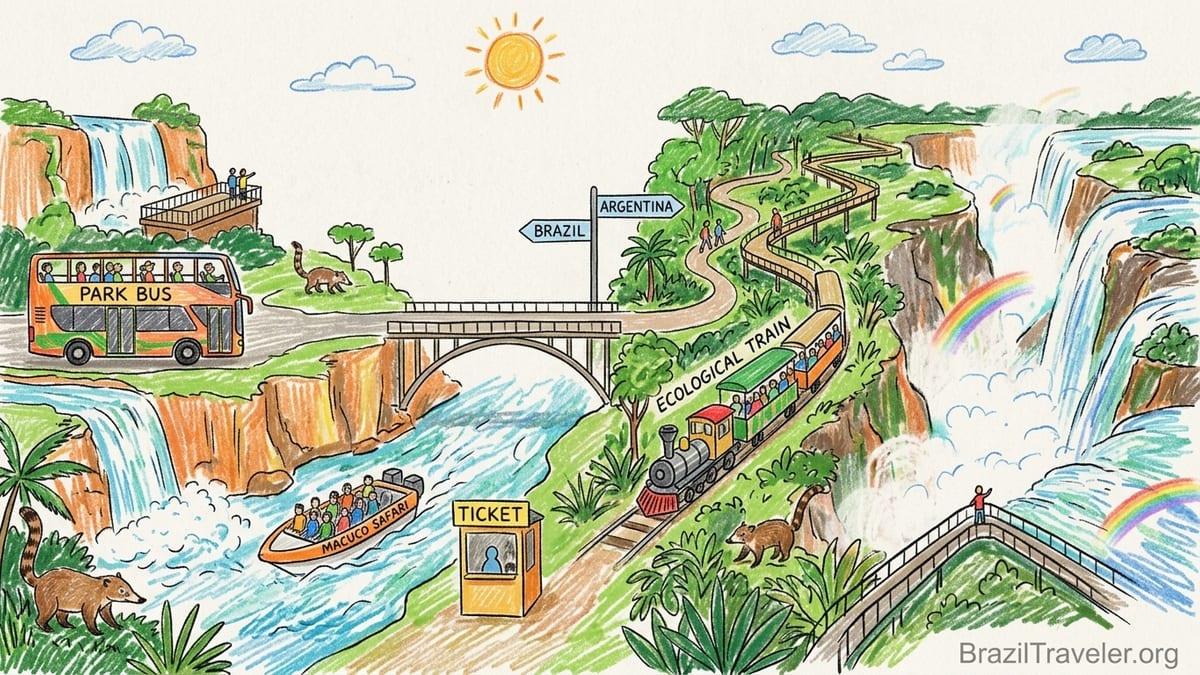
Planning the Trip: Why I Committed to Both Sides
Before arriving in Foz do Iguaçu, I booked my flights and hotel with one clear goal: to compare the Brazilian and Argentine sides of Iguazu Falls as fairly as possible. That meant visiting them on back-to-back days, starting from the same base in central Foz, using standard transport options and buying regular entrance tickets instead of packaged tours. Only by walking the same traveler path could I really judge which side offered better value, more memorable views and a smoother experience.
I purchased my national park tickets online in advance. For Iguaçu National Park in Brazil, international visitors currently pay a general entrance fee in the range of 130 to 150 Brazilian reais when buying through the official system, depending on the chosen date and any promotional structure in place. For Iguazú National Park in Argentina, international visitors pay a significantly higher amount, recently around 60,000 Argentine pesos for a one-day ticket according to updated specialist ticket guides. There is no combined ticket, so anyone who wants to see both sides must buy separate passes for each country.
Knowing prices had risen in recent years, I set myself a simple test: for two adults staying in Foz do Iguaçu, how much money, time and energy would it really take to visit both parks properly? I tracked every taxi ride, bus fare and queue, and made a point of walking all the open circuits on the Argentine side and the full main trail on the Brazilian side. Whenever a circuit or walkway was closed because of maintenance or high water, I noted it, since this can radically change the experience on either side.
Finally, I paid close attention to the emotional side of the visit. Where did I feel truly overwhelmed by the scale of the falls, where did I feel closest to the water, and where did crowds or logistics get in the way? The numbers matter, but so does that first gasp when you step out at a viewpoint and realize why Iguazu is considered one of the world’s great natural spectacles.
Brazilian Side: Panoramic Views and a Compact Circuit
My Brazilian day started from a hotel in downtown Foz do Iguaçu. I took a rideshare to Iguaçu National Park, a journey of about 25 to 30 minutes depending on traffic. The cost each way was roughly the equivalent of 6 to 10 US dollars for two people, consistent with recent reports by independent travelers who rely on app-based rideshares in the region. Public buses also run from the city to the park entrance, but with more stops and less flexibility in departure time.
At the Brazilian gate, the process was relatively streamlined. After scanning my pre-purchased ticket and showing a passport at the turnstiles, I joined the boarding queue for the internal park buses. These large double-decker coaches are included in the entrance price and shuttle visitors about 10 to 12 kilometers into the heart of the park. On my visit, the wait for a bus was around 10 minutes on a mid-season morning, increasing to roughly 20 minutes closer to midday when excursion groups arrived.
The main Brazilian walking route begins at a stop called Trilha das Cataratas. The trail itself is short and compact. I measured about 1.5 kilometers of mostly paved path with some stairs, railings and several wide viewing balconies. Walking it slowly, stopping for photos at each viewpoint, took around 90 minutes end to end. Someone walking briskly without many pauses could do it in 45 to 60 minutes, which is why many travelers describe the Brazilian side as a half-day experience.
Where the Brazilian side shines is in its panoramic vistas. Almost immediately, the trail presents sweeping views of the semicircle of falls on the Argentine side, layered with mist and rainbows when the sun angle is right. The sense of scale hits you early and never really lets up. The path gradually descends until it reaches a metal walkway that juts into the river at the foot of the thunderous Floriano and Devil’s Throat complex. Here I felt physically closest to the water on the Brazilian side, with spray soaking my clothes and camera lens within seconds.
Macuco Safari and Other Brazilian Add-ons
Partway along the Brazilian route, internal buses and park signage point to Macuco Safari, the famous boat trip that takes visitors up the Iguaçu River to the base of several falls. This is an optional extra and not included in the park ticket. According to the official Macuco Safari price board, the standard jungle plus boat package for adults currently costs around 380 Brazilian reais per person, with reduced rates for certain Brazilian residents and children. Prices are frequently updated, so I confirmed them against the operator’s latest online table before my visit.
I chose to do the full Macuco Safari experience. The excursion begins with an open-sided electric vehicle ride of roughly 2 to 3 kilometers through the forest, accompanied by a guide who explains local flora and fauna. There is then a short walk of about 600 to 700 meters down a trail and a staircase to the dock. The entire journey from the roadside check-in desk to the boat takes around 30 to 40 minutes, depending on group size and pace.
On the water, the boat accelerates upstream, performing a few photo stops before making repeated approaches into the spray beneath the smaller falls. Passengers in the front rows get completely drenched. The time actually spent on the river is about 20 to 25 minutes, but the high-adrenaline blast and the sensation of being dwarfed by the canyon walls make it feel much longer. For many visitors, including me, this was the closest physical contact with the water on the Brazilian side and arguably the most thrilling single activity of the entire trip.
Between the main trail, viewpoints and Macuco Safari, my total time inside the Brazilian park was just under five hours. That included a simple lunch at the food court near the main viewpoints and a short stop at the Porto Canoas area near the end of the trail. For most first-time visitors, especially those staying in Foz do Iguaçu, the Brazilian side can comfortably fit into a morning or afternoon with time left for an additional attraction such as the nearby bird park or the Itaipu Dam night show.
Argentine Side: Upper Circuit, Lower Circuit and Devil’s Throat
The Argentine day began earlier. From the same hotel in Foz do Iguaçu, I arranged a cross-border taxi through the reception desk. The driver quoted a fixed round-trip price equivalent to about 50 to 70 US dollars for two adults, covering pickup at the hotel, the border formalities on both sides, drop-off at the Iguazú National Park entrance in Argentina and return later in the afternoon. That cost was higher than the Brazilian-day transport, but it bought a door-to-door service and help with immigration, which I considered worthwhile given the long day ahead.
We drove over the Tancredo Neves International Bridge, stopping first at Brazilian exit control and then at Argentine immigration. Both offices required passports, and for some nationalities, proof of visa or visa waiver eligibility for Brazil or Argentina. The queue on my visit was modest, taking about 20 minutes in total for both borders. Travelers who rely on local buses between Foz and Puerto Iguazú often report longer waits at peak hours, since they rely on all passengers disembarking and reboarding at each border post.
At Iguazú National Park, international visitors were paying roughly 60,000 pesos for a one-day ticket during my visit, with discounts for Mercosur residents and Argentine citizens. Payment at the gate was possible with credit or debit cards when terminals were functioning correctly, though staff warned that network outages sometimes forced a temporary cash-only policy. Once inside, I headed straight for the Ecological Train station, the backbone of the park’s internal transport system.
Because water levels on the Iguazú River occasionally rise high enough to threaten boardwalks, park authorities sometimes close the Devil’s Throat access or parts of the Upper and Lower Circuits. On the day I visited, park information boards at the entrance clearly indicated which sections were open. The Upper Circuit and Lower Circuit were fully accessible. Devil’s Throat catwalks were open in the morning but subject to review if river flow increased, so I prioritized that section first.
Walking Distances, Waiting Times and Where I Felt Closest to the Falls
The Ecological Train station near the park gate displayed expected departure times, usually every 15 to 30 minutes depending on demand. I waited about 20 minutes to board the train to Garganta del Diablo, then another 15 minutes for the train to depart once full. The ride itself took around 20 minutes through subtropical forest and brought us to the trailhead for the Devil’s Throat walkway.
The walkway to Devil’s Throat is long but essentially flat, stretching roughly 1.1 kilometers one way across the river islands on steel catwalks. Most people walk it in 15 to 20 minutes, but photo stops and crowd flow can extend that. At the final viewing balcony, the falls explode into view almost beneath your feet. Here, I felt closer to the raw power of the falls than at any other single point on either side. The roar was deafening, spray soaked my clothes and visibility shifted constantly as clouds of mist rose and fell.
After returning on the same walkway and taking the train back to the central station, I set out on the Upper Circuit. This loop is around 1.7 kilometers, mostly on raised walkways above the canyon edge, with a series of balconies overlooking individual falls such as Salto Bossetti and others along the rim. Walking slowly with photo stops, it took me just over 90 minutes. The views here were among the most photogenic of the entire trip, with frequent rainbows and unobstructed wide angles. Unlike the Brazilian side, many of these viewpoints place you directly above the water, looking down into the gorge.
The Lower Circuit is more demanding. The loop is approximately 1.4 to 1.6 kilometers, depending on which spurs are open, and involves repeated stairs and elevation changes. It took me close to two hours at a steady but unhurried pace, including breaks to watch boats approach the falls from below. On this circuit, I alternated between mid-distance panoramas and nearer views beside the cascades, often framed by jungle vegetation. While I did not feel quite as physically close to the water as at Devil’s Throat, this circuit provided the most varied photo opportunities and the strongest sense of being immersed in the landscape rather than observing from a distance.
Logistics, Cross-Border Rules and Rental Car Realities
One of the biggest differences between the two sides has little to do with waterfalls and everything to do with logistics. The Brazilian side works as a compact outing from Foz do Iguaçu, with straightforward transport and no international formalities if you are already staying in Brazil. The Argentine side almost always requires a border crossing, even if you are staying in Puerto Iguazú and visiting Brazil for the day instead. That brings passports, potential visas and the need to understand local rules about travel within the so-called triple frontier region.
Tourism authorities in Foz do Iguaçu emphasize that travelers crossing by road between Puerto Iguazú and Foz must carry valid identity documents and comply with immigration checks, even when only visiting the neighboring city. For most Western European and North American visitors, both Brazil and Argentina permit visa-free short stays, but this can change, and some nationalities require pre-arranged visas or electronic travel authorizations. I met travelers whose plans were complicated by not realizing that a visa-free entry to one country did not automatically grant permission to enter the other.
Rental cars bring another layer of complexity. Many Brazilian rental companies prohibit cross-border travel to Argentina unless a specific authorization is obtained in advance, often for a fee, and may require extra insurance documents to be carried in the vehicle. Some contracts exclude cross-border travel altogether, meaning you would be driving without coverage if you simply crossed the bridge. Because of this, I chose not to drive myself. Instead, I used a licensed taxi company that regularly handles the border crossing and already understands the procedures at both immigration posts.
Public buses between Foz do Iguaçu and Puerto Iguazú are widely used and relatively inexpensive, with fares quoted by recent travelers at the equivalent of just a few US dollars each way. However, they can be slow, and riders must ensure that they disembark at both immigration checkpoints to receive exit and entry stamps. Drivers do not always automatically stop at these offices unless passengers ask. For first-time visitors trying to fit a full Argentine park day into their schedule, I found the time-saving and reduced stress of a pre-booked taxi to be worth the higher fare.
Counting the Cost: Two Adults, Two Parks, Two Days
Keeping track of expenses across currencies was a challenge. For comparison, I converted all costs into approximate US dollar equivalents using recent exchange rates at the time of my visit, while acknowledging that inflation in Argentina and currency fluctuations in both countries can shift these figures quickly. Still, a broad pattern emerged.
For two adults on the Brazilian day, I spent the equivalent of just under 100 US dollars in total. That included entrance tickets to Iguaçu National Park at around 25 to 30 dollars per person, rideshare transport from Foz do Iguaçu to the park and back, and a basic lunch. This figure did not include Macuco Safari, which, at close to 380 reais per person, added an additional 70 to 80 dollars per person depending on the exchange rate. With Macuco Safari, the Brazilian day climbed to around 240 to 260 dollars for two people, but also delivered one of the most memorable experiences of the trip.
For the Argentine day, the park entrance for two international adult visitors at around 60,000 pesos each quickly pushed the admission cost into a level that, when converted, came close to double the Brazilian entrance for two. On top of that, I paid roughly 50 to 70 dollars for the cross-border taxi, plus lunch and small purchases inside the park. All in, my Argentine day cost around 230 to 260 dollars for two adults, very similar to the total Brazilian day once Macuco Safari and lunch were included.
There were a few practical payment details worth noting. On the Brazilian side, card payments were widely accepted for almost everything, from tickets to restaurants. On the Argentine side, card acceptance at the ticket office and major eateries was also possible, but smaller kiosks and independent vendors leaned more heavily on cash. Exchanging a modest amount of pesos in Puerto Iguazú or at official exchange points in larger Argentine cities before arrival proved useful. Travelers who rely entirely on cards can usually manage, but should be prepared for occasional terminal outages or minimum charge amounts.
In the end, two adults visiting both parks over two days, with basic transport and one major paid add-on activity, will likely spend somewhere in the low to mid hundreds of dollars even before counting accommodation and flights. It is not a cheap side trip, but compared to the intensity and uniqueness of the experience, I ultimately felt the combined cost was defensible.
Is One Day for Both Parks Realistic or Just Exhausting?
Because I spent one full day on each side, I was able to observe how much time each park absorbs when visited at a comfortable pace. The Brazilian side, as mentioned, took me roughly five hours door to door from Foz do Iguaçu when including transport, bus shuttles and unhurried walking. The Argentine side, by contrast, filled nearly ten hours, with early pickup, border formalities, the Ecological Train, three major walking sections, and the return trip.
A one-day two-country plan from Foz do Iguaçu would therefore require compressing at least 15 hours of activity into a workable window, with almost no room for delay. In theory, a traveler could take a very early taxi to Argentina, rush through Devil’s Throat and one of the circuits, then cross back to Brazil for a late afternoon sprint along the Brazilian trail. In practice, this would mean limited time for photos, little flexibility if a circuit were closed or a train delayed, and a high risk of arriving at the second park already drained by heat and humidity.
Who would find the both-sides-in-one-day plan most exhausting? In my judgment, anyone traveling with young children, older relatives, or people with mobility limitations should avoid it. The Argentine Lower Circuit alone involves many stairs, and even healthy adults were visibly tired at the end of the day. Travelers visiting in the high humidity months between November and February would also be pushing their limits by walking long distances under intense sun after a very early wake-up call. Photographers who want time to compose shots and wait for good light will almost certainly feel rushed.
The only group for whom a one-day sprint might make sense are fit, time-pressed visitors who absolutely cannot spare a second day in the region and are willing to sacrifice depth for a quick overview. In that case, I would personally prioritize Devil’s Throat and one circuit in Argentina in the morning, then focus on the key viewpoints and the walkway near the base of the falls in Brazil. Even then, it would be a long, demanding and comparatively expensive day, especially considering the cost of cross-border transport and two separate park tickets.
Expectations vs Reality: Which Side Surprised Me, Which Disappointed Me
Going in, I expected the Brazilian side to be the clear favorite. Many guidebooks describe it as the best side for a first visit, thanks to its grand panoramas and efficient infrastructure. I also knew that Macuco Safari would probably be a highlight. At the same time, I had read that the Argentine side offered more extensive trails but potentially more logistical friction, especially regarding the Ecological Train and any closures of Devil’s Throat.
The reality was more balanced. The Brazilian side did deliver magnificent wide views almost from the first viewpoint, and the final walkway into the spray was every bit as dramatic as photos suggest. However, I was slightly disappointed by how quickly the main trail was over. Once I completed the 1.5 kilometer path and lingered at the key balconies, there was not much more to do without paying for additional activities. If someone is not planning to take the Macuco Safari or other extras, the Brazilian visit may feel relatively short, especially after the time and money invested in getting to Iguazu in the first place.
The Argentine side, in contrast, exceeded my expectations in terms of immersion. The combination of the Upper Circuit, Lower Circuit and Devil’s Throat created an almost all-day hiking experience with constantly shifting perspectives on the falls. There were quiet stretches between viewpoints, opportunities to spot coatis and birds, and plenty of corners where it was possible to step away from the largest crowds, at least briefly. The extent of walking was more demanding than I anticipated, but the reward in variety and photographic opportunities made the fatigue feel worthwhile.
My main disappointment on the Argentine side came from the potential vulnerability of the visit to closures. A few days before I arrived, reports had circulated of temporary shutdowns of the Devil’s Throat walkway due to high water. Had that closure persisted, the Argentine experience would still have been impressive, but missing its most iconic viewpoint would have changed my value calculation. On any future visit, I would make a point of checking the official park channels or recent traveler reports just before traveling, to confirm which circuits are operational.
The Takeaway: Value, Revisit Potential and Who Should Choose Which Side
When I weighed up all the factors, a few clear conclusions emerged. In terms of sheer value for money, the Argentine side edged ahead for me. Even with its higher ticket price and the extra cost of cross-border transport, the time I spent inside Iguazú National Park felt like a full day of continuous discovery. The diversity of trails, the powerful closeness of Devil’s Throat and the layered viewpoints on the Upper and Lower Circuits justified the expense and effort.
The Brazilian side, however, remained unbeatable for first impressions and simplicity. If I had to bring a friend or family member to Iguazu who had only half a day and wanted the most dramatic postcard views with the least walking, I would choose Brazil without hesitation. The internal buses, well-maintained single trail and immediately accessible panoramas make it easy to understand what the falls are all about, even with limited time or physical stamina.
As for which side I would revisit, if time allowed only one return visit, I would personally choose the Argentine side. I left feeling that there were still angles I had not fully explored, small detours I could take at different times of day, and photographic compositions that would benefit from varying light and water levels. The Brazilian side, by contrast, felt more like an experience I had essentially completed in one well-structured day, albeit an experience I would happily repeat with friends who had never been.
For first-time visitors, my recommendation is clear. If you have two full days in the region, stay in Foz do Iguaçu or Puerto Iguazú and visit both sides on separate days. Experience the Brazilian side first for the grand overview and the Argentine side second for depth and immersion. Families with younger children or travelers who tire easily may prefer to spend more time in Brazil, perhaps with a shorter Argentine visit that focuses on Devil’s Throat and the Upper Circuit rather than the more strenuous Lower Circuit.
Dedicated photographers and nature enthusiasts who must pick a single ticket should lean toward the Argentine side, provided Devil’s Throat and the key circuits are open when they plan to travel. Those with mobility challenges, or who are nervous about immigration formalities and multiple currencies, may feel more relaxed focusing on the Brazilian side alone, which still offers world-class vistas and can be paired with the nearby bird park for a full but manageable day. Whatever you choose, do not underestimate the heat, humidity and sensory overload of standing beside one of the planet’s great waterfalls. Give yourself enough time and energy to actually enjoy it.
FAQ
Q1. Do I need to visit both the Brazilian and Argentine sides of Iguazu Falls?
For the fullest experience, yes. The Brazilian side offers sweeping panoramas and a compact visit, while the Argentine side delivers longer trails, varied perspectives and the intense Devil’s Throat viewpoint.
Q2. How many days should I plan for Iguazu Falls?
Two full days are ideal, one for each country. This allows time for border formalities, walking all open circuits and enjoying views without rushing between parks.
Q3. Is it realistic to see both sides of Iguazu Falls in one day?
It is technically possible but very demanding. You would face a very early start, two border crossings, limited time on each side and a high risk of feeling exhausted and rushed.
Q4. Which side is better for families with children or older travelers?
The Brazilian side is generally easier, with a shorter main trail, fewer stairs and efficient internal buses. It suits families, older visitors and anyone with limited mobility more than the Argentine side.
Q5. Which side offers better photo opportunities?
Both sides are spectacular, but the Argentine side provides more varied compositions thanks to the Upper and Lower Circuits and the dramatic Devil’s Throat walkway, which brings you almost above the main chasm.
Q6. What documents do I need to cross between Brazil and Argentina?
You need a valid passport and, if applicable for your nationality, visas or electronic travel authorizations for both countries. Border officers may also ask about onward travel and length of stay.
Q7. Can I drive a rental car across the Brazil–Argentina border at Iguazu?
Some rental companies allow cross-border travel with prior authorization and extra insurance, while others forbid it. Always check your contract and obtain written permission before attempting to cross.
Q8. How much does it cost for two adults to visit both parks?
Expect to spend several hundred US dollars in total once you include two park tickets, cross-border transport, meals and any paid extras such as the Macuco Safari boat tour on the Brazilian side.
Q9. What is the main difference in walking distances between the sides?
The Brazilian side has a single main trail of about 1.5 kilometers. The Argentine side involves multiple circuits and the Devil’s Throat walkway, easily adding up to several kilometers of walking with stairs and elevation changes.
Q10. If I can afford only one ticket, which side should I choose?
If you want the broadest overview with minimal logistics, choose Brazil. If you prefer longer hikes, closer contact with the falls and can manage the border crossing, choose Argentina, especially if Devil’s Throat is open.