


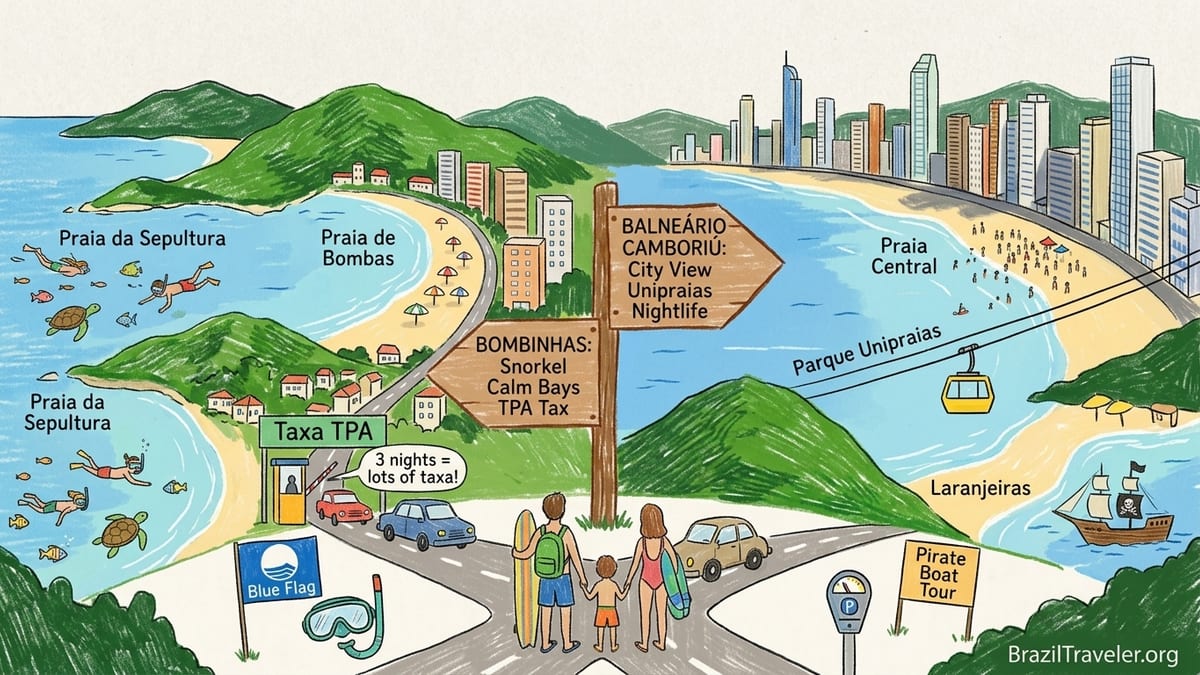
Choosing between Bombinhas and Balneário Camboriú is one of the biggest decisions travelers face when planning a beach holiday in Santa Catarina. I spent comparable summer periods in both destinations, including peak January and shoulder March dates, tracking what I actually paid for hotels, food, beach infrastructure, transport, a diving excursion in Bombinhas and attractions in Balneário Camboriú. I also checked Santa Catarina’s official IMA bathing-water reports for the specific weeks of my stays. What follows is not theory or marketing, but a grounded comparison for travelers genuinely deciding where to base themselves in southern Brazil.
How I Structured the Comparison and When I Traveled
To make the comparison fair, I planned two similar stays. In Bombinhas, I based myself once near Praia de Bombas and later near Bombinhas Beach itself, visiting Bombas, Bombinhas, Quatro Ilhas, Mariscal, Canto Grande and Praia da Sepultura over several hot January days and a less crowded week in March. In Balneário Camboriú, I stayed on or just behind Praia Central and used buses, ride-hailing and short drives to reach other nearby beaches such as Laranjeiras and Estaleiro. Both trips included weekday and weekend nights so I could feel the impact of domestic tourism peaks.
My goal was to behave like a typical family on a moderate budget rather than a luxury traveler. That meant mid-range hotels or serviced apartments with air conditioning and breakfast, paid public parking where needed, mainstream restaurants instead of fine dining and one paid excursion in each destination. In Bombinhas, that paid excursion was a licensed snorkeling trip near Sepultura and a shallow dive offered through a local operator. In Balneário Camboriú, I chose the Parque Unipraias gondola and activities around Barra Sul.
For water quality, I relied on the IMA’s balneabilidade bulletins, which publish weekly conditions by beach and sampling point. On some summer weekends, I noticed that points along Bombas and Bombinhas, and at times stretches of Praia Central in Balneário Camboriú, alternated between suitable and unsuitable status over short periods. Because of this variability, I avoid saying either destination is always cleaner and instead point you to the IMA reports for the specific week you plan to visit.
Finally, all prices here are in Brazilian reais and were checked against recent rates in late 2025 and 2026. They should be treated as realistic examples, not fixed promises. High summer, New Year and Carnival dates can easily push costs higher than the ranges I recorded.
Hotel Costs, Parking and the Hidden Price of Bombinhas’ Environmental Tax
On accommodation alone, Bombinhas and Balneário Camboriú look similar on paper. In practice, timing and location make a big difference. In Bombinhas, a clean one-bedroom apartment-hotel unit a short walk from Bombas with air conditioning and kitchen facilities ran in the range of 350 to 500 reais per night for a family of three to four in late January, according to recent booking quotes and rate histories for comparable properties near Bombas and Bombinhas Beach. Sea-view units or pousadas directly on smaller beaches like Sepultura or Mariscal can easily rise above 700 reais per night during New Year and school holidays.
In Balneário Camboriú, I found central hotels on or one block behind Praia Central starting slightly lower outside New Year, with functional double rooms for around 280 to 400 reais per night in January when booked in advance, including breakfast but not always parking. More modern towers with partial sea views, full buffet breakfasts and amenities such as indoor pools were often in the 450 to 700 reais range per night for a double, with family rooms costing more. Because supply is large and competitive, last-minute deals can appear in Balneário Camboriú more often than in tight, fully booked Bombinhas.
Bombinhas introduces an extra cost that catches many first-time visitors by surprise: the Taxa de Preservação Ambiental, or TPA. This environmental preservation tax is charged per vehicle that enters the municipality between 15 November and 15 April each season. According to the official municipal information and recent updates for the 2025 to 2026 season, private passenger cars pay a daily amount based on a municipal reference unit, which in practice works out to a figure in the tens of reais per day. Larger vehicles such as vans and buses pay more, motorcycles less. Crucially, the fee is charged per day the vehicle remains in the municipality, up to a capped number of days, and camera systems at the city entrance identify plates automatically.
For a three-night family stay arriving by car in mid-January, I effectively added what felt like an extra night’s budget-hotel cost just in TPA charges. In contrast, Balneário Camboriú does not charge an environmental entry tax for vehicles. However, daily hotel parking rates in Balneário Camboriú often ranged between 35 and 70 reais per day in central properties, while in Bombinhas I found both free on-site parking at smaller guesthouses and private open-air lots near busy beaches charging 20 to 40 reais for the day. Over a week, a family driving to Bombinhas should factor in several hundred reais in combined TPA and parking costs on top of accommodation.
Traffic, Access and the Reality of Crowded Peninsulas vs Vertical Resort City
Bombinhas’ beauty comes with a serious logistical price in high season. The municipality occupies a compact peninsula with just a few main access roads. On Saturday afternoons in late January, entering Bombinhas from the BR-101 and Porto Belo side took me almost two hours to cover a distance that outside the season takes less than thirty minutes. The traffic slowed to a crawl from the hill that separates Porto Belo and Zimbros onward, with long lines of cars approaching the TPA cameras and single-lane bottlenecks all the way to Bombas and Bombinhas centro.
Once inside, moving between beaches like Bombas, Bombinhas and Canto Grande by car during peak afternoon hours was possible but frustrating. Parking near Praia da Sepultura and Quatro Ilhas was particularly limited. On one summer afternoon I circled for nearly forty minutes above Sepultura before giving up and parking farther away on a hillside street, then walking down in heavy heat with beach gear and a child. In Mariscal, public street parking filled quickly but rotated more often, and arriving before 9:00 a.m. or after 4:30 p.m. made a significant difference.
Balneário Camboriú presented a different pattern. The city is dense, vertical and loud along Praia Central, but its grid layout and multiple entry routes from the BR-101 kept traffic more fluid outside New Year’s Eve and holiday peaks. I did experience congestion near the Barra Sul area, especially around the Parque Unipraias access and the bridge to the neighboring municipality, yet crossing town from the north tower blocks to Barra Sul generally took thirty to forty minutes in busy January traffic, rather than the one to two hours sometimes needed to enter Bombinhas on a Saturday.
Street parking in the heart of Balneário Camboriú is strictly regulated and mostly paid, using meters or apps. Short daytime parking along the waterfront avenue bordering Praia Central came at a moderate hourly rate but spaces were scarce from mid-morning onward. For longer stays it was easier to accept the hotel’s daily parking fee or use private garages. If you are traveling with kids and large beach bags, the elevator ride from a tower garage in Balneário Camboriú was often less stressful than navigating steep, dusty side streets in Bombinhas looking for an open spot.
Beach Atmosphere, Shade, Crowds and Water Conditions
On Bombas and Bombinhas beaches, the atmosphere felt like a classic Brazilian resort town on a human scale. Buildings are mid-rise at most, so the sun reaches the sand for most of the day in summer. Families set up their own umbrellas or rent chairs and parasols from local vendors along the promenade. Rental bundles of two chairs and an umbrella on Bombas in January ranged around 40 to 70 reais for the day, depending on proximity to the water and negotiation. Water was usually calm enough for children, with a gentle slope and occasional small waves, especially on Bombas.
Water quality varied week by week. Checking the IMA’s interactive reports for the specific weeks I visited showed a mix of “próprio” and “impróprio” statuses at different sampling points on Bombas and Bombinhas through recent summer seasons. One weekend in March showed all points proper for bathing, while a mid-January bulletin flagged at least one point as temporarily unsuitable. This matched anecdotal reports from locals and travelers who described periods of murkier water and occasional post-holiday contamination, followed by recovery after rain and tide changes. Because of this fluctuation, I always verified the current week’s bulletin before letting children spend long periods in the water.
In Balneário Camboriú, Praia Central delivered a different experience. After the large sand expansion works in recent years, the beach is wide, but it runs parallel to a wall of high-rise apartment buildings and hotels. In summer the towers cast long shadows that move across the sand. By mid to late afternoon, large stretches of Praia Central can be in shade, which some visitors appreciate during heatwaves but others find gloomy. Crowding on busy January weekends was intense, with rows of rented chairs almost touching and loud music from multiple directions. Chair and umbrella rentals there often cost similar amounts to Bombinhas or slightly higher, especially near popular kiosks.
On water quality, recent communications from the Balneário Camboriú city government and IMA bulletins have highlighted improvements in the percentage of sampling points rated suitable for bathing along Praia Central after sewage and drainage works. At the same time, older seasonal reports show that in some previous summers certain stretches of Praia Central recorded repeated unsuitable readings, especially near river mouths. During my own January visit, the IMA bulletin for that exact week listed most Praia Central points as suitable, and the water visually appeared clearer than its past reputation suggested. However, I still preferred to time swims away from stormwater outlets and after checking the current bulletin, just as I did in Bombinhas.
Snorkeling and Diving in Bombinhas vs Attractions in Balneário Camboriú
Bombinhas’ greatest strength is underwater. Near Praia da Sepultura, I joined a small-group snorkeling session organized by a licensed local operator. For around 120 to 180 reais per person, including mask, snorkel, fins and a short safety briefing, we entered the sheltered cove from shore under guide supervision. Visibility on my January day hovered around several meters, not as crystal clear as tropical islands but more than enough to see schools of sargentos, small parrotfish and other reef species circling near the rocky edges. Even without a tour, basic mask-and-snorkel rentals on the sand were available for modest hourly rates, though I preferred the hygiene and fit of the operator’s equipment.
For a shallow introductory dive near Bombinhas, operators quoted packages in the 250 to 450 reais range per person, depending on depth, boat inclusion and photo packages. These outings used proper scuba equipment, licensed dive instructors and small boats departing from nearby piers. On my half-day program, we stayed relatively close to the coast and within beginner depths, still managing to see starfish, small crustaceans and a rewarding concentration of colorful fish. Sea turtles are occasionally spotted, although none appeared on my dive. Motion-sensitive travelers should be aware that summer swells can make the boat ride choppy, especially around Mariscal.
Balneário Camboriú does not match Bombinhas for accessible snorkeling from shore. Praia Central is sandy and better suited to urban swimming and people-watching than to viewing marine life. Instead, the city compensates with built-up attractions. At Barra Sul, the Parque Unipraias complex links the seafront with the green hillside and the quieter beach of Laranjeiras via a gondola. Tickets for the basic cable car ride for adults were priced in the low hundreds of reais, with discounts for children and combo options that bundle in extra activities such as zip-lines or mountain sled rides, which push the total higher for an active family afternoon.
I spent a full half-day between the cable car ride, viewpoints over the skyline, forest trails and a couple of paid attractions at the top station. Food and drink within the park were priced above typical city restaurants but still manageable for a one-off experience. Back at Praia Central, boat tour hawkers sold excursions ranging from simple coastline cruises to party boats and pirate-themed trips marketed to families and children. Prices for these varied widely, but many short coastal tours were quoted in the 60 to 150 reais per person bracket, sometimes with drinks or snacks included. These cruises delivered fine views of the skyline and nearby coves but did not offer the coral and fish density I saw around Sepultura and Mariscal in Bombinhas.
Food, Nightlife and Daily Spending for Three vs Seven Nights
Food budgets felt broadly similar across both destinations, with important nuances. In Bombinhas, beachside restaurants at Bombas and Bombinhas offered generous platters of fried fish, rice, salad and pirão for two to three people for around 150 to 250 reais, depending on the species and level of the establishment. On Mariscal and Canto Grande, I found slightly fewer options directly on the sand but good value a block or two inland, where daily specials like grilled peixe espada or anchova with sides could be found for under 80 reais per person without drinks.
Balneário Camboriú offered far more variety, from buffets paid by weight to sushi, pizza and burger chains, often clustered along Avenida Brasil and the streets parallel to Praia Central. In January, a simple prato feito or executive lunch in a central restaurant commonly cost between 30 and 60 reais including a soft drink, while more polished á la carte dinners with seafood or steak ranged from 90 to 150 reais per person before drinks. For travelers who like having many options and are willing to walk a few blocks off the main beachfront, Balneário Camboriú made it easier to manage costs through choice.
Nightlife was another clear divider. In Bombinhas, evenings centered on strolls along the Bombinhas promenade, early dinners and some beach bars. There are bars and a few clubs scattered across Bombas and Bombinhas, with louder spots in summer, but it still felt family-oriented and relatively quiet after midnight except on specific party weekends. Balneário Camboriú, by contrast, is one of southern Brazil’s nightlife capitals, with famous clubs and bars in the broader metropolitan area and a constant flow of young adults in high season. Even if you do not enter major nightclubs, the atmosphere along Praia Central, Barra Sul and neighboring streets stays lively well past midnight.
For a three-night family stay, including four days on the ground, my realistic spending in Bombinhas for two adults and one child looked roughly like this in recent summers: around 1,200 to 1,600 reais in accommodation for a mid-range apartment with breakfast, TPA charges and some paid parking adding 200 to 350 reais, meals and groceries totaling 900 to 1,300 reais and one paid snorkeling or diving excursion costing 350 to 800 reais for the group. That put the three-night baseline in the approximate range of 2,650 to 4,000 reais.
In Balneário Camboriú over three nights, a similar family could expect 1,000 to 1,500 reais for a central hotel with breakfast, 120 to 200 reais for hotel or garage parking, 900 to 1,300 reais for food and daily treats and 400 to 900 reais for a visit to Parque Unipraias plus one boat tour. That yields a ballpark total of 2,420 to 3,900 reais. For a seven-night stay in either destination, it is reasonable to project roughly double those totals with a slight per-night discount if you secure weekly rates, though attractions and occasional splurges can push the final figure upward quickly.
Families, Couples, Nightlife Seekers and Value: Who Fits Where
For families with young children who prioritize calm water and nature but can travel outside the absolute peak of January and Carnival, Bombinhas delivered my favorite moments. Early mornings at Praia da Sepultura and late afternoons on Mariscal provided space to play in the sea, explore tide pools and watch the light over Canto Grande’s hills. When the IMA bulletins showed good bathing conditions, I was far more tempted to enter the water than on most parts of Praia Central in Balneário Camboriú. That said, the stress of driving in, the TPA and the difficulty of parking near small coves like Sepultura were very real and could quickly sour a short trip.
Balneário Camboriú made much more sense for families or couples who arrive without a car, or who prefer not to use one daily. From most central hotels you can walk to Praia Central in minutes, use local buses or ride-hailing to reach quieter nearby beaches such as Laranjeiras or Estaleiro and return to a long list of restaurants each evening. If weather turns stormy, shopping centers, cinemas and urban attractions offer backup plans that Bombinhas cannot match. Parents of teenagers may also appreciate the city’s nightlife and evening energy more than Bombinhas’ quieter promenades.
For snorkelers, casual divers and couples seeking a nature-forward experience, Bombinhas clearly had the edge for me. The combination of accessible rocky coves, the variety among Bombas, Bombinhas, Quatro Ilhas, Mariscal, Canto Grande and Sepultura, and the presence of environmental programs such as Blue Flag on selected beaches in recent seasons all indicated a stronger orientation toward coastal conservation. Even on busy days, I could find corners of relative calm by walking a bit further from the main access points, particularly in shoulder season.
Nightlife seekers, food-focused travelers and those who want an animated, almost city-break atmosphere by the sea will likely prefer Balneário Camboriú. The urban noise, dense crowds and high-rise shade on Praia Central are real downsides, especially if you imagine a secluded tropical scene. However, I found that short trips to nearby beaches combined with evenings enjoying restaurants and bars added up to a practical and fun option, especially for a long weekend when long drives into a congested peninsula would eat too much time.
The Takeaway
After staying in both destinations during comparable summer periods, my personal verdict splits by travel style. For pure swimming and snorkeling, Bombinhas won clearly in my experience. On days when IMA bulletins confirmed good bathing conditions, the clarity and color of the water around Sepultura and along Mariscal felt more inviting than the urban sea at Praia Central. The possibility to join a reasonably priced guided snorkel or intro dive and actually see fish, starfish and rocky bottoms just a few meters offshore is something Balneário Camboriú could not match.
For families, the answer depends on patience and priorities. If you can travel in late November, early December or March, avoid Friday and Saturday arrival peaks and are comfortable budgeting extra for the TPA, Bombinhas offers a family-friendly coastline with plenty of small-scale charm. But if your only option is a tight three or four night window in mid-January and you dislike traffic queues or hunting for parking, Balneário Camboriú is the more practical base. You can still add day trips to quieter beaches by bus or car without committing to a full week of peninsula congestion.
For nightlife and restaurants, Balneário Camboriú was my pick. Its density of venues and late-night energy simply overshadow Bombinhas. Couples who enjoy long dinners, bars and possibly clubbing will find more to do there after dark. For couples who care more about daytime paddles in calm water, quieter pousadas and starry nights, especially in shoulder season, Bombinhas can justify its extra logistical effort and cost.
On overall value, my impression after tracking real expenses and experiences is that costs per day were broadly similar for a mid-range family trip in both places when you factor in hotel, meals, parking and one excursion. The difference was what I got for that money. In Bombinhas I paid for access to natural scenery and underwater life, while accepting traffic and vehicle taxes. In Balneário Camboriú I paid for convenience, choice and infrastructure while accepting urban noise and less secluded beaches. Knowing which tradeoff you prefer is ultimately the key to choosing between these two emblematic Santa Catarina beach destinations.
FAQ
Q1. Is Bombinhas really more expensive than Balneário Camboriú for a family holiday?
In my experience, daily costs ended up similar once I added hotel, meals, parking and one excursion, but Bombinhas adds the vehicle environmental tax, while Balneário Camboriú adds higher central parking and more temptation to spend on urban attractions.
Q2. How bad is the traffic to Bombinhas in summer?
On January weekends and around holidays, entering Bombinhas by car from the BR-101 often took close to two hours instead of under thirty minutes, with slow-moving lines from the municipal entrance through Bombas and Bombinhas.
Q3. Do I have to pay the Bombinhas environmental tax if I arrive without a car?
No. The Taxa de Preservação Ambiental is charged per vehicle entering between 15 November and 15 April. If you arrive by bus and walk or use local transport, you are not charged personally.
Q4. Which beaches did you find best for children?
In Bombinhas, Bombas, Bombinhas and the more sheltered side of Canto Grande offered calmer water on many days. In Balneário Camboriú, central sections of Praia Central were manageable when IMA bulletins showed good conditions, but I preferred nearby Laranjeiras for kids.
Q5. Is the water always cleaner in Bombinhas than in Balneário Camboriú?
No. IMA reports show both destinations have weeks with suitable and unsuitable bathing points, sometimes in quick succession. I checked the bulletin for the exact week before letting children swim in either place.
Q6. Is snorkeling in Bombinhas worth paying for a guided tour?
For me, yes. Around Praia da Sepultura, a guided snorkel with equipment and a safety briefing cost under 200 reais per person and significantly improved what I saw and how comfortable I felt in the water.
Q7. Can I enjoy Bombinhas without a car?
It is possible if you stay near Bombinhas Beach or Bombas and accept walking and occasional taxis or ride-hailing, but reaching Mariscal, Canto Grande or some smaller coves is much easier with your own vehicle.
Q8. What is the main downside of staying on Praia Central in Balneário Camboriú?
The combination of high-rise shade in the afternoon, dense crowds, urban noise and occasionally variable water quality along certain stretches is the main tradeoff for the excellent infrastructure and convenience.
Q9. For a seven-night holiday, which destination felt less stressful overall?
Balneário Camboriú felt less stressful over a full week because I did not have to fight my way in and out of a peninsula, and daily activities were reachable on foot or by short rides, even though Bombinhas offered more natural beauty.
Q10. If I have only three summer nights, where would you personally choose to stay?
With only three peak-summer nights, I would choose Balneário Camboriú for practicality and flexibility, then plan a dedicated, longer Bombinhas stay in shoulder season when traffic and parking are more manageable.