


Riding the Serra Verde Express from Curitiba to Morretes had been on my South Brazil wish list for years. When I finally booked the classic Serra do Mar journey, I treated it as my main railway experience in the region, determined to test how the Mata Atlântica scenery, historic engineering and tourist-friendly setup compared with simply renting a car and driving. This is the detailed account of what I actually booked, what it cost, what the train was really like on board and, crucially, whether I would spend a full day of a South Brazil itinerary on this route again.
Booking the Serra Verde Express and Choosing a Class
I booked my Curitiba to Morretes trip directly with Serra Verde Express, which currently operates the tourist services along the historic Paranaguá–Curitiba railway. The company sells a mix of basic “turista” cars, upgraded panoramic cars and more premium options that bundle snacks and drinks. The official 2026 fare table lists complete Curitiba–Morretes packages for adults starting in the low 300s Brazilian reais and rising into the 400–500 reais range as you move into higher classes and include road transfers or lunch. I wanted a good balance of cost and comfort, so I chose a mid-range tourist class rather than the top premium lounge categories.
The booking process itself was straightforward. I used the operator’s online system, where you pick the date, direction and carriage category first. Only after choosing the class could I see remaining seats. On my departure date in the high season, basic tourist cars already showed limited availability, while many of the higher-priced seats were still free. That confirmed what several local agencies had told me in Curitiba: budget-conscious travelers tend to sell out the cheapest category first, while the more expensive ones stay open a bit longer.
Seat selection mattered more than I expected. The line clings to the side of the Serra do Mar, with the most dramatic drops, bridges and forest views on the ocean-facing side. In the carriage I booked, seats were arranged in pairs on each side of a central aisle. The booking engine did not clearly label “sea side” and “mountain side,” so I used diagrams from the operator and asked by email for a window on the better view side. The reply confirmed my seat, though they reminded me that operational changes can occasionally switch the train’s orientation.
In the end, my chosen tourist-class seat on the scenic side cost just over 350 reais when bought as a train-plus-road-return package. Standalone one-way rail tickets in a similar category showed base values around the mid 200s reais range in the tariff material for 2026, with premium panoramic cars and first-class service climbing above that. Exact prices fluctuate with promotions and seasons, but the pattern is clear: this is a premium-priced tourist experience by Brazilian standards, more comparable to a full-day wine train than a regular intercity train ticket.
Curitiba Station: Arrival Time, Check-in and Luggage
My day started at Curitiba’s combined bus and rail complex, the Estação Rodoferroviária. Serra Verde Express recommends arriving early, and their own guidance indicates that same-day buyers should be there by around 7:30 in the morning for the typical 8:30 departure if they still need to purchase tickets at the counter. With a pre-booked ticket, I aimed to be at the station about 45 minutes before departure, and that timing felt comfortable rather than rushed.
Check-in took place at the company’s dedicated counter inside the station. I presented my passport, booking code and was given a printed boarding pass and a small colored wristband corresponding to my carriage category. Staff made clear which platform to use and pointed to a waiting area with seating and a small café. The atmosphere was far more relaxed than an airport or large city station, with a mix of Brazilian families, international backpackers and older couples treating this as a bucket-list ride.
Luggage restrictions were less strict than on many tourist trains elsewhere in the world. Serra Verde Express positions itself as a transport operator rather than a theme-park attraction, and their own FAQ clarifies that they are legally considered a railway transport service, not just a cultural or entertainment activity. In practice, that meant I could bring a standard cabin suitcase and a daypack without anyone measuring or weighing them. Overhead racks in my carriage held small and medium bags, while larger suitcases were tucked at the end of the car near the entrance door.
Boarding started roughly 20 minutes before departure. Staff walked along the platform calling out car names and checking boarding passes. Each tourist carriage had its own attendant who helped passengers step across the gap and pointed them to assigned seats. The process felt orderly but not rushed. Unlike commuter rail, there was no last-minute sprint. Anyone who arrived at least half an hour before departure could move through ticketing, bathrooms and a quick coffee before strolling out to the train with time to spare.
Inside the Tourist Carriage: Comfort, Atmosphere and Views
My first impression on stepping into the tourist-class carriage was of polished nostalgia rather than luxury. The car had large windows with sliding upper panes, two-abreast seating on each side of a central aisle and overhead luggage racks. Seats were padded and reclined slightly but were closer to coach-class airline seats than business class. Upholstery showed some wear, a reminder that this is a hard-working tourist train, not a newly built luxury service, but everything was clean.
The carriage had a dedicated bilingual guide who provided commentary in Portuguese first and then English, sometimes mixing in brief explanations in Spanish for neighboring country visitors. The commentary covered the history of the line, the Atlantic Forest, the construction of the major bridges and tunnels and pointed out waterfalls and viewpoints as they appeared. A small printed leaflet in Portuguese and English summarized key landmarks, which helped me match the place names with the scenery outside.
As for amenities, my tourist-class ticket did not include a full meal service, but there was a simple snack and drink service. Attendants came through offering coffee, soft drinks and light snacks for sale. Some upgraded classes on the same train received more elaborate boxes with snacks and local products, and premium cars offered alcoholic drinks included in the fare, but I judged that my mid-level tourist carriage offered enough comfort for a journey that averages around three and a half hours downhill.
Even within the tourist category, the difference between a window seat and an aisle seat was significant. From my window on the forest side, I could lean slightly out when the upper pane was open to photograph bridges and the curving train ahead. Passengers on the aisle needed to stand and lean over someone else at key viewpoints. If I booked again in this class, I would still prioritize seat position over upgrading to a slightly fancier carriage with similar window sizes but better snacks.
Through the Serra do Mar: Scenery, Weather and Engineering
Once we rolled out of Curitiba and the city blocks fell away, the train began its descent of the Serra do Mar mountain range. The first 20 to 30 minutes felt relatively gentle, passing through outer neighborhoods, small farms and low hills. The drama increased as we entered stretches of preserved Atlantic Forest, known locally as Mata Atlântica, with dense greenery brushing close to the tracks and mist clinging to the upper slopes.
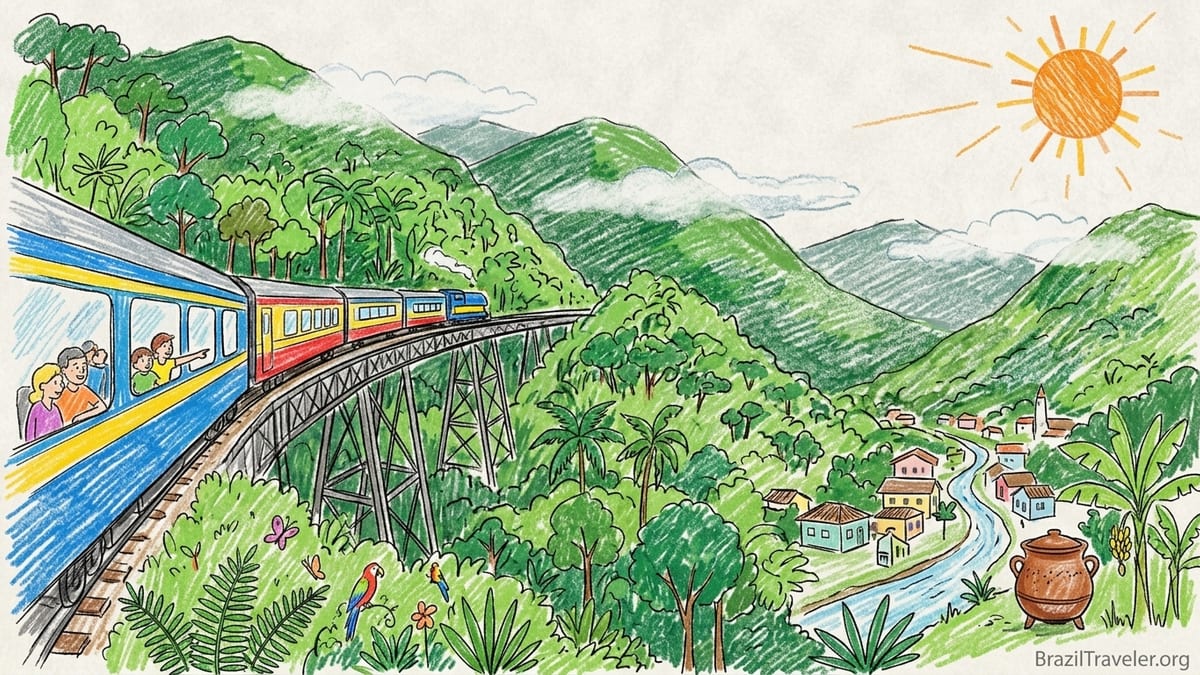
Some of the most memorable engineering features came roughly an hour into the journey. The line crosses a series of viaducts and bridges that seem to hang on the edge of the mountainside, offering sudden views down steep valleys. The guide called out the approach of a particularly famous iron bridge that curves just enough for passengers in the forward cars to photograph the rest of the train behind. On my trip, low morning cloud hovered just above the highest peaks, so I had clear views down into the valleys but a hazier skyline.
Tunnels punctuated the route, short bursts of darkness followed by new glimpses of waterfalls and river gorges. Many of these tunnels were hand-carved in the late nineteenth century, and the commentary gave just enough historical context to appreciate the effort without feeling like a history lecture. I noticed that whenever the train plunged into cloud, condensation beaded on the open window frames and camera lenses, making photography a little tricky. Keeping a microfiber cloth handy proved useful, and I learned to alternate between shooting through the glass and briefly opening the upper pane for a clearer frame.
Rain is common in the Serra do Mar, and guides on board warned us that visibility can drop significantly on some days. On my run, a light shower moved through the forest around the mid-point of the descent. The effect was atmospheric rather than disappointing. Mist wrapped around the trees, and the forest looked richer and deeper, though distant peaks vanished. Photographers in the carriage talked about wanting bluer skies but admitted that the soft light reduced glare and reflections in the windows. If your travel dates are inflexible, it is worth embracing the fact that this is a rainforest railway, not a postcard-skyline route.
Comparing Tourist and Premium Classes
While my own ticket was for a mid-range tourist carriage, I was able to look into neighboring premium cars at Curitiba station and during a brief stretch when doors were open at an intermediate stop. Premium categories featured more spacious armchairs arranged in pairs, sometimes at small tables, with upgraded upholstery and a slightly more refined décor. Windows in some panoramic cars extended higher up the wall, giving a greater sense of openness, although the width of the openings was similar to my own carriage.
From talking to fellow passengers during arrival in Morretes, the biggest perceived advantage of the premium cars was the included food and drink. Travelers in those categories reported welcome drinks, better snack boxes and alcoholic beverages. They also mentioned slightly quieter atmospheres, with fewer small children and a more grown-up feel. However, they confirmed that the actual external view was not dramatically different as long as you had a window seat in any car. One guest who had done both classes on different trips said he would only pay the premium again if traveling as a couple celebrating a special occasion.
Because I did not ride the entire journey in a premium seat myself, I relied on the operator’s own descriptions to understand the more subtle differences. Higher categories promise onboard hosts, more personalized service and in some cases themed décor that pays tribute to the railway’s history. They also bundle transfers, city tours or lunch in Morretes more often than the basic tourist tickets, which can simplify logistics for those who prefer a single package rather than piecing the day together on their own.
For my budget and travel style, the tourist-class carriage felt like the right compromise. I appreciated the authentic rail atmosphere, large enough windows and commentary without feeling that I had overpaid for frills I would barely use. If I returned in a future year and wanted a more indulgent experience, perhaps to show the route to friends on their first visit to Brazil, I might consider moving one notch higher to a panoramic car, but only if I could still secure a window seat on the best-view side.
Arriving in Morretes: Historic Streets and Riverside Atmosphere
The transition from deep forest to lowland valley happens gradually, then suddenly you notice that the train has entered flatter terrain and the air feels warmer and more humid. Approaching Morretes, the line passes small farms and clusters of houses before finally slowing and gliding into the town’s modest station. After three and a half hours of curves and viaducts, stepping onto the platform and seeing the Serra do Mar ridge behind the station feels like emerging from another world.
Morretes is a historic riverside town between the mountains and the coast, known for its preserved colonial houses and quiet streets. The center is compact enough to explore on foot. Leaving the station, I walked a few minutes along cobbled streets lined with colorful facades, small guesthouses and artisan shops selling local cachaça and sweets. The town’s charm lies not in grand monuments but in the coherent ensemble of low-rise historic architecture and the way daily life spills gently into the streets.
The heart of Morretes is the riverfront along the Nhundiaquara River. Here, restaurants line the banks with terraces and balconies overlooking the water and the distant peaks. On a clear day, you can see the outline of the Marumbi massif from town, tying the coastal plain back to the Serra do Mar you have just descended. Even at midday, the pace remains unhurried. Locals linger over long lunches while day-trippers from Curitiba wander between menus comparing barreado specials.
Because the train schedules are designed around day trips, you effectively have a choice: either you treat Morretes as a relaxed lunch-and-stroll stop before heading back to Curitiba, or you check into a pousada and stay overnight. I planned for several hours in town before my return by road, which gave me time for a proper meal, a walk through the oldest streets and a short pause in a riverside square to simply watch the water flow past.
Tasting Barreado: A Traditional Meal in Morretes
No account of the Curitiba–Morretes railway is complete without describing barreado, the slow-cooked beef dish that has become the culinary symbol of this part of Paraná. Barreado is prepared in a clay pot sealed with a paste of manioc flour, then slow-cooked for many hours until the beef fibers completely fall apart into a rich, thick sauce. It is traditionally served with rice, more manioc flour, banana slices and sometimes fish or seafood on the side.
Morretes has built much of its tourism identity around barreado, and the town’s main riverfront is dotted with restaurants that highlight it. Established names like Madalozo, Ponte Velha, Terra Nossa, Casarão and several others compete on recipes, accompaniments and atmosphere. Some occupy colonial houses in the historic core, while others spread along the riverbank so that guests can eat while watching kayakers drift by. Barreado has even been recognized at state level as part of Paraná’s intangible cultural heritage, and local authorities highlight it in official tourism and planning documents.
For my own meal, I chose a long-running restaurant on the historic riverfront that offered a barreado buffet combined with fried fish. The fixed-price option hovered around forty to fifty reais per person for all-you-can-eat servings, in line with prices reported by recent visitors. The waiter brought the first plate already assembled so I could see how locals combine the components, then encouraged me to experiment with my own mix of rice, meat and banana. The stew itself was deep and comforting, bordering on heavy for a warm day, but perfect after a morning spent sitting and staring out of train windows.
Over lunch, it became clear that barreado is as much a social ritual as a dish. Families shared large pots, explaining to visiting friends how to test whether the meat is tender enough and how to sprinkle just the right amount of manioc flour. Nearby tables clinked glasses of local cachaça and regional craft beer. For travelers who do not eat beef, most restaurants offer alternative mains such as grilled fish and vegetarian plates, but the town’s identity is unmistakably tied to this particular stew, which gives the stop in Morretes a depth that goes beyond simple scenery.
Return Options: Train, Road and Estrada da Graciosa
Once you have eaten and wandered Morretes, the big decision is how to get back to Curitiba. Serra Verde Express sells same-day return tickets by train, but many visitors choose a mixed itinerary, descending by rail and returning by road. This is partly a matter of time. The downhill train already takes most of the morning, and climbing back up through the same tunnels and bridges at similar speeds would consume the entire afternoon. Some travelers relish that, while others prefer to experience a different route.
On my trip, I booked a combined package that paired the morning train with an afternoon road transfer. A tour van collected passengers near the riverfront at a prearranged time, leaving enough margin for a relaxed dessert and coffee. The road followed the faster BR-277 for much of the climb back to Curitiba, turning the return journey into roughly a one and a half to two hour ride depending on traffic. This option felt efficient, with air-conditioning, scheduled photo stops kept to a minimum and arrival back in the city before dusk.
An especially scenic alternative, when weather and road conditions allow, is to return via the Estrada da Graciosa, the historic PR-410 road that once served as a muleteer route linking the plateau to the coast. The paved road winds through dense Atlantic Forest with cobbled sections, viewpoints and picnic areas. State and local authorities highlight it as a scenic heritage route, with several official mirantes and recreation spots along its length. However, local advice and recent traveler reports warn that in periods of heavy rain it is prone to landslides, one-way controls and temporary closures, which can significantly extend travel time.
Driving the Estrada da Graciosa in your own car or rental can be a spectacular experience, but you need to be confident on steep, curving, occasionally slippery pavements. Several Curitiba residents I spoke with prefer to descend to Morretes via the Graciosa on dry morning days and then return by the more modern BR-277 in the afternoon light. For those who do not want to drive, some operators offer van transfers that descend or climb via the Graciosa when conditions are favorable, often at a slight premium over the basic highway route due to increased time and risk.
Counting the Cost: What My Day in 2026 Really Added Up To
Putting numbers on the day helps show whether the Serra Verde Express is a worthwhile splurge. My mid-range tourist-class train ticket combined with a road transfer back to Curitiba cost a little above 350 reais through the official tariff applied in 2026 for complete packages. If I had chosen the absolute cheapest train-only option, I might have saved some tens of reais but then needed to sort out a separate bus back to Curitiba on my own.
Lunch in Morretes, with an all-you-can-eat barreado buffet plus a soft drink and coffee, added approximately 70 reais. It is possible to spend less by picking a simpler plate rather than a buffet, but I wanted the full local experience, and most riverfront restaurants are priced within a fairly narrow band. An additional small spend went on snacks and drinks on the train, about 20 to 30 reais depending on choices, and souvenirs in town such as local cachaça or handmade sweets can easily add another 50 to 100 reais if you are inclined.
Transport to and from Curitiba’s station was modest. A short ride by app-based taxi or regular cab from the central area cost under 30 reais each way. Walking would be possible from some central hotels, but with camera gear and an early departure I preferred door-to-door convenience. If you are staying in neighborhoods like Batel or near the municipal market, you can expect similar fares.
All told, my full day of the Curitiba–Morretes train, lunch, drinks, transport to the station and light shopping landed somewhere around 500 to 600 reais. A traveler who chose a premium panoramic or luxury class, ordered additional drinks and shopped more heavily could easily push that close to or beyond 800 reais for two people. By Brazilian cost-of-living standards, this places the Serra Verde Express firmly in the “special outing” category rather than an everyday mode of transport.
What Disappointed Me and What Impressed Me
No premium tourist train is perfect, and the Serra Verde Express is no exception. The first mild disappointment was simply how long some sections feel when the train slows for curves, maintenance zones or to allow freight trains priority on sections of single track. There were stretches where the train crawled along at a walking pace, which heightened the sense of being on a nostalgic journey but occasionally tested my patience, especially after the most dramatic scenery had passed.
Another frustration involved obstructed or repetitive views. Even with a good window seat, some parts of the line are hemmed in closely by vegetation, with trees pressing against the embankments. This is an unavoidable consequence of running through a protected forest, and in many ways it is part of the charm, but it also means not every minute delivers postcard vistas. In an aisle seat, the experience can be more limited, with your line of sight partially blocked by your neighbor and the window frame.
On the positive side, the landscape itself and the sense of history more than balanced these annoyances. Looking down from iron bridges across steep valleys cloaked in forest, it is impossible not to appreciate the ambition of the engineers and workers who carved this line into the Serra do Mar. The combination of tunnels, stone retaining walls and curved viaducts gives the journey a clear narrative arc, especially when paired with on-board commentary that points out each major feature as you pass.
I was also pleasantly surprised by the atmosphere among passengers. Despite the premium pricing, the train did not feel exclusive. Families mixed with solo budget travelers and small groups of European and Latin American tourists. Guides were quick to offer to take photos at scenic stretches, and there was an easy camaraderie in the carriage by the time we rolled into Morretes. That shared experience, combined with the distinctive barreado lunch and the town’s preserved riverside streets, created a sense of having completed a classic, almost old-fashioned excursion.
The Takeaway
After a full day invested in the Curitiba–Morretes route, I came away convinced that the Serra Verde Express deserves its reputation as the signature railway experience of South Brazil. The combination of Serra do Mar mountain scenery, Atlantic Forest, historic engineering and the highly bookable, tourist-oriented operation makes it unique in the region. The fact that you can arrange everything in advance, from seat class to return transfer and even lunch, allows the ride to slot smoothly into a broader itinerary that might also include Curitiba’s parks and the coastal island of Ilha do Mel.
Was the price justified compared with simply renting a car and driving? For travelers solely focused on efficiency and budget, driving via BR-277 or taking a bus might indeed be cheaper and faster. Yet the train offers something the road cannot: the chance to sit back and watch a nineteenth-century engineering project thread through a living rainforest, with space to photograph, listen to stories and let the scenery unfold at a human pace. In that sense, the premium functions less as a transport cost and more as an entry fee to an experience.
If I were to book again, I would still choose a tourist or panoramic class rather than the very top luxury tiers, but I would be even more deliberate in securing a specific window seat on the best-view side. I would also avoid packing the rest of the day with other commitments. The train, lunch and either a scenic return by Estrada da Graciosa or a relaxed van ride up BR-277 already fill the hours fully, and trying to squeeze in additional activities back in Curitiba the same evening risks undoing the unhurried charm that makes this excursion special.
For anyone planning a South Brazil itinerary that passes through Curitiba, I believe the Curitiba–Morretes train merits an entire day. It is not the cheapest outing, and parts of the ride are slow or hemmed in by trees, but the best stretches are spectacular, the historical context is rich and the combination with Morretes’ riverside lunch and colonial streets creates a complete experience. Given the choice between allocating a day solely to city sightseeing and reserving one to descend the Serra do Mar by rail, I would give the edge to the train, especially for travelers who value landscape and local flavor as much as museums and shopping.
FAQ
Q1. How early should I arrive at Curitiba station for the Serra Verde Express?
Arriving 45 to 60 minutes before departure works well if you already hold a ticket. Those hoping to buy on the day should aim for at least an hour in advance to clear ticketing and boarding calmly.
Q2. Which side of the train has the best views from Curitiba to Morretes?
On the descent from Curitiba to Morretes, the ocean-facing side generally offers the most dramatic views over valleys and bridges. Ask the operator or your agency to specify a window seat on that side when booking.
Q3. Are there strict luggage limits on the Serra Verde Express?
Luggage policies are relatively flexible, closer to regular rail travel than to airlines. Small and medium suitcases plus daypacks are usually accepted, with bags stored in overhead racks or at the end of the carriage.
Q4. How long does the train journey between Curitiba and Morretes take?
The downhill journey typically lasts around three and a half hours, though it can vary with operational conditions. Slow sections on curves and around maintenance zones are part of the experience.
Q5. Is it worth paying for a premium or panoramic class instead of basic tourist class?
Premium and panoramic classes offer more spacious seating and inclusive snacks or drinks, plus a quieter atmosphere. However, if you secure a good window seat in tourist class, the core views and experience remain very similar.
Q6. How much should I budget for a full day including train, lunch and transport?
A mid-range package with tourist-class train and road return, barreado lunch, station transfers and a few small extras typically totals in the region of 500 to 600 reais per person, depending on choices.
Q7. Does Morretes deserve an overnight stay or just a few hours?
Day-trippers can enjoy lunch and a stroll in a few hours, which fits well with the train schedule. An overnight stay works if you want a quieter evening by the river or to explore nearby hikes and nature spots.
Q8. What if the weather is cloudy or rainy during the train ride?
Cloud and light rain are common in the Serra do Mar. Visibility of distant peaks may be reduced, but the mist can make the forest atmosphere more dramatic. Only heavy fog or storms significantly limit views.
Q9. Is the Estrada da Graciosa a better return option than the highway?
The Estrada da Graciosa offers a beautiful, historic route through Atlantic Forest but can be slow or affected by landslides in wet periods. The BR-277 highway is quicker and more predictable, especially in bad weather or after dark.
Q10. Would you personally choose the Curitiba–Morretes train again over driving?
Yes, I would choose the train again for at least one full day in a South Brazil itinerary. The engineering, forest scenery and Morretes experience justify the premium over simply driving, provided you value the journey itself as much as the destination.